What happens when 70 years of watchmaking history is condensed into a 19mm mechanical jewel?
Blancpain answers with the Lady B, a distinctly contemporary interpretation of the idea that gave birth to the Ladybird collection in 1956.
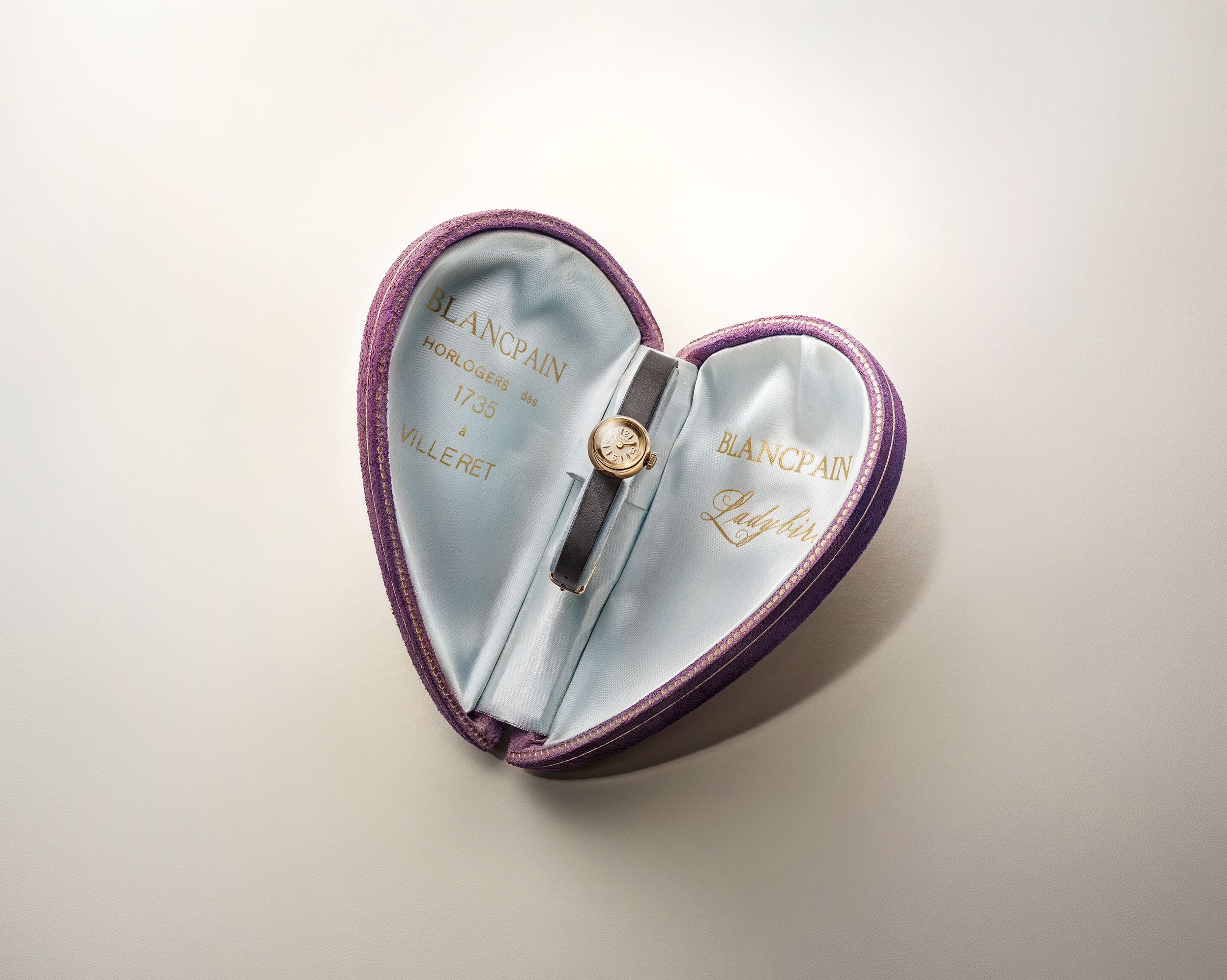
Created under the leadership of Betty Fiechter, the first woman to lead a Swiss watch manufacture, the original Ladybird Bullet was built around an extraordinary ambition: create a remarkably small yet robust mechanical movement. Its R52/R55 calibre measured just 11.85mm in diameter and became the world’s smallest round mechanical movement produced in series, according to Blancpain’s historical account.
Seven decades later, Blancpain isn’t simply bringing that watch back.
It is rethinking the idea behind it.
From Ladybird Bullet to Lady B
The new Blancpain Lady B is explicitly described as a contemporary reinterpretation rather than a reissue of the 1956 Ladybird Bullet. Its design takes the original watch’s philosophy of miniaturisation and translates it into an entirely new architecture.
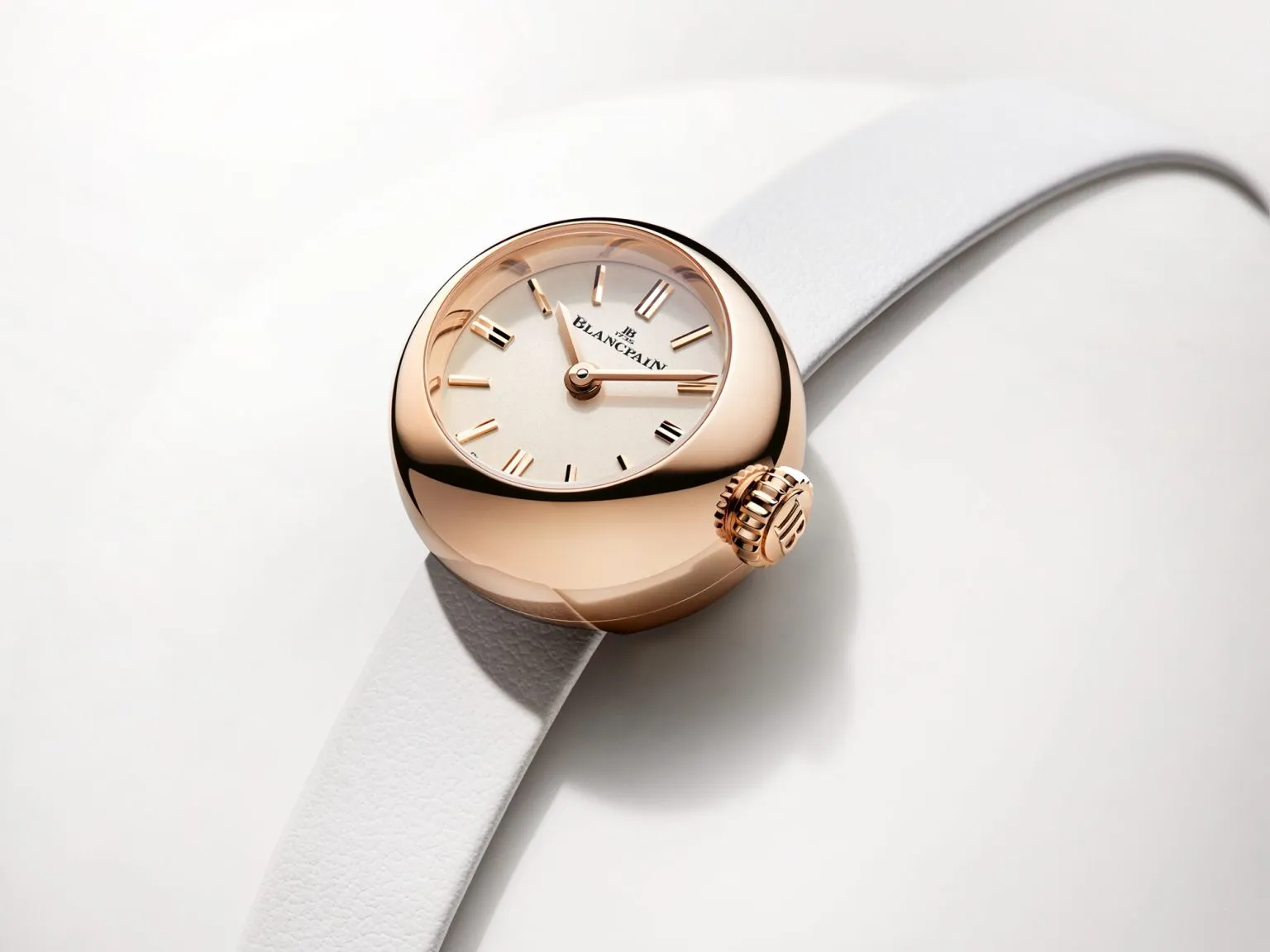
Its most immediately striking feature is its spherical case.
Measuring only 19mm in diameter, the case has a thickness of 13.20mm and a volume of just 2.9cm³. Rather than treating the watch as a flat object defined primarily by its diameter, Blancpain conceived Lady B in three dimensions.
The result is closer to a polished mechanical pebble or jewel than a conventional round wristwatch.
And that is precisely the point.
A Mechanical Heart in a Tiny Space
Inside the spherical case is Blancpain’s Manufacture Calibre 615, an automatic movement measuring 15.70mm in diameter and 3.90mm thick.
It contains 180 components and 29 rubies, operates at 3Hz, or 21,600 vibrations per hour, and delivers a 38-hour power reserve. Its plates are finished with Côtes de Genève, while a silicon balance spring is part of its evolution.
The movement’s compact architecture wasn’t simply placed inside an existing case.
The entire watch was developed around it.
Blancpain says the spherical case, sapphire crystal, polished rehaut, integrated strap passage and water resistance were developed in parallel to accommodate Calibre 615.
That makes the Lady B’s small dimensions more than an aesthetic exercise. They are the consequence of designing the watch around its mechanical core.
No Lugs. No Conventional Case Architecture.
Perhaps the most unusual aspect of Lady B is what it leaves out.
There are no traditional lugs.
Instead, the calf leather strap passes directly through an opening machined into the case. The passage measures just 10 × 1.6mm, and Blancpain describes the interior as micro-blasted so the leather can glide through it. The edges and knurling are finished by hand.
This creates a continuous visual relationship between the spherical case and the strap.
The watch doesn’t look as though a strap has been attached to it.
The strap appears to emerge from it.
Minimalism Is Doing the Heavy Lifting
The dial takes an equally restrained approach.
The warm beige opaline dial is identical across the stainless-steel and 18K red-gold versions. There is no gem-setting, allowing the dial surface, gold indices and reflections from the polished rehaut to define the visual character.
The applied stick indices are made from gold and measure only 1.82 × 0.39mm.
The hands remain deliberately simple, displaying only the hours and minutes.
This restraint is important because the case is already doing most of the visual talking. The polished spherical architecture creates changing reflections across its surface, while the clean dial prevents the watch from becoming visually busy.
Seven Straps, One Tiny Wrist Presence
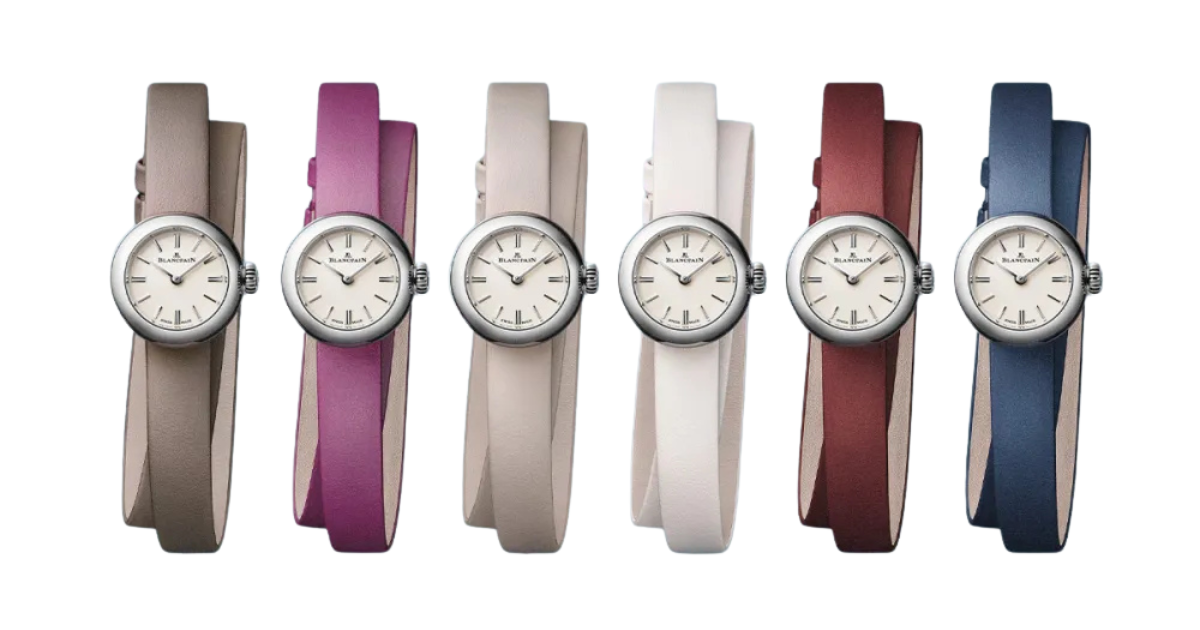
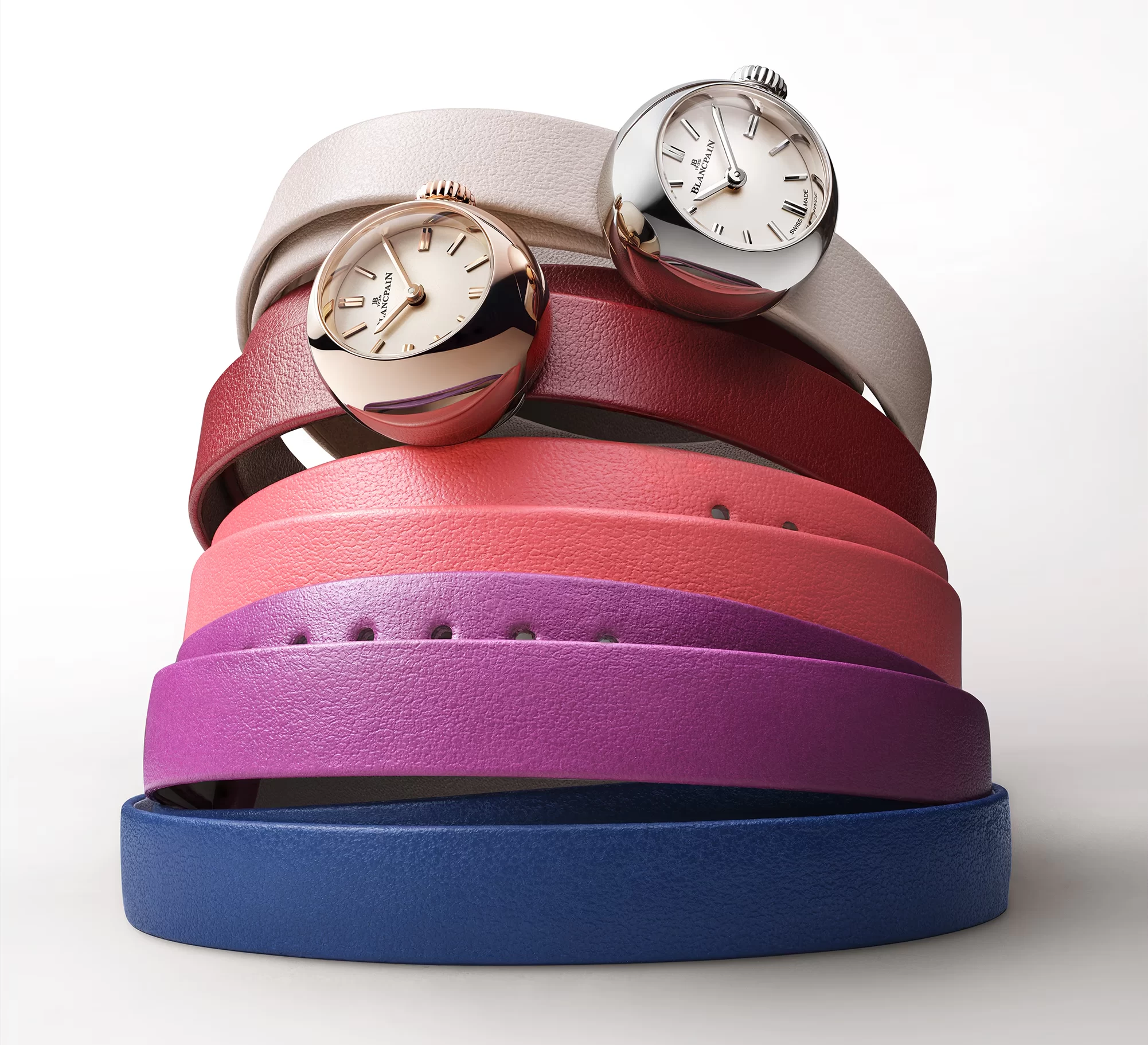
The Lady B arrives on a double-tour calf leather strap, reinforcing its jewellery-like character.
There are seven colour options:
White
Beige
Mocha
Burgundy
Blue
Coral
Purple
The strap fits through the rear of the watch and can be changed easily.
The double-tour construction also changes how the 19mm case sits visually on the wrist. Instead of functioning simply as a tiny watch, the strap becomes an integral part of the design language.
Betty Fiechter: The Woman Behind the Original Vision
The Lady B story becomes considerably more interesting when you look back at Betty Fiechter.
Fiechter entered Blancpain’s workshop in Villeret as a 16-year-old apprentice in 1912. By 1933, she had become co-owner of the Manufacture, and she ultimately became the first woman to own and lead a Swiss watch manufacture.
Her contribution wasn’t limited to keeping the company operating through difficult economic and historical circumstances.
She also recognised the importance of mechanical watches for women.
Blancpain’s historical account notes that Fiechter believed women’s watches deserved the same ingenuity and mechanical integrity as other timepieces, making this area one of Blancpain’s defining strengths.
In 1956, the Ladybird emerged from this philosophy.
The Lady B now connects that history to Blancpain’s contemporary approach to mechanical miniaturisation.
The 1956 Technical Miracle
The original Ladybird Bullet’s R52/R55 calibre was only 11.85mm in diameter.
Its compact architecture incorporated a fifth wheel into the gear train and shock protection for the balance, allowing Blancpain to pursue extreme miniaturisation without abandoning robustness. The movement contained 133 individually machined components and operated at 3Hz.
The movement’s influence extended beyond Blancpain, with the press release noting that houses including Omega and Longines subsequently adopted it for their own creations. Its tiny footprint also enabled a wide variety of jewellery watches, bracelets, bangles, rings and pendants.
That history explains why the Ladybird is more than simply an old model in Blancpain’s archive.
Miniaturisation became a creative platform.
Lady B continues that idea in a radically different form.
Stainless Steel or 18K Red Gold?
Blancpain offers the Lady B in two case materials:
Stainless Steel
19mm diameter
13.20mm thickness
30m water resistance
CHF 9,500
18K Red Gold
19mm diameter
13.20mm thickness
30m water resistance
CHF 14,500
The watch is not a limited edition and is available through Blancpain boutiques and authorised retailers from 17 September 2026.
A New Chapter, Rather Than a Reissue
The Blancpain Lady B succeeds by resisting the obvious route.
It doesn’t attempt to reproduce the Ladybird Bullet line for line. Instead, it takes the central idea behind that watch, mechanical watchmaking on an extraordinarily small scale, and pushes it into a new design language.
A spherical 19mm case.
A tiny automatic movement.
An integrated double-tour strap.
A deliberately quiet opaline dial.
And a direct connection to Betty Fiechter and the Ladybird’s history.
Seventy years after the Ladybird first appeared, Blancpain’s smallest statement may also be one of its most conceptually interesting.
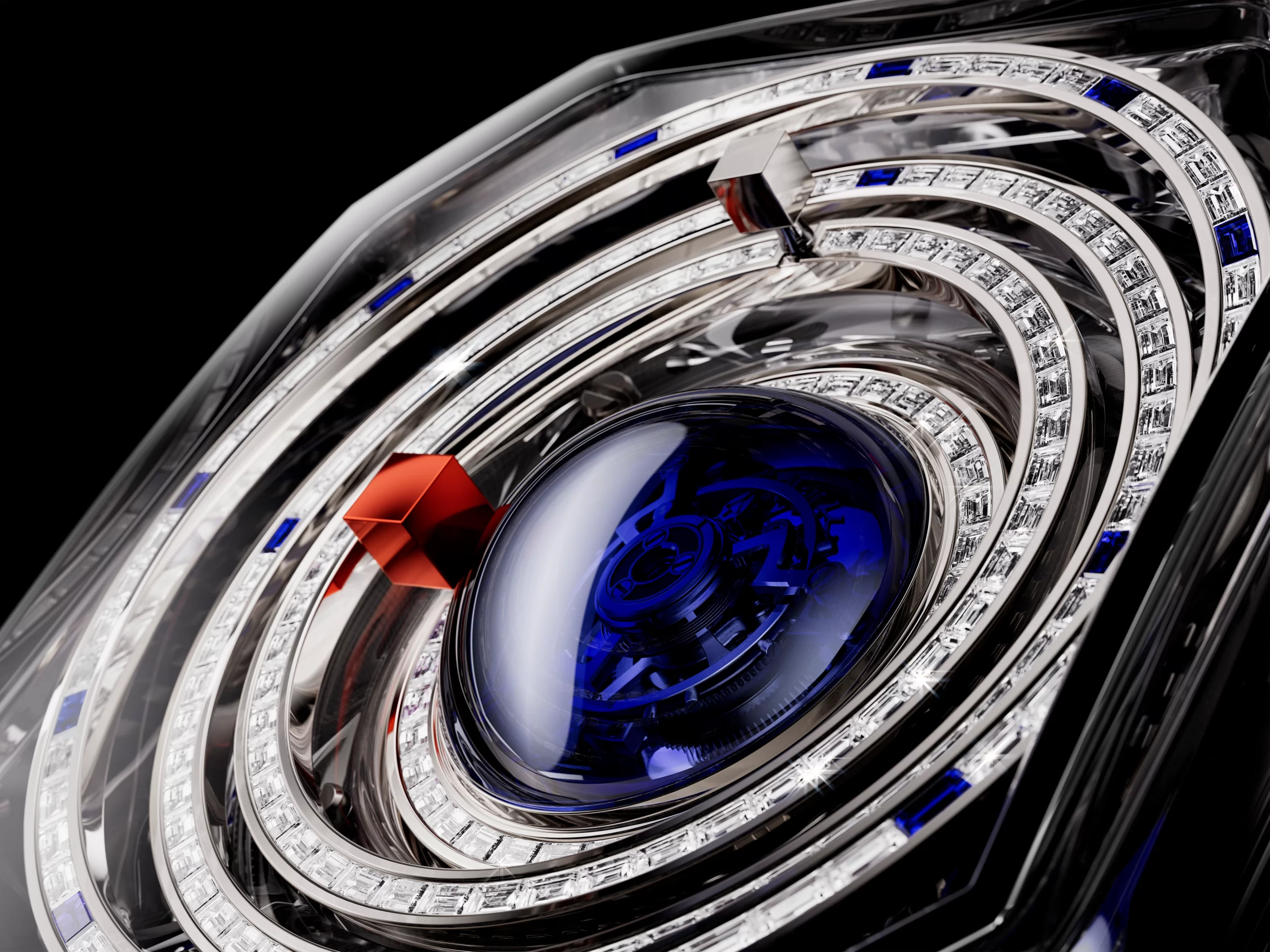
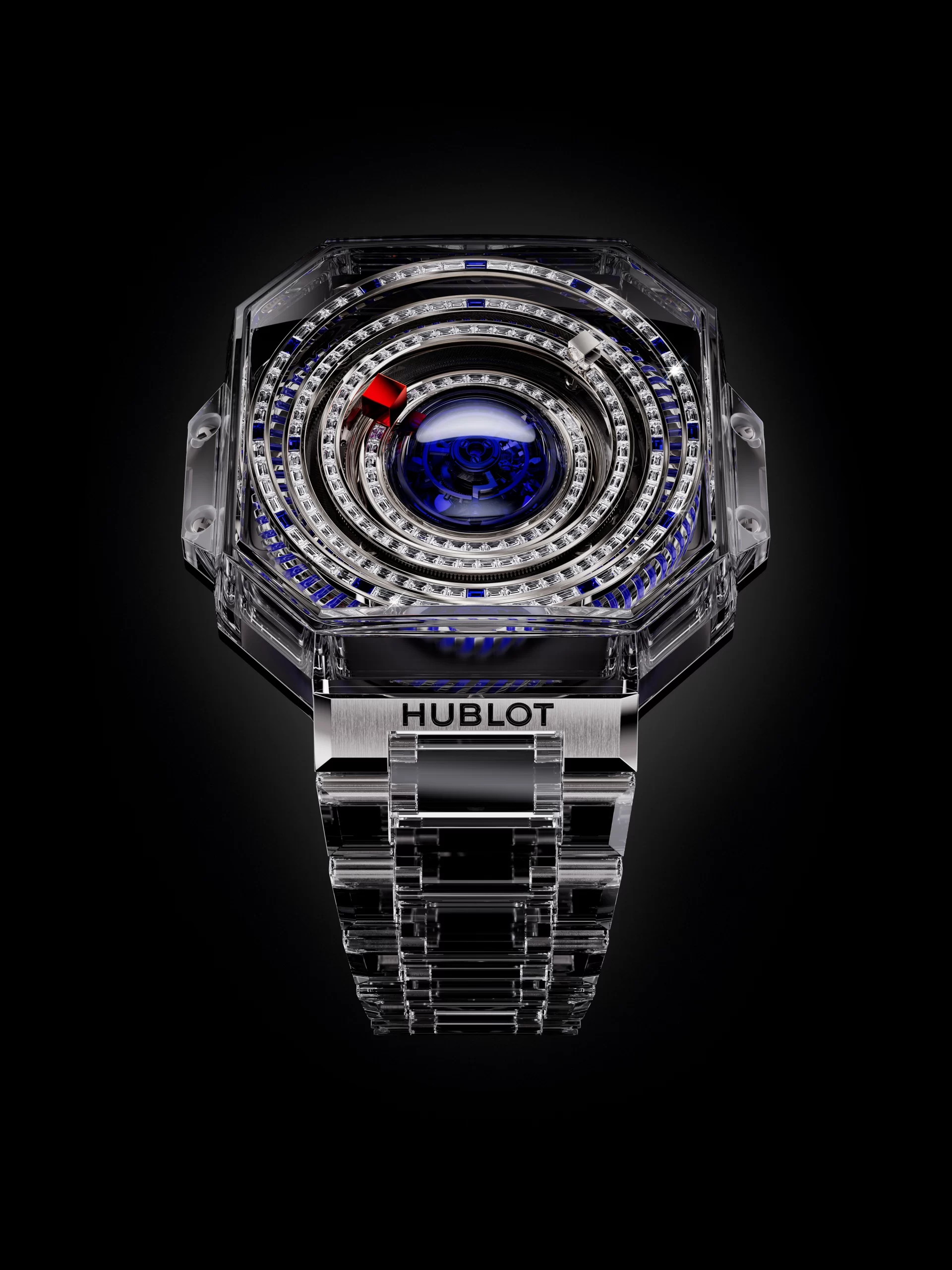
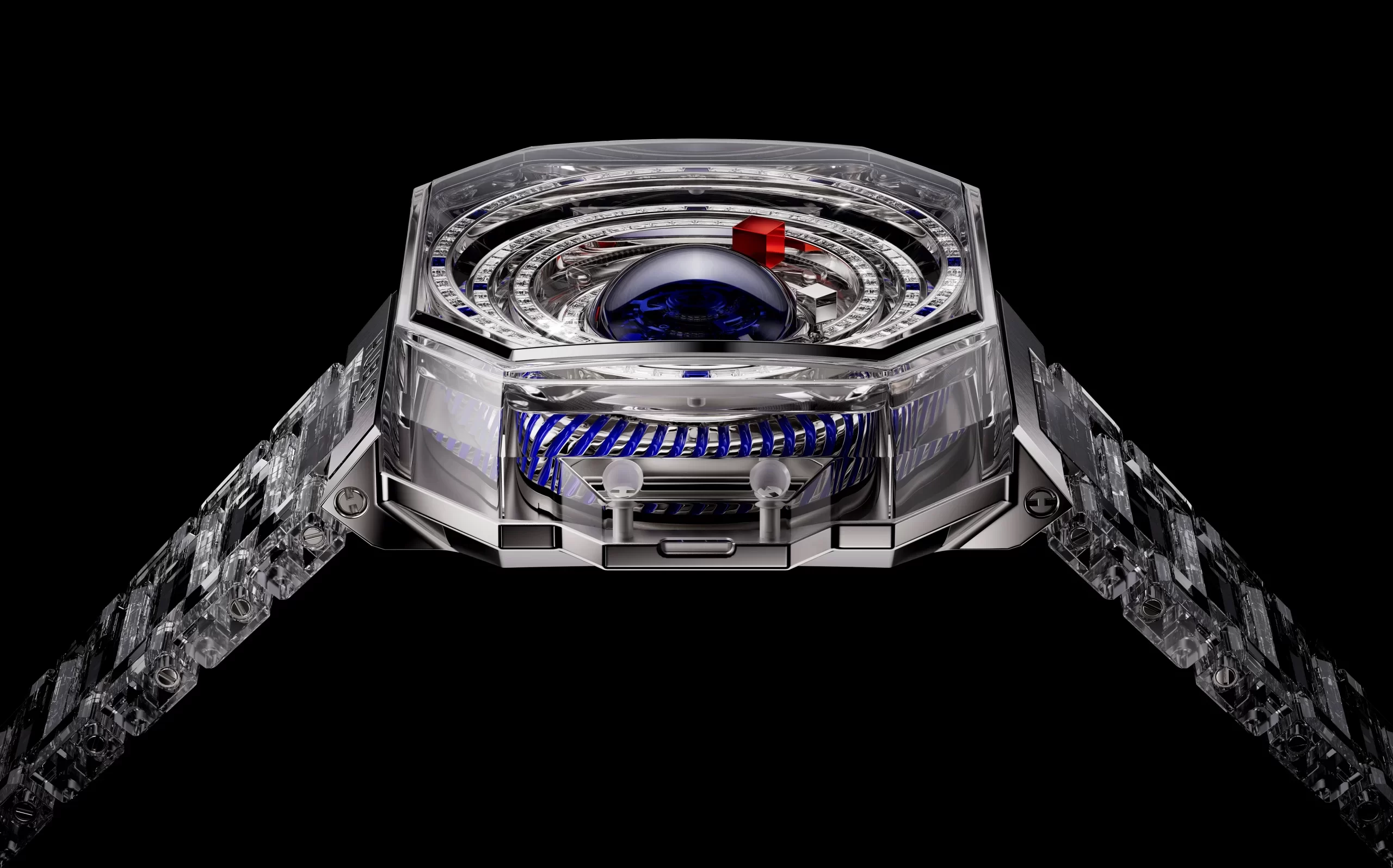
Hublot and Jeff Koons have turned the idea of creation into a mechanical work of art with the new MP-14 Origin by Jeff Koons. Unveiled in New York on 16 September 2026, the timepiece brings together sapphire architecture, gem-setting, contemporary art and Hublot’s high-horology expertise in an exceptionally complex 44 mm creation limited to just 30 pieces.
Rather than simply decorating a watch with artistic references, the collaboration attempts something considerably more ambitious: to make the watch itself behave like a miniature universe, with a central tourbillon acting as its mechanical point of origin and concentric rings appearing to expand around it.
A collaboration built around transformation
The partnership between Hublot and Jeff Koons brings together two creative disciplines that share an interest in transforming familiar ideas into something unexpected. Alongside the MP-14 Origin, the collaboration also introduces the Classic Fusion Balloon Dog, connecting Koons’ artistic vocabulary with Hublot’s watchmaking.
For the MP-14 Origin, that philosophy is expressed through an architecture combining sapphire, titanium and gem-set white gold. The result sits at the intersection of high jewellery and high watchmaking, while its visual concept is rooted in the creation and expansion of the cosmos.
The watch also represents an important technical development for Hublot: the introduction of the manufacture’s first automatic central tourbillon.
Why “MP-14”?
The name MP-14 is not simply a sequential designation. According to Hublot, the number 14 references an important moment in Jeff Koons’ early artistic career.
Koons held his first solo exhibition in 1980 at the New Museum in New York, which was then located at 65 Fifth Avenue at 14th Street. Hublot connects this address with the MP-14 name, making the number part of the artistic story behind the watch.
The MP-14 also belongs to Hublot’s Exceptional Timepieces collection, the brand’s experimental high-horology laboratory dedicated to unconventional architectures, advanced materials and radical mechanical concepts.
A miniature universe constructed in sapphire
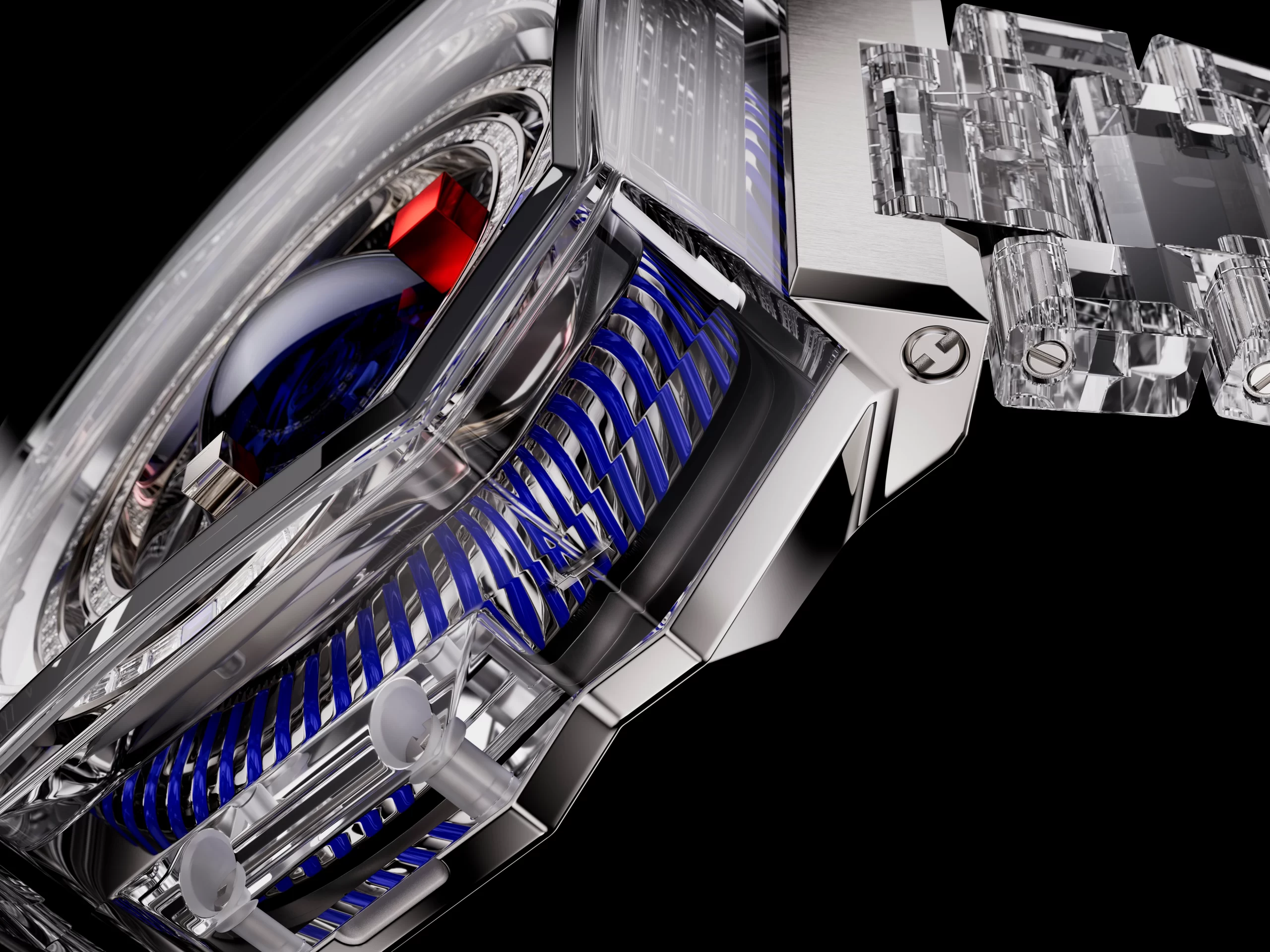
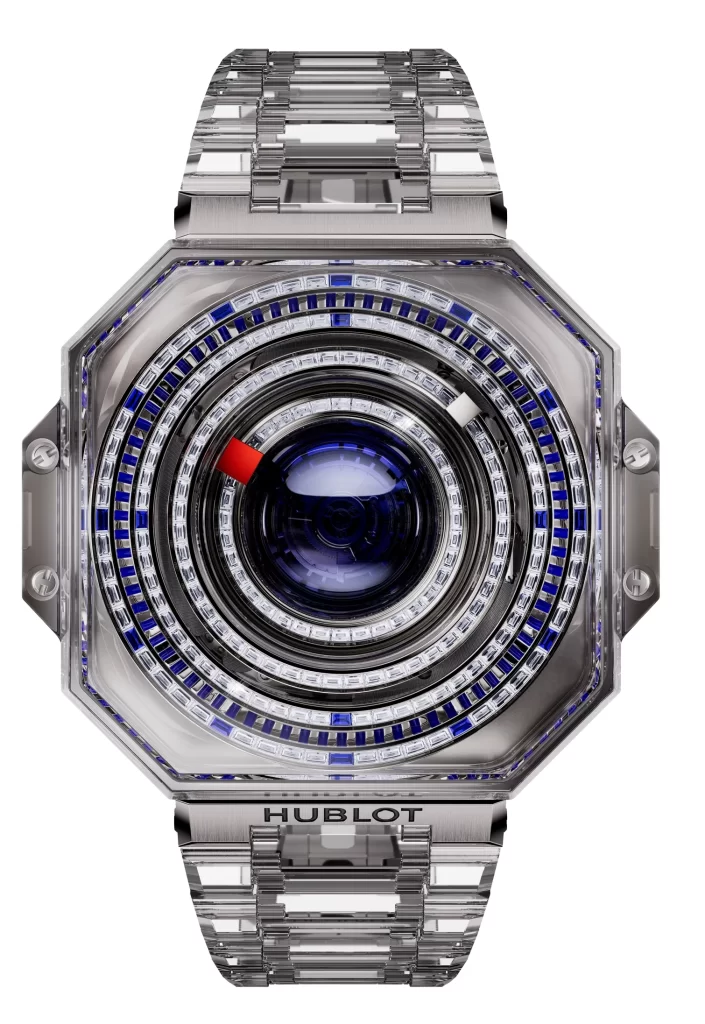
The MP-14 Origin measures 44 mm and uses an octagonal case made from polished sapphire crystal and titanium. Its transparent sapphire structure is central to the design rather than merely a material choice.
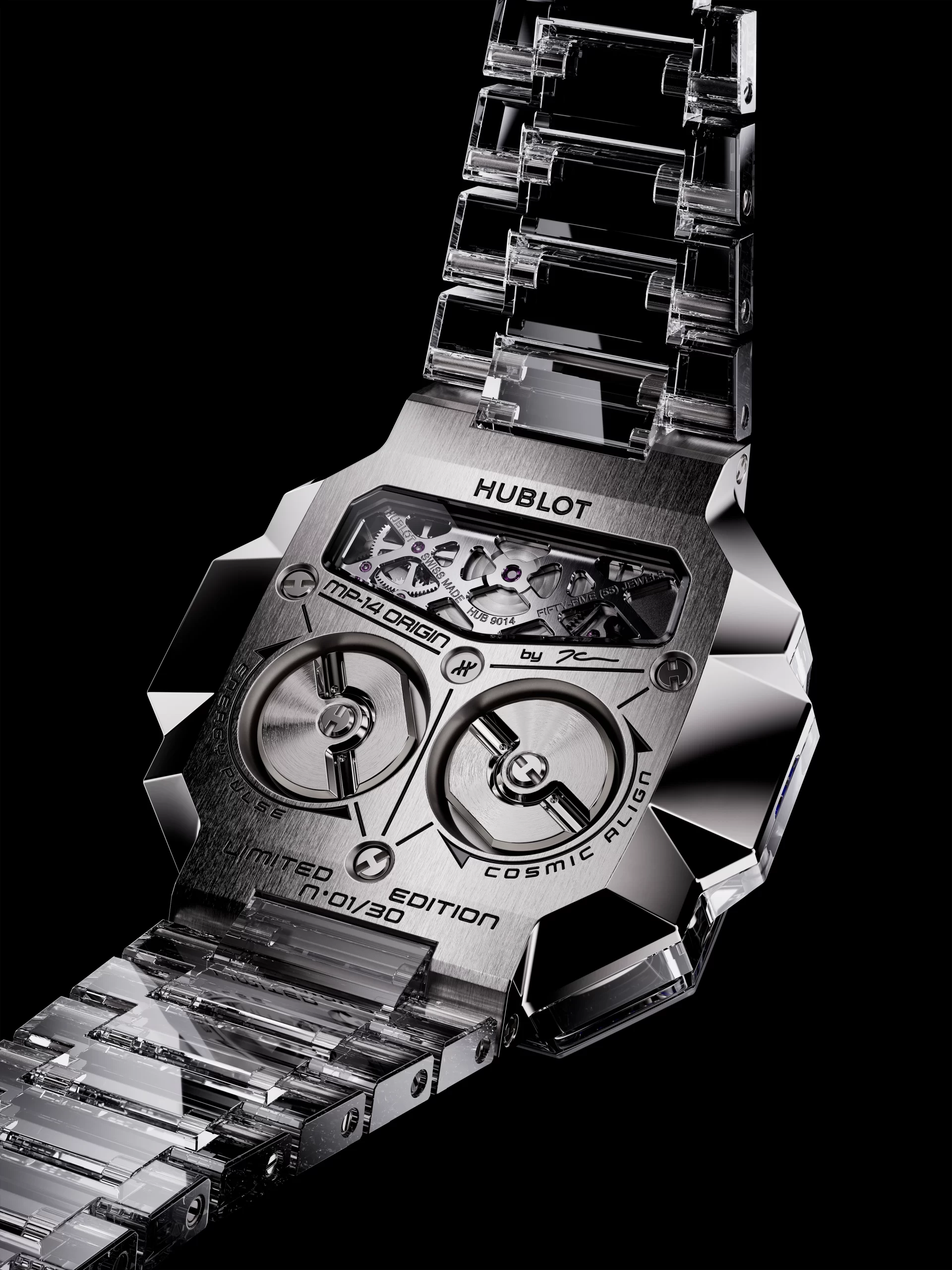
According to Hublot, machining the sapphire case requires approximately 534 hours. A titanium case back, H-shaped polished titanium screws and Hublot’s characteristic case “ears” at 3 and 9 o’clock complete the architecture.
Inside, the transparent construction reveals a series of concentric rings that create the impression of orbital movement. The rings are crafted in white gold and set with baguette-cut diamonds and blue sapphires, gradually directing the eye towards the centre of the watch.
At that centre sits the tourbillon, positioned beneath a transparent sapphire dome. The dome takes inspiration from Jeff Koons’ Gazing Ball works and is hand-coated in translucent blue varnish by a micropainter.
It is a clever visual metaphor. Instead of representing the universe through a conventional celestial dial, Hublot places mechanical motion at the heart of the composition.
Time appears to orbit the movement
The MP-14 Origin takes an unconventional approach to displaying the hours and minutes.
Two suspended rotating rings carry floating indicator cubes. The hour indicator is a polished stainless-steel cube finished with translucent red varnish, while the minute indicator is represented by a polished grey stainless-steel cube.
Two additional rings remain fixed. Blue sapphires mark the quarters on the minute ring, while the hour ring uses blue sapphires to indicate the hours. Collectively, the four rings contain 202 gemstones, representing approximately 2.6 carats.
The result is a time display that deliberately avoids the familiar arrangement of hands moving around a stationary dial. Here, the indicators appear suspended within a layered mechanical environment.
The HUB9014: the mechanical heart
Driving this unusual architecture is Hublot’s HUB9014 manufacture movement.
It is an automatic central tourbillon equipped with a peripheral oscillating weight, operating at 3 Hz, or 21,600 vibrations per hour, with a 60-hour power reserve. The movement contains 594 components.
The peripheral winding system is particularly important to the design. By moving the oscillating mass away from the traditional central position, Hublot can preserve the open appearance of the movement while maintaining the visual continuity of the architecture.
The tourbillon cage sits beneath the sapphire dome, becoming the visual and mechanical centre of the watch. In the context of the Koons collaboration, Hublot describes this as the first pulse from which the surrounding structure appears to expand.
Even the winding system disappears into the architecture
The MP-14 Origin takes its unusual construction a step further by concealing the functions normally associated with the crown.
Two hidden crown systems are integrated into the case, allowing the wearer to wind the watch and adjust the time without interrupting its clean architectural appearance.
The winding function is associated with the engraving “ENERGY PULSE”, while the time-setting function is marked “COSMIC ALIGN.”
It is the sort of detail that makes the watch less like a conventional timepiece and more like an engineered object whose functions have been absorbed into its design.
From watch to immersive presentation
Hublot extends the cosmic concept beyond the watch itself.
The presentation case uses an infinite mirror installation, incorporating LED illumination and one-way mirror technology to create an impression of limitless depth. Its octagonal geometry echoes the shape of the watch and is topped by a transparent dome, effectively turning the presentation environment into an extension of the timepiece’s architecture.
This matters because the MP-14 Origin is designed to be experienced as more than an object on the wrist. Its visual language continues from the sapphire case to the presentation environment, reinforcing the central idea of an expanding mechanical cosmos.
Jeff Koons’ interpretation of creation
For Koons, the MP-14 Origin represents a horological interpretation of creation itself, centred on the transformation of energy into form and form into time.
The central tourbillon becomes the starting point, while the surrounding mechanical structures suggest controlled expansion. Hublot’s press material specifically connects the concept to the Big Bang, translating that idea through mechanical movement, material tension and the interaction of light with the watch’s transparent architecture.
The concept is therefore not simply about putting a cosmic image on a dial. The movement, case, gemstones and rotating indicators all participate in the same visual narrative.
Technical specifications
Specification: Hublot MP-14 Origin by Jeff Koons
Reference: 914.NJ.0100.JX.9941 Edition: Limited to 30 pieces Case: Polished sapphire crystal and titanium Case size: 44 mm Thickness: 20 mm Water resistance: 3 ATM / 30 m Winding system: Peripheral oscillating weight Movement diameter: 39.20 mm Movement thickness:14.65 mm Components: 594 Jewels : 55 Frequency: 3 Hz / 21,600 A/h Power reserve: 60 hours Gem-setting: Baguette-cut diamonds and blue sapphires Gemstone total: 202 stones / approximately 2.6 carats Crystal: Sapphire Case back: Polished and satin-finished titanium Strap: Sapphire crystal and titanium deployant buckle
A 30-piece expression of experimental watchmaking
The Hublot MP-14 Origin by Jeff Koons is limited to just 30 pieces and is available through selected Hublot points of sale. The press release lists pricing at CHF 405,000, EUR 479,000, USD 488,000 and GBP 383,000.
At its most interesting, however, the MP-14 Origin is not about rarity or price. Its significance lies in how Hublot has attempted to make mechanical watchmaking itself tell the story.
The central tourbillon becomes the point of origin. The sapphire case provides the space. The gemstone-set rings create the impression of orbital structures. Floating cubes indicate the passage of hours and minutes. Even the winding and time-setting systems have been absorbed into the architecture.
In that sense, the MP-14 Origin does not simply depict a universe.
It builds one around the mechanism that makes the watch come alive.
Luxury watchmaking has never been content with simply telling time. The most interesting watches often exist somewhere between engineering, design and culture, and Hublot’s latest collaboration with Jeff Koons pushes that idea into distinctly sculptural territory.
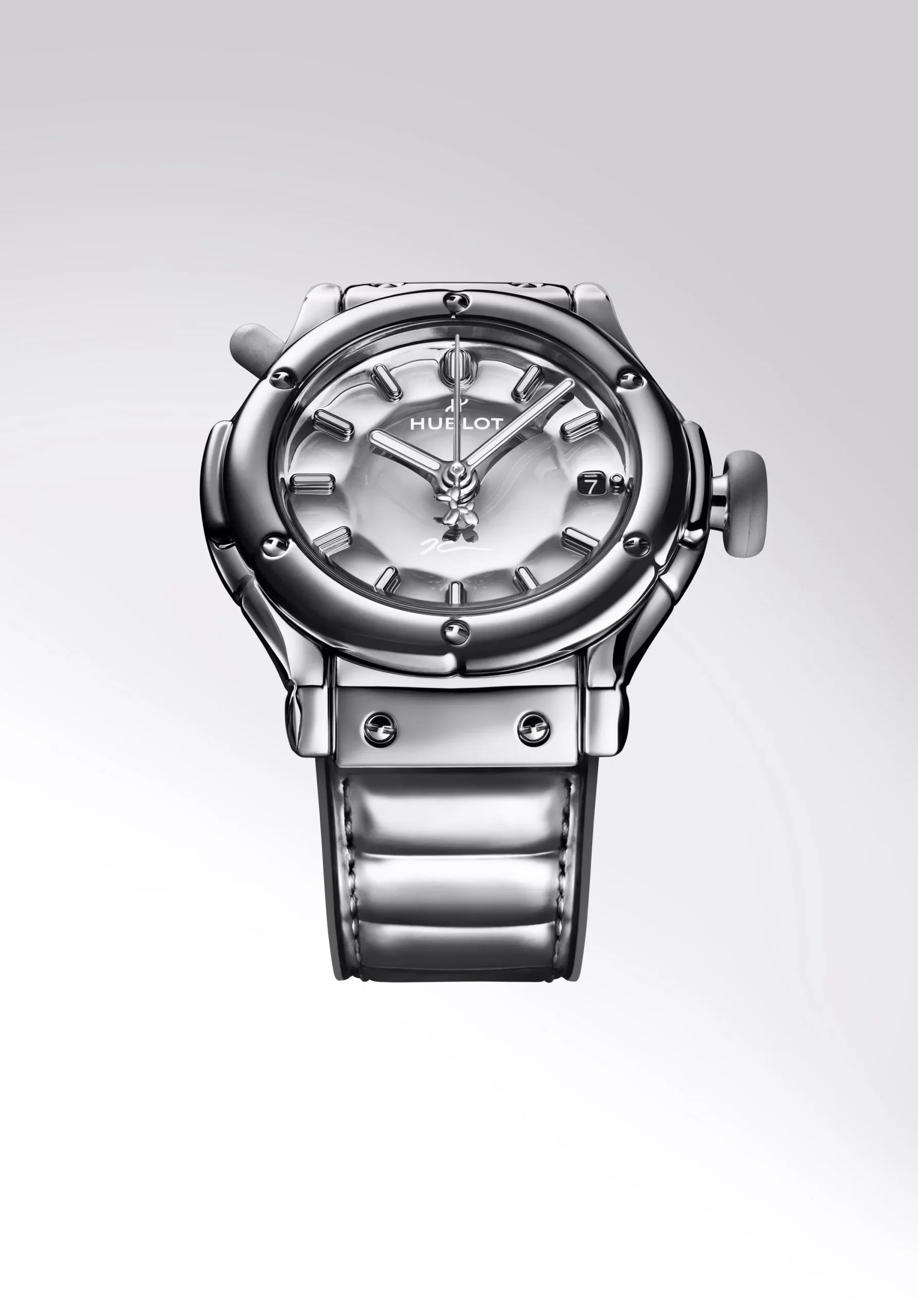
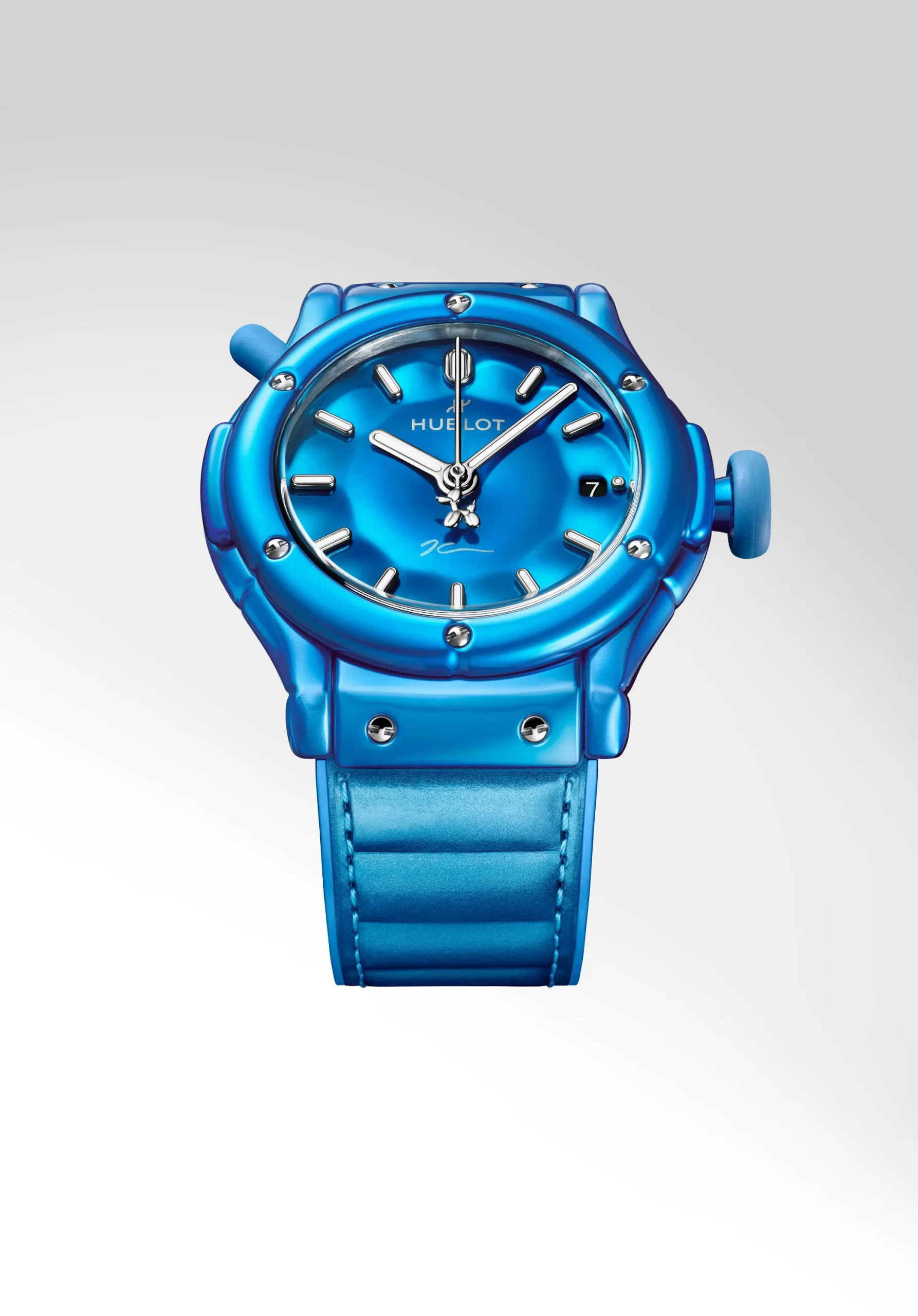
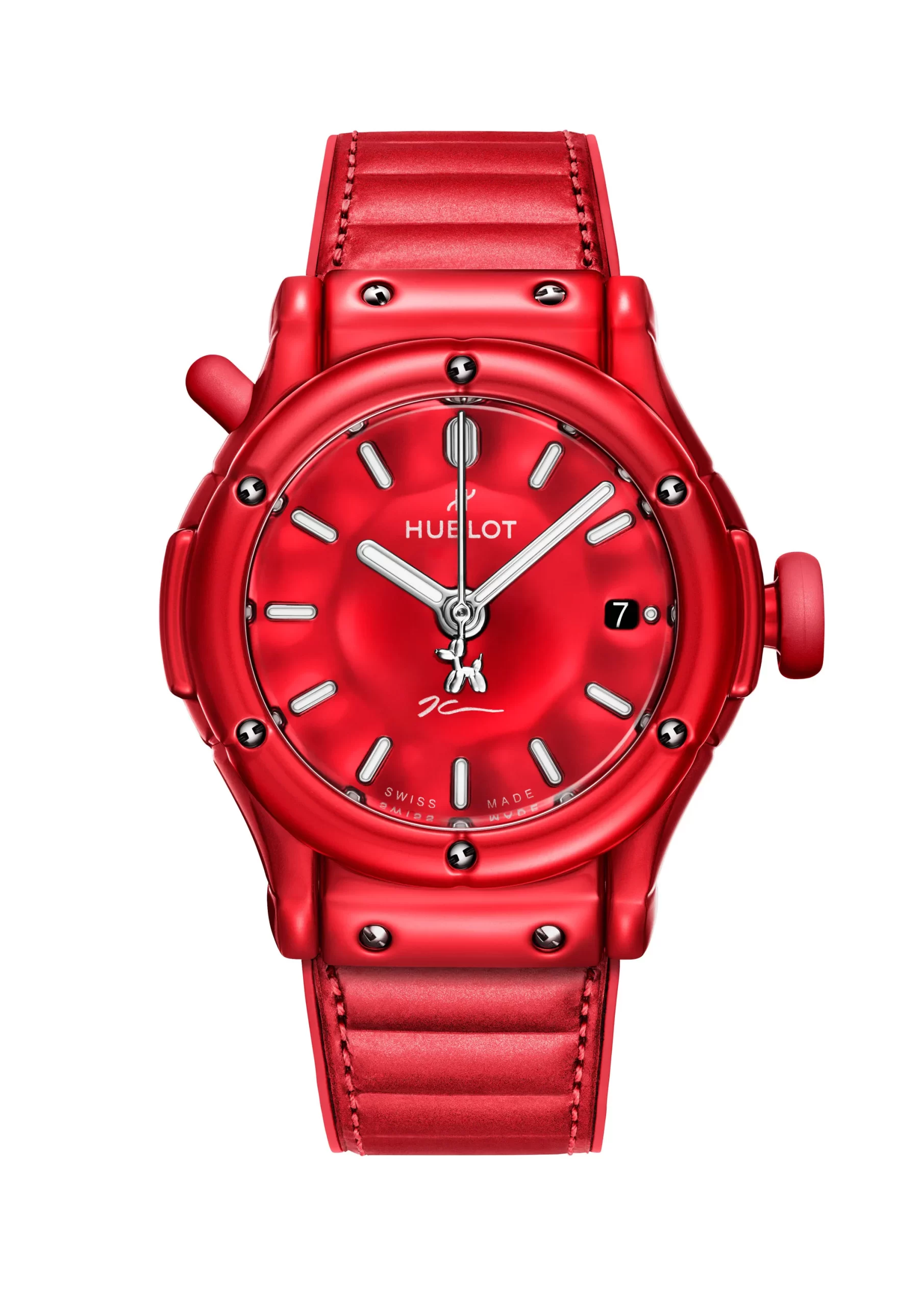
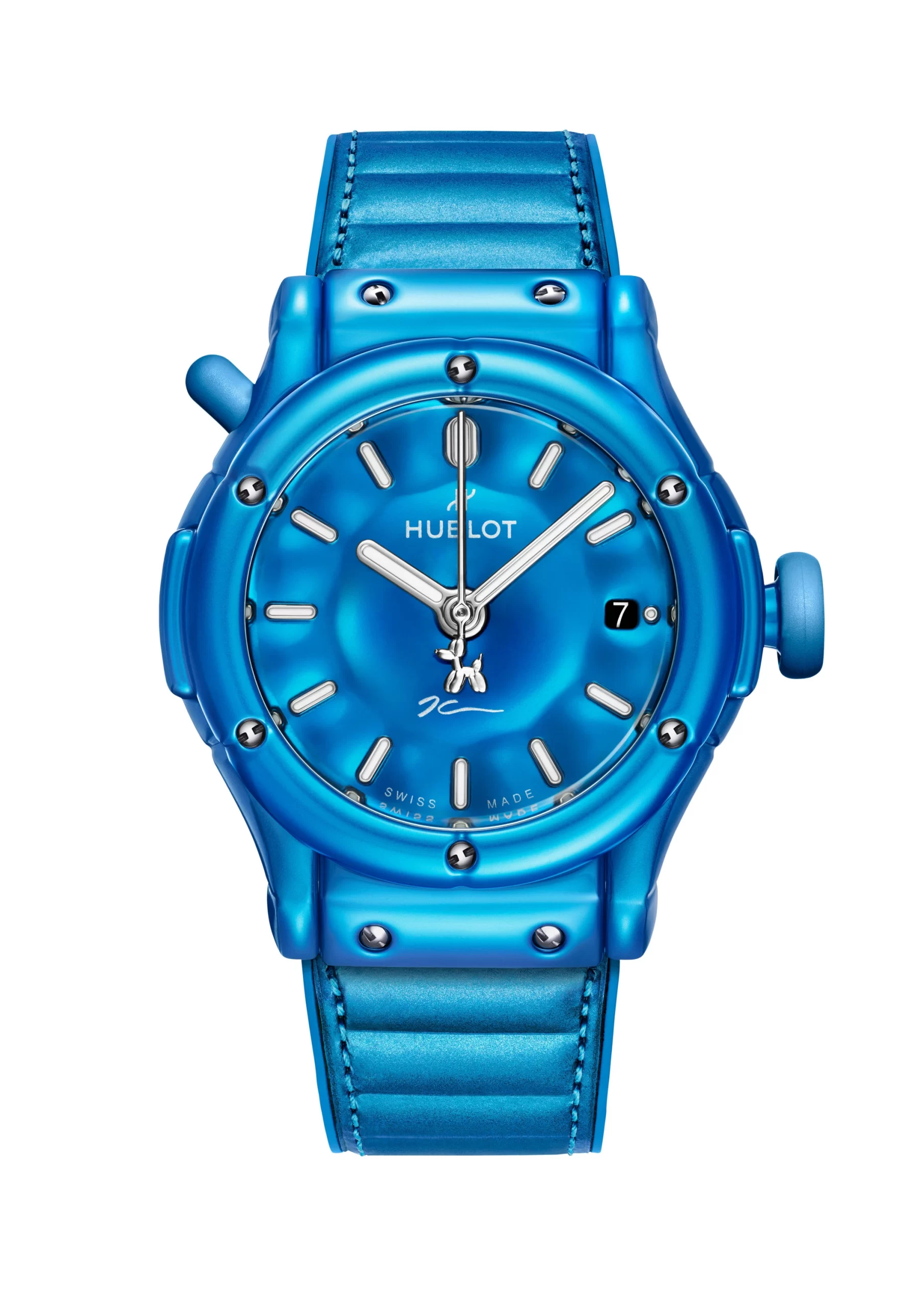
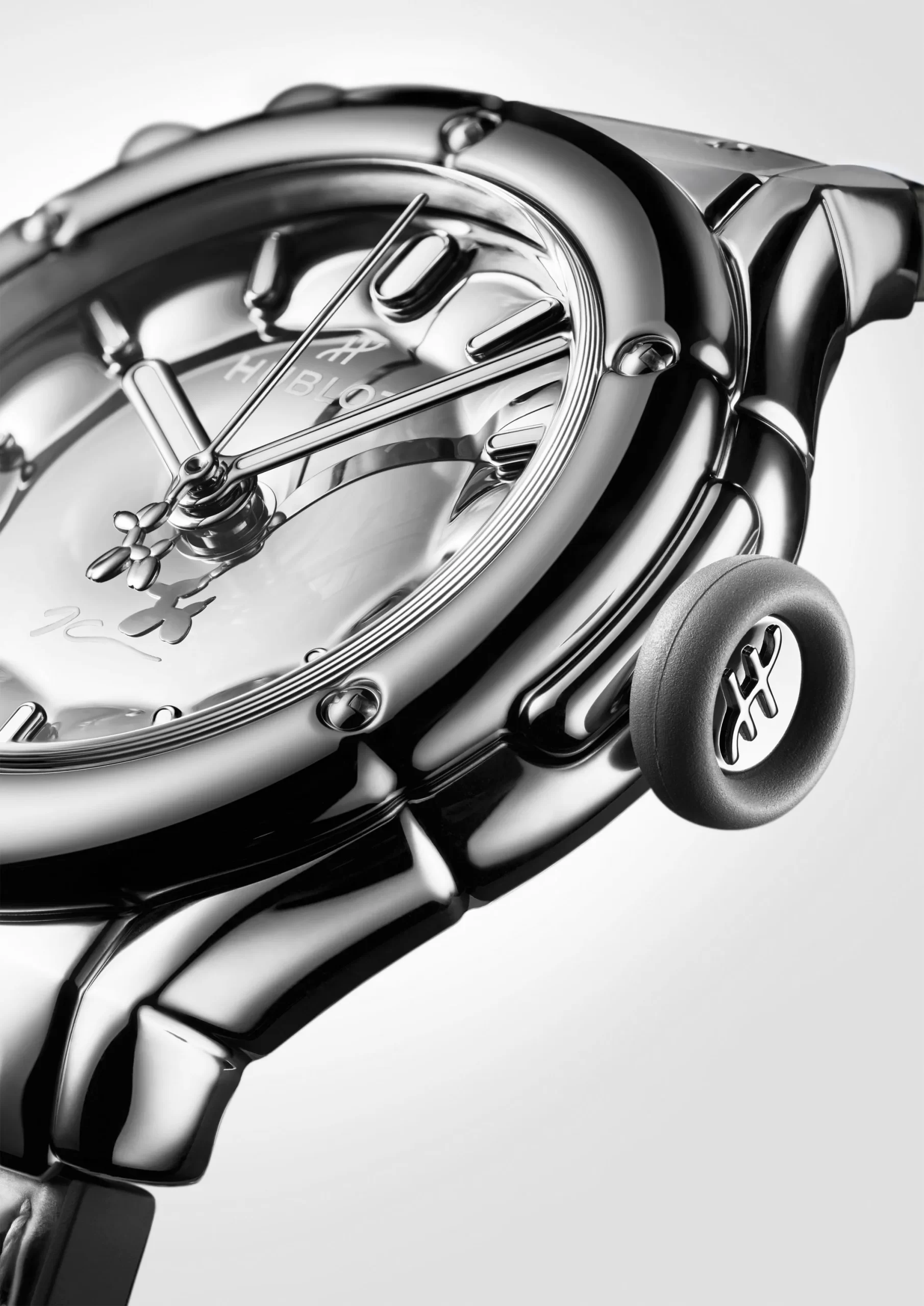
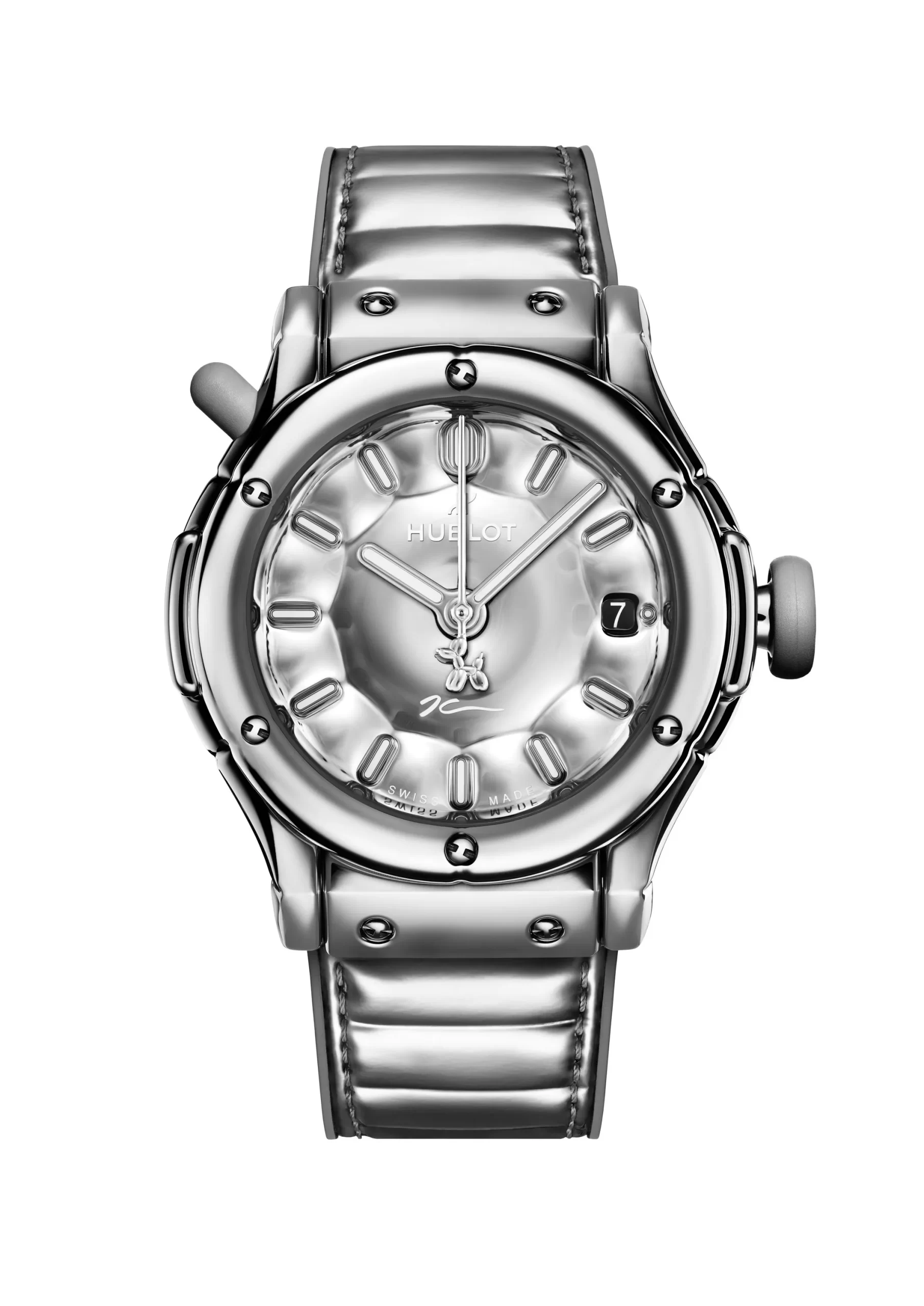
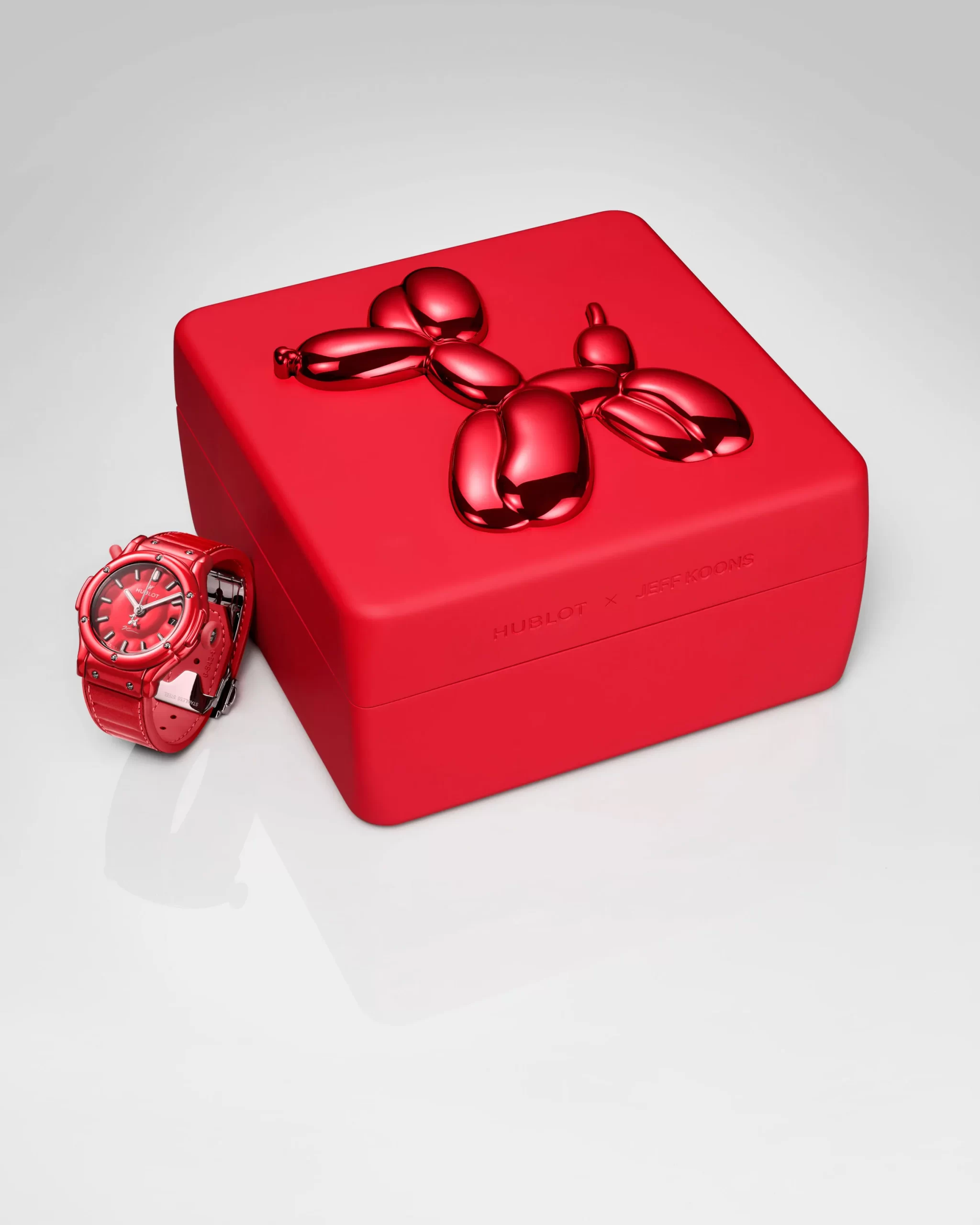
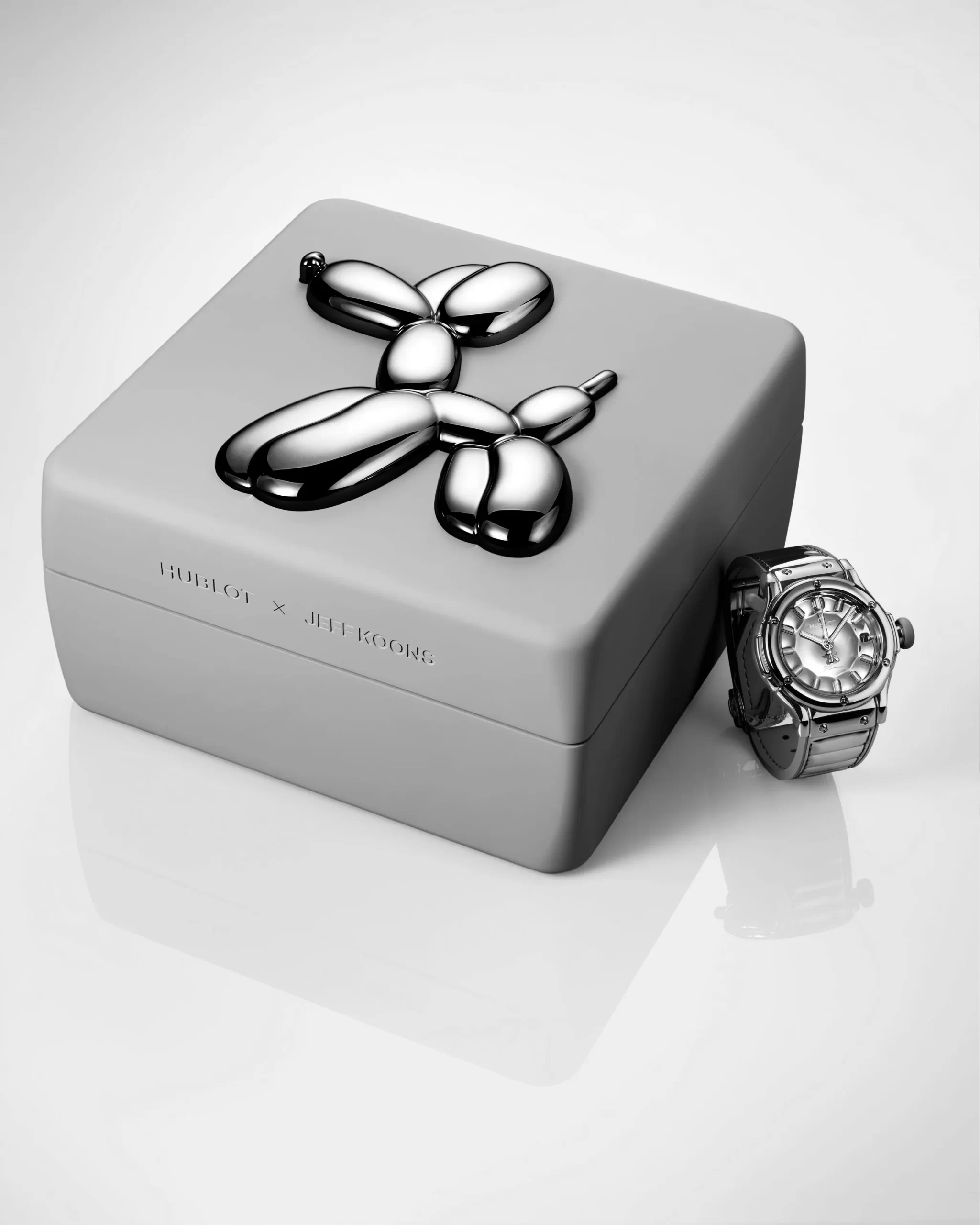
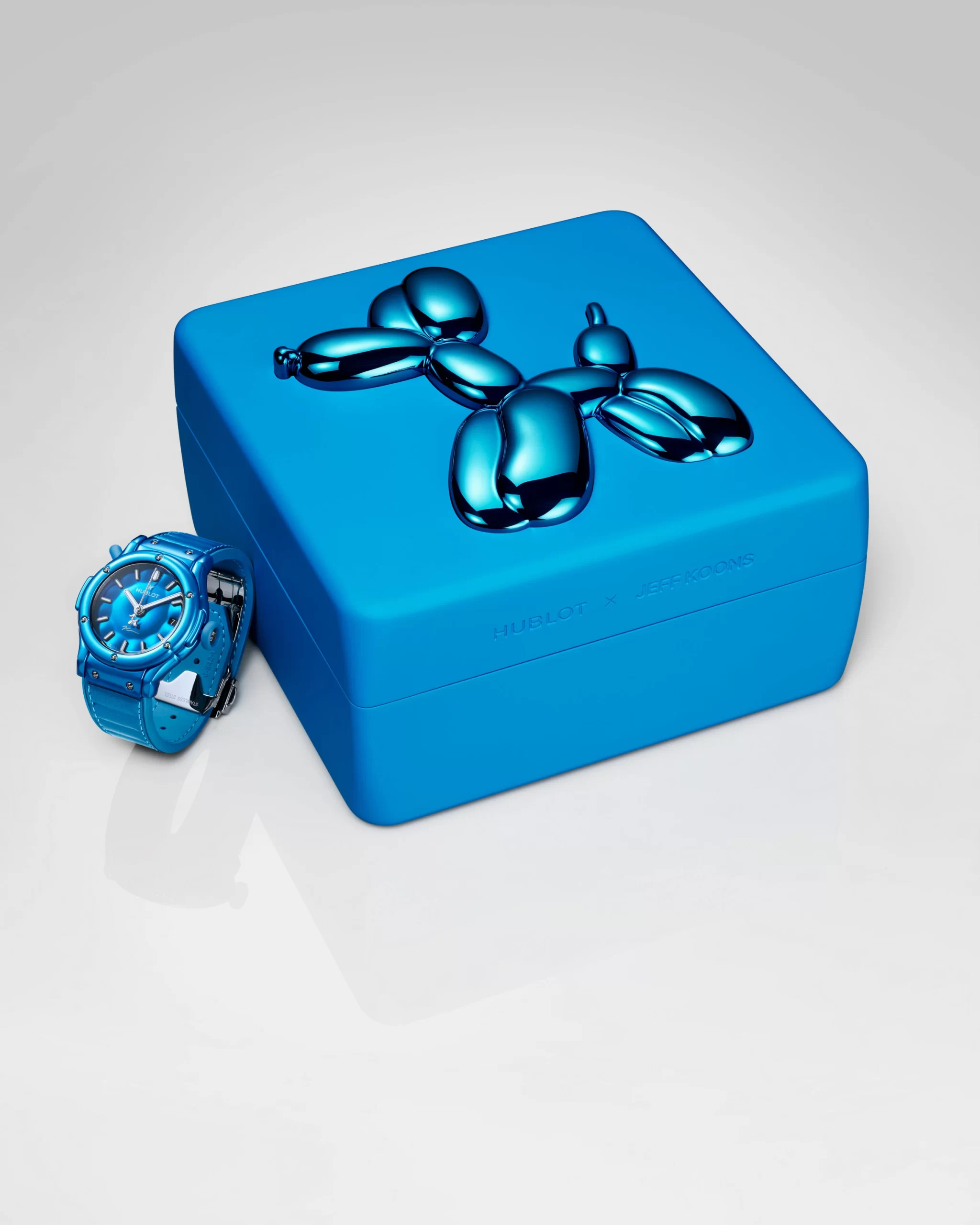
Unveiled in New York on 16 September 2026, the Hublot Classic Fusion Balloon Dog by Jeff Koons transforms Koons’ instantly recognisable Balloon Dog into a wristwatch. Available in mirror-polished stainless steel, red anodized aluminium and blue anodized aluminium, the collection is limited to 200 pieces in each edition.
The result is not simply a Classic Fusion decorated with references to an artwork. Hublot and Koons have rethought the architecture of the watch itself, creating a timepiece that appears almost as though it has been inflated.
From Balloon Sculpture to Wristwatch
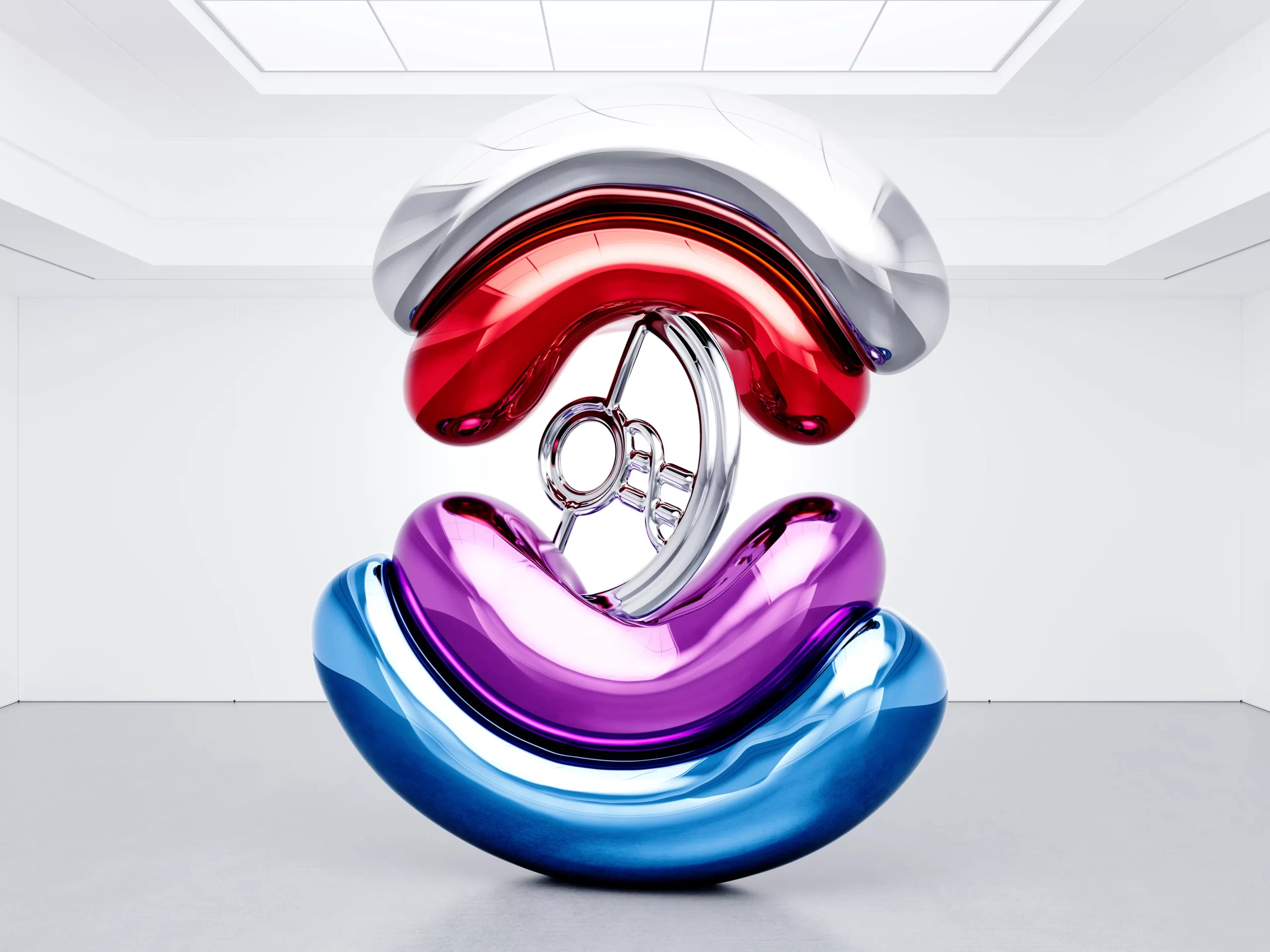
Jeff Koons’ Balloon Dog, created between 1994 and 2000 as part of his Celebration series, takes one of the most familiar forms of childhood play and turns it into something permanent and monumental.
That transformation is central to Koons’ artistic language. Something temporary becomes enduring; something ordinary becomes iconic. Hublot sees a natural connection between that philosophy and its own approach to watchmaking, particularly its long-standing interest in combining unexpected materials, shapes and ideas.
For the Classic Fusion Balloon Dog, the challenge was therefore much greater than placing an artistic motif on an existing watch.
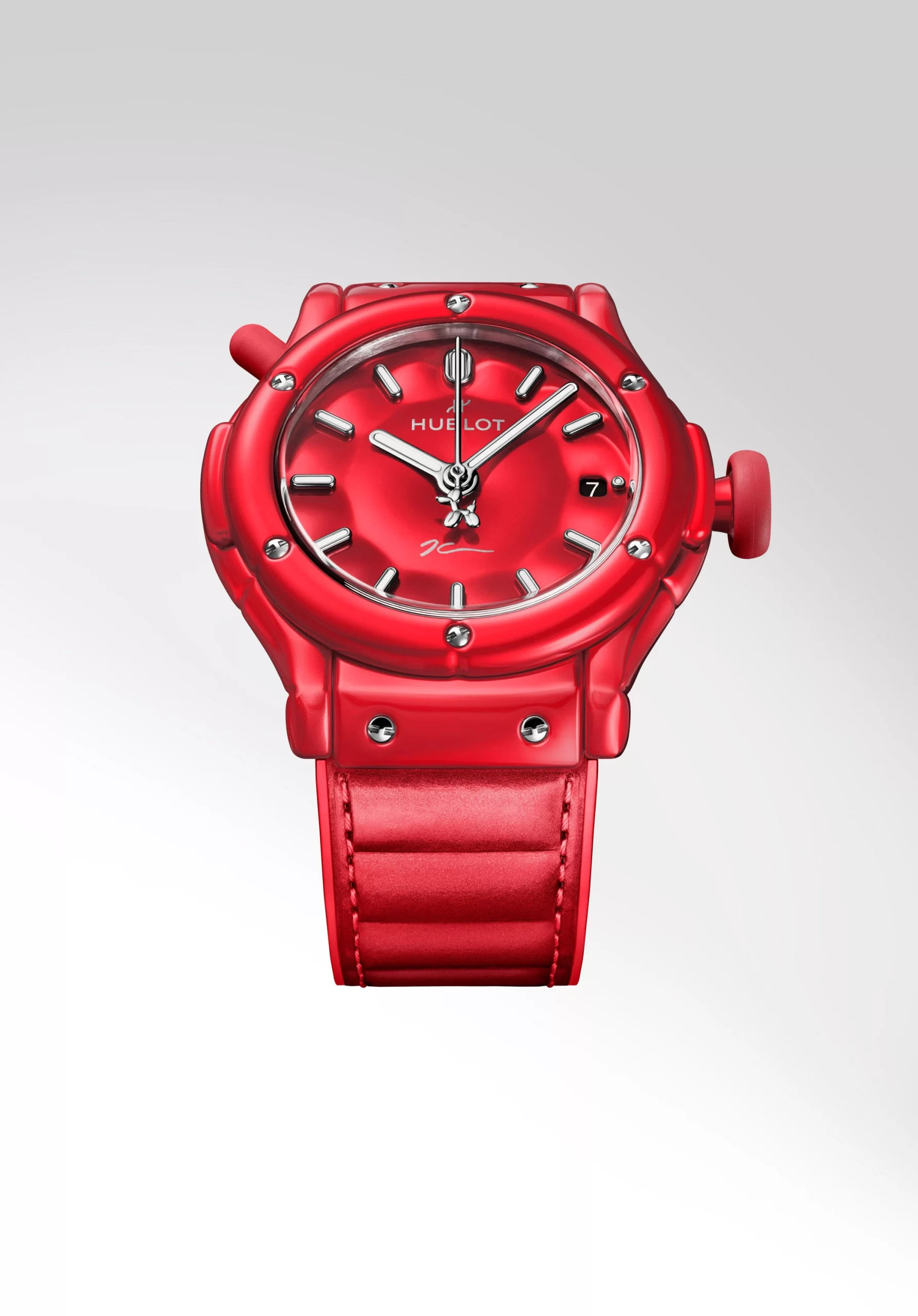
The 42mm Classic Fusion was fundamentally re-engineered around the visual language of an inflatable sculpture. Its normally sleek architecture gives way to rounded, convex and domed forms designed to create the impression of volume and internal pressure.
That distinction matters. This is not a conventional art-inspired dial. The artwork has influenced the physical architecture of the watch.
A Classic Fusion That Looks Inflated
Almost every visible component contributes to the illusion.
The sapphire crystal has a raised, domed profile, while the titanium H-shaped screws feature inflated heads. The dial itself adopts a convex, padded appearance, and the case follows the same rounded visual vocabulary.
Even the strap has been integrated into the concept. Its metallic leather and rubber construction continues the soft, padded aesthetic, while the attachment points have been softened rather than left with the sharper geometry traditionally associated with a sports-luxury watch.
Then come the details that make the connection to Balloon Dog unmistakable.
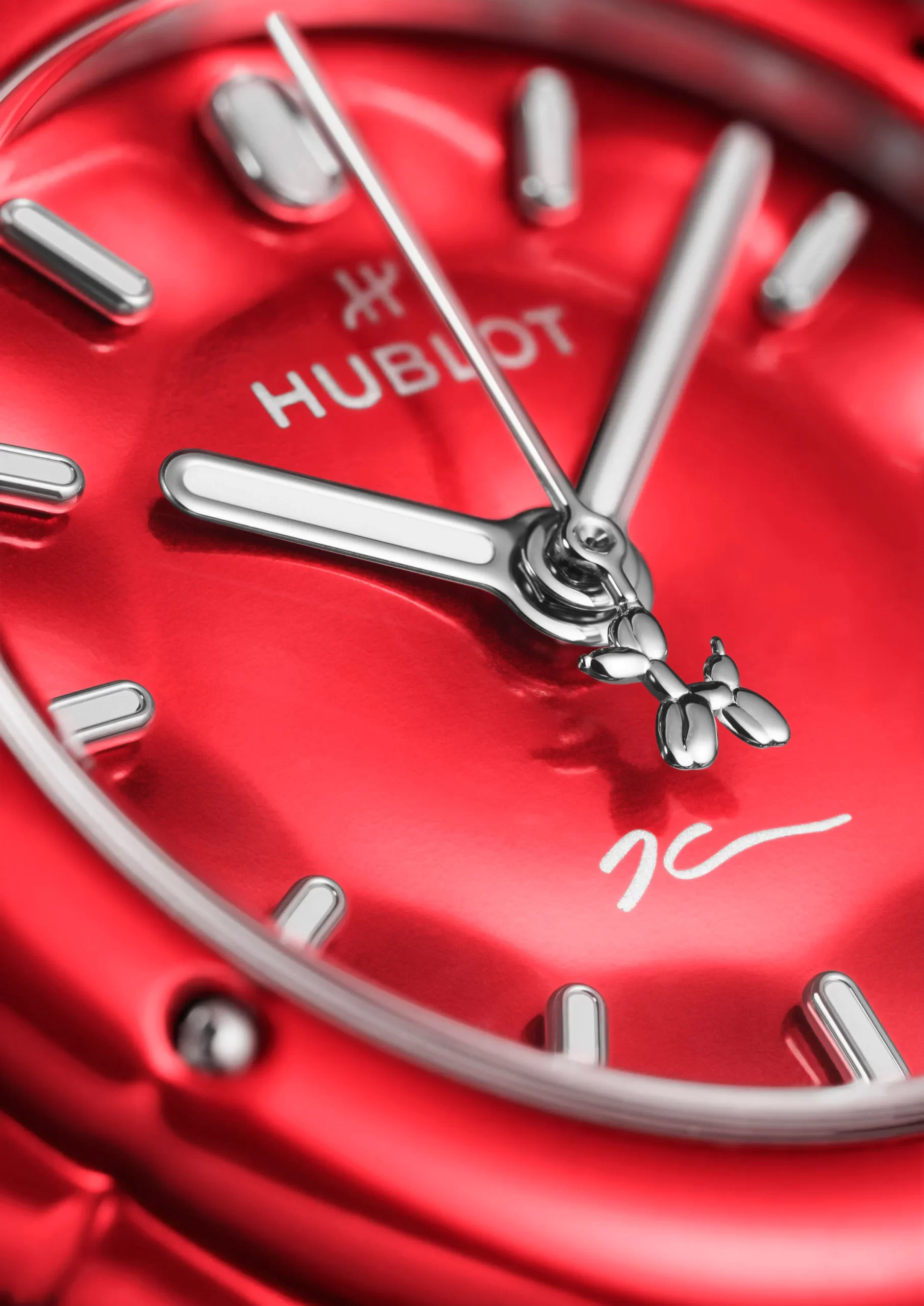
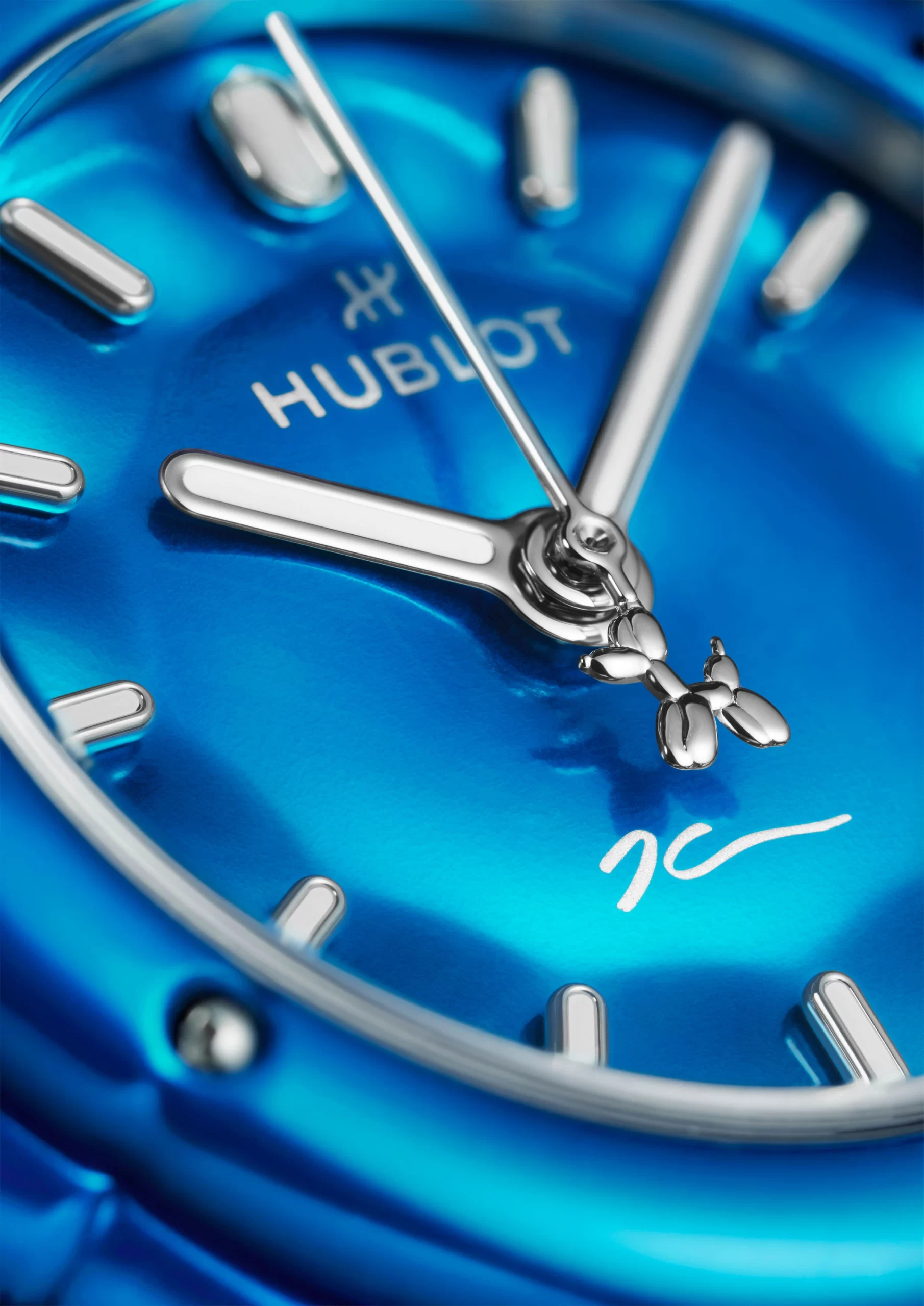
The crown is shaped like a balloon’s inflation valve. A flexible decorative “balloon tail” appears at 10:30, while the seconds hand carries a Balloon Dog-shaped counterweight. The hour and minute hands and dial indexes incorporate inflated Super-LumiNova elements.
It is playful, but the execution is anything but casual.
Three Interpretations, One Concept
Hublot has produced the Classic Fusion Balloon Dog in three distinct finishes.
Red
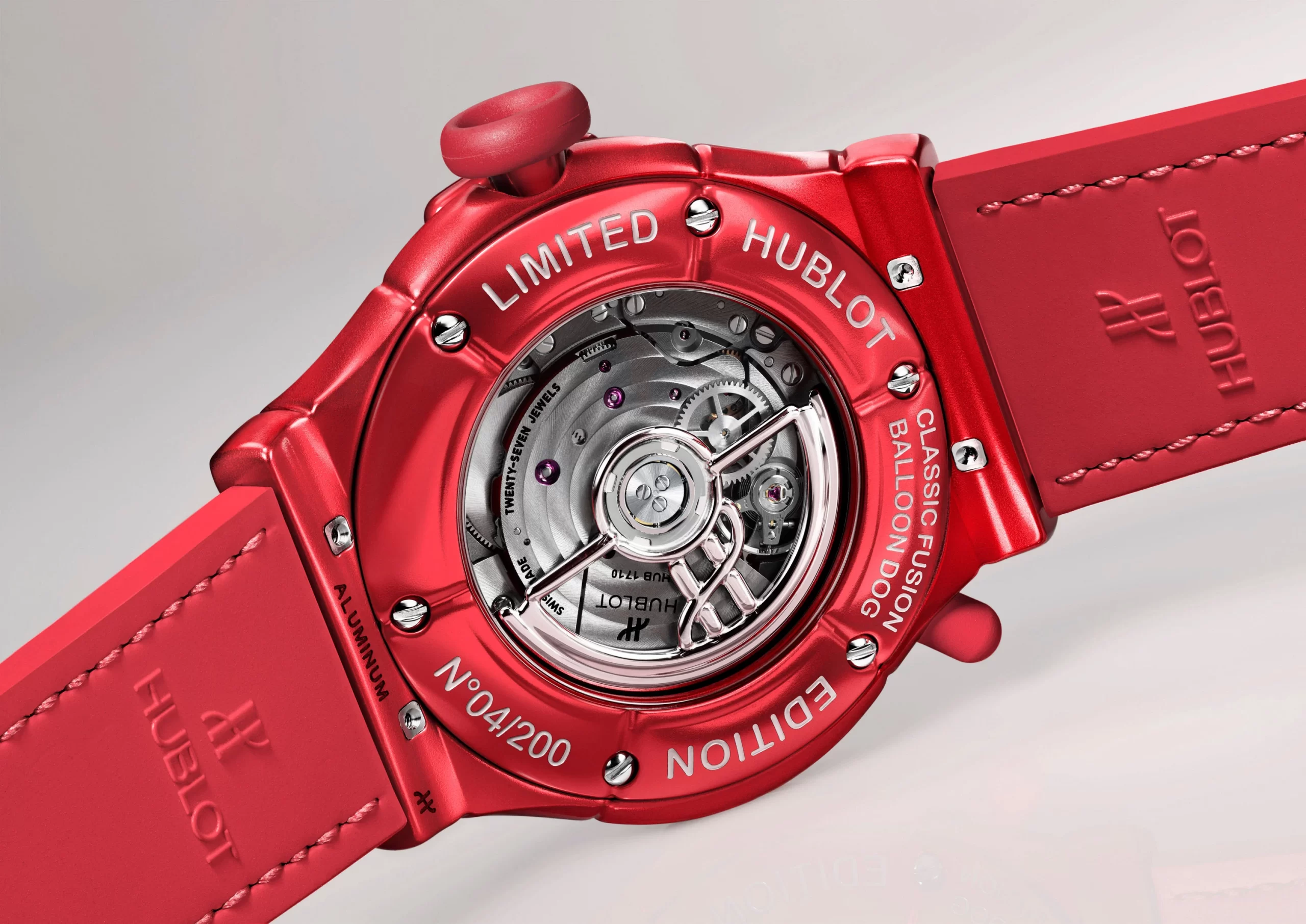
The red edition uses polished red anodized aluminium for the case, bezel and caseback, complemented by a red rubber balloon-tail detail. Its full red dial features domed appliques with 3D white Super-LumiNova and Jeff Koons’ signature at 6 o’clock.
Reference 542.UR.8170.NR.JKN26, it measures 42mm in diameter and 11mm thick, with 50 metres of water resistance.
Blue
The blue version follows the same sculptural construction but uses polished blue anodized aluminium. A blue rubber balloon tail, blue dial and matching strap create a monochromatic interpretation of the concept.
Its reference is 542.UB.5170.NR.JKN26, with the same 42mm diameter, 11mm thickness and 5 ATM water resistance as the red edition.
Silver
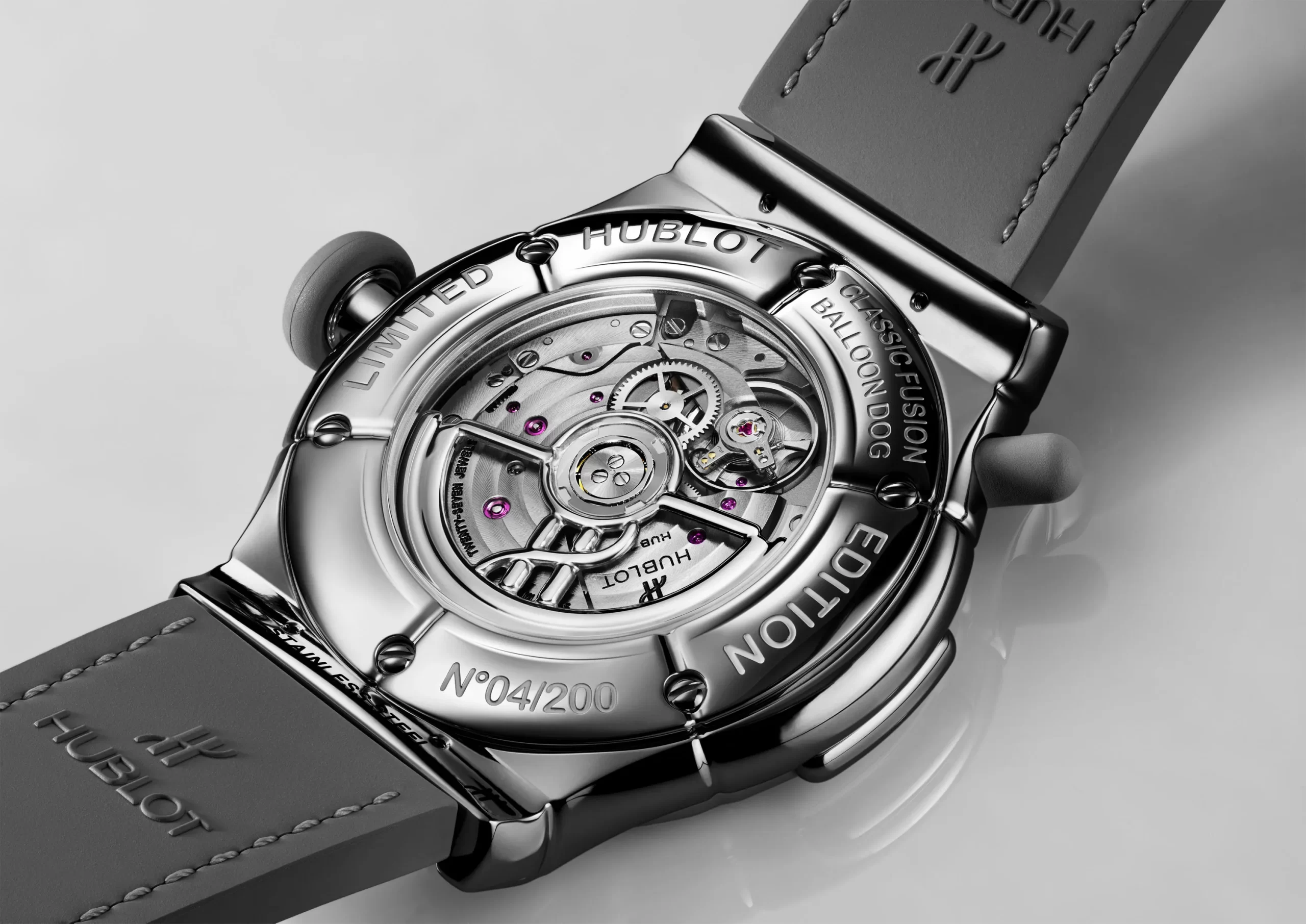
The third interpretation replaces colour with reflective metal. The 542.SX.0820.NR.JKN26 combines polished stainless steel with a rhodium-plated dial and grey accents.
Here, the mirror-like surface becomes particularly important. It echoes the reflective quality associated with Koons’ Balloon Dog sculptures while giving the watch a more restrained visual character.
All three versions are limited to 200 pieces.
The Horology Beneath the Sculpture
For all its artistic personality, the Balloon Dog remains a mechanical Hublot.
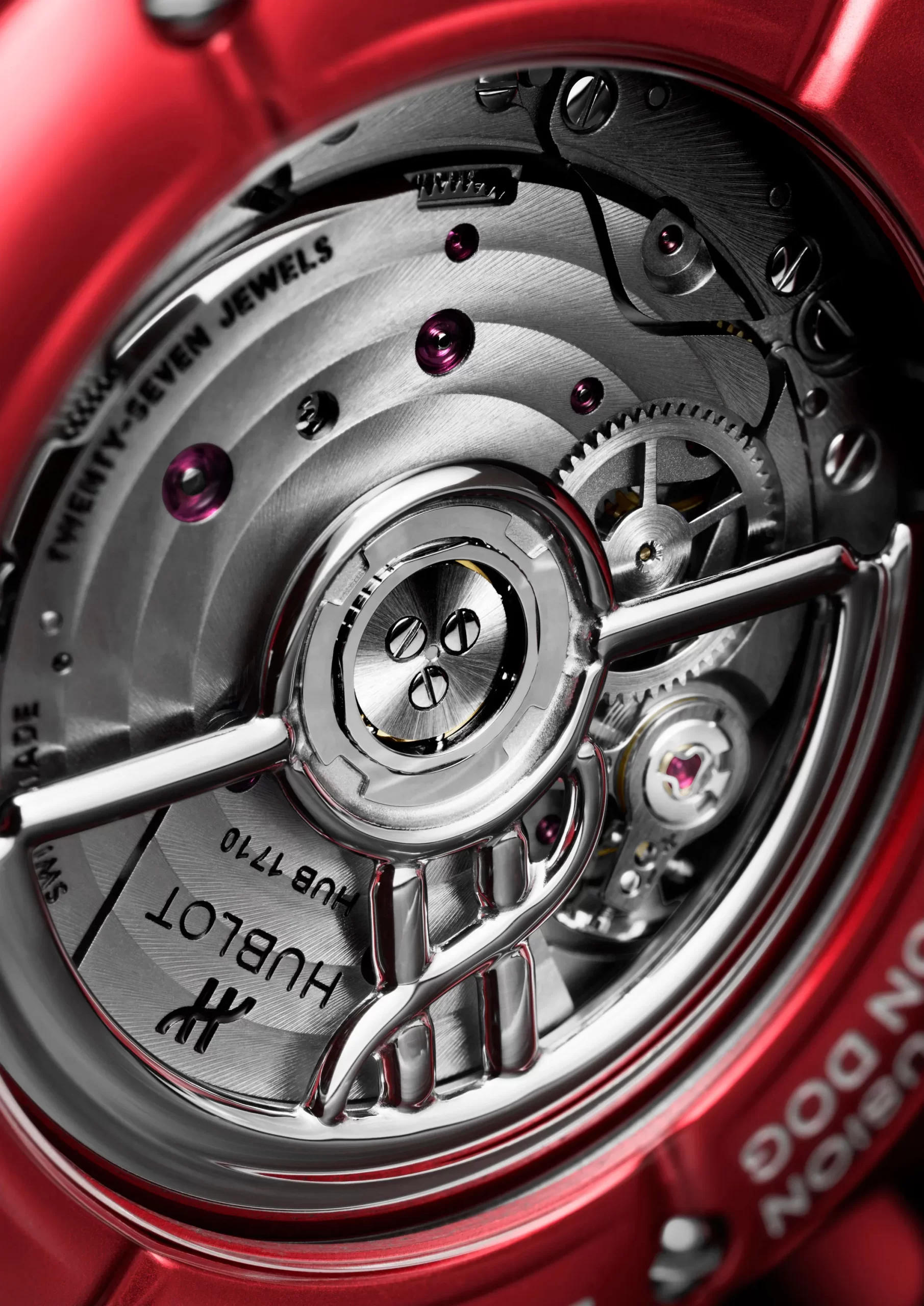
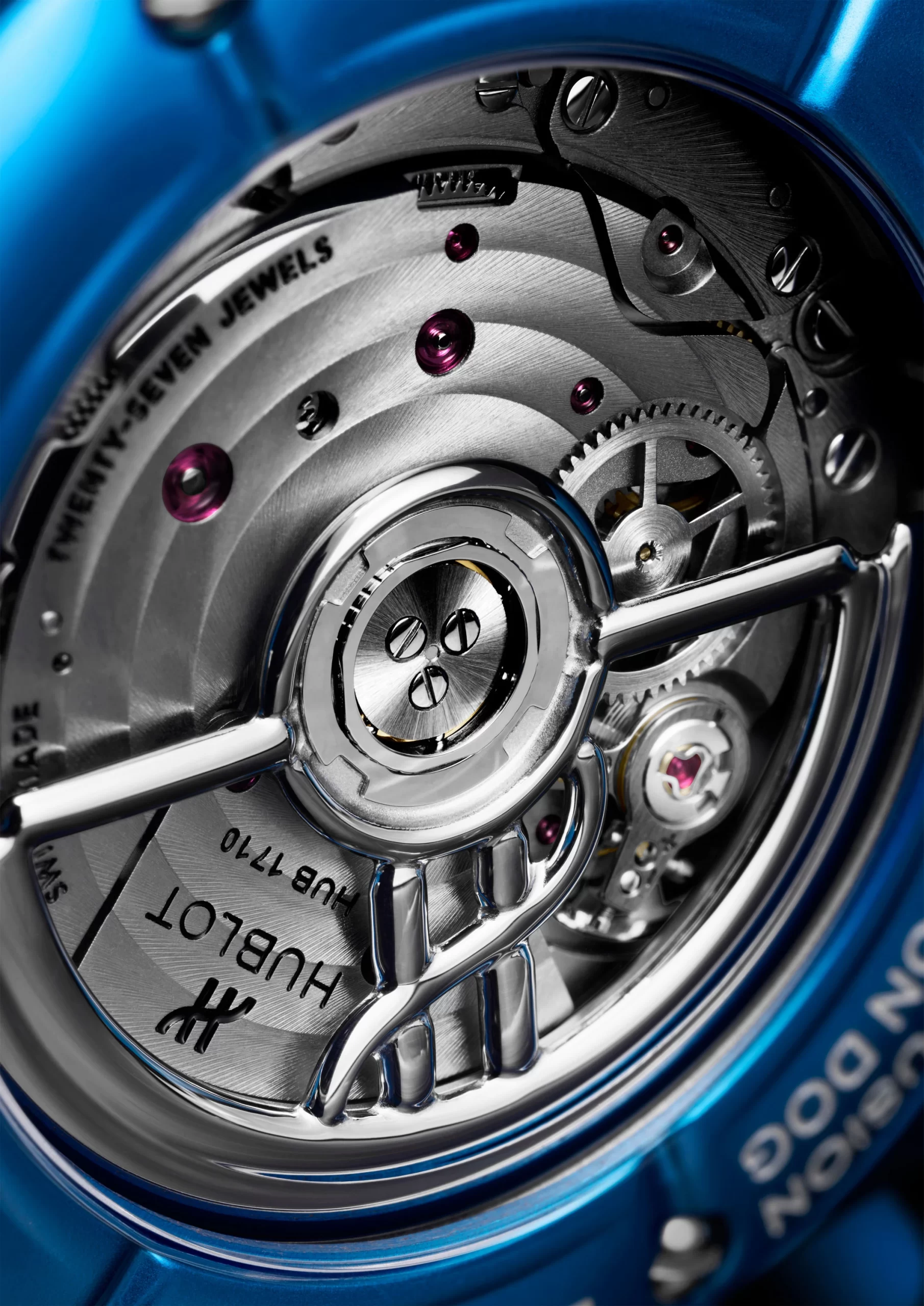
At its heart is the HUB1710 self-winding movement, with anthracite ruthenium-treated bridges and main plate. The movement incorporates a date display at 3 o’clock and a polished rhodium-plated oscillating weight designed with an inflated visual effect.
The technical specifications include:
Movement: Hublot HUB1710 automatic
Diameter: 25.6mm
Thickness: 3.7mm
Components: 185
Jewels: 27
Frequency: 4 Hz / 28,800 vibrations per hour
Power reserve: 50 hours
Date: 3 o’clock
Case diameter: 42mm
Water resistance: 50 metres
There is also an important technical point hidden beneath the playful exterior. The movement’s oscillating weight continues the visual language established by the case, creating a relationship between the mechanical heart of the watch and its external sculpture.
In other words, the Balloon Dog concept does not stop at the dial.
Where Art Meets Engineering
Perhaps the most interesting aspect of the collaboration is the amount of engineering required to make something apparently simple look simple.
Hublot states that the components were reimagined, reshaped and refined, with 5-axis CNC machining used to create the distinctive puffed forms before the components were finished by hand.
That combination of industrial precision and hand finishing is particularly appropriate for a collaboration with Koons. His sculptures are famous for their apparently flawless surfaces, yet achieving that simplicity requires considerable control over materials, proportions and finishing.
The same principle applies here.
The watch is supposed to look effortless. Making it look effortless is the difficult part.
More Than a Limited-Edition Watch
Hublot has also extended the Balloon Dog idea beyond the wrist.
Each watch comes in packaging inspired by the sculpture, featuring a chromed Balloon Dog with a colour-matched finish. Its rubber-effect painted surface continues the tactile and playful character of the timepiece.
The watches are conceived, developed and assembled at Hublot’s Manufacture in Nyon. They are also covered by the brand’s evolved 5+5 warranty programme for eligible watches purchased from 1 January 2026, providing a five-year basic warranty with the possibility of a further five-year extension through the Hublotista programme.
The watches are priced at CHF 20,800 / EUR 24,600 / USD 25,100 / GBP 19,700 across the three editions.
The Hublot Approach to Contemporary Art
The collaboration also makes sense within Hublot’s broader history.
Since 1980, the brand has built much of its identity around the idea of “Art of Fusion”, beginning with its combination of a gold case and rubber strap. The Big Bang subsequently expanded that philosophy through its layered construction, while the Classic Fusion established a different balance between contemporary design and restraint.
The Balloon Dog takes that philosophy into another dimension, quite literally.
Here, Hublot is not merely fusing materials. It is fusing watchmaking and sculpture, mechanical precision and visual emotion, childhood familiarity and contemporary luxury.
That is what makes the collaboration particularly relevant.
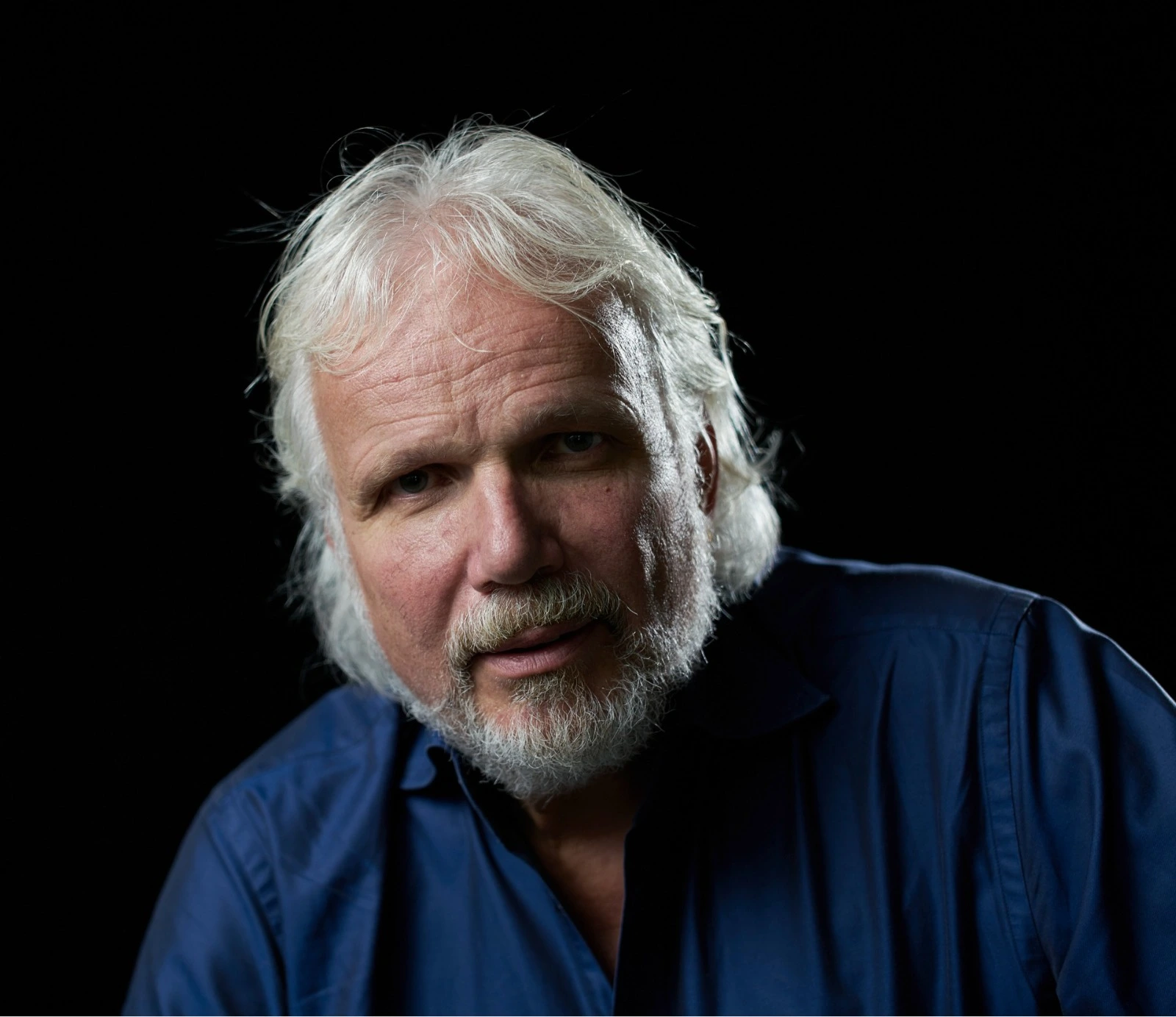
Jeff Koons
Few artists have transformed popular culture into iconography as profoundly as Jeff Koons. For over forty years, he has redefined contemporary art by taking everyday objects and elevating them through scale, transformation of material, craftsmanship with great precision and care. Known for works such as Balloon Dog, Rabbit and Puppy, Koons turns the ordinary into the extraordinary, the ephemeral into the permanent and the playful into the monumental. Beneath the reflective surfaces and universally recognizable forms lies a discipline rooted in the experience of feelings and sensation and a commitment to realizing a vision through execution. Behind their playful appearance lies a profound connection to human experience and our communal history, along with a celebration of this moment in time. His work revolves around themes of self- acceptance, empowerment, and transcendence. Mirror-polished surfaces, industrial precision and attention to detail have become his signature, transforming ephemeral objects into timeless iconic symbols.
Final Thoughts
The Hublot Classic Fusion Balloon Dog by Jeff Koons occupies an unusual space in modern watchmaking. It is recognisable as a Hublot, unmistakably connected to Koons, and yet neither identity completely dominates the other.
The familiar balloon animal has become a mechanical object. The Classic Fusion has been given curves, volume and a sense of movement that make it appear almost inflated. And beneath all that visual playfulness sits a serious automatic movement produced at Hublot’s Manufacture.
In a world where luxury watches can sometimes become exercises in adding more decoration, Hublot and Jeff Koons have taken a different route: they changed the shape of the idea itself.
And that may be the most interesting thing about this collaboration. Time has not simply been placed inside a work of art. It has been inflated into one.
An exclusive EyesOnTime conversation with HYT’s co-founder on risk, fluidic innovation, the future of independent watchmaking and why mechanical timekeeping is becoming an art of expression.
Lucien Vouillamoz is a Swiss engineer, inventor, entrepreneur, and philanthropist.
He is best known as the original creator of the mecano-fluidic technology behind HYT watches—a world-first innovation that united fine watchmaking with the poetry of fluids, redefining the boundaries of timekeeping.
He has also significantly invested in Kairos Technologies Switzerland (KTS), the company that revived the HYT brand. While not a member of its Board of Directors, this commitment reflects his strong belief in HYT as the proud standard-bearer of fluidic watchmaking—the modern heir to the ancient clepsydra, which measured time through water more than 3,500 years ago.
Beyond HYT, Vouillamoz has co-founded and supported several ventures at the crossroads of Swiss precision and innovation, yet his true passion remains the art of horology and the dialogue between mechanics, fluids, and time.
Living in Feusisberg, Switzerland, he is married, with four children and ten grandchildren. A passionate sailor, he spends several weeks each year exploring the seas of the world. Committed to giving back, he founded Ganydar.org, a philanthropic initiative supporting education for young people in Latin America.
At the intersection of invention, heritage, and vision, Lucien Vouillamoz embodies both the spirit of Swiss innovation and the timeless pursuit of horological excellence.
What happens when you put liquid inside a mechanical watch?
For HYT’s co-founder, the answer is wonderfully dramatic: “bringing the devil into the machine.”
It is also an accurate description of the technological challenge that has defined HYT from the beginning. A mechanical wristwatch is expected to be watertight, precise and reliable. HYT chose to introduce liquid into that equation and, more radically, make the movement of that liquid the means of displaying time.
The idea sounds simple when reduced to a sentence.
Making it work was anything but.
The development required flexible, watertight bellows derived from aerospace technology, precision-formed borosilicate glass, specialised surface treatments to control the interaction between different liquids and glass, and an interface capable of transferring mechanical energy into fluidic motion using very little energy.
HYT was not merely designing a new watch display. It was creating technologies to make that display possible.
And even after the first watches reached the market, the story was far from finished. The company developed the fluidic mechanism as a replaceable module, allowing early owners to have it upgraded as the technology evolved. According to the interview, approximately eight years were required to resolve the fluidic, mechanical and synchronisation challenges.
Today, that history gives HYT an unusual perspective on innovation. The brand has already taken the risk of doing something that traditional watchmaking had never done before. The question now is what happens when that disruptive technology has been mastered.
In this exclusive conversation with EyesOnTime, HYT’s co-founder discusses the risks behind the brand, what a future without liquid might look like, the misconceptions surrounding hydromechanical watchmaking, the company’s turbulent leadership history, the balance between chaos and engineering discipline, and the surprising applications of HYT’s fluidic technology beyond watches.
Because HYT has already done the seemingly impossible once.
The more interesting question now is: what will it do with time next?
“Many independent brands innovate, but HYT disrupts”
EyesOnTime: Many independent brands innovate, but HYT disrupts. How do you decide which risks are worth taking in a category that already sees you as the outlier?
HYT: It was a very big risk.
To integrate or put liquid inside a wristwatch, which is supposed to be watertight, is, technologically speaking, bringing the devil into the machine.
When we launched HYT, practically none of the technologies we needed existed in the form required for a high-end wristwatch.
Take the bellows, for example. These reservoirs use technology from the space industry. They have to be watertight but extremely flexible because the watch does not have a lot of available energy.
And then there is aesthetics.
The military industry does not necessarily need these bellows to be beautiful. In a high-end wristwatch, they have to be aesthetically pleasing as well. You have to combine functionality, physical difficulties and aesthetics.
There were many other challenges.
HYT uses different liquids, and we had to compensate for their expansion and contraction with temperature. The capillary is made of borosilicate glass, and nobody before us had formed that glass with the precision required by Swiss watchmaking. We had to develop a machine specifically for it.
Even the interaction between the liquids and the glass created a problem. One liquid behaves more like oil and the other more like water, so we needed a special surface treatment inside the capillary to make both behave correctly.
Then there was energy.
Normally, you have enough energy in a mechanical movement to move a needle or a hand. Here, we had to move an entire system. We therefore had to develop an interface between the mechanical movement and the fluidic movement that could move a relatively important amount of liquid with very little energy.
That is what made HYT so risky.
The collectors who took the risk with HYT
There was another group taking a risk alongside the company: its earliest customers.
HYT knew that it was impossible to wait for perhaps ten years of development before putting the technology on the market. The real world had to become part of the development process.
The solution was to separate the mechanical movement from the fluidic system and make the fluidic module replaceable. Early owners could return their watches and have the module replaced as technological problems were resolved.
That meant HYT’s first collectors were not simply buying an unconventional watch.
They were trusting an unconventional technology.
According to the interview, around eight years were required to resolve the various challenges, including the fluidic system, mechanical components and synchronisation between the two. By 2017, the technological problems had been resolved to the point where the wearer could focus on the beauty, history and emotion of the watch rather than the technology itself.
For an independent watchmaker, that is an extraordinary way to build a collector relationship.
The customer did not merely witness the evolution.
The customer became part of it.
What happens if HYT removes the liquid?
EyesOnTime: The fluidic module is HYT’s signature. If you had to reinvent HYT without fluids, but with the same rebellious spirit, what would that vision look like?
HYT: That is exactly the body of the next ten years of HYT.
We are working on using some very unusual technologies to reinterpret the primordial ways humans have used to show time.
I cannot be too precise because we have to be a bit secret about that, but we have a plan for the next ten years with three major jumps.
The spirit will remain exactly the same: disruptive and technologically ambitious. One direction will continue with liquids, while another will explore something without liquids, but with exactly the same spirit.
There is another important lesson we have learned from being on the market.
We have to go smaller.
We are working on technologies that could fit into watches around 36 or 38 millimetres, ideally below 40 millimetres.
Smaller. Thinner.
We are also looking at lower entry prices, ideally from CHF 35,000.
That may be one of the most revealing answers in the interview.
HYT is not suggesting that its future lies in abandoning its identity and becoming conventional. Instead, the challenge is to translate its disruptive philosophy into smaller, thinner watches while exploring new technologies that may not require liquid at all.
The fluidic watch was the first chapter.
It may not be the last.
Is HYT misunderstood?
EyesOnTime: What’s a misconception the industry still has about hydromechanical watchmaking that you wish would disappear?
HYT: Perhaps part of the misconception comes from how we are taught to read watches.
When you are a child, you learn how to read a conventional watch. You learn what the position of the hands represents. It becomes an education.
Within the watch community, there is therefore a certain bias toward hands showing the time.
What has not really been done in high-end watches is the use of gauges.
Gauges are familiar from the automotive industry, but HYT brought that language into watchmaking. We did not only bring liquids. We brought a different way of showing time.
Perhaps that can create the impression that it is a gimmick.
But if you understand that HYT is reinterpreting a water clock on the wrist, the concept becomes different.
That historical connection is something HYT now wants to explore more deeply.
The brand discussed bringing together the history of monumental water clocks, educating people about them and creating events or smaller water clocks connected with HYT. The aim is to take people back to the real origins of water-based timekeeping: the clepsydra.
It is a clever distinction.
HYT is not simply asking people to understand a strange-looking watch.
It is asking them to reconsider something much older: how humanity has always tried to visualise the passage of time.
From complexity to poetry
That historical perspective also explains something fundamental about HYT.
The brand is not trying to compete with atomic clocks on precision.
The interview makes that point quite clearly. From sundials and water clocks to mechanical watches, quartz and atomic timekeeping, humanity has progressively developed more precise ways of measuring time. Today, nobody needs a mechanical watch simply to know the correct time.
Connected watches have taken the wrist in another direction altogether, turning it into a platform for information and personal utility.
So where does that leave the mechanical watch?
For HYT, it leaves room for art.
The interview describes the brand’s contribution as adding a new chapter of “poetry” to high-end horology.
Mechanical watchmaking itself is already a combination of different crafts and forms of artistic expression. HYT adds another axis by using fluidics to create a new visual representation of time.
The evolution of the brand can therefore be seen in two stages.
First, master the complexity.
Then, once the complexity is under control, return to the poetry.
That is where HYT says it finds itself now.
Can chaos and precision coexist?
EyesOnTime: How do you balance the instinct for wild creativity, colours, materials and architecture with the engineering team’s strict performance and reliability requirements?
HYT: The ground of creativity is chaos.
You cannot put an artist or creative person into an entirely structured environment. Creativity needs chaos.
But creativity is the opposite of productivity.
Chaos allows creativity. Structure allows productivity. The secret is therefore having the right people at the right moment in the process Some people create the disruption. Others structure it and make that disruption productive through quality, reliability and cost control.
The history of HYT illustrates exactly why that distinction matters.
When the company began, it could not find a single established industry capable of providing all the technologies it required. Microfluidics, glass forming and micromechanics existed as separate disciplines.
Some of the early technologies even had to come from outside Europe. The bellows were American, while an early coating technology was developed by a company in San Diego.
The coating alone illustrates the extent of the challenge.
One application reportedly cost a significant amount, during the early development phase. It was transparent and hidden inside the glass, but without it, the system could not function.
That is the less glamorous side of disruption.
The idea may be beautiful.
Making it reliable is expensive, difficult and sometimes painfully slow.
What will redefine independent watchmaking?
EyesOnTime: What’s something in HYT’s pipeline, whether technology, material or concept, that you believe will redefine what collectors expect from independent watchmaking in the next three years?
HYT: The company is working on three major technological jumps, including approaches that continue with liquids and others that explore ways of expressing time without them. At the same time, it is working toward smaller and thinner watches, with a target of ideally staying below 40 millimetres, alongside a lower potential entry point.
That restraint is telling.
In an industry where brands often tease future products with carefully calculated hints, HYT’s answer essentially says: the future is coming, but we are not going to tell you everything yet.
What it does reveal is the direction.
Smaller.
Thinner.
Technologically disruptive.
And potentially beyond liquid.
When a watchmaking invention leaves the watch
EyesOnTime: If you could collaborate with any non-watchmaking field, whether space technology, automotive, biotech or gaming, which sector feels most HYT, and why?
HYT: The immediate answer is liquid.
Liquid is life.
When HYT developed its technology, the original concept was about mastering the precise movement of liquid on living bodies. At microlitre precision, the same principles can have applications far beyond watches, including the controlled delivery of medical fluids.
That led naturally into medical technology.
The technology company associated with HYT’s intellectual property, Preciflex, has worked in parallel with the watch industry on medical applications. The interview also refers to PreciHealth and work involving diagnostics and blood analysis.
But the applications do not stop there.
The same thinking has found its way into the cigar industry, where precise control of liquids is important, and into deep geothermal energy, where fluidic systems are used in extracting heat from the Earth.
There is even a project addressing sea-level rise and plastic pollution through platforms on the high seas.
It is one of the most unexpected revelations of the conversation.
HYT’s fluidic technology may have begun as a watchmaking experiment, but the underlying expertise is not limited to watches.
The wristwatch was the proving ground.
The technology can travel much further.
Four CEOs, one idea
EyesOnTime: HYT has gone through a revival and leadership changes. What was the hardest cultural shift you had to introduce inside the company, and what was the most rewarding?
The answer takes the question in a slightly different direction.
Rather than describing one particular cultural shift, HYT’s co-founder reflects on the brand having gone through four different CEOs, each with a distinct personality and interpretation of the same fundamental idea.
Each CEO interpreted the same concept differently.
The underlying expression of time remained, while the creative interpretation changed.
That adaptability may be one of HYT’s greatest strengths.
The concept is strong enough to survive different personalities.
The people who believed before HYT was proven
The story also belongs to the collectors and retailers who were willing to take the risk.
The first customers purchased a completely new type of watch at considerable cost, knowing that the technology was still evolving. HYT remains deeply appreciative of those early owners.
Retailers were equally important.
The interview specifically mentions Laurent Picciotto as one of the early adopters who was willing to believe that HYT’s disruption was strong enough to persuade customers to embrace it.
It is an important reminder about independent watchmaking.
Disruption does not happen because an inventor has an idea.
It happens when enough people are willing to believe in that idea before the market has decided that it makes sense.
And HYT has always had a story that begins with the question of why a mechanical watch should look and behave the way it traditionally does.
When inspiration comes from outside watchmaking
That same philosophy can also be seen in HYT’s more unusual collaborations and limited editions.
The interview discusses an S1 cigar-inspired watch whose design translates elements of cigar culture into horological details.
The brown alligator strap recalls cigar leaves. The rose-gold case references the rings associated with cigars, while the red fluid evokes the fire of a lit cigar. A Havana-chocolate dial and rose-gold indexes complete the visual connection.
The edition is limited to eight pieces worldwide.
Here again, the fluid is not merely functional.
It becomes part of the narrative.
That is perhaps the clearest demonstration of HYT’s evolution from complexity toward poetry.
What does the mechanical watch become in a digital world?
EyesOnTime: In a world shifting toward digital timekeeping, how do you ensure that HYT stays relevant while still being unapologetically analogue and mechanical?
The answer lies in rejecting the idea that a mechanical watch must compete with digital technology on digital technology’s terms.
Nobody needs a mechanical watch simply to know the time.
The modern world already has more precise and convenient solutions.
The value of the mechanical watch therefore moves elsewhere.
Into craftsmanship.
Into mechanics.
Into design.
Into the experience of watching something mechanical come alive on the wrist.
For HYT, that means adding another dimension to the artistic language of watchmaking.
The brand’s fluidic display takes one of humanity’s earliest methods of measuring time and places it inside an extraordinarily sophisticated mechanical object.
That is why the future of HYT will not be defined by liquid alone.
If the company’s philosophy is to reinterpret the primordial ways humans have represented time, then liquid is only one possible language.
The next could be something entirely different.
HYT’s story began with an audacious question:
What if time could flow?
Answering it required years of technological development, the creation of components and processes that did not previously exist for watchmaking, the patience of early collectors and the willingness of retailers to support an idea that was far from conventional.
The company has also endured leadership changes and bankruptcy, while continuing to refine the technology at the heart of its identity.
Now, however, the challenge is changing.
The technology has been mastered.
The next stage is about imagination.
HYT’s co-founder describes that transition particularly well: the early years were dominated by the complexity of making the system work. Now, having mastered that complexity, the brand can focus once again on poetry.
That may be the most important thing to understand about HYT.
The liquid is not the destination.
It is a language.
And if HYT’s next decade delivers what this conversation hints at, the brand may eventually prove that its greatest innovation was never simply putting liquid inside a watch.
It was convincing us that there is no single correct way to show time.
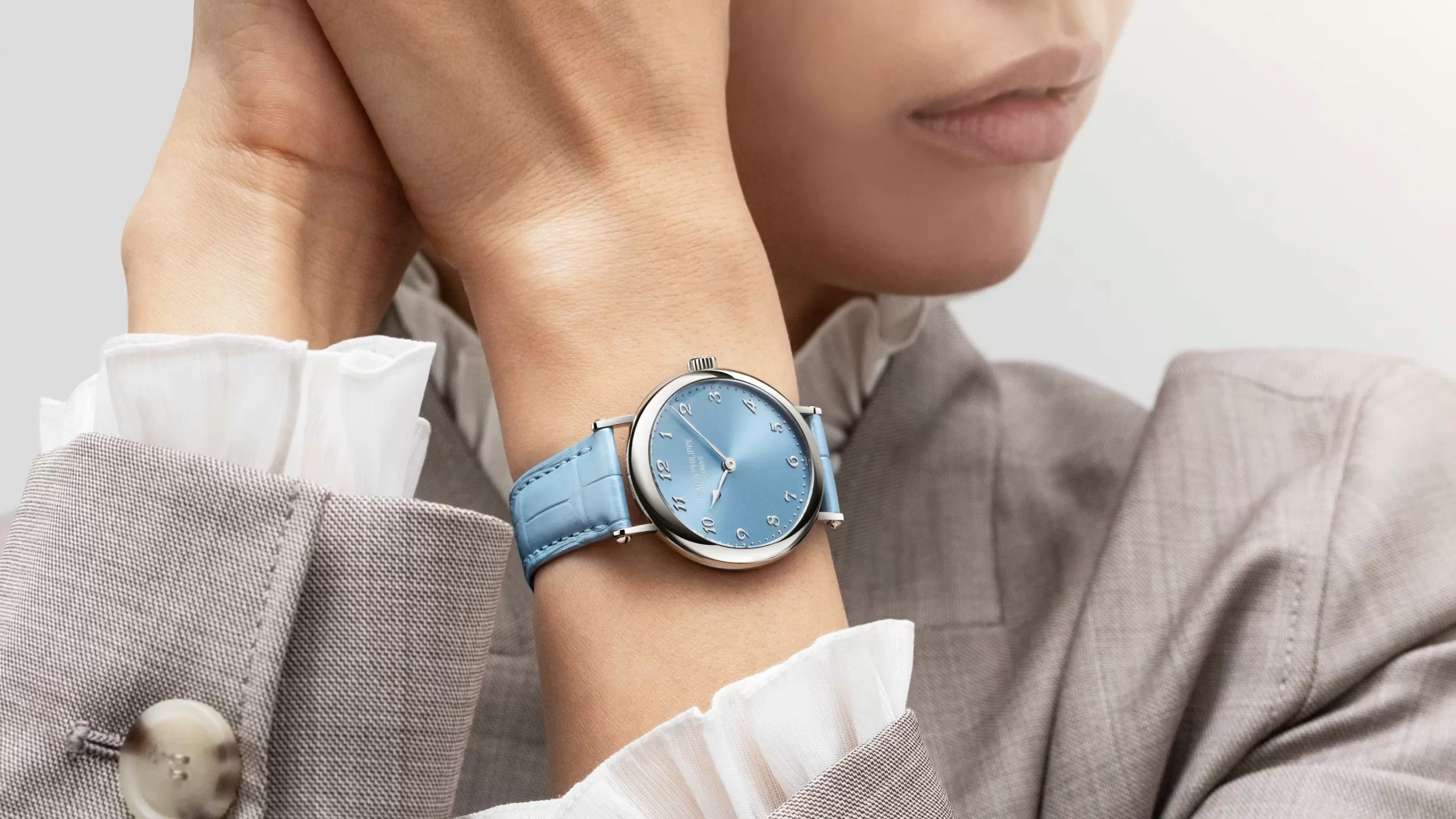
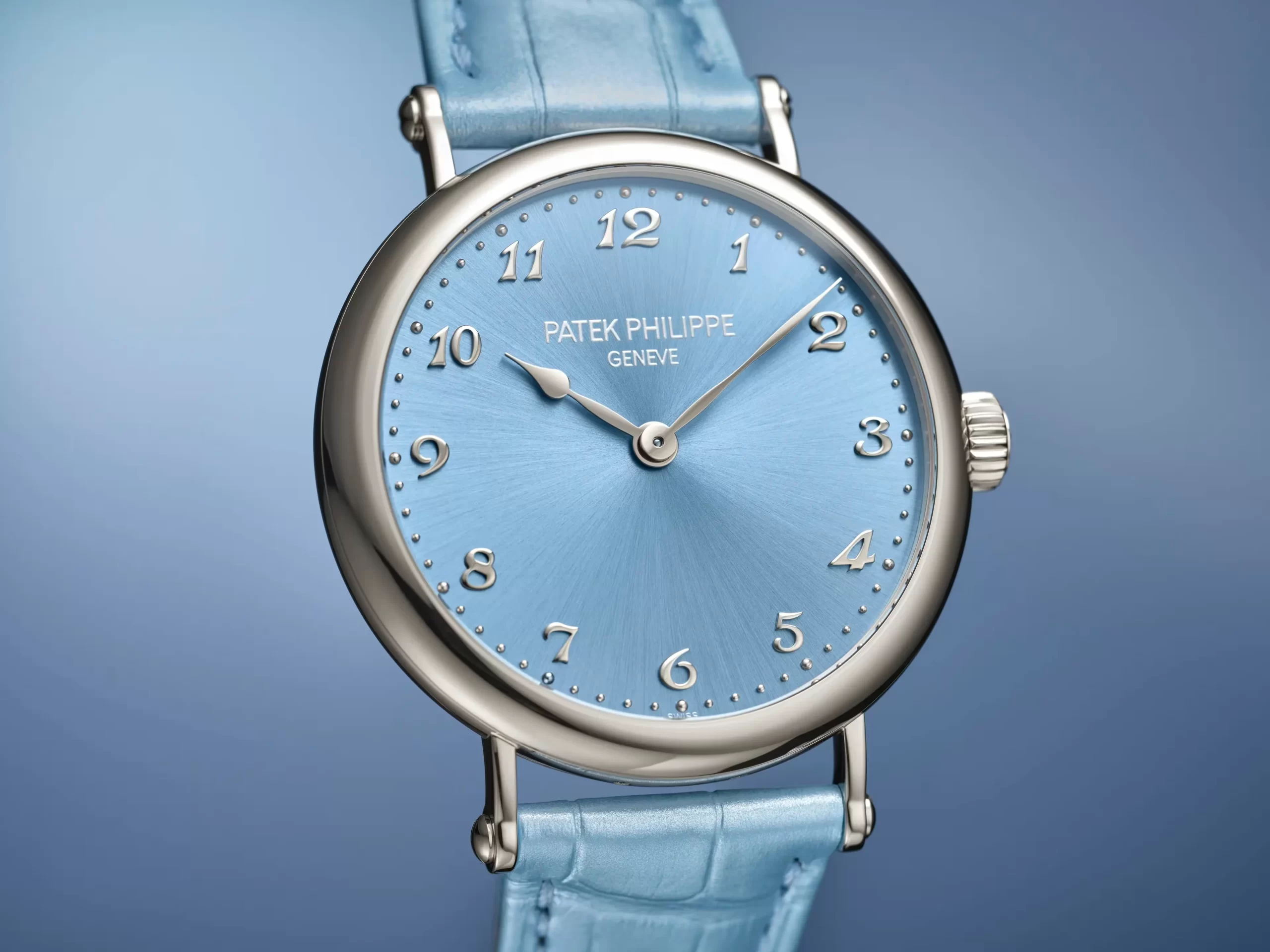
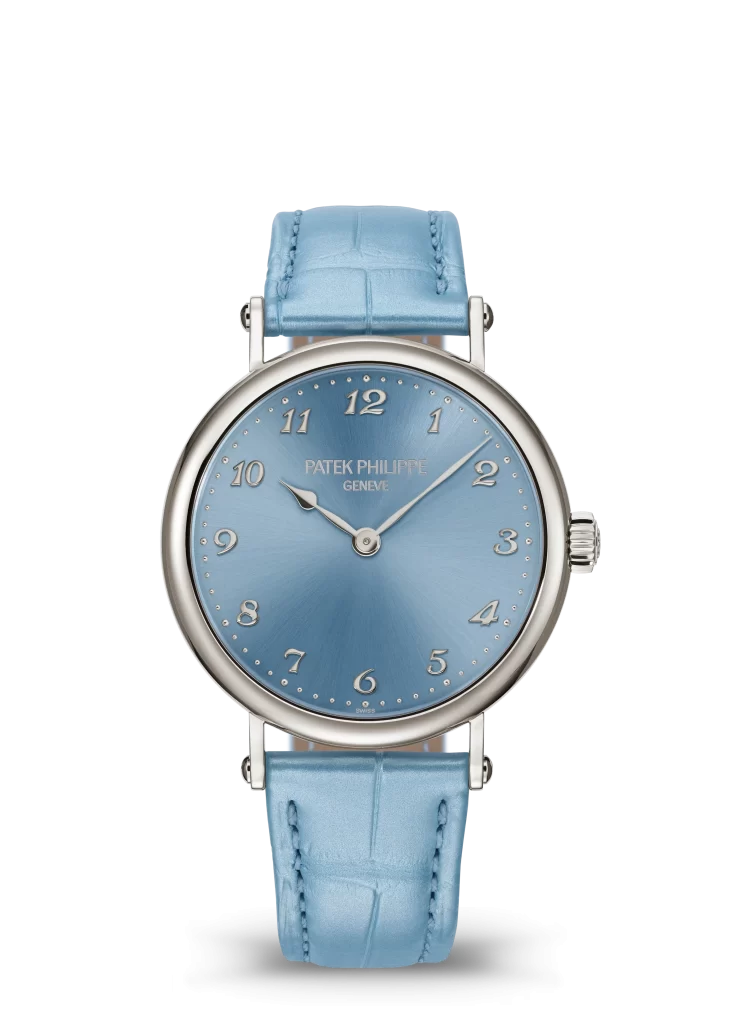
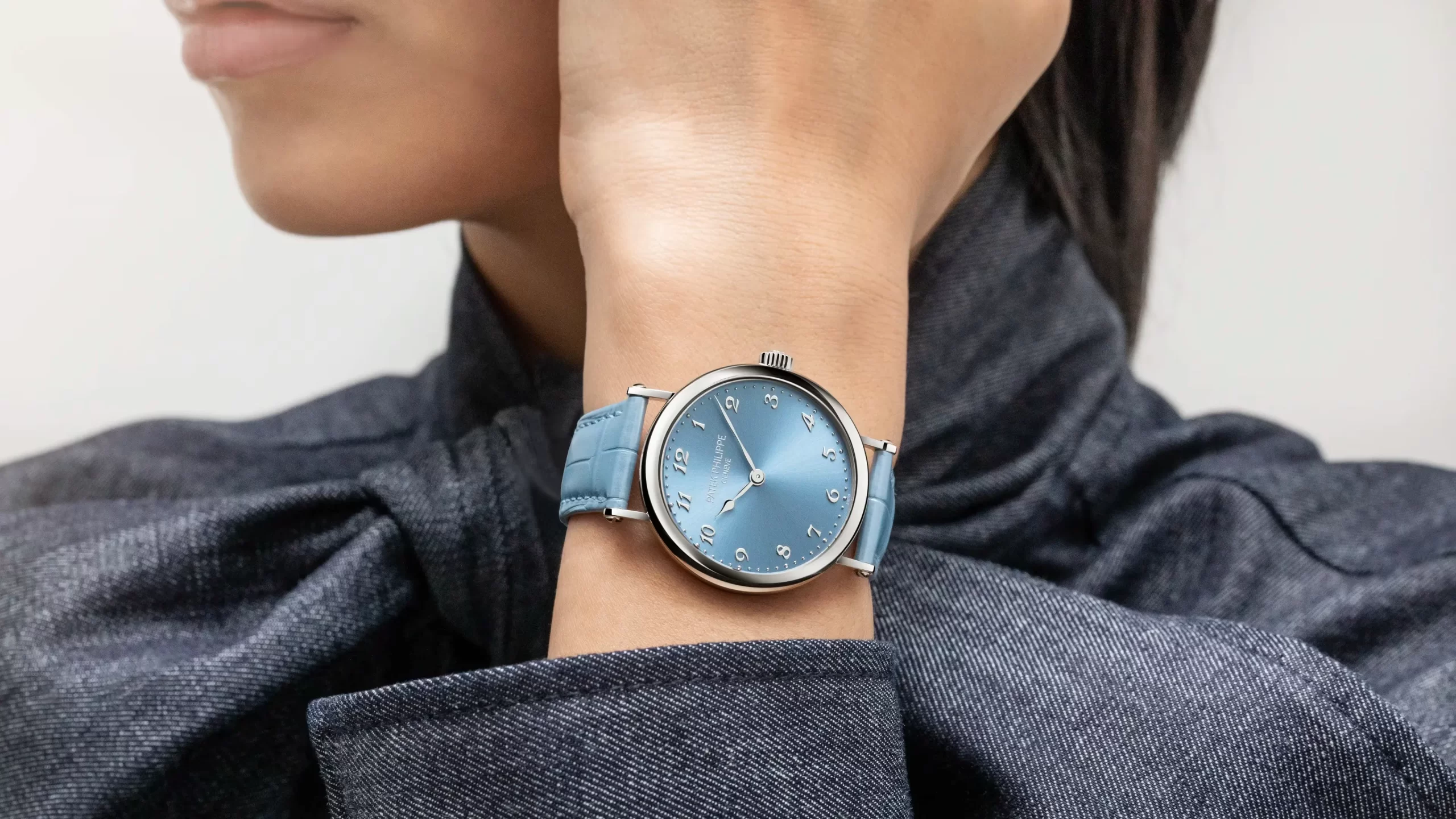
The Patek Philippe Calatrava 7200/50G-012 brings together the understated elegance of the Calatrava with a distinctive ice-blue palette. Its 34.6mm white-gold case is entirely polished and frames a sunburst ice-blue dial, while a pearly ice-blue alligator leather strap continues the same refreshing tone. Patek Philippe describes the watch as epitomising feminine elegance and highlights its Officer’s-style case as one of its defining characteristics.
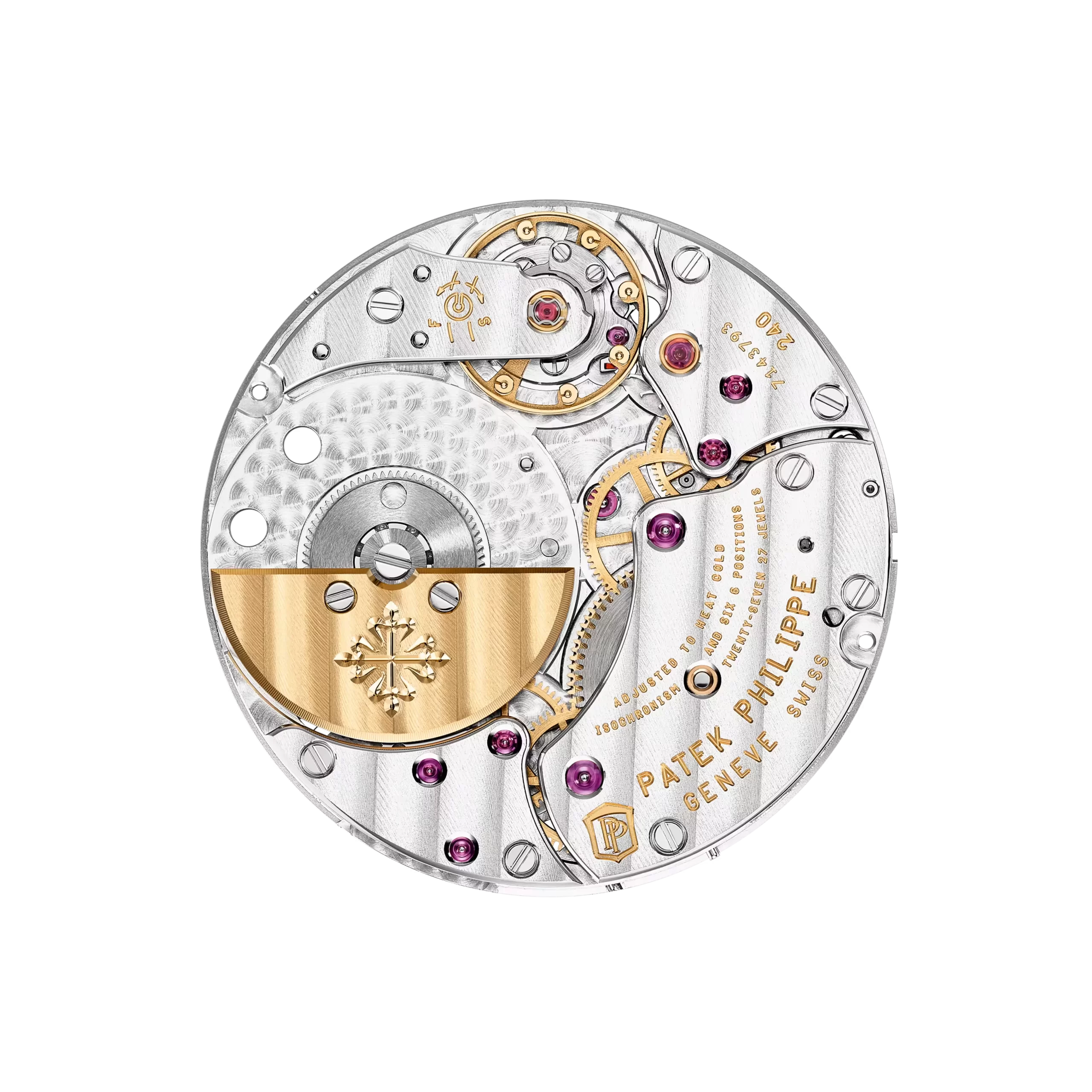
Behind this refined exterior is the ultra-thin self-winding Calibre 240. Measuring just 2.53mm thick, the movement features a 22K gold off-centre minirotor and offers a minimum power reserve of 48 hours. Together, the slim movement and 7.37mm-thick case give the Calatrava a remarkably slender profile.
The result is a watch where the appeal comes not from complexity on the dial, but from the careful relationship between colour, proportions, traditional details and mechanical refinement.
An Officer’s-Style Calatrava
The 7200/50G-012 is presented in a white-gold case measuring 34.6mm in diameter and 7.37mm in thickness. Patek Philippe specifies that the case is entirely polished.
The Officer’s-style construction gives the case its distinctive character, with straight lugs and screwed-in strap bars. These details are particularly noticeable against the otherwise clean silhouette of the Calatrava.
The case is water-resistant to 30 metres and features a sapphire-crystal case back, allowing the wearer to see the movement within.
It is a compact set of proportions, but one that allows the design to retain the restrained character associated with the Calatrava.
An Ice-Blue Dial Takes Centre Stage
The defining visual element of the Patek Philippe Calatrava 7200/50G-012 is its sunburst ice-blue dial.
Patek Philippe pairs the dial with applied white-gold Breguet numerals and white-gold pear-shaped hands. White-gold applied cabochons form the minute scale, adding detail while maintaining the clean appearance of the dial.
The sunburst finish gives the ice-blue surface a changing appearance as it catches the light, while the white-gold elements provide a crisp contrast.
There is a deliberate sense of restraint here. The dial focuses on the essential indications and allows the colour and finishing to become an important part of the watch’s identity.
Matching Ice Blue on the Wrist
Patek Philippe continues the colour of the dial onto the strap.
The watch is fitted with a pearly ice-blue alligator leather strap with square scales, secured by a white-gold prong buckle. The maison specifically describes the strap as echoing the refreshing tone of the dial.
This creates a continuous visual connection between the dial and the strap, with the polished white-gold case providing the neutral element between them.
The combination is distinctive without relying on an overly elaborate design.
The Ultra-Thin Calibre 240
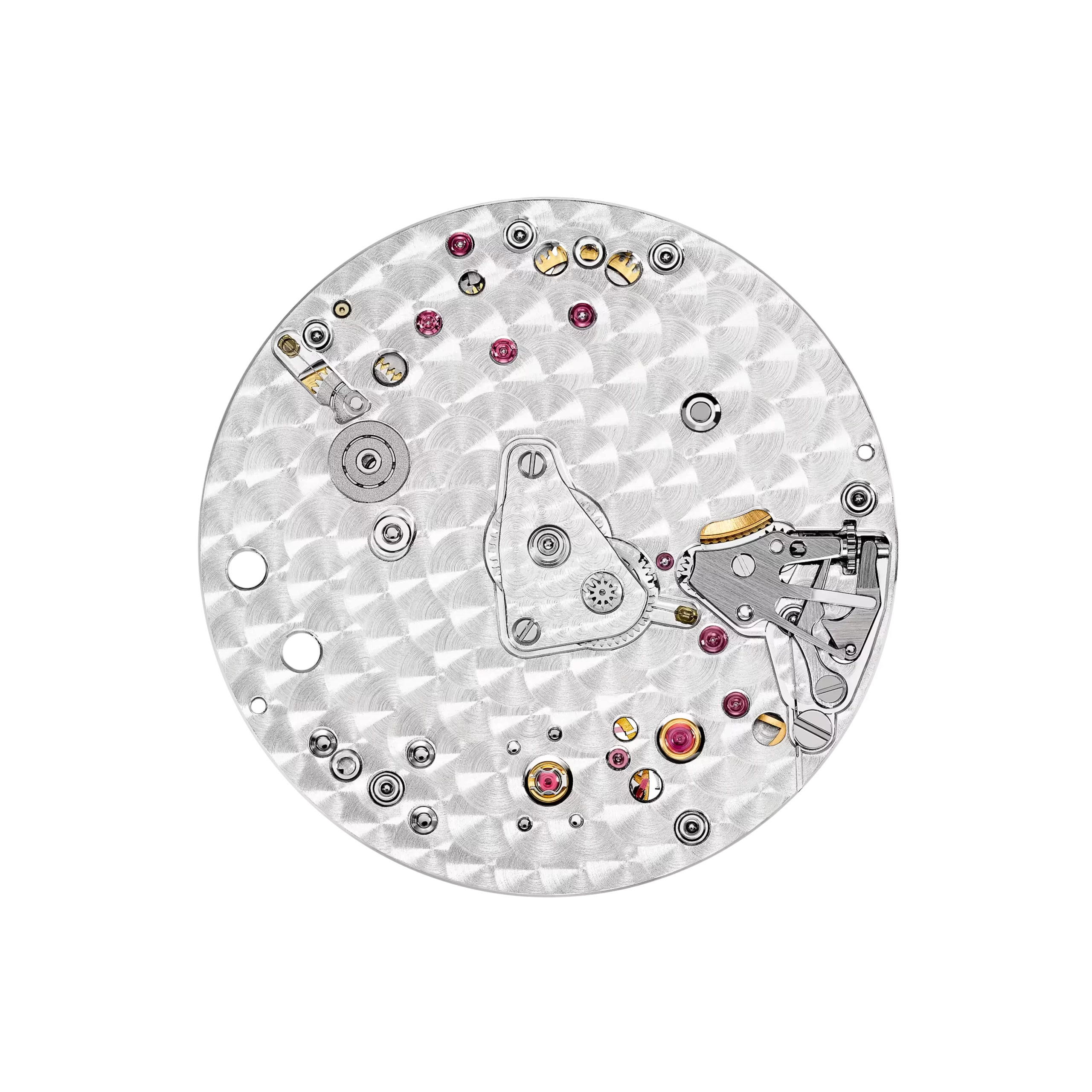
The mechanical heart of the Calatrava 7200/50G-012 is Patek Philippe’s Calibre 240, an ultra-thin self-winding movement.
The movement measures 27.5mm in diameter and 2.53mm in thickness. It consists of 152 parts and 27 jewels, with a minimum power reserve of 48 hours.
Its winding system uses a 22K gold off-centre minirotor. The movement also incorporates a Gyromax® balance and a Spiromax® balance spring. It operates at a frequency of 21,600 semi-oscillations per hour, or 3 Hz, and bears the Patek Philippe Seal.
The movement’s slim architecture is particularly relevant to the watch as a whole. At only 2.53mm thick, Calibre 240 allows Patek Philippe to combine automatic winding with the 7.37mm-thick case of the Calatrava.
Classical Details Meet a Contemporary Colour
The 7200/50G-012 is a good example of how a familiar watchmaking language can take on a different character through colour.
The Breguet numerals and pear-shaped hands bring traditional elements to the dial. The Officer’s-style case adds another classic detail, while the sunburst ice-blue dial and matching pearly strap give the watch its distinctive visual identity.
The design therefore does not depend on a complicated display to establish its personality. Instead, the details are distributed across the case, dial, strap and movement.
That balance is central to the appeal of this particular Calatrava.
A Feminine Expression of the Calatrava
Patek Philippe describes the 7200/50G-012 as “epitomizing feminine elegance.”
The watch’s 34.6mm diameter, white-gold case and ice-blue colour palette contribute to that positioning, while the mechanical construction ensures that the watch remains firmly rooted in traditional fine watchmaking.
Rather than overwhelming the design with decorative elements, Patek Philippe focuses on the relationship between the proportions, materials and finishing.
The result is a Calatrava that is elegant without being visually complicated.
The Details Collectors Will Notice
The first thing likely to catch the eye is the ice-blue dial, but the details become more interesting the closer one looks.
The Officer’s-style case features straight lugs and screwed-in strap bars. The dial combines applied Breguet numerals, pear-shaped white-gold hands and white-gold applied cabochons for the minute scale. The strap uses pearly ice-blue alligator leather with square scales and a white-gold prong buckle.
Then there is Calibre 240.
Its 2.53mm thickness, 22K gold off-centre minirotor, Gyromax® balance, Spiromax® balance spring and Patek Philippe Seal represent the technical side of the watch, all contained within a movement measuring 27.5mm in diameter.
The contrast is what makes the watch compelling: a relatively quiet exterior concealing an ultra-thin mechanical movement with a substantial list of technical specifications.
Key Specifications
Reference: 7200/50G-012 Collection: Calatrava Case material: White gold Case finish: Entirely polished Case style: Officer’s-style Case diameter: 34.6mm Case thickness: 7.37mm Lugs: Straight Strap bars: Screwed-in Water resistance: 30m Case back: Sapphire crystal Dial: Sunburst ice blue Hour markers: Applied white-gold Breguet numerals Hands: White-gold pear-shaped hands Minute scale: White-gold applied cabochons Strap: Pearly ice-blue alligator leather with square scales Buckle: White-gold prong buckle Movement: Calibre 240 Movement type: Self-winding, ultra-thin Movement diameter: 27.5mm Movement thickness: 2.53mm Number of parts: 152 Number of jewels: 27 Power reserve: Minimum 48 hours Winding rotor: 22K gold off-centre minirotor Balance: Gyromax® Frequency: 21,600 semi-oscillations/hour (3 Hz) Balance spring: Spiromax® Distinctive sign: Patek Philippe Seal
A Refined Take on the Calatrava
The Patek Philippe Calatrava 7200/50G-012 brings together a compact white-gold case, an ice-blue sunburst dial, traditional Breguet numerals and an ultra-thin self-winding movement.
Its identity comes from the details: the Officer’s-style case with straight lugs and screwed-in strap bars, the pear-shaped white-gold hands, the matching pearly ice-blue alligator strap and the Calibre 240 visible through the sapphire-crystal case back.
At 34.6mm in diameter and 7.37mm thick, the watch maintains a slim, compact profile, while the 2.53mm-thick Calibre 240 provides the mechanical foundation for that construction.
The 7200/50G-012 is therefore less about adding more and more to the watch, and more about getting every element to work together. It is a Calatrava expressed through colour, proportion and ultra-thin mechanical watchmaking, with the ice-blue palette giving the familiar design a distinctly fresh identity.
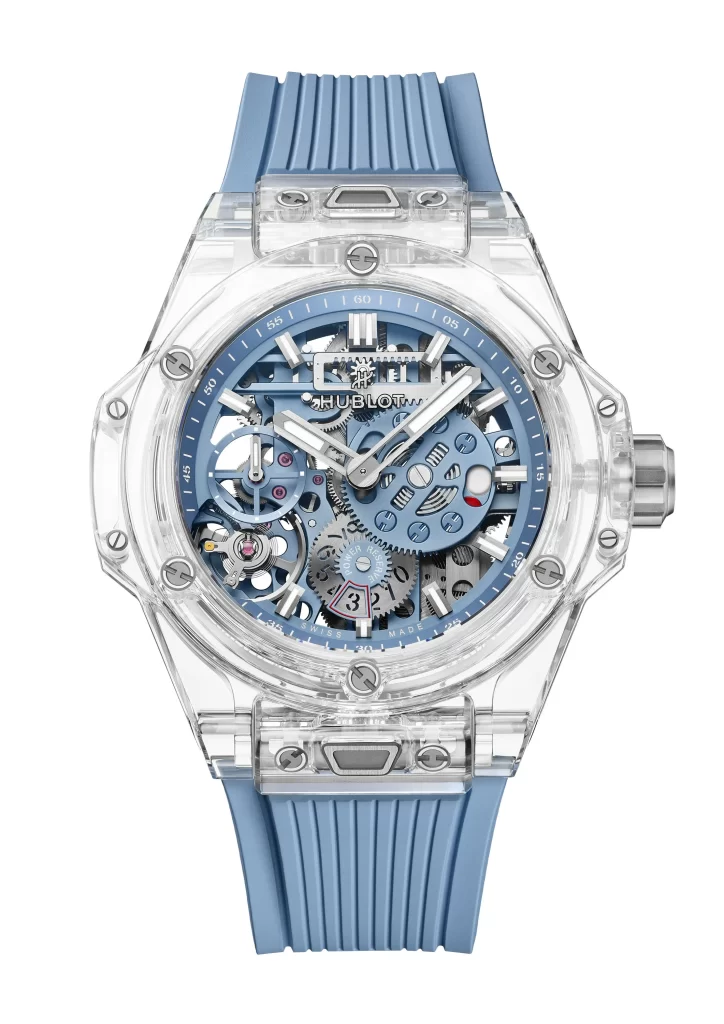
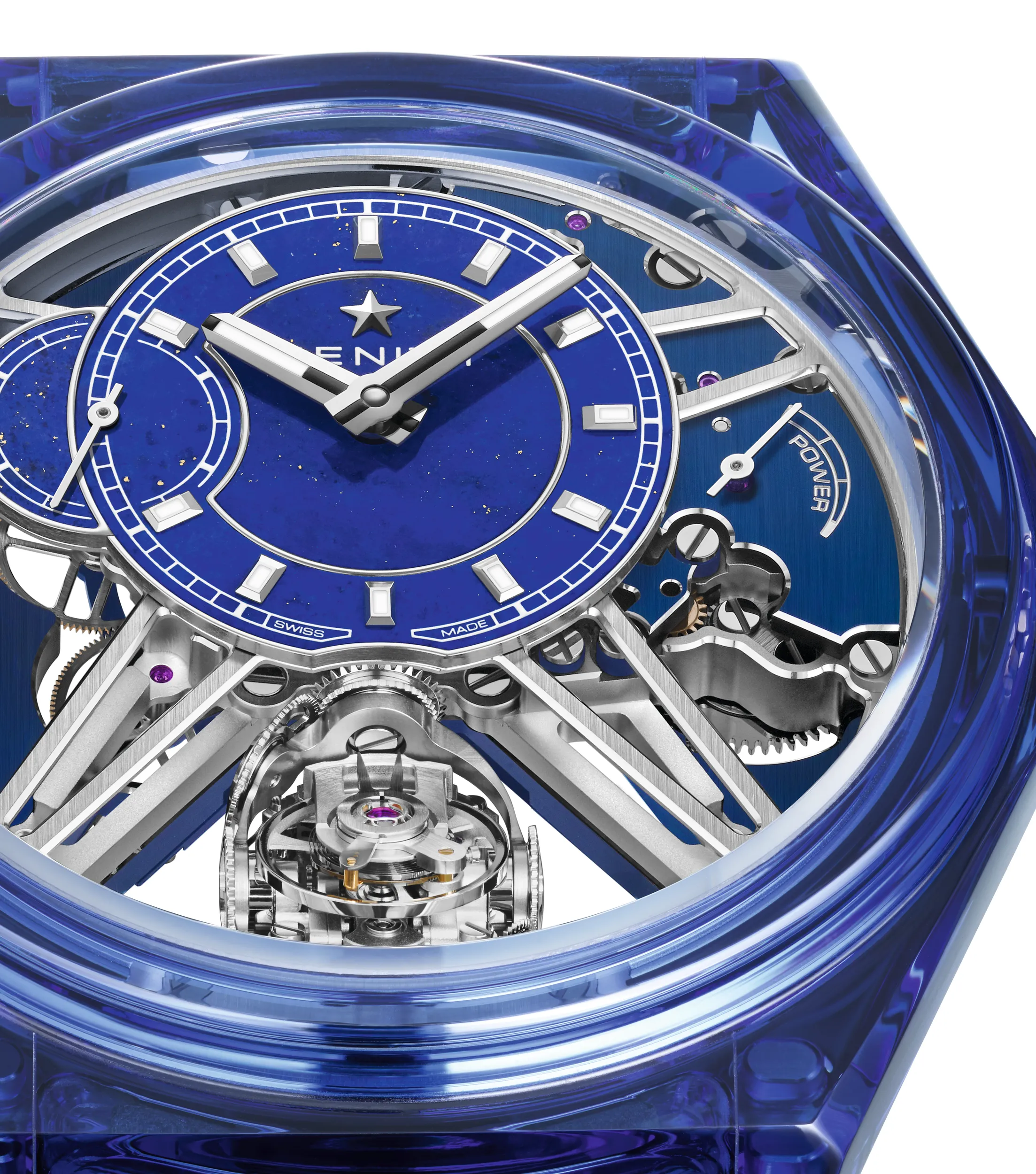
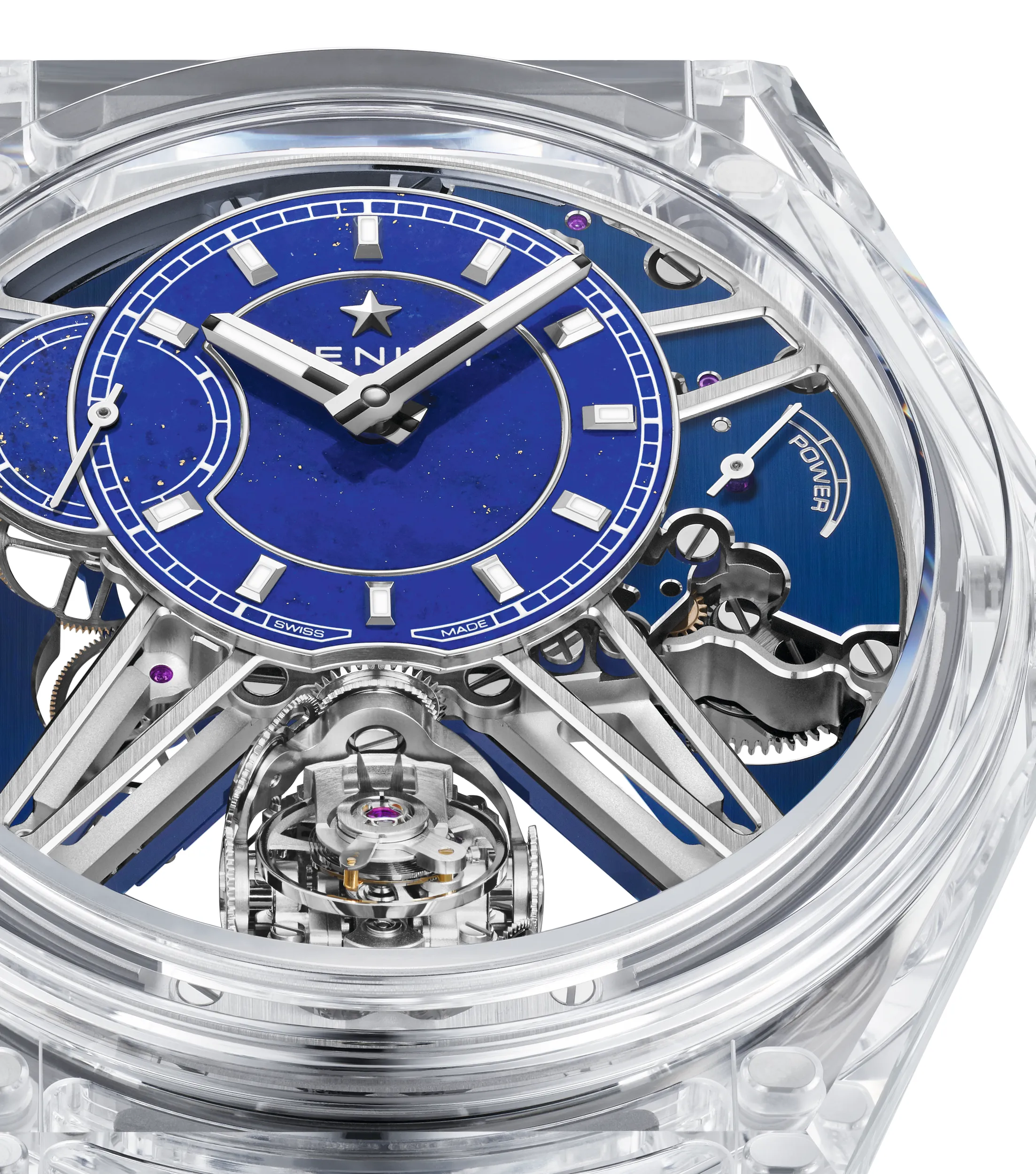
Hublot continues to redefine transparent watchmaking with the launch of the limited-edition Big Bang Sapphire Sky Blue, pairing its signature sapphire expertise with the impressive Meca-10 manufacture movement.
There are watches that tell time, and then there are watches that make a statement before you even glance at the dial. The Hublot Big Bang Sapphire Sky Blue belongs firmly in the latter category. Limited to just 100 pieces worldwide, this latest creation showcases everything Hublot has become synonymous with over the past decade: innovative materials, bold engineering and contemporary design.
Hublot’s Mastery of Sapphire Continues
Working with sapphire is no simple feat. Renowned for its exceptional hardness and transparency, sapphire is one of the most demanding materials in watchmaking. While many brands have experimented with it, Hublot has consistently expanded its possibilities, introducing coloured sapphire cases that combine technical complexity with striking aesthetics.
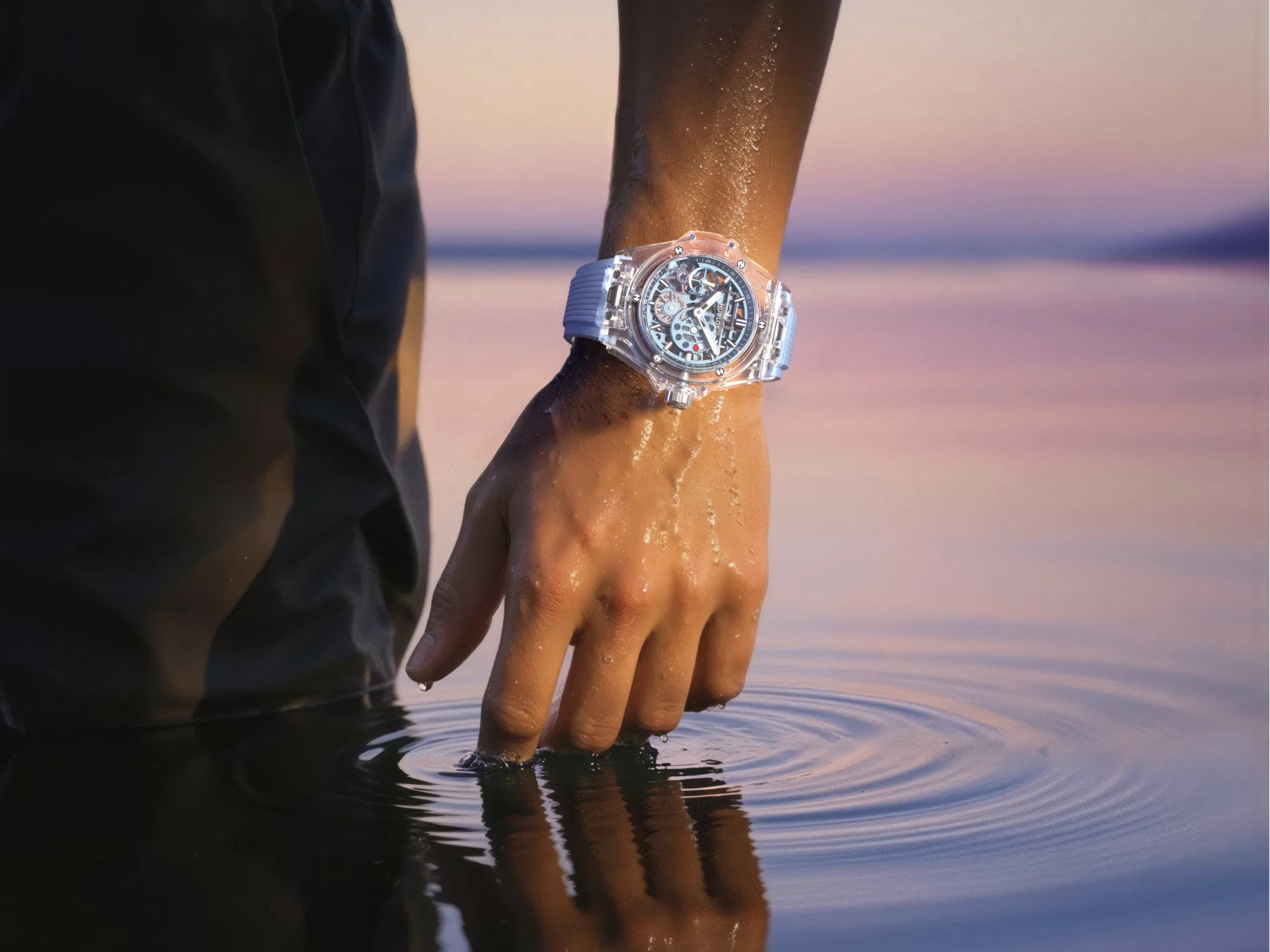
The Big Bang Sapphire Sky Blue captures the calm brilliance of a summer sky through its fully polished 44mm sapphire crystal case. Its transparent construction allows light to flow through every angle of the watch, giving it a presence that constantly changes depending on its surroundings. Titanium H-shaped screws secure the sapphire bezel, while a structured sky-blue rubber strap completes the distinctive monochromatic look.
The Meca-10 Movement Takes Centre Stage
Inside the transparent case is one of Hublot’s most celebrated in-house calibres: the HUB1201 Meca-10.
Originally introduced in 2016, the Meca-10 broke away from conventional movement architecture. Rather than hiding the mechanics beneath the dial, Hublot designed the movement to become the visual centrepiece of the watch. Inspired by mechanical construction systems, its fully skeletonised architecture reveals every functional component.
The manually wound movement consists of 223 components, delivers an exceptional 10-day (240-hour) power reserve, and uses two parallel mainspring barrels to maintain consistent energy delivery. One of its most distinctive features is the innovative rack-and-pinion power reserve display that moves horizontally across the movement, reinforcing the industrial aesthetic that has become synonymous with the Meca-10 collection.
Transparency That Reveals Every Detail
The appeal of the Big Bang Sapphire Sky Blue extends beyond its sapphire case. Its matte sky-blue skeleton dial, matching movement bridges and sapphire case-back ensure that the watch remains visually captivating from every angle.
Instead of concealing its mechanics, the watch celebrates them. Every gear, bridge and wheel becomes part of the overall design, creating a fascinating interplay between engineering and aesthetics. It is a reminder that modern haute horlogerie is as much about visual storytelling as it is about precision.
Built with Confidence
The Big Bang Sapphire Sky Blue is more than an exercise in design. It also reflects Hublot’s confidence in its manufacturing capabilities.
Eligible models purchased from 1 January 2026 benefit from Hublot’s 5+5 warranty programme, providing a five-year standard warranty with the possibility of extending coverage to ten years through the Hublotista programme. It is among the most comprehensive warranty offerings in contemporary luxury watchmaking and reinforces the brand’s trust in its products.
Limited to Just 100 Pieces
Exclusivity remains central to the appeal of this release.
The Hublot Big Bang Sapphire Sky Blue is limited to 100 pieces worldwide and will be available through selected Hublot boutiques, authorised retailers and the brand’s official online store. The watch is priced at USD 84,300, reflecting both the complexity of its sapphire construction and the sophistication of its in-house movement.
Final Thoughts
Few brands have embraced sapphire as confidently as Hublot. Over the years, the manufacture has transformed what was once considered an experimental material into one of its defining signatures. The Big Bang Sapphire Sky Blue continues that journey, combining a transparent sky-blue sapphire case with the technically impressive Meca-10 movement in a package that is both futuristic and unmistakably Hublot.
For collectors who appreciate avant-garde watchmaking, architectural movements and limited-edition craftsmanship, this latest Big Bang demonstrates exactly why Hublot remains one of the industry’s most daring innovators.
India’s luxury watch journey reaches another defining milestone this September.
From 28 September to 1 October 2026, Mumbai will host the Grand Prix d’Horlogerie de Genève (GPHG) Exhibition, presented by Ethos. Recognised globally as the “Oscars of Watchmaking,” the travelling exhibition brings together the year’s finest nominated timepieces, offering collectors, enthusiasts and industry professionals a rare opportunity to experience contemporary haute horlogerie up close before the winners are announced in Geneva.
The exhibition reflects India’s growing stature in the international watch industry and highlights the country’s rapidly expanding community of knowledgeable collectors. Over four days, visitors will have the opportunity to discover exceptional creations that showcase innovation, craftsmanship and mechanical excellence from some of the world’s most celebrated watchmakers.
A Rare Encounter with the World’s Finest Timepieces
Unlike the awards ceremony itself, the travelling GPHG Exhibition allows watch enthusiasts to experience the shortlisted watches firsthand. The Mumbai showcase will feature finalists across multiple award categories, ranging from complicated mechanical masterpieces and sports watches to artistic métiers d’art creations and groundbreaking independent watchmaking.
For many collectors, this is a unique chance to compare some of the year’s most significant horological creations side by side, all under one roof.
Why Mumbai Matters
India has steadily emerged as one of the most exciting luxury watch markets in the world. A new generation of collectors, increasing appreciation for independent watchmakers and growing demand for high-end Swiss timepieces have transformed the country into an important destination for global maisons.
Bringing the GPHG Exhibition to Mumbai is recognition of this momentum. It demonstrates the confidence that the international watch industry has in India’s collector community while creating a platform for enthusiasts to engage more deeply with contemporary watchmaking.
Ethos Continues to Shape India’s Watch Culture
As India’s leading luxury watch retailer, Ethos has consistently invested in building awareness around fine watchmaking through exhibitions, educational initiatives and partnerships with global brands.
Hosting the GPHG Exhibition further strengthens that commitment, giving Indian audiences direct access to watches that represent the very best of modern horology and reinforcing India’s place within the global watchmaking conversation.
A Must-Visit Event for Every Watch Enthusiast
Whether you’re a seasoned collector, an aspiring enthusiast or simply fascinated by mechanical craftsmanship, the GPHG Exhibition promises an extraordinary experience.
From 28 September to 1 October 2026, Mumbai becomes a destination where innovation, artistry and centuries of watchmaking tradition come together, offering a glimpse into the future of haute horlogerie.
Hublot’s Extraordinary Journey to the Island of Antikythera
The story of watchmaking is ultimately the story of humanity’s quest to understand time. Few projects illustrate this connection more vividly than Hublot’s latest expedition to the Greek island of Antikythera, a place that continues to fascinate historians, scientists and watch enthusiasts alike.
As part of its ongoing commitment to scientific research, innovation and heritage preservation, Hublot has partnered with Swiss content creator Anil Brancaleoni to document an extraordinary scientific mission to Antikythera. The resulting documentary, available on the Hublot and Anil B YouTube channels, offers a fascinating look at the intersection of ancient history, pioneering exploration and cutting-edge technology in the search for what Hublot calls the “origin of time.”
Why Antikythera Matters
Antikythera is a small Greek island that became famous after the discovery of an ancient shipwreck in 1901. Among the treasures recovered from the wreck was the Antikythera Mechanism, a remarkable device dating to around 60 BCE.
Widely regarded as the world’s oldest known astronomical calculator, the mechanism was capable of predicting celestial events, tracking eclipses and calculating the movements of stars and planets with astonishing accuracy. Its complexity revealed a level of technological sophistication far ahead of what historians once believed possible for the ancient world.
More than two thousand years after its creation, the Antikythera Mechanism remains one of history’s most important scientific discoveries and continues to inspire modern innovation.
Hublot Xplorations and the Search Beneath the Sea
Since 2014, Hublot’s dedicated Hublot Xplorations department has played an active role in missions to Antikythera, spending more than two weeks each year supporting archaeological dive teams working at the historic wreck site.
Specialising in research and development, the team has created advanced underwater technologies, including state-of-the-art drones designed to help archaeologists locate artefacts still buried beneath the seabed. These innovations enable more accurate exploration while helping preserve the fragile underwater environment surrounding the wreck.
The latest documentary follows Hublot Xplorations and Anil Brancaleoni during an 18-day expedition alongside an international team of archaeologists, divers and specialists investigating one of the most important underwater archaeological sites in the world.
The Watch That Brought Ancient Astronomy to the Wrist
Hublot’s connection to Antikythera extends beyond exploration.
In 2012, the Swiss watchmaker unveiled the MP-04 Antikythera, a groundbreaking concept watch inspired directly by the famous ancient mechanism. Designed to reproduce the astronomical functions of its ancient predecessor on a wristwatch scale, the timepiece represented an extraordinary technical achievement.
The MP-04 Antikythera incorporated highly complex indications inspired by the original device, including displays linked to lunar cycles, eclipses, zodiac positions and astronomical calendars. Through this ambitious project, Hublot demonstrated how ancient scientific ingenuity could inspire modern haute horlogerie.
The Antikythera SunMoon Legacy
A year later, Hublot expanded the concept with the Antikythera SunMoon.
Inspired by the world of the Antikythera Mechanism, the watch features displays for both the sun and moon while offering a unique indication of the actual zodiac sign corresponding to a specific date. Unlike conventional zodiac interpretations, the watch takes into account the precession of the equinoxes, delivering a more scientifically accurate representation.
The Antikythera SunMoon remains one of the most unusual and technically fascinating creations in Hublot’s history, reflecting the brand’s passion for combining science, astronomy and watchmaking.
Innovation Beyond Traditional Watchmaking
The Antikythera project highlights a lesser-known side of Hublot’s activities.
Through Hublot Xplorations, the brand actively supports scientific research, technological development and cultural preservation initiatives. Beyond underwater archaeology, the programme has contributed to ambitious projects including the European Space Agency’s ExoMars mission, reinforcing Hublot’s commitment to exploration and discovery.
This approach reflects Hublot’s long-standing philosophy of the “Art of Fusion”, bringing together diverse worlds including technology, science, history and watchmaking.
A Modern Exploration of Humanity’s Relationship with Time
For watch enthusiasts, the Antikythera story offers a compelling reminder that the fascination with measuring time predates modern horology by centuries.
By supporting archaeological research and developing technologies that help uncover humanity’s scientific heritage, Hublot is contributing to a deeper understanding of one of history’s most remarkable achievements.
The Antikythera expedition is not simply an exploration of an ancient shipwreck. It is an exploration of humanity’s enduring desire to understand the cosmos, measure the passage of time and push the boundaries of knowledge.
In that respect, the mission embodies the very spirit of watchmaking itself.
Final Thoughts
Hublot’s involvement in Antikythera demonstrates how a modern luxury watch brand can contribute meaningfully to scientific research and cultural preservation while remaining connected to the values that define fine watchmaking.
Through Hublot Xplorations, advanced underwater technology and a shared passion for discovery, the brand continues to bridge the gap between ancient innovation and modern horology.
The result is a fascinating journey that reminds us that the quest to understand time is as relevant today as it was more than two millennia ago.
Thirty years after its founding, independent Swiss watchmaker Parmigiani Fleurier has unveiled one of its most ambitious and meaningful creations to date. The new Carillon Tourbillon is far more than an anniversary watch. It is a celebration of the Maison’s philosophy of restoration, transmission, and mechanical excellence, expressed through a remarkable combination of a four-gong minute repeater and a tourbillon.
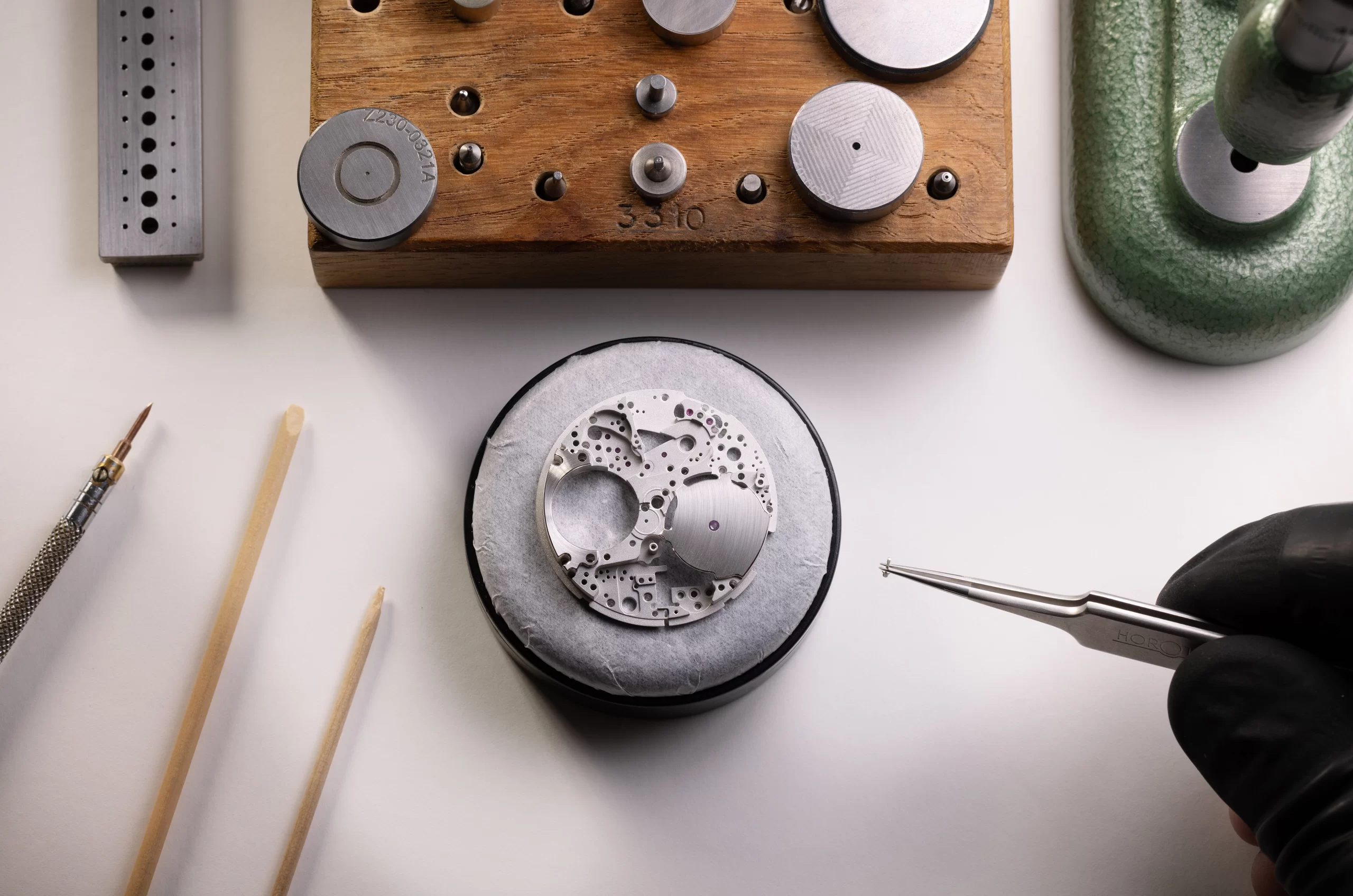
Created to mark Parmigiani Fleurier’s 30th anniversary, this exceptional haute horlogerie timepiece is limited to just five examples worldwide. Entirely conceived, developed, assembled and finished within the Manufacture, the Carillon Tourbillon stands as a testament to the independent Swiss watch brand’s dedication to preserving traditional craftsmanship while advancing contemporary watchmaking.
A Legacy Rooted in Restoration
Few modern watchmakers can claim a foundation as unique as that of Parmigiani Fleurier. Before establishing the Maison in 1996, Michel Parmigiani built his reputation as one of Switzerland’s foremost restorers of historic timepieces, automata, clocks and mechanical masterpieces.
His approach to restoration was never driven by nostalgia. Instead, it was a process of understanding. Through decades of studying historical mechanisms, Michel Parmigiani developed a profound appreciation for the intelligence, architecture and artistry hidden within traditional watchmaking.
The Carillon Tourbillon is a direct reflection of this philosophy.
Its origins can be traced to an early nineteenth-century pocket watch created by Perrin Frères and preserved within the renowned Sandoz Collection. Restored by Parmigiani Fleurier in 2000, the historic timepiece became a source of inspiration for the Maison’s latest creation. Rather than replicating its design, Parmigiani Fleurier sought to reinterpret its acoustic architecture, mechanical ingenuity and distinctive serpentine gongs within a contemporary luxury watch.
The Art of Sounding Time
At the heart of the Parmigiani Fleurier Carillon Tourbillon lies one of watchmaking’s most revered complications: the minute repeater.
Historically, the carillon tradition originated in bell towers, where the sound of bells marked the passage of time for entire communities. The Carillon Tourbillon transforms that public experience into something deeply personal, allowing time to be heard on demand through an intricate mechanical symphony worn on the wrist.
Unlike conventional minute repeater watches that utilise two gongs, the Carillon Tourbillon employs an advanced four-gong system.
The chiming sequence consists of:
One low-pitched gong for the hours
One high-pitched gong for the minutes
Two additional gongs dedicated to the quarter hours
Together, these four gongs create a rich and distinctive four-note melody that gives the watch its unique acoustic signature.
The striking mechanism is regulated by an integrated flywheel governor that ensures a smooth and perfectly controlled cadence throughout the chiming sequence. This guarantees a fluid acoustic performance free from acceleration or slowing, preserving the purity of every note.
A Contemporary Haute Horlogerie Statement
While inspired by historical horology, the Carillon Tourbillon is unmistakably modern in its execution.
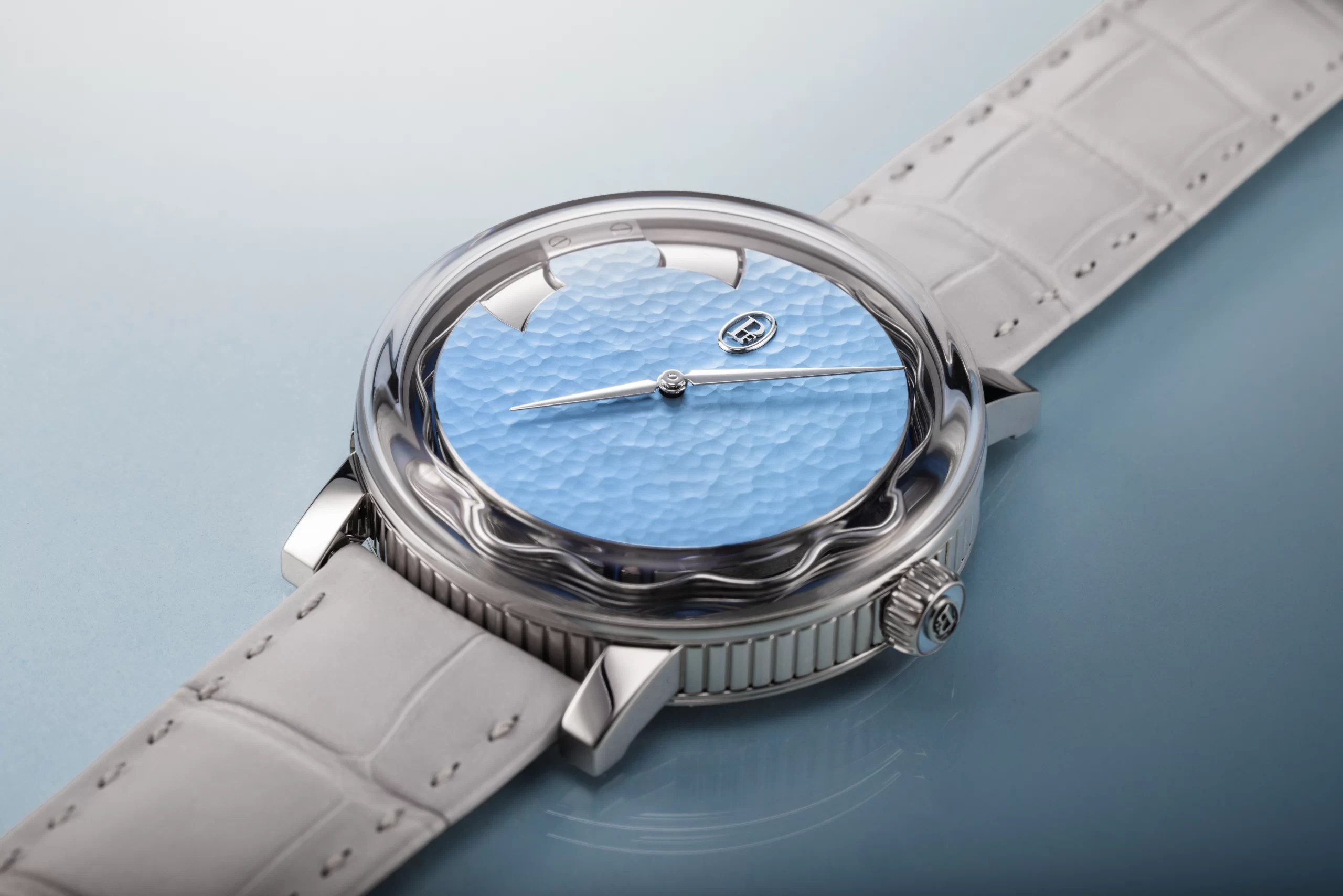
The 41.6mm case is crafted from 18-carat white gold and features vertical gadroons inspired by classical architecture, a recurring design element deeply associated with Michel Parmigiani’s aesthetic vision.
A sapphire crystal box construction allows an unobstructed view of the dial-side mechanics, including the visible hammers responsible for striking the gongs. Their presence transforms the watch into a dynamic performance, revealing the exact moment when mechanical energy is converted into sound.
One of the watch’s most distinctive visual features is its four serpentine gongs, which elegantly wrap around the dial. Inspired directly by the Perrin Frères pocket watch, these flowing curves create a powerful visual identity while simultaneously serving an essential acoustic function.
In the Carillon Tourbillon, acoustics become design.
The Beauty of Morning Blue
The dial itself represents another showcase of Parmigiani Fleurier’s artisanal expertise.
Crafted from 18-carat white gold, the dial features a hand-hammered finish and is presented in a subtle Morning Blue hue that shifts between silver and azure depending on the light.
The textured surface reflects the Maison’s belief in the value of the human hand. No two surfaces are exactly alike, ensuring each watch possesses its own individual character.
This hand-hammered finish continues the design language introduced through Parmigiani Fleurier’s recent anniversary creations and reinforces the Maison’s commitment to traditional craftsmanship.
Calibre PF950: A High-Complication Masterpiece
Powering the watch is the manually wound Calibre PF950, an extraordinary manufacture movement designed specifically for the Carillon Tourbillon.
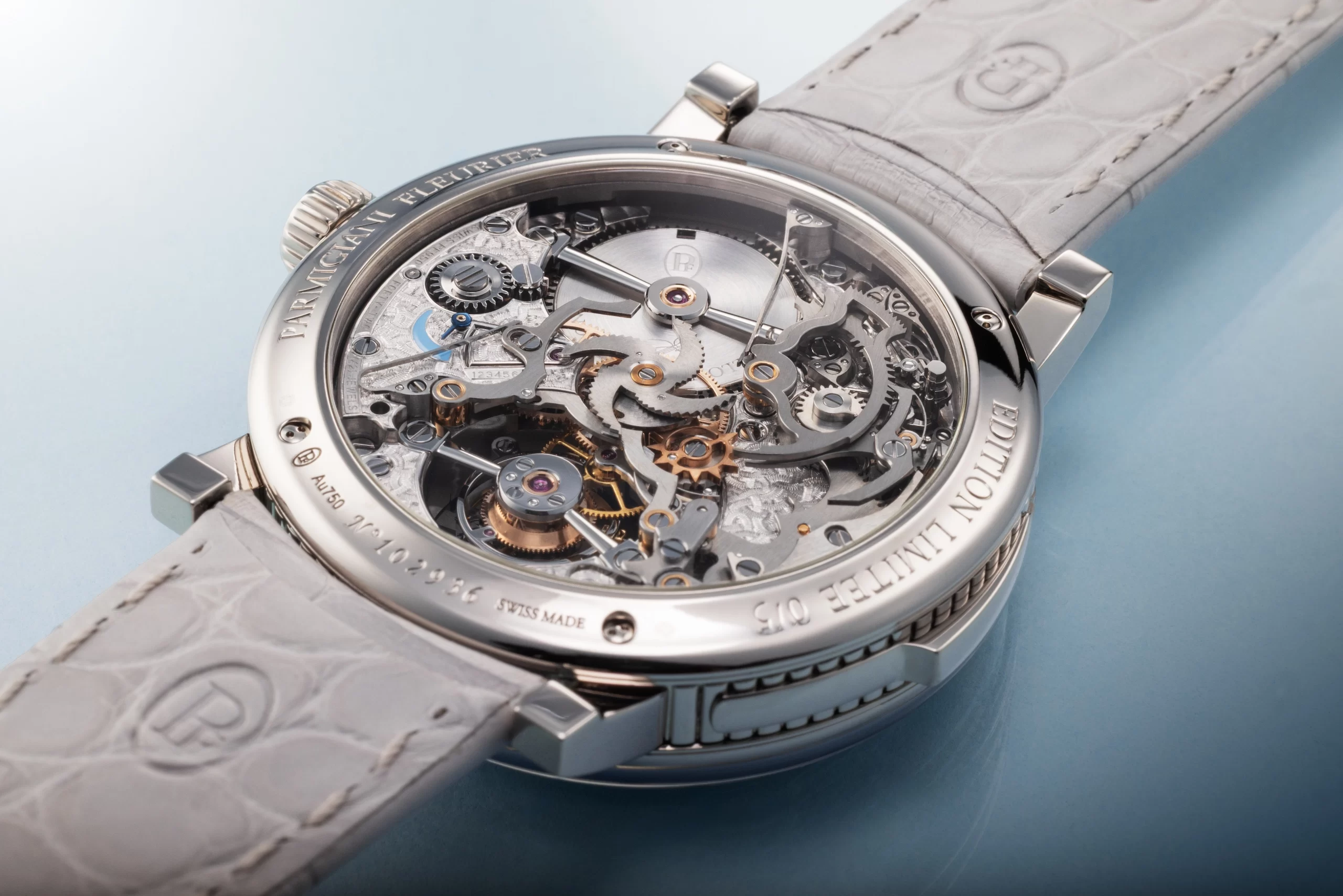
Comprising 456 components and 42 jewels, the movement integrates a minute repeater, a four-gong carillon striking mechanism and a 60-second tourbillon within a remarkably refined architecture.
The calibre operates at 21,600 vibrations per hour (3Hz) and delivers a power reserve of at least ten days, an impressive achievement for a high-complication watch featuring a chiming mechanism.
To achieve this performance, Parmigiani Fleurier developed a sophisticated three-barrel system.
Two superimposed barrels provide power to the movement, while a dedicated third barrel is reserved exclusively for the striking mechanism. This third barrel is automatically rewound each time the repeater slide is activated, ensuring optimal energy delivery whenever the chiming function is engaged.
Among modern haute horlogerie creations, combining a tourbillon and a minute repeater within a movement offering such extended autonomy remains a significant technical achievement.
Hidden Complexity and Refined Finishing
In keeping with Parmigiani Fleurier’s philosophy of restrained elegance, much of the watch’s complexity remains discreetly hidden from immediate view.
The tourbillon and power reserve indicator are positioned on the reverse side of the watch, preserving the balance and clarity of the dial while rewarding closer inspection.
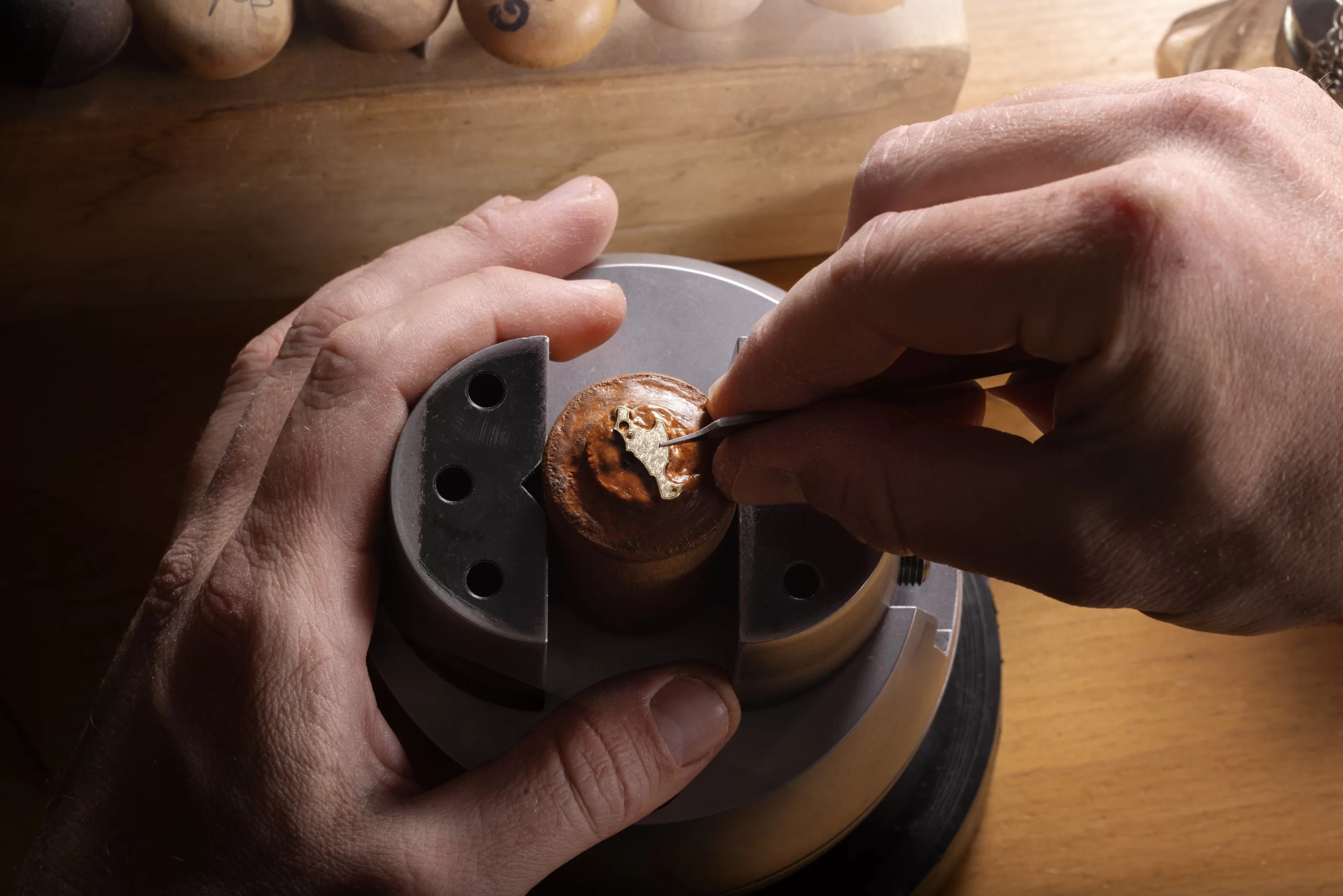
The movement itself serves as a canvas for exceptional hand-finishing. Its components are decorated with the Maison’s distinctive mezzo vibrato engraving, a technique previously explored on the Armoriale Objet d’Art collection.
Executed entirely by hand, the decoration creates a visual rhythm across the movement’s surfaces, echoing the acoustic resonance generated by the chiming mechanism.
The calibre’s bridges and components are further enhanced through hand-bevelling and hand-graining, underscoring the artisanal nature of the piece.
A Case Designed for Resonance
In a minute repeater watch, the case plays a crucial role in shaping the quality of sound.
Parmigiani Fleurier selected white gold not only for its luxurious appearance but also for its controlled acoustic properties. The material contributes to the transmission, clarity and resonance of the chiming sequence, ensuring harmony between the movement and its surrounding architecture.
Integrated into the case band is the repeater slide, which activates the chiming mechanism through a deliberate and tactile gesture. The interaction creates a ceremonial connection between wearer and watch, reinforcing the emotional dimension of mechanical horology.
Why the Parmigiani Fleurier Carillon Tourbillon Matters to Collectors
For collectors of independent haute horlogerie, the Carillon Tourbillon represents far more than a limited-edition luxury watch.
It embodies everything that has defined Parmigiani Fleurier over the past three decades: restoration as a source of innovation, craftsmanship as a form of cultural transmission, and mechanical complexity pursued in the service of beauty rather than spectacle.
With only five examples produced, the Carillon Tourbillon is among the rarest watches ever created by the Manufacture. Its exclusivity is not driven by marketing, but by the extraordinary level of expertise, hand-finishing and acoustic tuning required to bring each piece to life.
Thirty Years of Independent Watchmaking Excellence
The Carillon Tourbillon serves as a fitting tribute to Parmigiani Fleurier’s first thirty years.
Combining a four-gong minute repeater, a tourbillon, a hand-hammered Morning Blue dial and a movement engineered for exceptional acoustic performance, it captures the essence of the Maison’s identity.
More importantly, it demonstrates that true innovation in Swiss watchmaking does not require abandoning tradition. Instead, the Carillon Tourbillon proves that the most compelling creations emerge when history, craftsmanship and contemporary engineering work in harmony.
For Parmigiani Fleurier, the sound of thirty years is not merely heard. It resonates.
Technical Specifications
Parmigiani Fleurier Carillon Tourbillon White Gold Anniversaire
Audemars Piguet’s Neo Frame Jumping Hour doesn’t tell time the way you expect—and that’s exactly the point.
With no traditional hands and a display that jumps every hour, it challenges how we read a watch altogether. Inspired by a 1929 design and shaped by Art Deco principles, this release blends heritage with modern engineering, powered by the new Calibre 7122.
But beyond the complication, this is a watch about intent—about doing less, but doing it better. And once you understand it, the question becomes simple: what more do you really need from a watch?
What is the Audemars Piguet Neo Frame Jumping Hour?
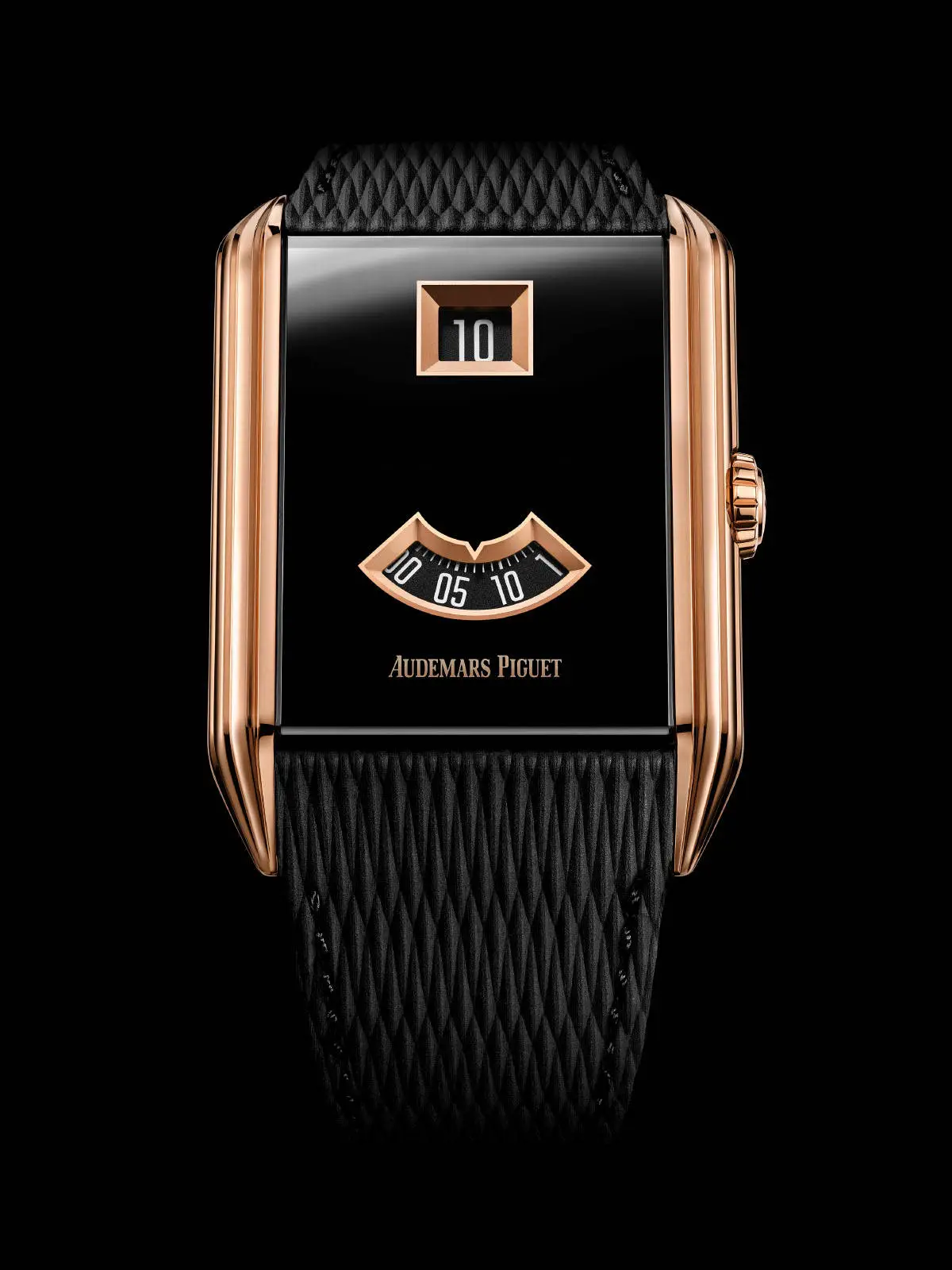
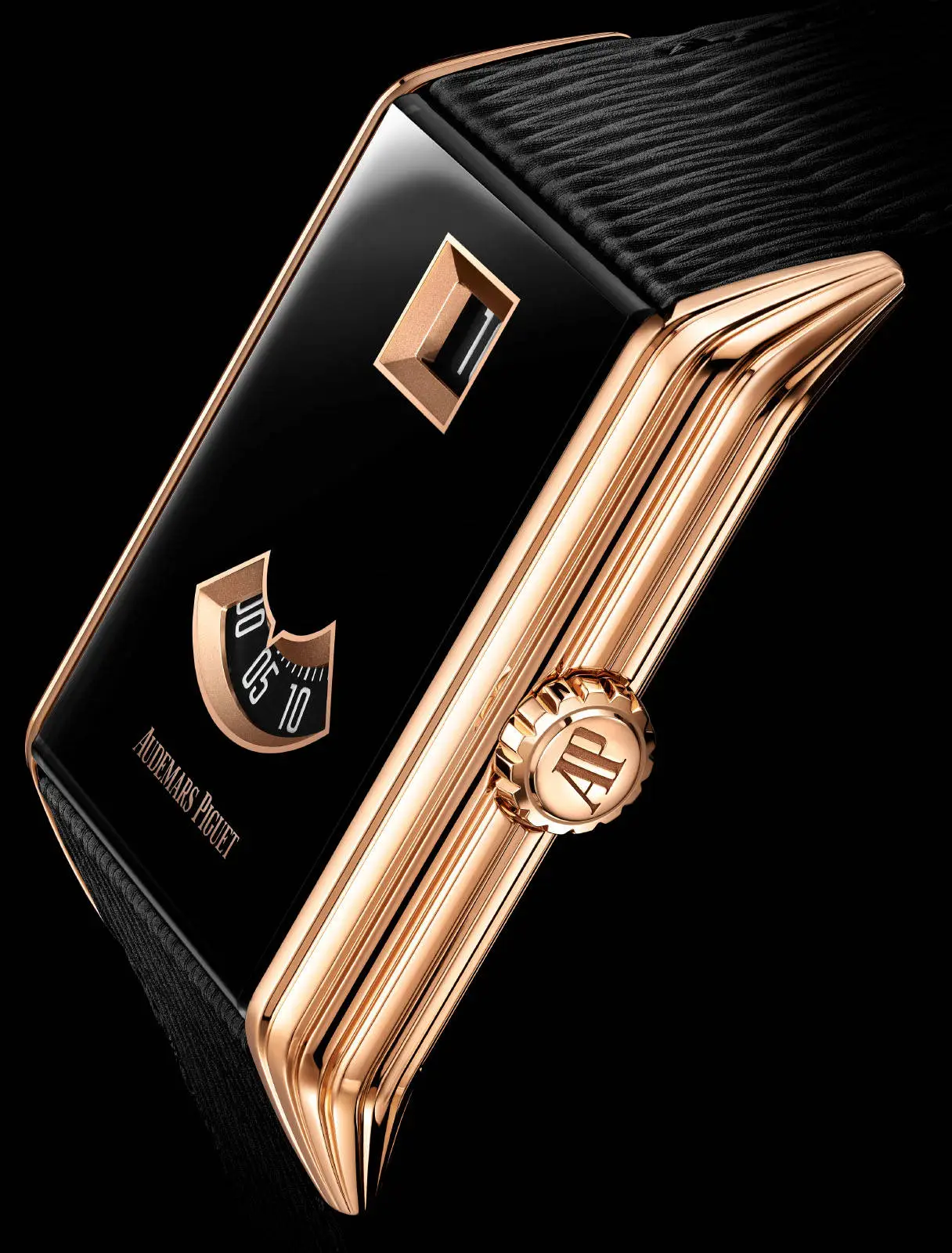
The Audemars Piguet Neo Frame Jumping Hour is a rectangular pink gold timepiece that replaces traditional hands with a digital-style display. The hour appears in an aperture and jumps instantly at the top of each hour, while the minutes are displayed progressively alongside it.
Powered by the in-house Calibre 7122, it represents the brand’s first selfwinding jumping hour movement—combining historical inspiration with contemporary watchmaking.
A Watch That Changes How You Read Time
This isn’t a watch you glance at. It’s one you interpret.
Instead of hands sweeping across a dial, time is revealed through two apertures. The hour disc snaps forward precisely every 60 minutes, while the minutes glide continuously. The result is a display that feels both mechanical and unexpectedly modern.
It slows you down, forcing a second look—and in doing so, makes time feel more deliberate.
How Does a Jumping Hour Watch Work?
A jumping hour watch displays time using rotating discs instead of traditional hands. The hour disc advances instantaneously at the top of each hour, while the minute disc moves in a continuous, progressive motion.
This system improves legibility and creates a distinctive digital-like display, while remaining entirely mechanical in execution.
Calibre 7122: A First for Audemars Piguet
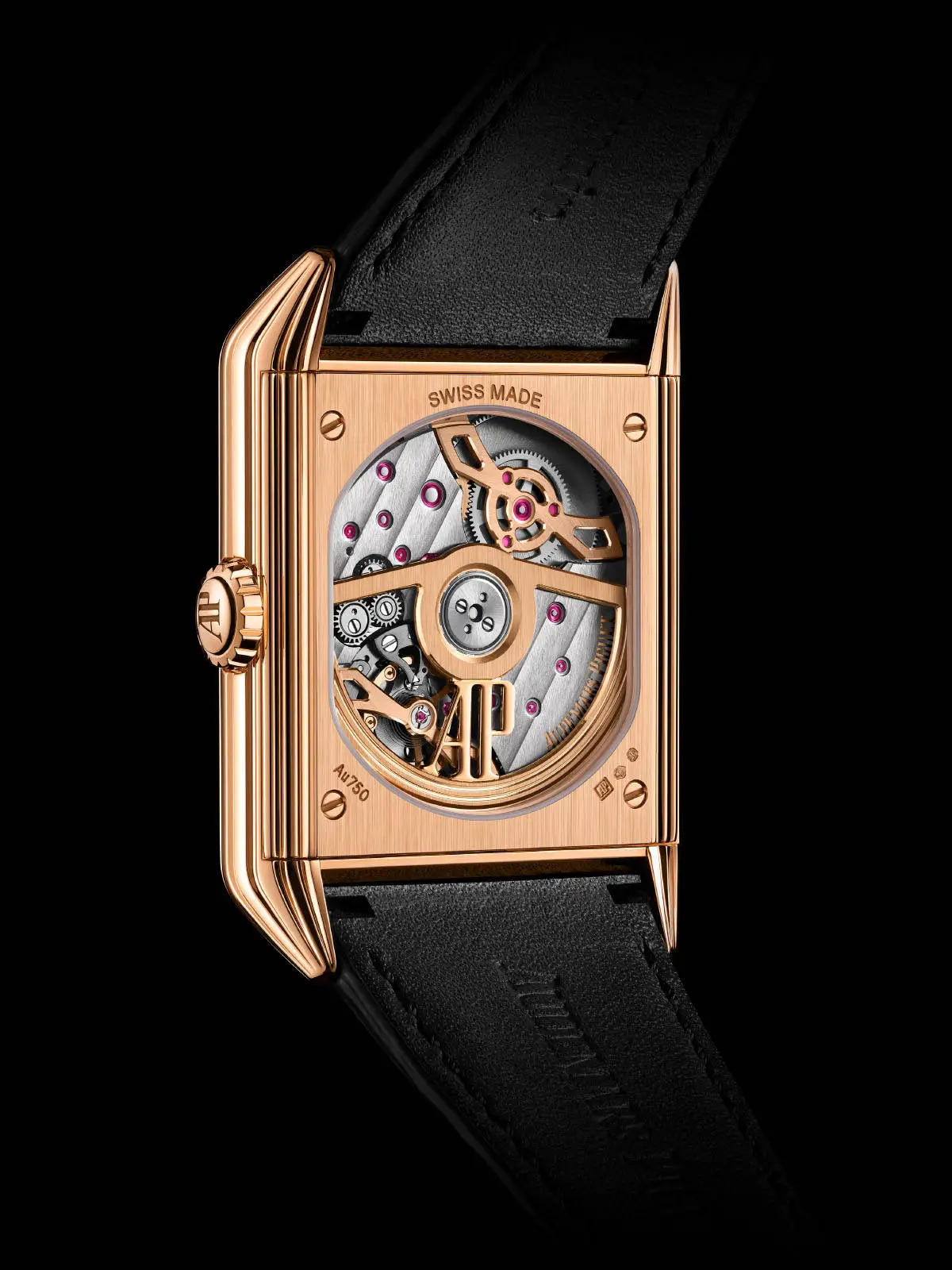
At the heart of the Neo Frame is Calibre 7122—Audemars Piguet’s first automatic jumping hour movement.
Developed entirely in-house, it combines precision with practicality:
Instantaneous jumping hour mechanism
52-hour power reserve
Shock-resistant system to prevent misalignment
Titanium hour disc for durability
Visible through the sapphire caseback, the movement is finished with traditional Haute Horlogerie techniques, reinforcing that this watch is as serious mechanically as it is visually.
Inspired by 1929, Designed for Today
The Neo Frame draws from a 1929 Audemars Piguet timepiece (pre-model 1271), reinterpreted through the lens of modern craftsmanship.
Its design language is rooted in the Streamline Moderne movement—a late branch of Art Deco characterised by aerodynamic forms, curved lines, and architectural precision.
This influence is visible throughout:
Vertical gadroons running along the case
A rectangular pink gold profile with sculpted lugs
A minimalist sapphire dial with two apertures
The result is a watch that feels less like an object, and more like a piece of design.
A Case Study in Restraint
What makes the Neo Frame compelling isn’t complexity—it’s clarity.
There are no extra elements competing for attention. No unnecessary layers. Just a refined display, a strong design identity, and a complication that serves a purpose.
Even the sapphire dial construction required a new approach to ensure durability and water resistance without compromising the open aesthetic.
This is watchmaking distilled.
Key Specifications
Case: 18k pink gold, rectangular
Size: 34.6 mm × 34 mm
Thickness: 8.8 mm
Movement: Calibre 7122 (selfwinding)
Power Reserve: 52 hours
Display: Jumping hour with trailing minutes
Water Resistance: 20 metres
Strap: Black calfskin leather
Why This Watch Matters
The Neo Frame Jumping Hour stands out not because it tries to do more—but because it chooses to do things differently.
It brings back a rare complication, pairs it with a strong design philosophy, and delivers it in a way that feels relevant today.
In a market that often leans on familiarity, this is a reminder that originality still matters.
Final Thoughts
Audemars Piguet hasn’t just revisited a complication—it has redefined how it fits into modern watchmaking.
The Neo Frame Jumping Hour is thoughtful, deliberate, and quietly confident. It doesn’t demand attention. It earns it.
Jaquet Droz and a collector have joined forces to bring to life a creation that represents a landmark in the history of artistic craftsmanship: the Petite Heure Minute Red Gold – Japanese Garden. It consists of 25 appliques, most of which are made from carved and engraved mother-of-pearl. These are affixed to a dial which is itself made entirely from mother-of-pearl. The work of a precision goldsmith, executed by hand to within a tenth of a millimetre. A unique piece and a synthesis of excellence.
A unique watch for a unique collector. Yet this one is something rather special; it is the embodiment of superlative craftsmanship. The Petite Heure Minute Red Gold – Japanese Garden combines multiple artisanal master strokes. At its heart, the mother-of-pearl is not merely the customary decoration applied to a gold dial: rather, it forms the dial itself, which is carved entirely from ultra-white mother-of-pearl sourced from the farthest reaches of the Pacific.
The composition it depicts has a distinctly dreamlike quality. It brings together all the elements of Japanese culture that foster serenity, harmony and inner peace. At the top of the dial stands a traditional temple. The brilliance of its execution lies not only in the extreme delicacy of its roof, its carved balconies and the perspective of its floors, but specifically in the three-dimensionality conjured by a subtle layer of semi-translucent grey paint. This depicts every shadow cast, allowing the eye to reconstruct the depth of the forms.
However, the temple does not merely appear in the background; it embodies it entirely, thanks to the 25 appliques positioned in front of it. On the left of the dial: reeds and water lilies. On the right: a cherry tree, a lantern. In the centre: a dance of koi carp. This is where we find the most exquisite applique of the entire scene: the reed stems emerging from the water are no more than 0.1 mm thick. Jaquet Droz had to devise an ingenious process to ensure that the stem at 5 o’clock could attach to the water lily petals on its left, all within a thickness of 0.1 mm.
Almost all of these elements are mother-of-pearl appliques, with a few exceptions – notably the cherry tree branches and the lantern frame, which are made from yellow gold. At the centre of the dial gleams a mother-of-pearl cabochon which, with an enigmatic touch of realism, reflects the river and its carp. Attention to detail has been taken to the extreme, with even the image projected onto its slightly curved surface faithfully reproduced. The process is reminiscent of that used by Vermeer in his Girl with a Pearl Earring.
A host of other details help to create additional volume and perspective. The hour and minute hands glide beneath the decoration, positioned to within a tenth of a millimetre. The carp swim beneath the water lilies, but their eyes shine with the brilliance of 0.5 mm diamonds so that they sparkle on the surface. The leaves floating on the surface of the river are applied as gold paillons over the ripples and pebbles. The glass box crystal that tops the red gold case gives a glimpse of what lies beneath the appliques. Here, even in this location visible only to the collector, the decoration still reveals itself to be hand-engraved. A refined and singular secret – just like the piece itself.
Hublot and legendary brand Yohji Yamamoto unite once again to redefine the art of black. For the fourth time since their first collaboration in 2020, they elevate black from a color to the Classic Fusion Yohji Yamamoto All Black Camo. A limited edition of 300 pieces where every texture and contrast are intentional. Matte black ceramic sculpts the 42mm case into light and depth, a monochrome camouflage pattern adds rhythm and motion while fabric and rubber fuse seamlessly on the strap.
This collaboration is more than fashion or watchmaking. It’s about vision. About how far you can strip something down to its essence. Both Hublot and Yohji Yamamoto have built their legacies on the same foundation: questioning the meaning of luxury. Both create through deconstruction. Hublot first broke Swiss tradition in 1980 with its Art of Fusion, blending gold with rubber, innovation with heritage. Since its debut at the Paris Fashion Week in 1981, Yohji Yamamoto redefined the conventions of fashion, using black as a response against excess and fashion’s norms.
For both creators, black is not absence, it is essence. Hublot pioneered the All Black concept in 2006, where light is defined by volume and texture, beyond its color. When Yohji Yamamoto first presented the collection in Paris in 1981, the black silhouettes were seen as revolutionary, an anti-fashion statement that freed creation from decoration. At Hublot, black is sculpted through material: matte ceramics, smoked sapphire, surfaces that play with shadow. For Yohji Yamamoto, black is woven through fabric: wool, silk, cotton layered to breathe and shift. Both treat black as visible and invisible.
“For Yohji Yamamoto, black reveals what truly matters, it purifies form, letting silhouette and texture speak. At Hublot, we treat black as a living material, sculpted, layered, folded where each surface interacts differently with light. This project marks our very first collaboration on a Classic Fusion model, and together, we share the belief that luxury is not what shines, but what endures”, stated Julien Tornare, CEO of Hublot.
Camouflage, reimagined in Yohji Yamamoto’s language, becomes a study in movement and material. On the Classic Fusion Yohji Yamamoto All Black Camo, the pattern appears as monochrome relief, black on black, dynamic under changing light.
“Black is modest and arrogant at the same time” affirmed Yohji Yamamoto.
The 42mm matte black ceramic case absorbs light and sculpts shadow. The black-on-black camouflage dial shifts subtly with movement, alive with contrast. The smoked sapphire caseback unveils the MHUB1110 Hublot automatic calibre and its skeletonized rotor while preserving a monochrome mystery. The strap, crafted from fabric and rubber, echoes the Japanese designer’s tactile couture and Hublot’s technical precision. The signature of Yohji Yamamoto is incorporated into the design of each of the 300 custom All Black boxes. The new Classic Fusion Yohji Yamamoto All Black Camo is available at a selection of Hublot points of sale and online at hublot.com.
HUBLOT
In 1980 and for the first time, a watch dared to put a gold case on a rubber strap, turning the luxury watch world upside down in the process. Named for the porthole-shaped bezel with its exposed screws, Hublot was born and with it, the Art of Fusion.
In 2005 the brand took this exercise in creative thinking to a new level with the Big Bang and its iconic design, size and layered construction case. That same year, Hublot received the Best Design award at the Grand Prix d’Horlogerie de Genève. Since then, spurred by this revolutionary mindset, the Big Bang has never stopped reinventing itself. The twenty-first century has its first watch Icon.
The concept of fusion is omnipresent, the guiding principle for every collection. Big Bang timepieces reshape the geometries of time; Classic Fusion balances boldness and restraint, while the Exceptional Timepieces overwrite expectations to create unprecedented horological objects. With its disruptive approach of challenging convention, Hublot’s DNA is transcribed in the Unico, Meca-10 and tourbillon in-house movements, to add another tier of meaning to the Art of Fusion.
Alchemy is ingrained into Hublot and not just at La Manufacture. Magic can take place on a football pitch, producing partnerships with major events (UEFA Champions League and UEFA EuroTM). Sometimes it happens at a concert, a basketball match, an artistic performance or at a unique gastronomic experience with Hublot’s family of starred Chefs. And so, the Hublot Vibes come to life, through shared moments of exaltation amongst the Hublotistas, its very own community of proud Hublot owners. The Art of Fusion goes beyond the tangible. It is a way of being, the Hublot way of life.
Yohji Yamamoto
Since his debut runway show in Paris in 1981, Yohji Yamamoto has been revolutionizing the fashion world through his philosophy of “conquering fashion through antithesis” – namely, an antithesis to traditional western clothing. Armed with a spirit of rebellion, he expresses his design philosophy though creating pieces that have endured the test of time, and which challenge taboos and propose radical convictions.
CASE
Microblasted Black Ceramic
Sapphire with Anti-reflective Treatment
Screws: Black plated H-Shaped polished Titanium
Size: 42 MM
Thickness: 10.4 MM
Water resistance: 5 ATM / 50M
CASE-BACK
Microblasted Black Ceramic
As a distinctively modern expression of femininity, the Rendez-Vous quickly became a pillar of JaegerLeCoultre’s collections when it was introduced in 2012. Now in 2025, the Maison refines and redefines the collection, beginning with two models: Rendez-Vous Night & Day and Rendez-Vous Moon.
Thirteen years after the collection’s inauguration, an aesthetic redesign and technical upgrades bring new allure to the Rendez-Vous, masterfully demonstrating the art of transformation while remaining faithful to the collection’s original codes.
A PIONEERING COLLECTION WITH A DISTINCTIVE ALLURE
When introduced in 2012, the Rendez-Vous offered women a rare combination at the time: marrying outer style and beauty with inner technical sophistication. In an era where quartz movements still dominated women’s watchmaking, Jaeger-LeCoultre quietly redefined expectations. The mechanically advanced movement that powered the first Rendez-Vous model, Calibre 967A, was developed and produced entirely in-house, specifically for the new watch.
The philosophy behind the Rendez-Vous collection can be traced back to the pioneering spirit of La Grande Maison’s founder, Antoine LeCoultre. Always forward-looking, the Maison began creating watches for women as well as men at an early stage; its feminine collections have continually captured evolving trends, and embodied women’s changing needs and desires. Since the late 19th century, when women pioneered the wearing of watches on the wrist (several decades before men were to do so), the Maison has understood the immense aesthetic and technical potential of timepieces that can also be worn as jewels and accessories. It is this philosophy that guides the Rendez-Vous collection today.
The first Rendez-Vous model in 2012 was envisaged not as a standalone but as the foundation for a full collection. Many variations have been created since then, in different case metals and varying sizes, with different complications and calibres – always produced entirely in-house at Jaeger-LeCoultre and featuring a variety of Métiers Rares™ created in the Manufacture’s own dedicated workshop. Through every interpretation, Rendez-Vous has represented the quintessential expression of modern femininity – that of confidence and elegance.
Rendez-Vous Moon 34 mm diamond bezel timepiece
Jaeger-LeCoultre Rendez-Vous Night & Day 34 mm watch
Jaeger-LeCoultre Rendez-Vous Night & Day 34 mm watch
A SUBTLE AESTHETIC EVOLUTION
When creating the new Rendez-Vous design, it was imperative to retain the four key aesthetic codes that define the collection: the textured guilloché dial, the ‘Floral’ numerals and hands, a complication displayed at 6 o’clock, and diamonds to express the jewellery spirit and draw the eye to the beauty of the dial.
While a total of 64 elements have been modified (including significant technical upgrades), many design changes are barely perceptible in their own right; however, taken together, they bring a notable freshness and richness to the overall aesthetic.
The new Rendez-Vous Night & Day is offered with three variations of the 34 mm case: all steel; steel with a diamond-set bezel and 18k pink gold (750/1000) with a diamond-set bezel. The new Rendez-Vous Moon, also in a 34 mm case is offered in steel or pink gold, both with a diamond-set bezel.
Emphasising the graceful allure of the collection, the redesigned case features a convex bezel, rounded sides and flattened lugs, enhancing comfort on the wrist and creating an impression of slimness.
Diamond hour markers and bezel
Interchangeable alligator leather strap close-up
On the dial, jewellery finishes have been subtly enhanced on all models. On the steel models with diamond hour markers, the diamonds have been slightly increased in size. On all models with gem-set bezels, the diamond size has significantly increased to further captivate the light. The tone-on-tone aesthetic and overall unity of the dial design has been enhanced: on the Night & Day steel model with non-set bezel a textured inner dial ring replaces a ring marked with dots while the other versions feature a diamond-set inner ring echoing the diamond-set bezel. The pink gold version adorns golden coloured floral numerals that match the colour of the precious metal case.
Jaeger-LeCoultre Rendez-Vous Night & Day 34 mm watch
Rendez-Vous Moon 34 mm diamond bezel timepiece
An entirely new bracelet has been designed for the collection, its exclusive lozenge-shaped links smooth, comfortable and wearing like a second skin on the wrist. The integration between bracelet and case has been improved and the bracelet can be quickly interchanged by the wearer, without the need for a special tool or technique. A second strap, in alligator leather, is included with models that are purchased with a metal bracelet. Alternatively, both the Rendez-Vous Night & Day and Rendez-Vous Moon in both steel and pink gold may be purchased with only an alligator strap.
Sunray finished dial with applied numerals
Rendez-Vous Moon 34 mm diamond bezel timepiece
IN-HOUSE MECHANICAL MOVEMENTS REVISITED
Complementing the aesthetic changes, both of the new Rendez-Vous models are equipped with enhanced self-winding movements. The power reserves of both calibres have been significantly increased, from 38 hours to 70 hours. The Rendez-Vous Night & Day is powered by Calibre 898 with functions of hours, minutes, seconds and a night-and-day complication, while the Rendez-Vous Moon is animated by Calibre 925, offering hours, minutes, seconds and a moon phase display, with a quick-reset moon phase adjustment button on the left case side.
Updated to deliver a fresh expression of beauty, elegance and performance, the Rendez-Vous collection continues to offer a graceful interpretation of timekeeping for women. More than simply marking the time, the new Rendez-Vous models are distinctive visions of femininity, crafted to capture the attention and imagination.
TECHNICAL CHARACTERISTICS
RENDEZ-VOUS NIGHT & DAY
Case: Steel, or steel with diamonds, or 18k Pink Gold (750/1000) with diamonds Dimensions: 34 mm x 8.63 mm Movement: Automatic Manufacture Calibre 898 Functions: Hours, Minutes, Seconds; Night & Day complication Power Reserve: 70 hours Dial: Silvered sunray-pattern guilloché Caseback: Open Stones: 12 diamonds ( 0.05 carats), or 107 diamonds (0.84 carats) Water resistance: 50 m Strap: Blue alligator (steel), Taupe alligator (pink gold) Bracelet: Steel, for steel models, interchangeable double folding clasp
References:
Q3448411 Steel 12 diamonds, blue alligator strap
Q3448111 Steel 12 diamonds, steel bracelet and blue alligator strap
Q3448431 Steel 107 diamonds, blue alligator strap
Q3448132 Steel 107 diamonds, steel bracelet and blue alligator strap
Q3442441 Pink Gold (750/1000) 107 diamonds, taupe alligator strap
Night & Day indicator subdial close-up
Night & Day indicator subdial close-up
JLC Rendez-Vous elegant round case design
Rendez-Vous 2025 relaunch luxury watches
JLC Rendez-Vous elegant round case design
RENDEZ-VOUS MOON
Case: Steel with diamonds or 18k Pink Gold (750/1000) with diamonds Dimensions: 34 mm x 9.42 mm Movement: Automatic Manufacture Calibre 925 Functions: Hours, Minutes, Seconds; Moon phase complication Power Reserve: 70 hours Dial: Silvered sunray-pattern guilloché Caseback: Open Stones: 107 diamonds (0.84 carats) Water resistance: 50m Strap: Blue Alligator (steel), Black alligator (pink gold) Bracelet: Steel, for steel models, interchangeable double-folding clasp
References:
Q3578431 Steel 107 diamonds, blue alligator strap
Q3578131 Steel, 107 diamonds, steel bracelet and blue alligator strap
Q3572431 Pink Gold (750/1000) 107 diamonds, black alligator strap
Q3572131 Pink Gold (750/1000) 107 diamonds, black alligator strap
A new dress-watch model version set with spessartites and featuring an innovative sapphire crystal dial adorned with a zebra motif
First launched in 2006, the Gondolo Serata stands out with its soft, Art Deco-inspired curves. Its distinctive design offers a contemporary take on the evening or “dress” watch that can be worn with style during the day. It made its grand debut in diamond-set white gold versions framing guilloché mother-of-pearl dials (References 4972G-001 and 4972/1G-001), that were produced until 2021.
In 2023, this jewelry watch exuding unique style and timeless elegance made its return to the Patek Philippe current collection in a slightly larger rose gold version featuring a spessartite-set case and a brown lacquered dial graced with a floral motif (Reference 4962/200R-001).
Patek Philippe is reinterpreting this model with a dial bearing an original zebra motif inspired by the Reference 5738/50G-023 Golden Ellipse wristwatch in cloisonné enamel, one of the highlights of the 2022 Rare Handcrafts collection. To recreate the visual interplay of the stripes with the zebra firmly in the foreground, the Manufacture has applied an innovative and refined technique involving a sapphire crystal dial engraved and black varnished on both sides. The zebra motif is then completed with black metallization and white varnish on the underside of the sapphire crystal dial, thus creating magnificent volume and depth effects. The time is displayed by two applied Breguet numerals at 12 o’clock and 6 o’clock swept over by rose gold leaf-shaped hands.
The rose gold case (28.6 x 40.85 mm) is set with 94 brilliant-cut spessartite gemstones (2.02 ct) arranged in a double color gradient covering a spectrum from cognac shades at 12 o’clock and 6 o’clock to tangerine tones at 9 o’clock and 3 o’clock. This dark-light-dark effect and the variations in the size of the gemstones emphasize the daintily “waisted” and cambered profile of the watch, ensuring a perfectly smooth fit on the wrist. A second row of spessartite gemstones on the lower part of the case accentuates its asymmetrical curves.
The new Gondolo Serata Reference 4962/200R-010 comes with a white calfskin strap with satin finish.
The rose gold pin buckle is adorned with the Patek Philippe logo.
This timepiece houses the Patek Philippe quartz caliber E15 whose mechanical components are finished with the same attention to detail as those found in the manufacture’s all-mechanical movements.
Technical Specifications
Ref. 4962/200R-010
Movement: E15 Quartz
Dial: Metallized sapphire crystal, zebra motif, engraved and inked, white varnish, rose gold applied Breguet numerals.
Case: Rose gold. Dimensions : 28.6 x 40.85 mm. Thickness: 7.36 mm. Water-resistant to 30m. Solid case back.
Gemsetting: Case 94 spessartites, “cognac” to “mandarine” tones (2.02 cts).
Srap: Calfskin, satinated finish, brushed white. Rose gold prong buckle.
Some watches tell time. Others redefine it.
Zenith’s Defy Zero G Sapphire belongs to the latter. It doesn’t just keep time—it defies gravity itself. Literally.
In a world where watchmaking has seen almost everything, Zenith dares to reimagine what precision can mean. And the result? Two breathtaking limited editions that look as if they were carved from starlight itself—one in deep celestial blue sapphire, the other in transparent crystal clarity. Each limited to just 10 pieces worldwide.
A Story of Defiance and Discovery
Back in 2008, Zenith unveiled a concept that seemed almost impossible: a wristwatch movement that could cancel out gravity’s pull on its precision. Fast forward to today, and that dream lives inside the Defy Zero G.
At the heart of this watch beats a world-first innovation — the Gravity Control module, a gimbal-mounted escapement that constantly keeps itself perfectly level, no matter how your wrist moves.
It’s inspired by marine chronometers that once helped sailors navigate the open seas. Only now, that same principle of stability lives inside a 46mm sapphire case, wrapped around your wrist.
That’s the kind of audacious engineering that makes Zenith… Zenith.
A Universe Captured in Sapphire
The blue sapphire edition is pure cosmic poetry. Its lapis lazuli dial, flecked with gold pyrite, shimmers like a slice of the night sky. Each piece has its own pattern—no two alike—like constellations drawn by hand.
The transparent sapphire edition strips everything down to pure form and function. Every bevel, bridge, and balance wheel is visible in luminous clarity. Nothing to hide, everything to admire.
Inside beats the manual-winding El Primero 8812S calibre, running at 5Hz, revealing a hypnotic dance of motion through openworked architecture. The rotating Gravity Control module at 6 o’clock keeps the escapement level, as if the laws of physics were optional.
Precision Becomes Art
There’s something almost philosophical about the Defy Zero G. In a world obsessed with speed, Zenith slows things down—to focus on mastery. Every movement, every polished edge, every laser-engraved star speaks of patience and purpose.
The counterweight of the gyroscopic system even carries an engraving that resembles a celestial body—a reminder that this isn’t just a watchmaker’s experiment. It’s a meditation on control, beauty, and balance.
Ten Pieces. Infinite Imagination.
Each Defy Zero G Sapphire is a limited edition of just 10. Priced around USD 207,500, it’s not a watch for everyone—and that’s exactly the point.
It’s for the dreamers, the collectors, the believers in the impossible. Those who see time not as something to measure, but something to master.
Because at Zenith, defying gravity isn’t a metaphor.
It’s a way of life.
Conclusion
The Zenith Defy Zero G Sapphire isn’t just about mechanics—it’s about emotion. It’s about watching centuries of horological heritage collide with modern innovation to create something timeless, transparent, and alive.
In sapphire and steel, light and motion, Zenith has built not just a watch, but a statement: that perfection is never static—it’s always in motion, just like time itself.
Technical Specifications
DEFY ZERO G Reference: 04.9003.8812/51.R584 Key points: Full blue sapphire case. Entirely skeletonized movement : El Primero 8812.
“Gravity Control” gyroscopic module that ensures horizontal positioning of the regulating
organ. Now occupies only 30% of its initial volume. Inspired by the legendary marine
chronometers. Openworked dial. The movement is protected by 1 patent related to the
Gravity Control cage. Limited edition of 10 pieces. Movement: El Primero 8812 Frequency: 36,000 VpH (5 Hz) Power reserve: 50 hours Functions: Hours and minutes excentred at 12 o’clock, small seconds at 9 o’clock, self-
regulating Gravity Control module at 6 o’clock, power-reserve indication at 3 o’clock Finishes: Exclusive two tones (blue and rhodium) signature on plates and bridges + milled
Starry Sky. Laser decorated Platinum counterweight of the gyroscopic system. Price: 200 000 CHF / 220 000 Euros / 207 500 USD Material: Blue Sapphire Water resistance: 3 ATM Case: 46mm Dial: Openworked with Lapis Lazuli dial Hour markers: Rhodium-plated, faceted and coated with SuperLuminova SLN C1 Hands: Rhodium-plated, faceted and coated with SuperLuminova SLN C1 Bracelet & Buckle: Blue Alligator leather lining on rubber with titanium folding clasp
DEFY ZERO G Reference: 04.9000.8812/51.R584 Key points: Full transparent sapphire case. Entirely skeletonized movement : El Primero
8812. “Gravity Control” gyroscopic module that ensures horizontal positioning of the
regulating organ. Now occupies only 30% of its initial volume. Inspired by the legendary
marine chronometers. Openworked dial. The movement is protected by 1 patent related
to the Gravity Control cage. Limited edition of 10 pieces. Movement: El Primero 8812 Frequency: 36,000 VpH (5 Hz) Power reserve: 50 hours Functions: Hours and minutes excentred at 12 o’clock, small seconds at 9 o’clock, self-
regulating Gravity Control module at 6 o’clock, power-reserve indication at 3 o’clock Finishes: Exclusive two tones (blue and rhodium) signature on plates and bridges + milled
Starry Sky. Laser decorated Platinum counterweight of the gyroscopic system. Price: 200 000 CHF / 220 000 Euros / 207 500 USD Material: Transparent Sapphire Water resistance: 3 ATM Case: 46mm Dial: Openworked with Lapis Lazuli dial Hour markers: Rhodium-plated, faceted and coated with SuperLuminova SLN C1 Hands: Rhodium-plated, faceted and coated with SuperLuminova SLN C1 Bracelet & Buckle: Blue Alligator leather lining on rubber with titanium folding clasp
In the world of haute horlogerie, few names carry the mystique of Jaquet Droz. Known for its automata, métiers d’art, and poetic approach to time, the brand has spent nearly three centuries challenging conventions while keeping emotion at the heart of every creation.
During his recent visit to India, Alain Delamuraz, CEO of Jaquet Droz, shared his thoughts on legacy, innovation, and the brand’s deepening connection with Indian collectors.
Art Beyond Time
When asked whether Jaquet Droz feels closer to a poem, a painting, or a piece of music, Alain Delamuraz resists a single definition: “I think that all the arts are connected. Watchmaking art, métiers d’art, paillons, enamel, engraving, micro-painting — all these things are together. If you copy an art, you die. All the arts need to be challenged every time.”
For him, watchmaking at Jaquet Droz is less about the object itself and more about the dialogue it inspires: “We do not make a piece and then try to sell it. We create it together with the people who will wear it. It’s a connection, a human connection.”
Disruptive Legacy
With centuries of history behind the brand, the temptation might be to look backward. Alain Delamuraz instead looks forward: “The question is not what did Pierre Jaquet-Droz do, the question is what he would do today if he were still alive… He was a disruptive person — inventive, creative, full of craziness. We have to keep this disruptive attitude. Disruptive is positive — it is not destroying, but it is faster and more creative than normal evolution.”
For him, disruption is not an occasional strategy but the brand’s DNA: “Innovation is our tradition. Disruption is our legacy.”
The Soul of Emotion
Precision is essential, but it is emotion that defines true luxury. As Alain Delamuraz explains: “You can have passion, authenticity, technical excellence — but without emotion, it is nothing. We are in direct connection between an artist and another artist who is the collector. If there is no emotion, people don’t buy. There is never, ever something we do without emotion.”
That emotional connection is rooted in people — the watchmakers, artisans, and collectors who bring each piece to life: “The soul is that you can see the people making your piece of art. You talk with the engraver, the painter, the enameller. You create together. That, I believe, is the soul of Jaquet Droz: putting people together, humanizing luxury, and giving emotion — not only price.”
India: A Dialogue of Cultures
India, with its rich artistic heritage, resonates naturally with Jaquet Droz’s philosophy. “We take inspiration from every culture — Japan, China, India. We also did some Indian themes. Always by hand, always unique, one-of-one. That is why I am here in India — to feel the culture, to meet people, to understand more, and to be more ready to create bespoke pieces of art in the spirit of this culture.”
Indian collectors, he observes, are especially eager to co-create: “It would begin with colors, crafts, and themes unique to India — because this is what connects naturally to our métiers d’art. We work with the client to refine it: more blue, less green, more red, different materials. The idea is always to co-create.”
What excites him most about the market is its youthful boldness: “The younger generation cannot be fooled. They want authenticity, emotion, and individuality. They are curious and bold. That’s why we create both the timeless and the unexpected.”
Collaborations & Living Art
Beyond watches, Jaquet Droz has often blurred the lines between horology and fine art. A striking example is the brand’s collaboration with John Howe, the legendary illustrator behind The Lord of the Rings: “He created a dragon for us — his signature is engraved on the back, and the automaton moves with 16 separate pieces. This is live art. With a lot of pleasure, we are always ready to collaborate with artists. Our concept is to redefine painting, engraving, or sculpture so collectors can travel with their piece of art.”
It’s a philosophy that aligns perfectly with India’s own artistic traditions — a fertile ground for future collaborations.
An Industry of Emotion, Not Marketing
In a world where marketing often overshadows craft, Alain Delamuraz insists on a more human-centered approach: “In our case, we don’t do advertising anymore. Our marketing concept is to know the people and to interact with them. Automata are about surprise and emotion — you don’t know what will happen, then suddenly something moves and you say ‘wow.’ That surprise is the emotion. We are not only a brand, not only a watchmaker. We are an emotion.”
Conclusion
Alain Delamuraz’s vision for Jaquet Droz is clear: a brand rooted in disruption, guided by emotion, and deeply connected to its collectors. Whether through métiers d’art, automata, or bespoke creations inspired by India, Jaquet Droz continues to prove that true luxury lies not only in what is made, but in the human connection it creates.
Every September, Geneva comes alive with a different kind of energy. Instead of the closed, high-walled watch fairs of old, Geneva Watch Days spills into the city’s boutiques, riverside pavilions, and galleries. It feels more like a festival than a trade show—one where collectors, journalists, and curious passersby all share the same stage.
In 2025, few brands captured that spirit better than Bvlgari. The Roman jeweller-turned-watchmaker has spent the past decade redefining what modern horology can look like, and this year, its spotlight once again shone on the Octo Finissimo.
What began as a daringly thin wristwatch over ten years ago has now grown into a whole world of experimentation. And at Geneva Watch Days, Bvlgari unveiled three very different but equally compelling takes on its philosophy: one rooted in art, another in nature, and the third in time itself.
Octo Finissimo Lee Ufan × Bvlgari – Minimalism With a Soul
One of the fair’s most talked-about watches was Bvlgari’s collaboration with Lee Ufan, the Korean-Japanese artist known for his contemplative works that balance stillness and space.
At first glance, the watch’s mirrored dial looks almost simple. But like Ufan’s art, it asks you to slow down. The reflection turns every glance into a dialogue—between presence and absence, light and shadow, permanence and fragility.
The titanium case keeps things featherlight, while the ultra-thin micro-rotor movement inside reminds us that this is still a serious piece of horology. Produced in just 150 pieces, it’s less of a wristwatch and more of a wearable artwork—one that lives at the intersection of philosophy and precision.
Octo Finissimo Marble Tourbillon – Nature on the Wrist
If the Ufan collaboration was about reflection, the Marble Tourbillon was about permanence. Bvlgari dared to carve a dial from deep-blue Italian marble, a material as stubborn as it is beautiful. To thin it down enough for a watch dial without losing its character is a feat in itself.
Framed by a platinum case and powered by a hand-wound flying tourbillon, the watch looks like a slice of earth frozen in time. On the wrist, it feels less like jewellery and more like sculpture—quietly powerful, endlessly fascinating. Limited to just 30 pieces, it’s destined to be one of the most coveted watches from the entire fair.
Bvlgari Aluminium Bronzo – Watches That Evolve With You
While the Octo Finissimo grabbed headlines, Bvlgari also surprised collectors by giving its sporty Aluminium line a new twist: bronze.
Two models joined the family:
A Bronzo Chronograph with bold racing-style sub-dials and a rugged, sandblasted bronze case.
A Bronzo GMT, built for travellers, with a clean 24-hour scale and dual-time functionality.
The beauty of bronze lies in its changeability. Over time, it develops a patina unique to its wearer—no two watches will age the same way. In a world where luxury often feels polished to perfection, the Bronzo celebrates imperfection as a form of individuality.
Why These Watches Matter
Bvlgari’s Geneva Watch Days 2025 novelties aren’t just new models—they’re statements.
Form: The Octo Finissimo continues to lead the ultra-thin category, proving less really can be more.
Material: Marble and bronze push watchmaking into fresh, tactile territory.
Culture: Collaborations with artists like Lee Ufan remind us that watches can carry ideas as much as they carry hours.
Together, they show that Bvlgari isn’t just making timepieces—it’s exploring time itself.
Eleven Years of Record-Breaking Innovation
Alongside these novelties, Bvlgari also took time to reflect on the Octo Finissimo’s journey. At Geneva Watch Days 2025, the Maison presented its first full retrospective of the collection—an exhibition charting eleven years of relentless innovation and ten world records.
The Octo Finissimo is as much about architecture as it is about mechanics. Its octagonal case was inspired by the Basilica of Maxentius in Rome, translating Roman geometry into a contemporary design language. Over the past decade, this architecture has become the canvas for groundbreaking engineering and creative collaborations alike.
Key Milestones
2014 — The Beginning: The Octo Finissimo Tourbillon introduced the ultra-slim BVL 268 calibre, measuring just 1.95mm, setting the stage for record-breaking thinness.
2017 — Everyday Icon: The Octo Finissimo Automatic debuted at 5.15mm thick, proving ultra-thin could be practical, elegant, and wearable.
2021 — A Crown Achievement: The Octo Finissimo Perpetual Calendar in titanium not only claimed the record as the thinnest perpetual calendar at 5.80mm, but also won the Aiguille d’Or at the Grand Prix d’Horlogerie de Genève.
2025 — Breaking Limits Again: This year, the Octo Finissimo Ultra Tourbillon, unveiled at Watches and Wonders, stunned with a case just 1.85mm thick—a technical feat that almost defies belief.
The retrospective made one thing clear: the Octo Finissimo is more than a collection. It’s a statement of intent—Bvlgari’s relentless drive to push design, engineering, and artistry beyond the imaginable.
Final Thoughts
Walking away from Bvlgari’s showcase this year, one thing was clear: these aren’t watches that quietly tick in the background. They’re meant to start conversations, to spark curiosity, to evolve with you.
Whether it’s the reflective stillness of the Lee Ufan edition, the sculptural presence of the Marble Tourbillon, or the ever-changing Bronzo Aluminium, Bvlgari has given collectors pieces that feel alive.
For anyone who believes a watch should tell more than the time, Bvlgari’s 2025 lineup is proof that horology can be as poetic as it is precise.
In its quest for modern yet timeless creations, Franck Muller offers an iconic piece as its High Jewellery launch for 2024: the Round Skeleton Baguette in 31mm, an exceptional collection set with baguette diamonds or precious gems, reflecting the perfect marriage between the world of Fine Jewellery and Haute Horlogerie.
The new timepiece is the latest addition to the repertoire of Round Skeletons which are already available in 39mm and 42mm. In this Asia Pacific Exclusive collection, diamonds are also seamlessly set on the sides of the bezel and case. The collection also boasts the smallest ever skeleton movement ever manufactured within the Franck Muller range.
The collection harmoniously integrates into the prestigious Round line, celebrating Franck Muller’s craftsmanship in the art of watchmaking. The Round Skeleton Baguette, with its sleek profile and understated design, is the result of a quest for purity and excellence, embodying the fundamental principles of the collection.
Baguette-cut diamonds or precious stones are meticulously set by hand using the channel setting technique featuring gem stones set inside the bezel, securely held in place within the ring. Crafted in precious metals, the bezel’s channel walls hold in place this majestic crown that encircles the precisely skeletonised dial, enhancing its optimal transparency.
The in-house movement within, blending aesthetics and technicality, reveals a highly technical mechanism and a perfectly balanced style. In this new size, Franck Muller has minimised the openworked movement to fit into a 31 mm case, while still affording a generous 4 day power reserve. Parts of the movement, such as the mainplate and bridges, are pared down further to make the watch components visible and offer a captivating visual experience. While maintaining a sense of refined elegance, the skeletonised movement allows for a satisfyingly detailed observation of the timepiece’s inner workings.
Available in white and rose gold, and set with various combinations of diamonds and precious stones, the new Round Skeleton Baguette in 31mm stands out for its elegant design and perfect proportions, making it a timeless accessory that complements its wearer with sophistication and grace.