BREITLING INTRODUCES SIX NATIONS CHRONOMAT LIMITED EDITIONS FOR MEN AND WOMEN WITH DISTINCTIVE DESIGNS FOR EACH UNION IN TWO FORMATS: A GMT 40 MM AND A 32 MM
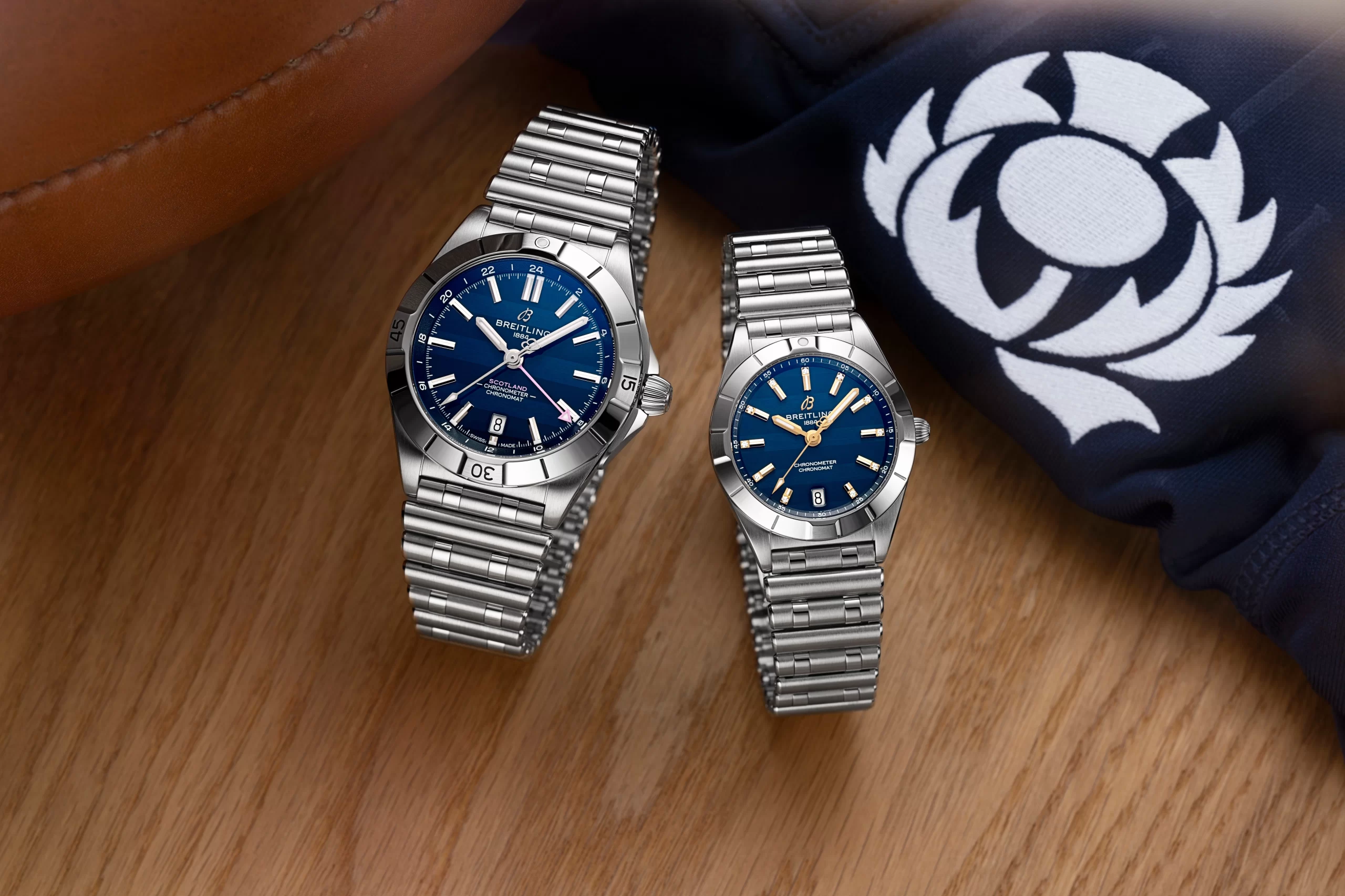
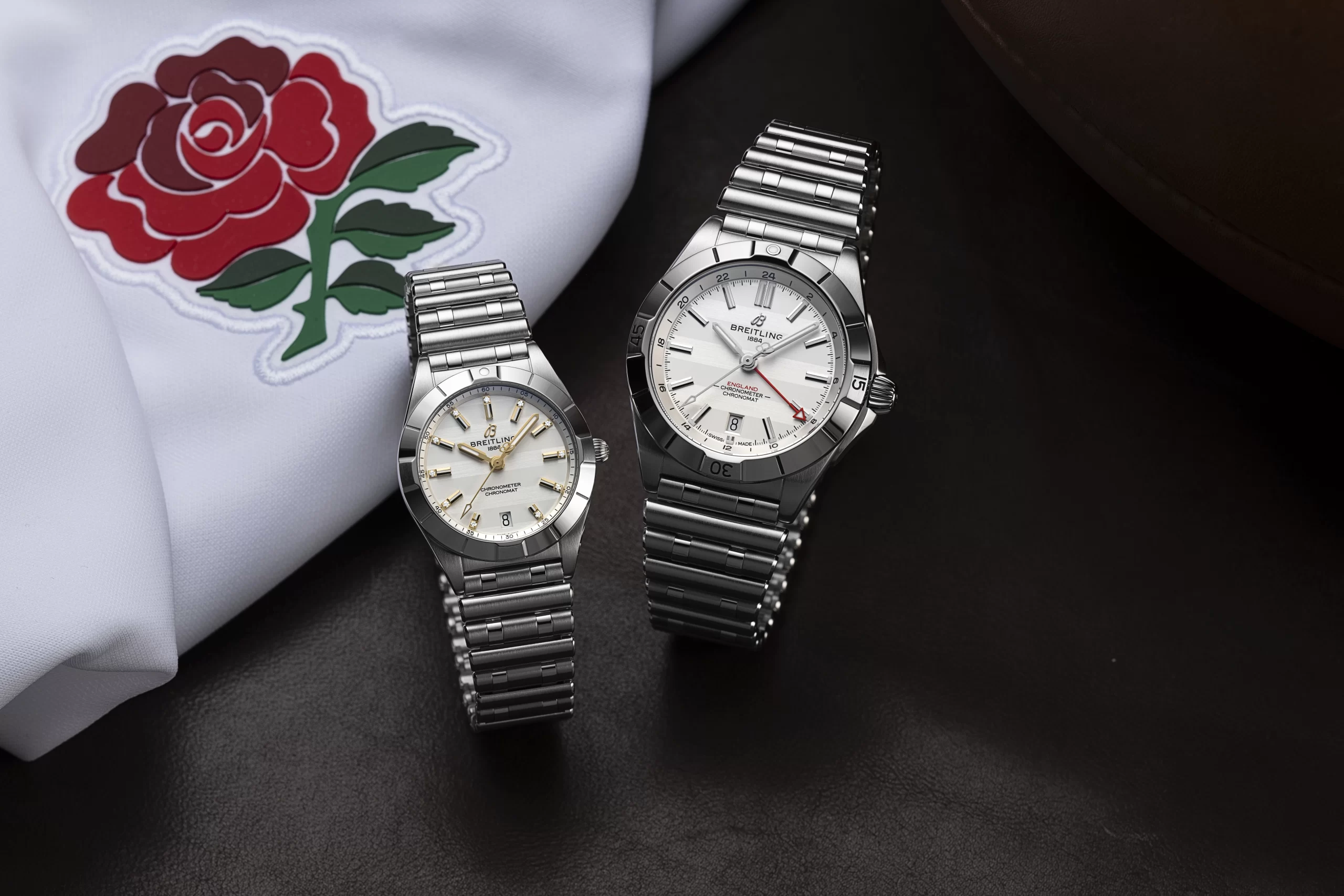
Breitling’s latest Chronomat Six Nations limited-edition series combines precision engineering with distinct dial designs that honor the unique identity of the six unions that make up Six Nations Rugby: England, Ireland, Scotland, Wales, France, and Italy. For the first time, Breitling expands the Six Nations collection to include dedicated 32 mm models for women, highlighting the brand’s commitment to celebrating the growing prominence of women’s rugby.
The 2025 Guinness Six Nations Championships mark Breitling’s fourth season as the the Official Timing Partner and exclusive luxury watch partner to all six unions. With roots tracing back to 1883 for Six Nations Rugby and 1884 for Breitling, the partnership reflects a shared legacy of tradition and innovation. Together, they celebrate the enduring impact of the sport through exceptional timepieces.
Breitling CEO Georges Kern says: “You can feel the energy of rugby’s greatest championship and all six unions in these limited editions, created by Breitling for this partnership. We are proud to be the official timekeeper of Six Nations Rugby, supporting both men’s and women’s rugby, and celebrate the bold spirit of a sport that resonates with Breitling’s sense of purpose.”
DESIGNED FOR THE GAME WITH A “PITCH FINISH”
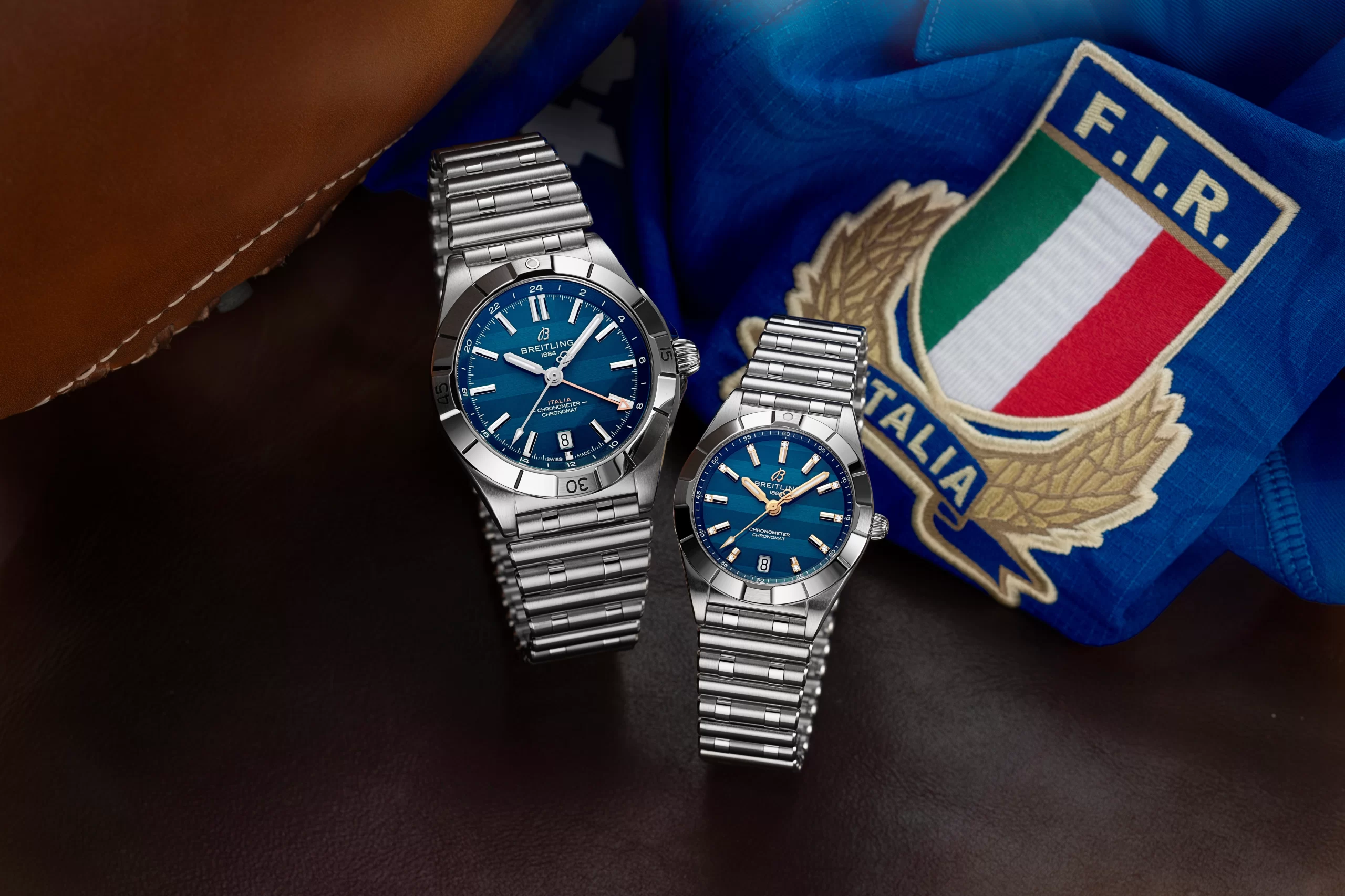
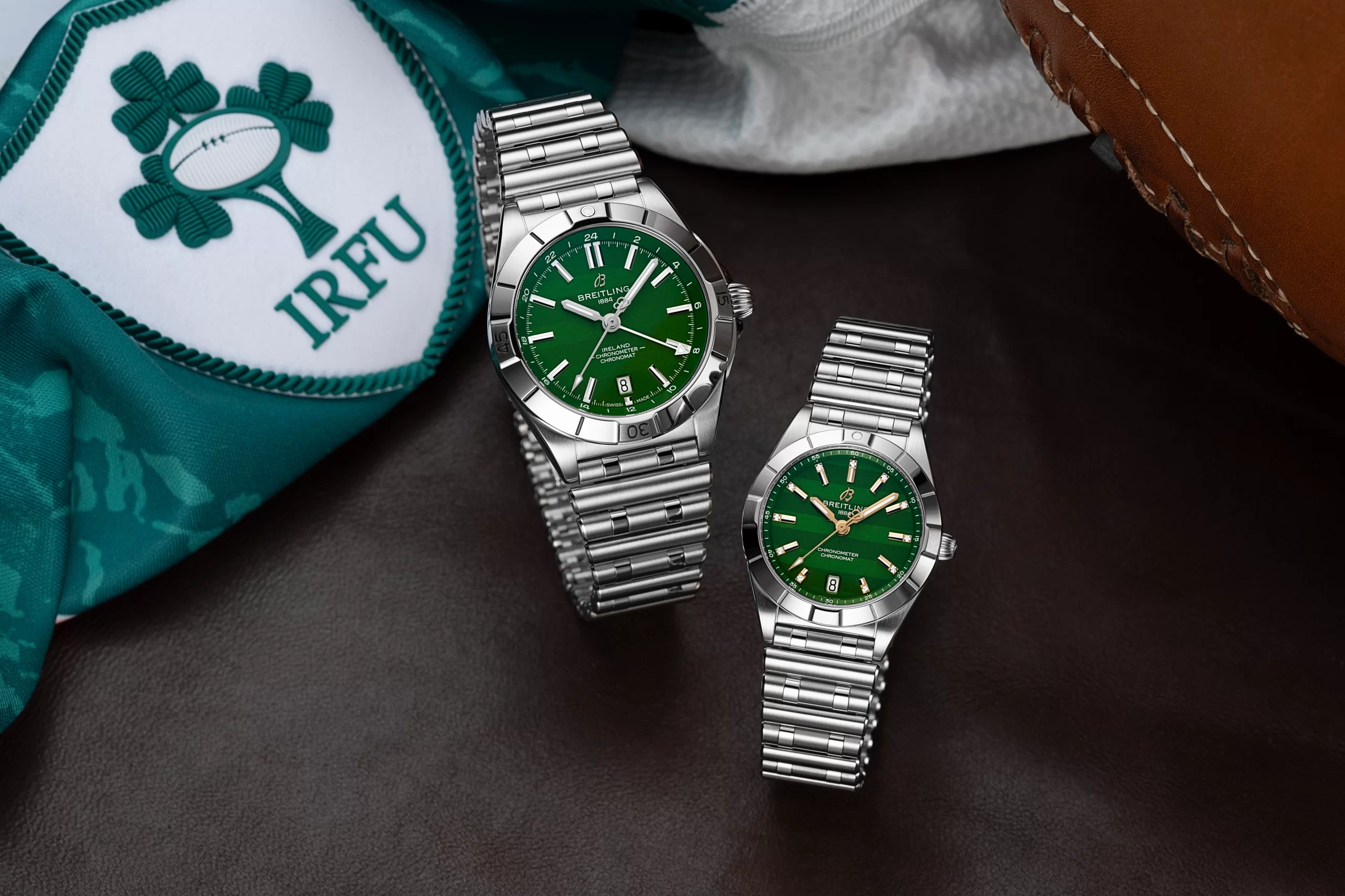
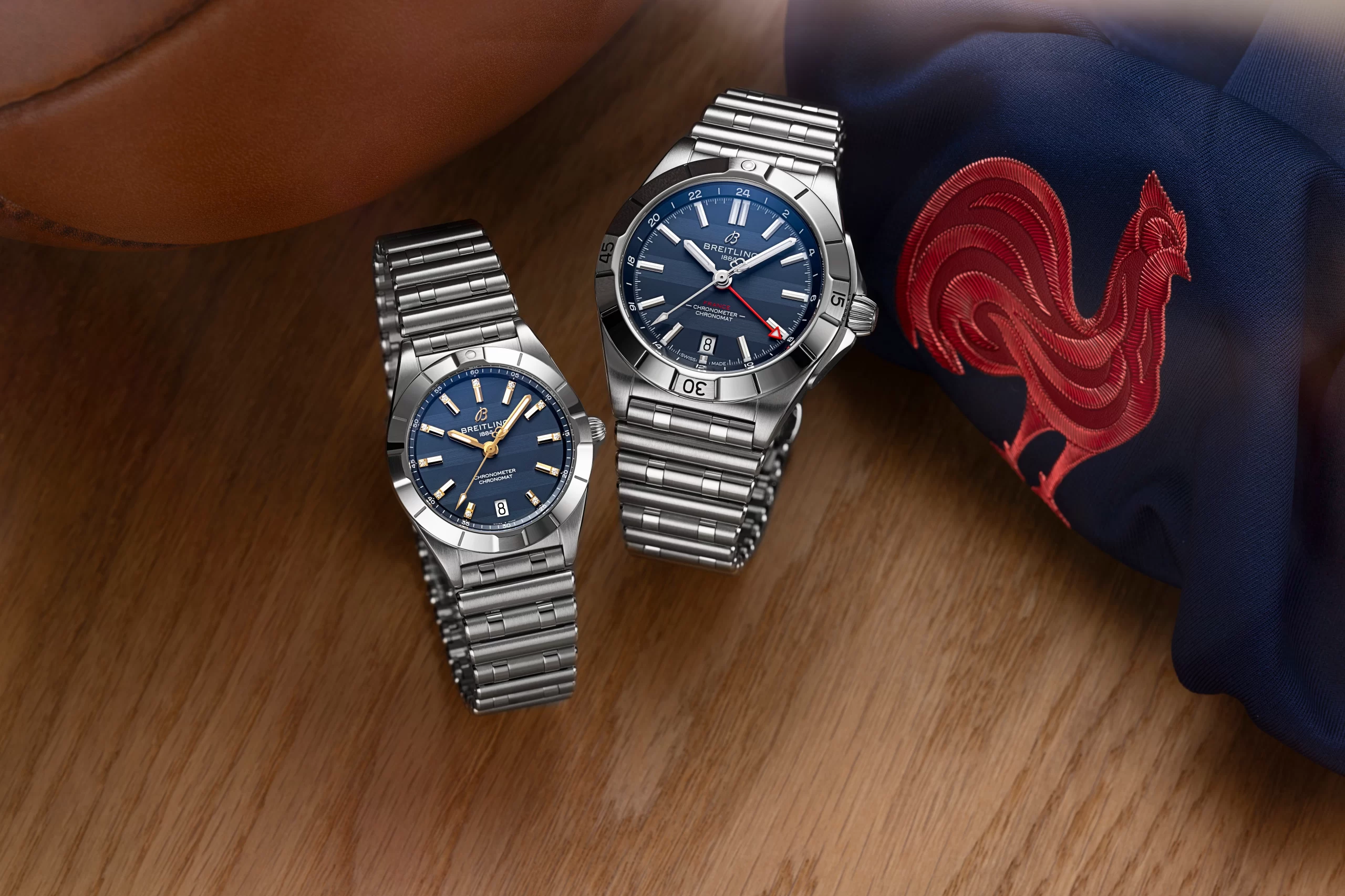
The Chronomat Six Nations Limited Editions were designed to pay homage to rugby’s heritage. There is a watch for fans of each union in two distinct models: a Chronomat Automatic GMT 40 mm and a Chronomat 32 mm three-hand model.
Each team’s watch features a textured dial with alternating matte and horizontal brushed finishes, inspired by the stripes of the rugby field. The dynamic dial design creates a striking play of light reflecting the grit and elegance of rugby both on and off the field.
The GMT 40 mm is limited to 250 pieces per union with a dial in the signature shade of each nation.
Each watch proudly displays the union’s name in its local language in a second contrasting color. The multi-timezone readability of the GMT function allows fans to track matches across the globe.
All the iconic Chronomat features are present, including the onion crown and the distinctive Rouleaux bracelet. The GMT 40 mm model is powered by the Breitling Caliber 32, offering a second time zone function, a 42-hour power reserve and 200 m water resistance. The engraved caseback features each union’s crest as well as “Six Nations Rugby” and “One of 250” to underscore the exclusivity of the limited edition.
The limited-edition Chronomat 32 mm, Breitling’s popular women’s size watch, marks a significant first for the collection, bringing a refined yet bold design to the wrists of rugby fans. The models feature colors that have never been used before within the women’s collections and
are released as a 75-piece limited edition.
The dials of the Chronomat 32 are further elevated by striking yellow gold indexes, adding a sophistication and contrast against the vibrant hues. The caseback features the union crest along with “Six Nations Rugby” and “One of 75” engravings. Powered by the Breitling manufacture Caliber 77, a SuperQuartz movement renowned for its precision, the Chronomat 32 is water resistant to 100 m and is COSC-certified.
With this expanded limited-edition collection, there is now a Chronomat for every rugby fan – uniting all supporters under a shared passion for the game.
The 2025 Guinness Men’s Six Nations Championship kicks off on Friday, January 31, 2025.
The Chronomat Six Nations limited-edition watches are only available in store and online within the UK from January 28. They will also be sold in select EU countries.
THE CHRONOMAT: BREITLING’S ALL-PURPOSE SPORTS-CHIC WATCH
First launched in 1983 as the official watch for the Frecce Tricolori, the renowned Italian aerobatics squadron, the Chronomat quickly became a symbol of all-purpose sports chic. Its robust construction and clean-lined design garnered attention far beyond aviation, making it a favorite among car racers, regatta teams, and athletes who push the limits of endurance. Over the decades, the Chronomat has cemented its reputation as Breitling’s most versatile sports watch, equally at home in the air, on land, and at sea.
Now, with the Six Nations Chronomat Limited Editions, Breitling brings the Chronomat’s storied legacy to rugby’s greatest championships. These timepieces combine the Chronomat’s iconic design with contemporary rugby-inspired elements, including bespoke dials and union-specific details. Whether it’s the GMT 40 mm with its dual time-zone functionality or the 32 mm women’s model with its elegant yet sporty aesthetic, the collection is a fitting tribute to the sport’s global appeal and enduring spirit.
CHRONOMAT AUTOMATIC GMT 40 SIX NATIONS FRANCE, WALES, IRELAND, SCOTLAND, ENGLAND, ITALY
WATCH MOVEMENT
Caliber: Breitling Caliber 32
Diameter: 25.6 millimeters
Depth: 4.1 millimeters
Winder: self-winding mechanical, bidirectional with ball bearing
Power reserve: approx. 42 hours
Balance frequency: 28,800 a/h or 4 hertz
Display: hour, minute, second, date, second time zone
Certification: COSC-certified
CASE
Material: stainless steel
Diameter: 40 millimeters
Thickness: 11.77 millimeters
Height (upper lug tip 47.4 millimeters
to lower lug tip):
Water resistance: 10 bars
Glass: cambered sapphire, glareproofed on both sides
Caseback: solid with engraved emblems, screwed-in
Crown: non-screw-locked, two gaskets
Bezel: stainless steel, unidirectional, ratcheted
DIAL/HANDS
Burgundy (Wales), Green (Ireland), Blue (Scotland), Blue (France), Blue (Italy), Silver (England)
Rhodium-plated hour, minute and second hands with luminescent Super-LumiNova® and contrasting GMT hand
STRAP
Stainless-steel Rouleaux bracelet with butterfly clasp
CHRONOMAT 32 SIX NATIONS FRANCE, WALES, IRELAND, SCOTLAND, ENGLAND, ITALY
WATCH MOVEMENT
Caliber: Breitling Caliber 77
Diameter: 23.3 millimeters
Depth: 3.22 millimeters
Movement: thermocompensated SuperQuartz™
Battery life: approximately 3–4 years
Display: hour, minute, second, date
Certification: COSC-certified
CASE
Material: stainless steel
Diameter: 32 millimeters
Thickness: 8.54 millimeters
Height (upper lug tip 39.4 millimeterss
to lower lug tip):
Water resistance: 10 bars
Glass: cambered sapphire, glareproofed on both sides
Caseback: solid with engraved emblems, screwed-in
Crown: non-screw-locked, two gaskets
Bezel: stainless steel, fixed
DIAL/HANDS
Burgundy (Wales), Green (Ireland), Blue (Scotland), Blue (France), Blue (Italy), Silver (England) dials,
18 k yellow gold indexes with diamonds
18 k yellow-gold-plated hands with luminescent Super-LumiNova®
STRAP
Stainless-steel Rouleaux bracelet with butterfly clasp
An historical L.U.C complication: the perpetual calendar with astronomical moon phase in a reshaped aesthetic.
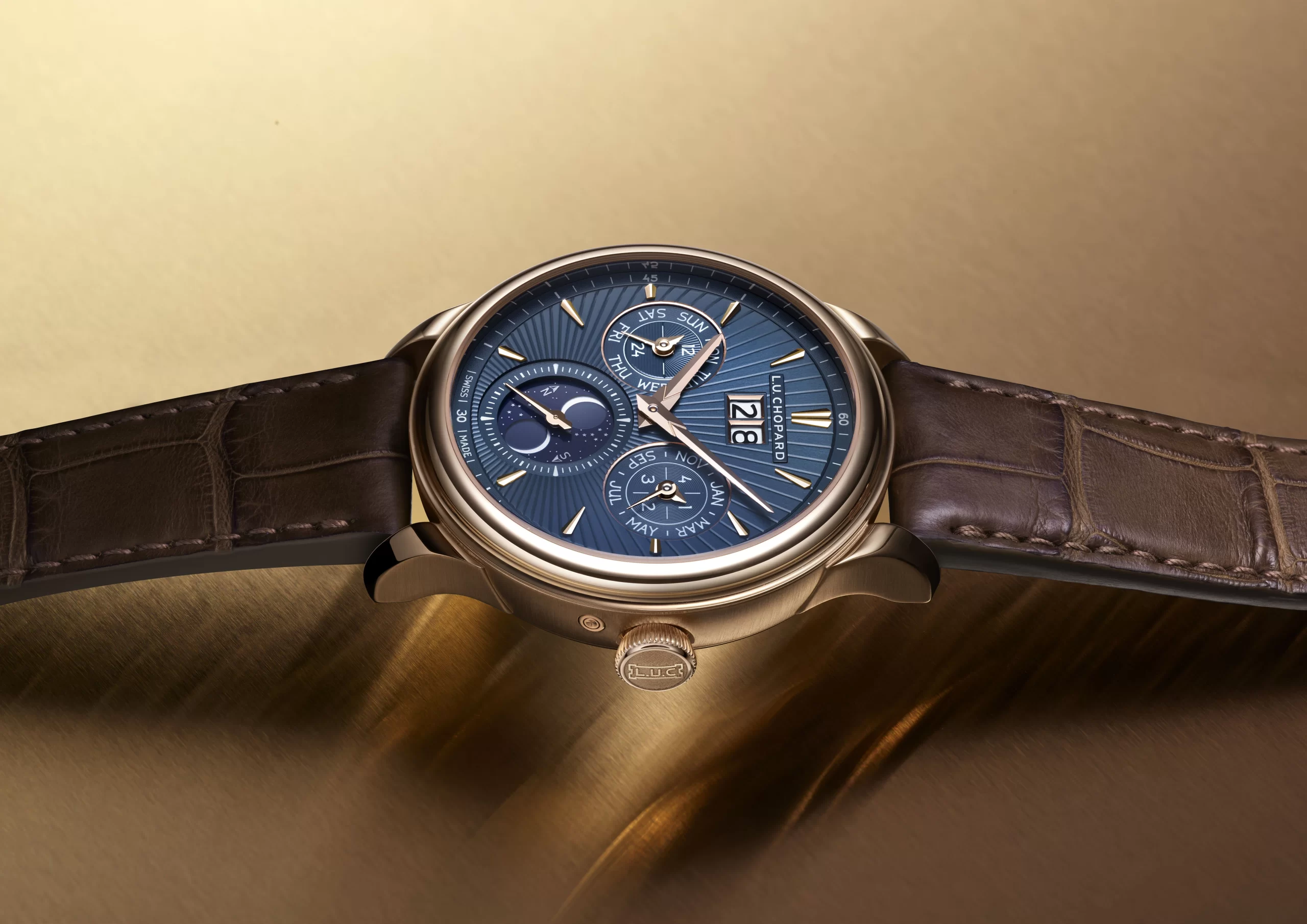
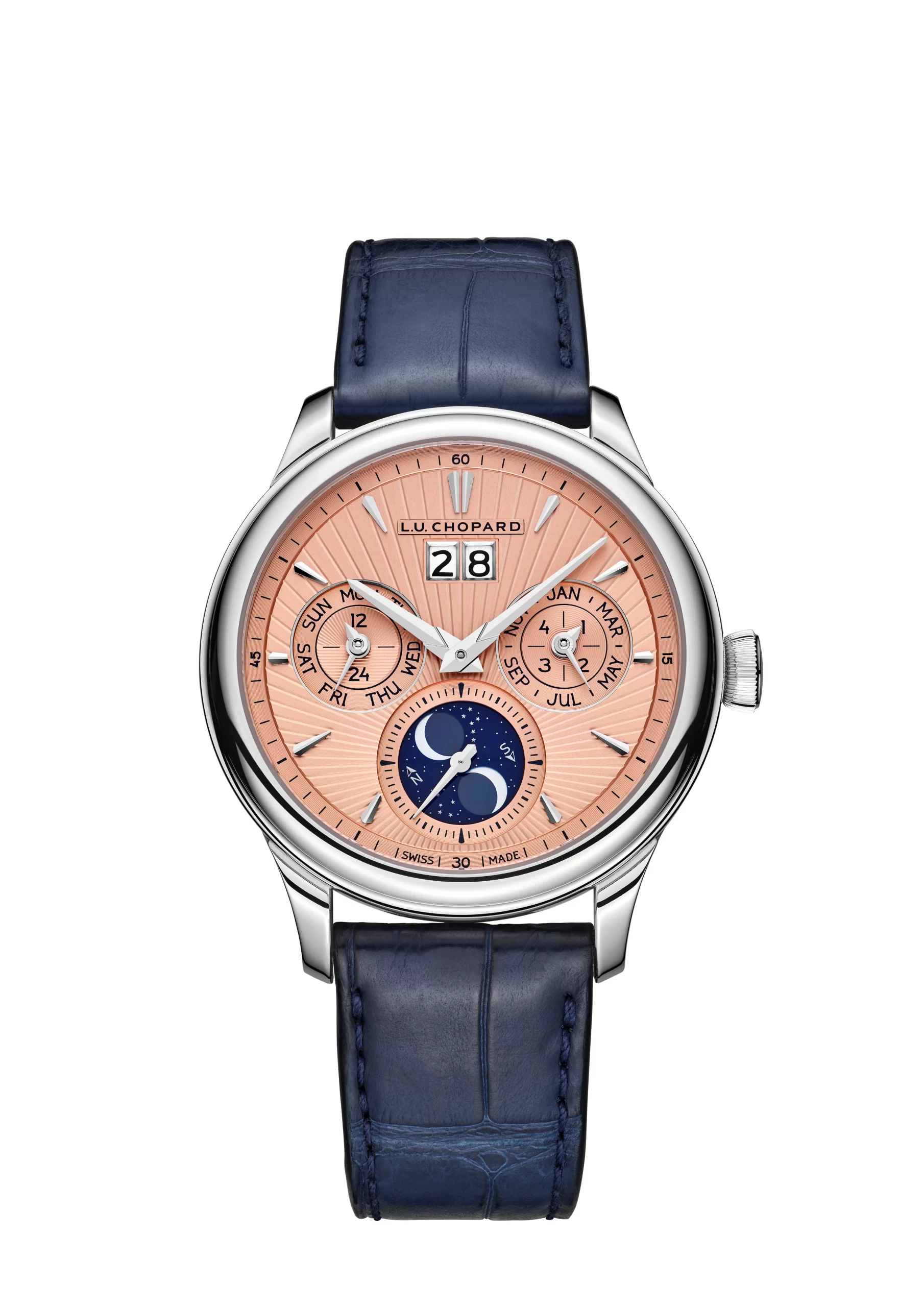
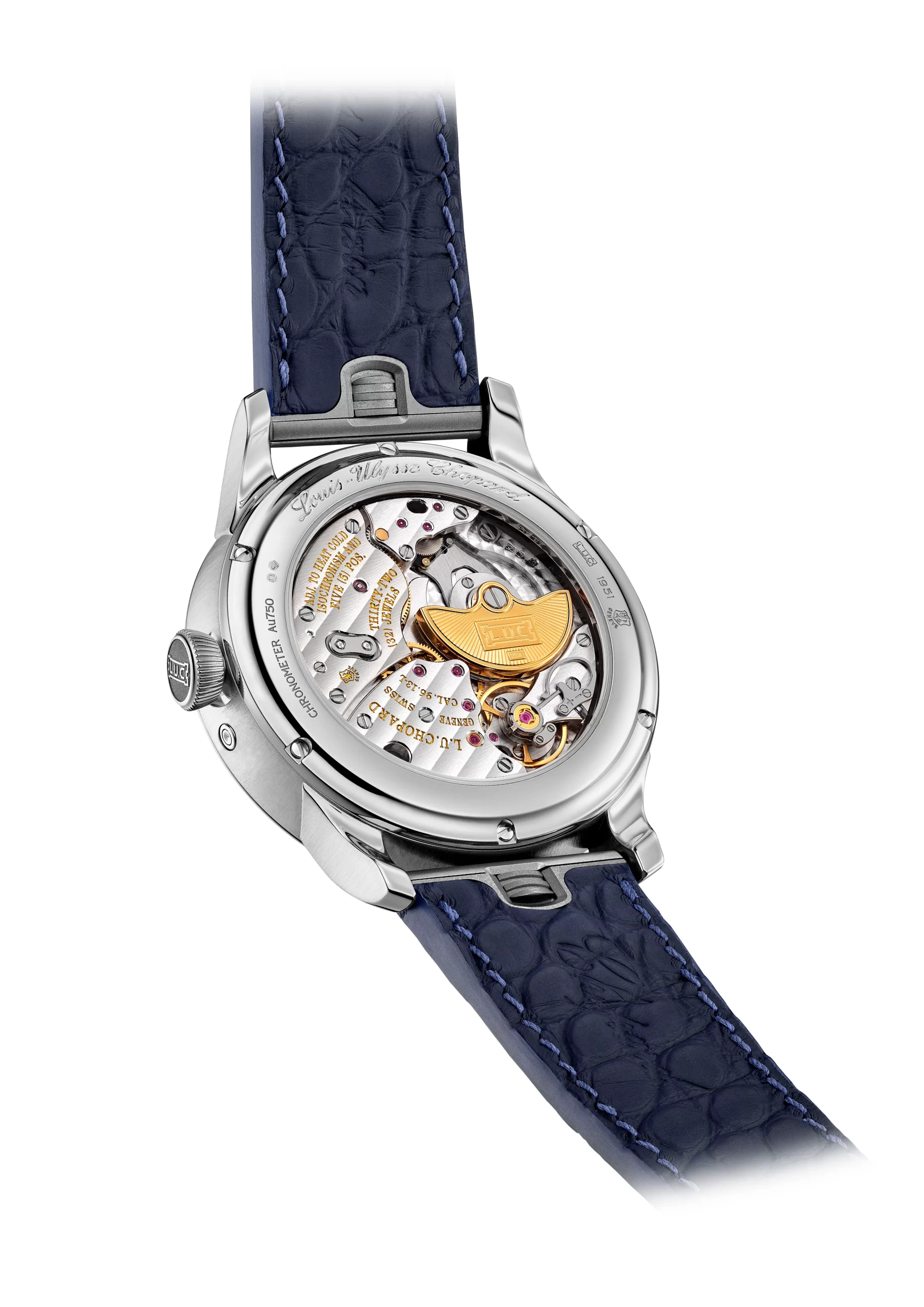
Since being the first ‘calendar and astronomy’ complication presented by Chopard Manufacture in 2005, the L.U.C Lunar One model has remained the only timepiece in its category equipped with a precision orbital moon-phase display featuring a rotating window. The mechanical self-winding L.U.C Calibre 96.13-L with perpetual calendar and astronomical moon-phase function – achieving a rare degree of accuracy guaranteeing a single day’s difference in 122 years – powers two new timepieces whose profile has been reshaped in line with the latest L.U.C aesthetic. Framed by a 40.5 mm-diameter case in ethical 18-carat gold, the hand-guilloché dial demonstrating artisanal expertise is distinguished by highly legible indications, while an ingenious interchangeable strap system offers a variety of styles. While the movement’s accuracy is chronometer-certified, the high-quality finishing of these two L.U.C Lunar One models has also earned them Poinçon de Genève recognition.
L.U.C Calibre 96.13-L: a mere one-day difference in 122 years – astronomical accuracy
In 2005, by introducing a complication for the first time in an evolution of its founding L.U.C Calibre 96.01-L, Chopard Manufacture presented one of its milestones: a large-date perpetual calendar with a degree of astronomical precision to which only a handful of Manufactures can lay claim.
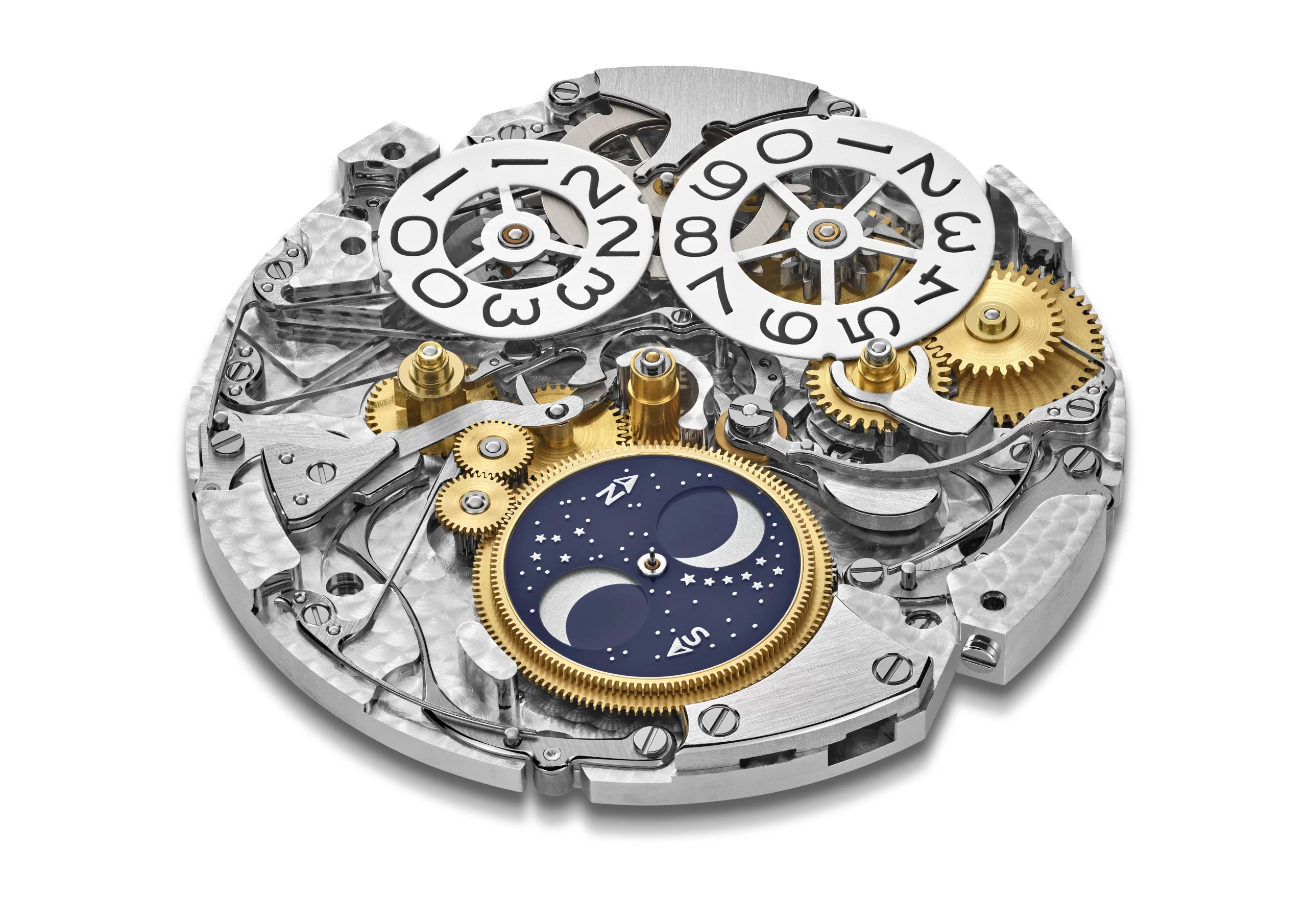
The L.U.C Lunar One timepiece equipped with the L.U.C 96.13.L chronometer-certified movement illustrates the trajectory of the moon with remarkable accuracy. Its perpetual calendar with orbital moon phases clearly indicates the date, day, month and leap years. It also features an additional 24-hour scale. The night star rotates around the small seconds axis, hence the term ‘orbital’. The movement represents the sky as seen from the Northern Hemisphere with the Big Dipper; as well as from the Southern Hemisphere with the Southern Cross. Calibrated by Chopard’s finest watchmaking Artisans, this display boasts astronomical precision: with a time difference of just 57.2 seconds between two moons, it will take 122 years for it to show a one-day discrepancy with the real moon. Only then will it need to be adjusted.
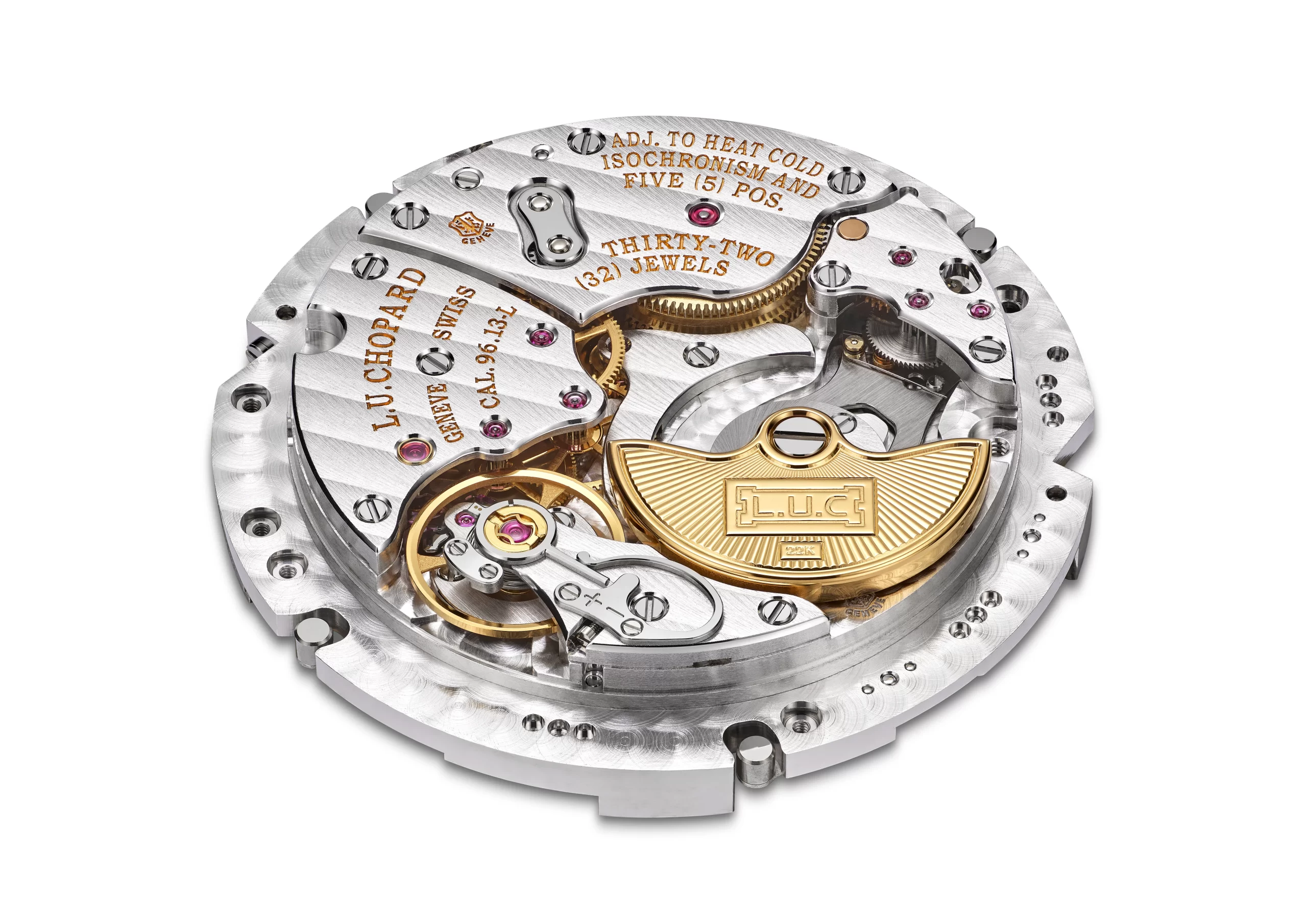
Reflecting Chopard Manufacture’s perpetual quest for slenderness, the L.U.C Lunar One timepiece is also one of the very few self-winding perpetual calendars to feature a micro-rotor. The latter is made of solid gold and integrated into the movement thickness, thereby slimming it down and enabling it to be admired through the sapphire crystal pane fitted on the case-back. Engraved with the L.U.C logo and finely guilloché, this micro-rotor heralds the extreme degree of finishing lavished on L.U.C Calibre 96.13-L – of which all 355 components are produced, hand-decorated and assembled in the Manufacture’s workshops. Thanks to the two stacked barrels of Chopard Twin technology, the L.U.C Lunar One model is also endowed with a 65-hour power reserve.
The Poinçon de Genève: a guarantee of excellence
The L.U.C Lunar One testifies to the finest craftsmanship cultivated by Chopard. Several hundred made-to-measure tools are involved in reworking and hand-trimming each rough-cut component, before manually decorating it using traditional skills – even if it is destined to remain concealed beneath a bridge. Each creation is successively enhanced by chamfering, satin-brushing, polishing, circular graining and Côtes de Genève patterns, before being individually tested and hand-assembled in the workshops. The prestigious Poinçon de Genève quality hallmark to which Chopard has been loyal for many years attests to this degree of artisanal skill and meticulous care. This aesthetic and technical certification is validated by an independent body and governed by a law instated by the Canton of Geneva. It imposes peerless criteria of excellence encompassing the case and movement, including their structure, appearance and precision.
A slimmer, reshaped case
While these two new timepieces are joining the L.U.C Lunar One family, they differ from their predecessors with a slimmer case, subtly reshaped in line with the L.U.C collection’s latest aesthetic codes. At 40.5 millimetres in diameter and 11.6 millimetres thick, they fit smoothly on any wrist. Crafted in ethical 18-carat white or rose gold, the case features a bassine shape, meaning its base is narrower than its domed, polished bezel. Reflecting craftsmanship inspired by the pocket watches that emerged from Louis-Ulysse Chopard’s creative heritage in the 19th century, this distinctive profile creates an impressive sense of aesthetic refinement.
This new case with its vertical satin-brushed sides is paired with a curved, fluted crown that is not only elegant but also easy to handle. The slightly domed sapphire crystal perfectly matches the curves of the bezel, giving the watch a rounded, harmonious profile. Another sign of fine craftsmanship is that the lugs are made separately before being welded to the case to ensure a perfect aesthetic result. This reshaped design makes the L.U.C Lunar One a timeless object for watch connoisseurs, and paves the way for the aesthetics of future timepieces in the collection.
The hand-guilloché dial: a strong commitment to craftsmanship
Since the first L.U.C 1860 timepiece was presented in 1997, the L.U.C models’ dials have perpetuated a legacy reflecting the purest watchmaking tradition, in which the art of guilloché has become a collection signature. Having teetered on the brink of extinction during the 1990s, this age-old craft has survived thanks to the efforts of Manufactures such as Chopard, which still owns a few rare guilloché lathes with which specialised artisans guide their burins over fine metal surfaces to adorn them with repeating patterns accurate to a tenth of a millimetre.
Meticulous work is required to ensure that each dial intended for these new L.U.C Lunar one models – available in a choice of deep blue or salmon pink colours – is adorned with a sunburst guilloché pattern radiating from the moon-phase indicator at 6 o’clock, the focal point of this timepiece.
One particularly distinctive feature of the L.U.C Lunar One model is the large twin-aperture date window at 12 o’clock. A concentric snailed pattern runs around the dial periphery, below the minutes track. The Dauphine fusée hands and herringbone-type hour-markers are in white or rose gold matching the case. The two perpetual calendar counters are also snailed, with the exception of the central section of the one located at 9 o’clock. The latter is dedicated to the 24-hour indicator, which also serves as a day/night display. The upper part (day) bears a radiating pattern symbolising the presence of the Sun, while the lower section is engraved with a horizontal motif evoking the serenity of the night. Ultimately, the arrangement of each indication is both aesthetically pleasing and perfectly legible.
Interchangeable straps: a combination for every occasion
For the first time in the Chopard collections, this new model is equipped with an interchangeable strap system enabling its owner to vary styles and adapt to different outfits, occasions and activities. This extremely convenient new system is designed for quick, tool-free swap-outs via the case middle and clasp. The aim is to guarantee the user-friendliness and wearer comfort that are core to the Chopard philosophy. In addition to the two alligator leather and calfskin straps supplied with the timepiece, each Chopard boutique will offer an assortment of additional straps in a variety of textures and colours.
The L.U.C collection: watchmaking excellence
In 1997, Chopard Manufacture launched the first watch to emerge from its watchmaking workshops: the L.U.C 1860, equipped with the L.U.C 96.01-L movement. Since then, through the L.U.C collection, it has accumulated mastery of all the major horological complications. Between Fleurier and Geneva, Chopard Manufacture conceives, develops, produces, assembles, decorates and certifies all its timepieces. Thanks to Karl-Friedrich Scheufele’s commitment to watchmaking tradition combined with technical innovation, the Manufacture maintains a high level of finishing by preserving numerous artistic crafts and skills.
L.U.C Lunar One
In ethical 18-carat white gold
Case:
Ethical 18-carat white gold
Total diameter 40.50 mm
Thickness 11.63 mm
Water resistance 30 m
Crown in ethical 18-carat white gold with L.U.C logo 6.60 mm
Bassine-shaped case middle with vertical satin-brushed finishes
Polished bezel and case-back
Transparent exhibition case-back
Glare-proofed sapphire crystal
Movement:
Mechanical self-winding L.U.C 96.13-L
Number of components 355
Diameter 33.00 mm
Thickness 6.00 mm
Number of jewels 32
Frequency 28,800 vph (4 Hz)
Power reserve 65 hours
Two stacked barrels – Chopard Twin Technology
Three-spoke balance
Bridges adorned with Côtes de Genève and circular graining
Guilloché-worked micro-rotor in ethical 22-carat gold with L.U.C logo
Balance-spring with Phillips terminal curve
Chronometer-certified by the COSC
‘Poinçon de Genève’ quality hallmark
Dial and hands:
Dial in ethical 18-carat gold featuring a salmon pink colour obtained by galvanic treatment, sunburst guilloché pattern centred around the moon phase
Navy blue transfers
Herringbone-type hour-markers in ethical 18-carat white gold
Dauphine fusée hours and minutes hands in ethical 18-carat white gold
Baton-type day and month hands in ethical 18-carat white gold
Day/night and year indicated by triangles in ethical 18-carat white gold
Functions and displays:
Central display of the hours and minutes
Small seconds at 6 o’clock
Perpetual calendar with day, date, month and leap-year cycle
Month and leap-year display at 3 o’clock
Small seconds a 6 o’clock
High-precision moon phases appearing in a rotating aperture (orbital moon) for Northern and Southern hemispheres, at 6 o’clock
24-hour scale and day of the week at 9 o’clock
Semi-instantaneous twin-aperture large date display at 12 o’clock
Strap and buckle:
Hand-sewn navy blue alligator leather with tone-on-tone stitching, or blue grained calfskin with tone-on-one stitching
Pin buckle in ethical 18-carat white gold
Ref. 161951-1002 – in ethical 18-carat white gold with salmon pink dial
L.U.C Lunar One
In ethical 18-carat rose gold
Case:
Ethical 18-carat rose gold
Total diameter 40.50 mm
Thickness 11.63 mm
Water resistance 30 m
Crown in ethical 18-carat rose gold with L.U.C logo 6.60 mm
Bassine-shaped case middle with vertical satin-brushed finishes
Polished bezel and case-back
Transparent exhibition case-back
Glare-proofed sapphire crystal
Movement:
Mechanical self-winding L.U.C 96.13-L
Number of components 355
Diameter 33.00 mm
Thickness 6.00 mm
Number of jewels 32
Frequency 28,800 vph (4 Hz)
Power reserve 65 hours
Two stacked barrels – Chopard Twin Technology
Three-spoke balance
Bridges adorned with Côtes de Genève and circular graining
Guilloché-worked micro-rotor in ethical 22-carat gold with L.U.C logo
Balance-spring with Phillips terminal curve
Chronometer-certified by the COSC
‘Poinçon de Genève’ quality hallmark
Dial and hands:
Dial in ethical 18-carat gold featuring a blue colour obtained by galvanic treatment, sunburst guilloché pattern centred around the moon phase
White transfers
Herringbone-type hour-markers in ethical 18-carat rose gold
Dauphine fusée hours and minutes hands in ethical 18-carat rose gold
Baton-type day and month hands in ethical 18-carat rose gold
Day/night and year indicated by triangles in ethical 18-carat rose gold
Functions and displays:
Central display of the hours and minutes
Perpetual calendar with day, date, month and leap-year cycle
Month and leap-year display at 3 o’clock
Small seconds a 6 o’clock
High-precision moon phases appearing in a rotating aperture (orbital moon) for Northern and Southern hemispheres, at 6 o’clock
24-hour scale and day of the week at 9 o’clock
Semi-instantaneous twin-aperture large date display at 12 o’clock
Strap and buckle:
Hand-sewn brown alligator leather with tone-on-tone stitching, or anthracite grained calfskin with tone-on-one stitching
Pin buckle in ethical 18-carat rose gold
Ref. 161951-5001 – in ethical 18-carat rose gold with blue dial
In 1755 in Geneva, Jean-Marc Vacheron began writing the first chapter of a story that has become a remarkable human adventure – a quest for excellence passed down from generation to generation. The passion, expertise and creativity of the men and women of the Manufacture have shaped
Constantin’s identity through a subtle balance between technical mastery and artistic sensitivity. Deeply rooted in the workshops, these values do much to explain the Maison’s longevity. Since the turn of this century, Vacheron Constantin has marked each new decade by honouring its heritage, looking to the future and issuing a number of exceptional timepieces. Throughout 2025, to mark 270 years of creation, tradition and innovation, a series of celebrations begins with the reissue of an iconic timepiece, much awaited by its clients, the Historiques 222, cased in stainless steel.
“Since the turn of the century, Vacheron Constantin has taken each decade anniversary as an opportunity to talk about its history and the values handed down through the centuries.”- Christian Selmoni
AN EXTRAORDINARY HUMAN QUEST
In the 18th century, when Vacheron Constantin was born, Geneva was a peaceful and economically prosperous city. ‘The factory that flourished most in Geneva was the watchmaking industry, which accounted for more than a fifth of the city’s population’, noted Diderot and d’Alembert’s Encyclopédie. Its booming economy was matched by great cultural richness: the home city of Rousseau, it attracted other great minds, including Voltaire, who took up residence the same year that the Maison was established.
Jean-Marc Vacheron’s signing of his watchmaking apprenticeship contract in 1755 is regarded as the founding act of Vacheron Constantin – the beginning of a quest for watchmaking excellence driven by the determination and passion of successive generations. This contract also established a fundamental value of the Maison: the transmission of knowledge and skills. The sharing of knowledge over 270 years – at first supported by the open-mindedness of the Age of Enlightenment and always driven by the desire for constant progress – has forged the character of Vacheron Constantin. In 1819, Jacques Barthélémi Vacheron, the founder’s grandson, received a note from his new business partner, François Constantin, urging him to «do better if possible, and that is always possible». This maxim remains the motto of the Maison to this day.
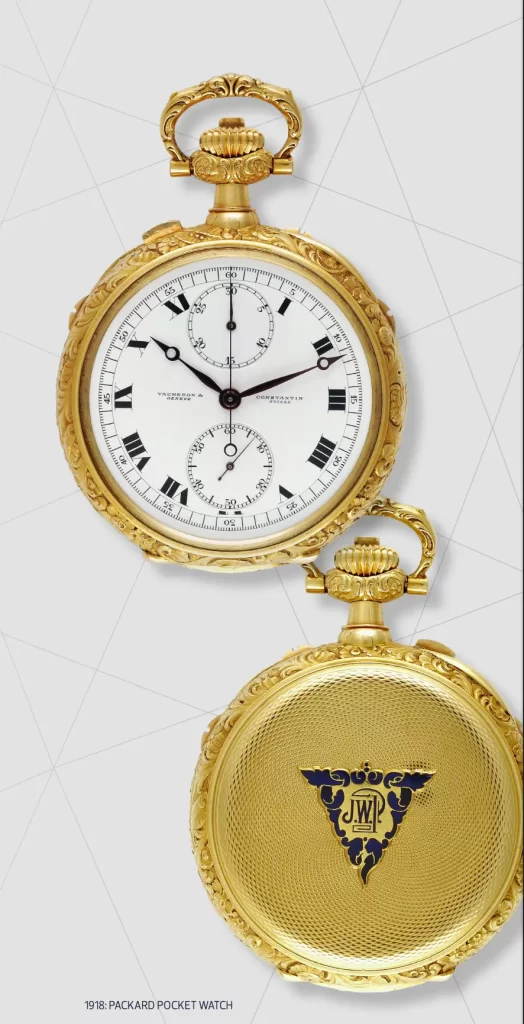
Vacheron Constantin’s enduring success lies in its singular approach to watchmaking – one that deftly balances technical mastery and artistic sensitivity, mechanical complexity and craftsmanship, innovation and elegance. Witness the pocket watch with chronograph and chiming mechanism set in an elaborately chased 20k gold case, created in 1918 for American industrialist James Ward Packard; and the Les Cabinotiers Armillary Tourbillon, a single-piece edition timepiece created in 2023 for the dashboard of the bespoke Rolls-Royce Amethyst Droptail.
Timepieces such as these encapsulate the creativity and skill of the Maison’s watchmakers, artisans and designers, driven by perseverance and passion as they constantly push the boundaries, like a quest driven by perseverance and mastery.
This pursuit of fine workmanship has defined the Maison’s identity for the past 270 years and is showcased through a new communication campaign rolled out in 2025. The campaign refers to the quest for excellence that has always motivated Vacheron Constantin, both in the most accomplished expression of the art of watchmaking and in the promotion and transmission of knowledge. The result is a visual story of a human adventure which longevity is entirely dependent on this seek for beauty. Woodkid, a French musician and artistic director who has been working with the Maison for the past three years, notably on mentoring programs, has composed music dedicated to this 270-year quest for excellence.
270 YEARS OF TECHNICAL ACCOMPLISHMENTS AND HOROLOGICAL INNOVATION
Throughout its history, Vacheron Constantin has been imbued with a boldly creative spirit that has given birth to countless innovations, particularly in the field of high complications and timekeeping precision.
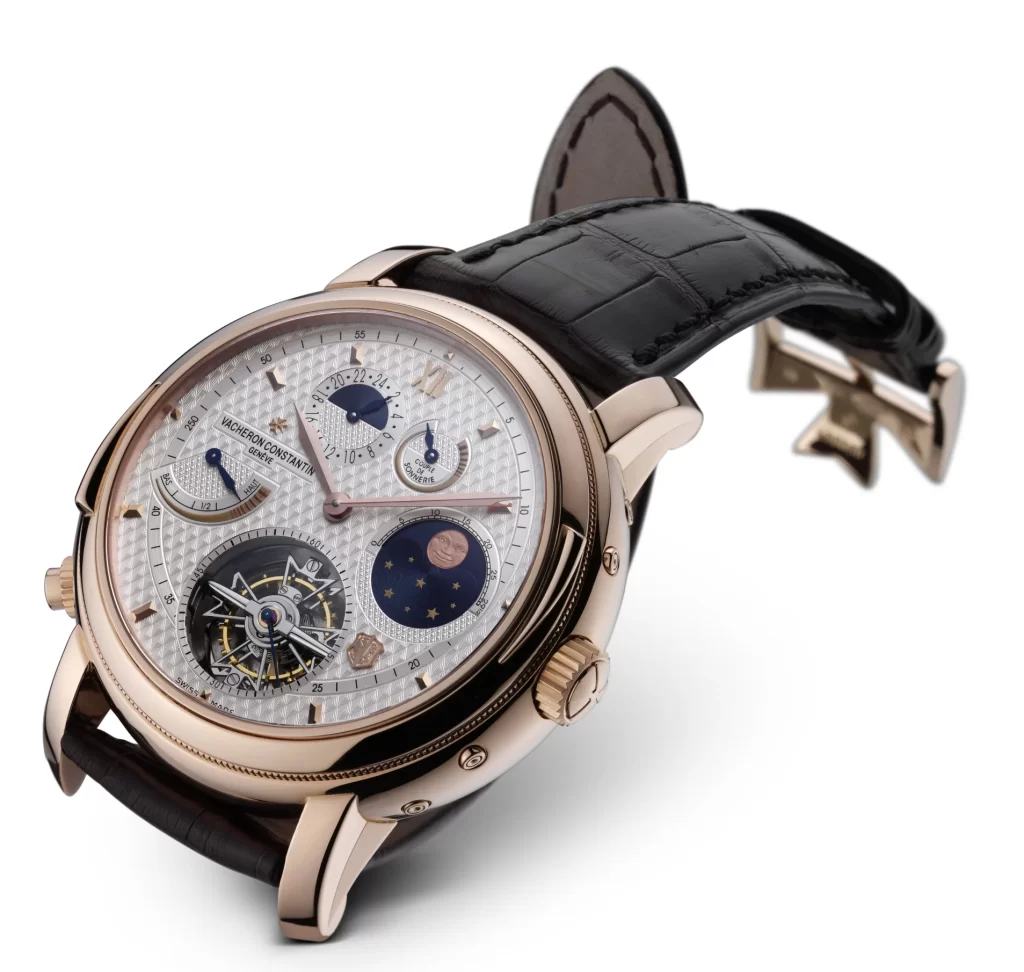
From the first calendar timepiece recorded in the Manufacture’s archives in 1790 to the 2024 Les Cabinotiers The Berkley Grand Complication watch equipped with 63 complications, the Manufacture has explored many fields of technical expression: chiming watches, mechanisms for measuring short intervals of time, astronomical functions, special displays and tourbillon regulators.
These avenues of research and development have led to major innovations, not only in timekeeping mechanisms but also in the refinement of production processes. In 1839, the Manufacture engaged Georges-Auguste Leschot to invent a special watchmaking pantograph that enabled the standardisation and interchangeability of components for watches equipped with the same calibre. In 1934, it developed a portable high-frequency precision device enabling the calculation of 1/20th of a second.
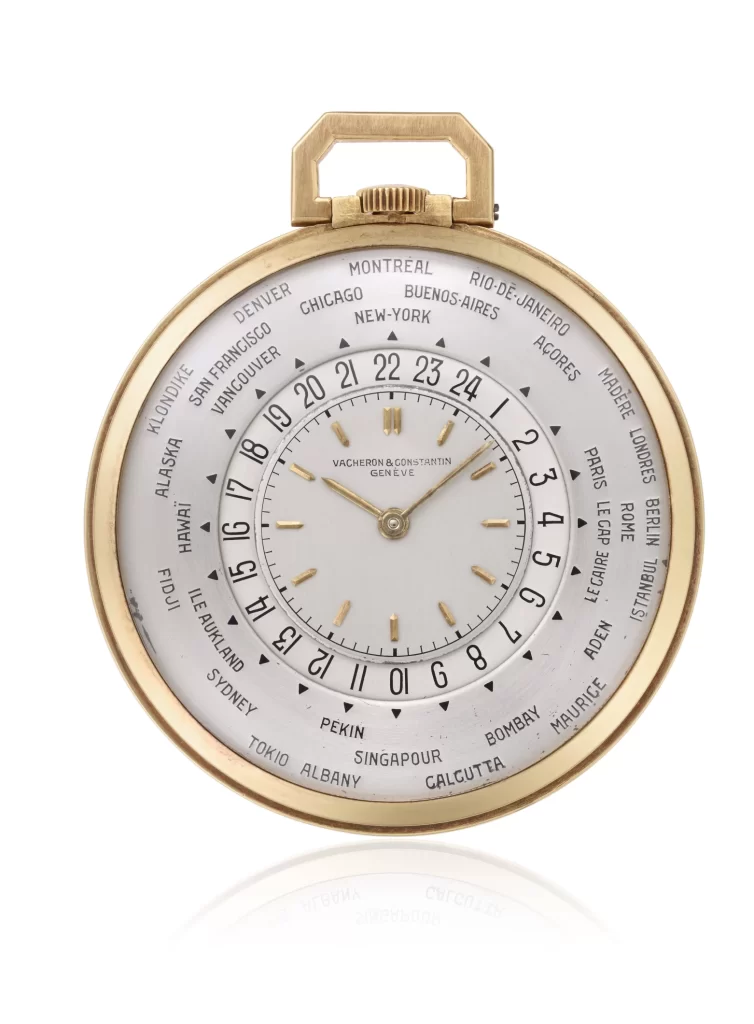
In 1914 the Maison’s passion for technical innovation led to the creation of a very small rectangular movement named the tuyau (pipe). At just 26 mm long and 6.5 mm wide, it was the forerunner of the baguette movement, which was fitted to many jewellery watches. In 1932, Vacheron Constantin collaborated with Louis Cottier in developing Reference 3372, the first watch to incorporate the ‘Cottier system’ world time complication. Patented the previous year, the complication enables the simultaneous display of 24 time zones and was to become the standard on which almost all world time displays are based.
Many more world firsts have followed – among them the first retrograde date display (the “Don Pancho” in 1940), the first Hebraic perpetual calendar (Les Cabinotiers Reference 57260 in 2015) and the first Chinese perpetual calendar (Les Cabinotiers The Berkley Grand Complication in 2024). In 2019, the Maison developed a dual-frequency mechanism with two oscillators, presented in Calibre 3160 QP. By alternating between the 5 Hz oscillator (active mode) and the 1.2 Hz oscillator (standby mode), the power reserve can be extended to 65 days.
In Vacheron Constantin’s quest for excellence, accuracy of timekeeping is a prerequisite – equally fundamental in time- only calibres and the most complicated watches – such as Les Cabinotiers Celestia Astronomical Grand Complication 3600, which is orchestrated around civil, solar and sidereal time. This pursuit of timekeeping precision is symbolised by the Maltese cross that has been the Maison’s emblem since 1880. The emblem was inspired by the shape of a component in early movements that improved constant force from the mainspring.
In the 19th century, marine chronometers were synonymous with scientific progress, as the burgeoning of chronometry competitions – notably in Geneva from 1872 onwards – gave the Manufacture the opportunity to shine in this field. In 1869, Vacheron Constantin presented a pocket chronometer with a yellow gold hunter-type case and a white enamel dial, regulated by a highly accurate detent escapement. In 1947, a Vacheron Constantin pocket-watch, submitted to the Geneva Observatory and tested during the 44 days of the competition, registered an average daily deviation in rate of just two hundredths of a second.
In 1907, the Manufacture unveiled the Chronomètre Royal, conceived as a robust and highly technical timepiece that offered an outstanding level of precision and reliability. In 2007, the centenary of that watch was marked with a special re-edition that not only bore the Hallmark of Geneva and COSC chronometer certification, but also successfully passed the Manufacture’s stringent 30-day functional test.
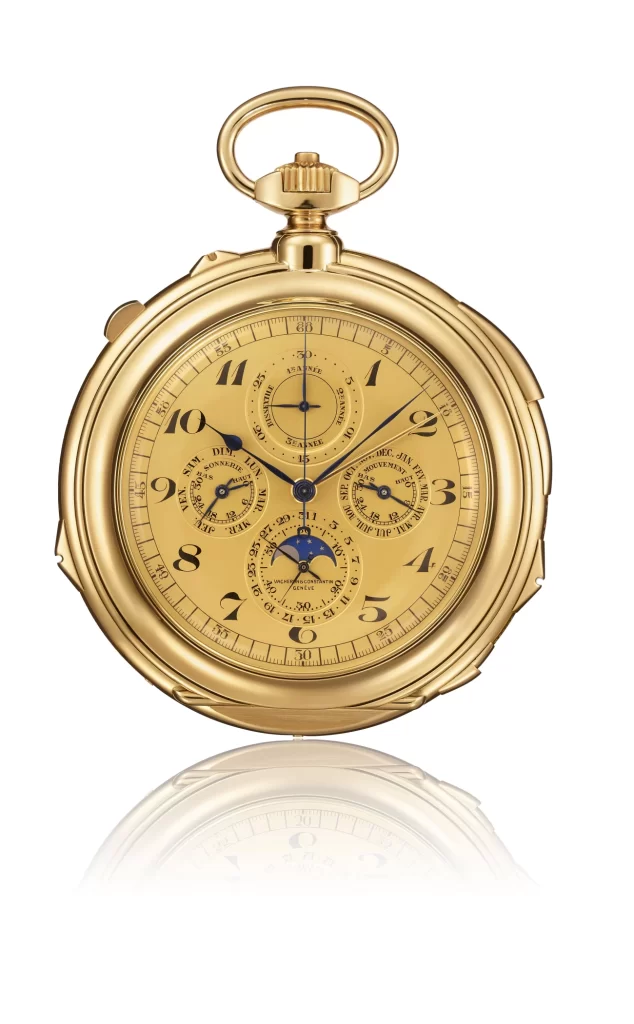
Not content with simply mastering horological complications, Vacheron Constantin went further, combining them in highly complex calibres. During the first half of the 20th century, in keeping with long-established tradition, many special, high-complication timepieces were commissioned from the Maison by distinguished collectors or created as gifts for sovereign rulers. In 1929, King Fouad of Egypt was presented with a Grand Complication pocket watch with beautiful enamelling on the yellow gold case, by Egypt’s Swiss expatriate community. In 1946, as a gift for King Fouad’s son, King Farouk I, the Swiss government commissioned a chiming pocket watch in 18k yellow gold that combined a minute repeater with Grande and Petite Sonnerie with a split-seconds chronograph, perpetual calendar, indication of the phases and age of the moon, an alarm and two power reserves.
270 YEARS OF AESTHETIC MASTERY AND BOLD CREATIVITY
Since the earliest days, the value that has clearly distinguished Vacheron Constantin from other watchmakers is that its continuing quest for complex mechanical engineering is inseparable from its pursuit of beauty and cultivation of aesthetic craftsmanship. This ethos is applied not only to the outside of timepieces but also to the inside part once assembled.
Every movement component is hand-finished – even those that are invisible once the watch is assembled. Many calibres carry the prestigious Poinçon de Genève (Geneva Seal), a hallmark awarded only to timepieces made in Geneva and attesting to the highest level of hand-decoration and finishing. Decorative techniques may include perlage, Côtes de Genève, bevelling, chamfering, mirror-polishing and engraving. An art unto itself, open-working involves the carving away of metal from movement components to leave only a fine structural skeleton that allows the eye to travel deep into the calibre – its most accomplished and technically demanding expression being the skeletonisation of ultra-thin movements.
Vacheron Constantin has its own métiers d’art workshops. Here, specialised artisans have mastered the crafts of engraving, gem-setting, enamelling and guillochage, among many others – elevating timepieces into miniature works of art and honouring a philosophy that dates back to the Maison’s beginnings.
An early example of this approach is a 1812 quarter-repeater watch with an enamel dial and guilloché caseback, which epitomised the Maison’s technical mastery and artistic sensibility. In 1943 the Maison introduced Reference 4261, a minute repeater with a record-setting ultra-thin movement just 3.2 mm thick. The technical prowess inherent in this movement is equalled by the pure elegance and sublime craftsmanship of its case and dial. At 36 mm in diameter and just 5.25 mm thick, the case – with double-stepped bezel and convex three-tiered sides – is complemented by teardrop-shaped lugs. On the sector dial, pierced dots mark the minutes and Roman numerals and faceted arrowhead hour markers are applied onto a guilloché pattern of concentric circles.
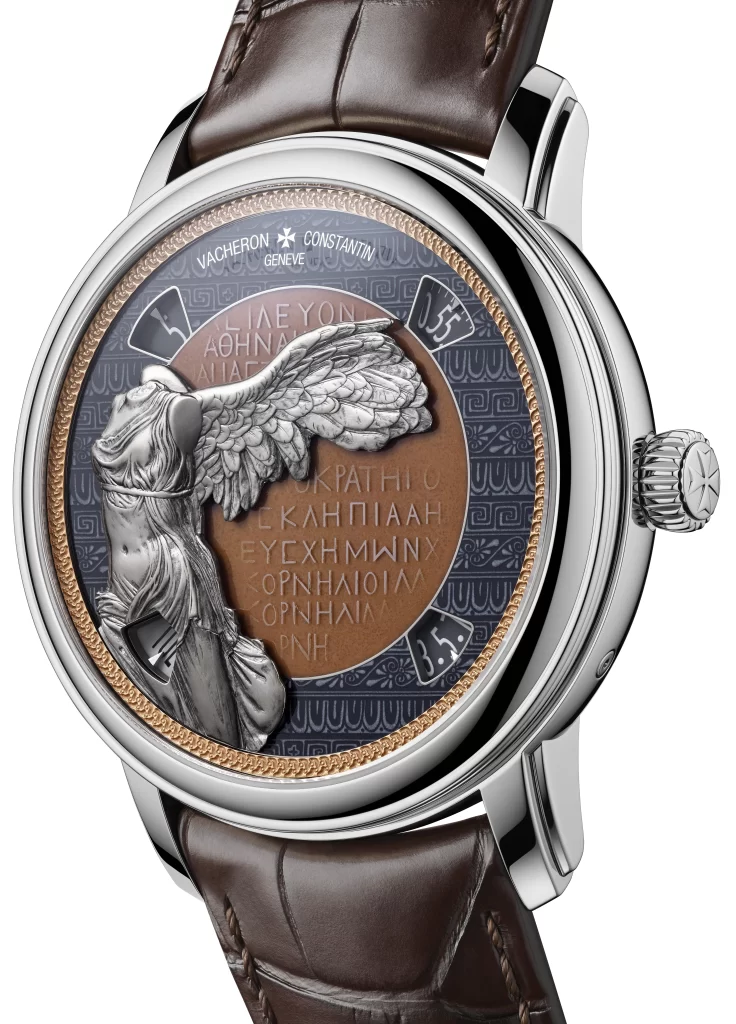
Today, combined with the Manufacture’s openness to world cultures (symbolised by its partnerships with some of the world’s greatest institutions – the Louvre in Paris, the Metropolitan Museum in New York and the Educational Institute of the Palace Museum in Beijing), the expertise housed in the métiers d’art workshops has made possible the creation of pieces that are as original as they are beautiful. Among many examples the Métiers d’Art – Tribute to Great Civilisations (2022). With four discs indicating the hours, minutes, days and dates, they seamlessly blend mechanics and art into a whole.
Throughout Vacheron Constantin’s history, its deep commitment to craft has been allied to great creative flair, fostering a signature that has been perpetually in tune with its time – inspired and progressive yet always imbued with classical elegance.
In the 1920s, as men began to adopt wristwatches rather than carrying pocket watches, Vacheron Constantin introduced the American 1921, an avant-garde wristwatch named after its year of launch and the market for which it was secretly produced. Capturing the spirit of the Roaring Twenties, it is said to have been originally designed with drivers in mind: with a cushion-shaped case offset by 45 degrees and the crown at 1 o’clock, its white enamel dial reveals time at a glance with no need for the driver, according to legend, to lift his hand from the steering wheel.
In June 1972, the French government awarded the rare Diplôme du Prestige de la France to Vacheron Constantin – the first watch company to receive the honour. To celebrate this honour, Vacheron Constantin designed a new wristwatch with an oval movement set in an asymmetrical quadrilateral case – an early example of the bold aesthetics that characterised the emancipatory style of the 1970s.
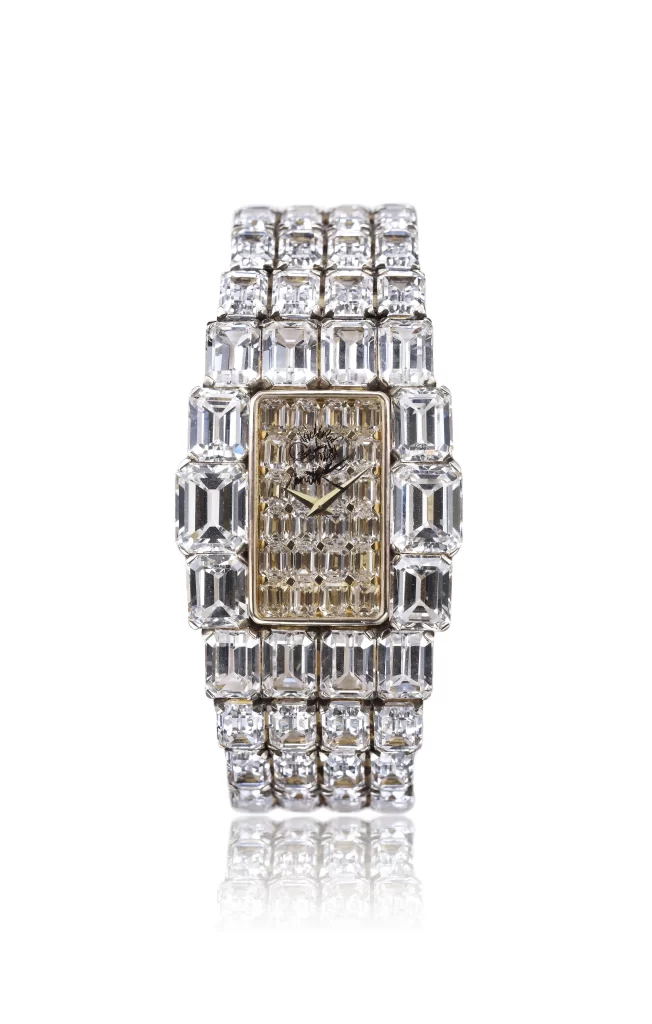
Since the creation of the Maison’s first ladies’ watch in 1889, Vacheron Constantin’s quest for innovative and imaginative watchmaking has consistently led it to pay particular attention to High Jewellery timepieces. A curved version of the baguette movement was made in 1916 for a ladies’ wristwatch acquired by the Maharaja of Patiala, Sir Bhupinder Singh. Crafted in platinum and diamonds, its open-worked, chased and engraved case enables a sideways view of the time. In 1979, the presentation of the Kallista represented the apotheosis of High Jewellery watchmaking. Carved from a one-kilo gold ingot and set with 118 diamonds totalling 130 carats, it required 6,000 hours of work.
In 1994, exploring an entirely different stylistic avenue, Vacheron Constantin commemorated the 400th anniversary of the death of the Flemish Renaissance cartographer Gerhard Kremer, known as Mercator. The dial of the Mercator watch features a multicoloured champlevé enamel motif representing one of his hemisphere maps and the movement features bi-retrograde hours and minutes. Time displays such as this, including jumping hours and retrograde indications, are a signature of the Maison – their visually engaging style underpinned by highly sophisticated mechanics.
“These milestone anniversaries celebrate a philosophy that combines mechanical research and innovation with a deep commitment to craft and a stylistic approach that is both progressive and highly respectful of classical elegance.”- Christian Selmoni
CELEBRATING MILESTONE ANNIVERSARIES WITH EXCEPTIONAL TIMEPIECES
In 1955, to mark the bicentenary of its founding, Vacheron Constantin showcased the marriage of aesthetic elegance and technical know-how with a series of the thinnest watches ever conceived until that time. The three models were equipped with Calibre 1003, a hand-wound movement as thin as a 20 Swiss centime coin at just 1.64 mm – bearing the Poinçon de Genève hallmark as testament to the superlative hand-finishing of its components.
The Maison also presented the Reference 6068 in a limited edition. Its dial is distinguished by the Maltese Cross emblem – and the four lugs on the 18k yellow gold case form the same cross when brought together.
Since the 1990s, Vacheron Constantin has celebrated each decade anniversary by presenting timepieces that perfectly illustrate the expertise cultivated within the Manufacture since 1755. In 1995, to mark its 240th anniversary, Vacheron Constantin showcased its philosophy of balancing technical prowess and aesthetic sophistication, by unveiling a tonneau-shaped watch in gold or platinum. Set in a case with moveable lugs, Calibre 1127 offers a power reserve indicator along with date and small seconds displays.
In 2005, the Tour de l’Île watch marked the Maison’s 250th anniversary. The movement, Calibre 2750, united 16 complications to be read off a double-sided display, making it the most complicated ever series-produced wristwatch. In the same landmark year, the Manufacture presented the Saint Gervais – with a record-breaking 250-hour power reserve delivered by four barrels – the Jubilée 1755, an ode to sophisticated simplicity; the Métiers d’Art Four Seasons; and L’Esprit des Cabinotiers – a one-of-a-kind secret clock concealed within an eight-petaled pink gold orb.
A decade later, to mark its 260th anniversary, Vacheron Constantin unveiled the entirely new Harmony collection, comprising models for both men and women in a cushion- shaped case. Set in an 8.40 mm case, the Harmony Chronographe Grande Complication set a new world record with the self-winding Calibre 3500 – comprising 459 components – measuring just 5.20 mm thick. The flagship piece of this anniversary was the Les Cabinotiers Reference 57260 pocket watch, which took eight years to develop and craft, featuring 57 complications, including the first Hebraic perpetual calendar.
“While talking about the Maison’s remarkable heritage is one thing, putting it into practice is another. Each of these anniversaries is marked by timepieces that perfectly illustrate the values cultivated within the Manufacture since 1755.”- Christian Selmoni
HISTORIQUES 222 STAINLESS STEEL WATCH, REINVENTING A SYMBOL OF DARING CREATIVITY
To begin the celebration of 270 years of passion, and in response to the expectations of its clients, Vacheron Constantin presents the inaugural timepiece marking its anniversary year: the Historiques 222 in stainless steel.
This model harks back to a legendary creation, first unveiled in 1977 to mark its 222nd anniversary. Designed by Jorg Hysek, the model was an immediate departure from the sports watch conventions of the time, which had mainly been professional models for pilots, divers and explorers, and captured a new cultural mood that blurred the lines between formality and sportiness. As well as marking a break with traditional sports watch characteristics, the 222 was a quintessentially 1970s design and introduced a new stylistic signature to the Maison.
Fitted with an integrated bracelet, its case featured a functional construction with a flat table, topped by a prominent fluted bezel and stamped with a Maltese cross at 5 o’clock. The monobloc case, which required the movement to be fitted from the top, was water-resistant to 120 metres thanks to its screw-down bezel. Displaying the hours, minutes and date, the 222 also boasted exemplary slenderness at just 7 mm, thanks to the ultra-thin Calibre 1120; measuring a mere 3.05 mm, it was the world’s thinnest full-rotor automatic movement. Balancing this visual elegance, the simple, baton-style hands and hour-markers, and the large hexagonal central links of the bracelet conveyed an impression of robustness and confident modernity.
In 2025, Vacheron Constantin presents a new edition of the first 222 model – nicknamed ‘Jumbo’ by collectors and featuring a blue dial framed by a 37 mm stainless steel case. The re-edition benefits from several technical improvements. The joints of the bracelet – which is now fastened with a triple-blade rather than a twin-blade clasp – have been redesigned to hide the visible pins and improve ergonomics. The caseback which bears a signature representing Vacheron Constantin’s 270th anniversary has been fitted with a transparent sapphire crystal to reveal the in-house Calibre 2455/2. Slightly smaller in diameter than its predecessor, it is still only 3.6 mm thick. The oscillating weight of this high-precision movement is engraved with the original 222 logo and edged with a fluted motif reminiscent of the bezel. Thanks to its frequency of 4 Hz (28,800 vibrations per hour) – compared with 2.75 Hz on the original model – the movement offers enhanced precision and is endowed with a 40-hour power reserve.
On the dial, the date window has been moved towards the centre so that it no longer encroaches on the minutes track. The vintage font of the “AUTOMATIC” inscription and the Super-LumiNova® coating of the hands and hour-markers (off-white by day and lime green by night) are a nod to the hue of the tritium used in historical timepieces. The finishing displays Vacheron Constantin’s eternal attention detail, with a combination of vertical satin-brushing and polishing on several elements of the watch, such as the crown, bracelet and bezel, which creates fascinating light effects.
Like all of the models in Vacheron Constantin’s Historiques collection, the 222 marked an important point in the Maison’s history. While retaining the distinctive design – along with the nostalgic charm – of the original, the 2025 re-edition in stainless steel is absolutely contemporary, embodying the Maison’s core values with sophisticated refinement, a sense of casual ease and uncompromising commitment to the quest for excellence.
“By kicking off its 270th anniversary with this iconic timepiece – one that is vintage yet resolutely contemporary – the Maison is weaving past and present together.”- Alexandra Vogler
TECHNICAL DATA
Historiques 222
Reference: 4200H/222A-B934 Calibre: 2455/2
Developed and crafted by Vacheron Constantin
Mechanical, self-winding, 22K 3N yellow gold dedicated oscillating weight 26.2 mm (111⁄4‘’’) diameter, 3.6 mm thick
Approximately 40 hours of power reserve
4Hz (28,800 vibrations per hour)
194 components
27 jewels
Hallmark of Geneva certified timepiece
Indications: Hours, minutes, date
Case: Stainless steel
37 mm diameter, 7.95 mm thick
18K yellow gold Maltese cross placed at 5 o’clock
Transparent sapphire crystal caseback
Water-resistance tested at a pressure of 5 bar (approx. 50 metres)
Dial: Blue
White gold polished Maltese cross applied to the dial
White gold hour-markers and hands highlighted with Supe-LumiNova® (off-white during the day and lime green at night)
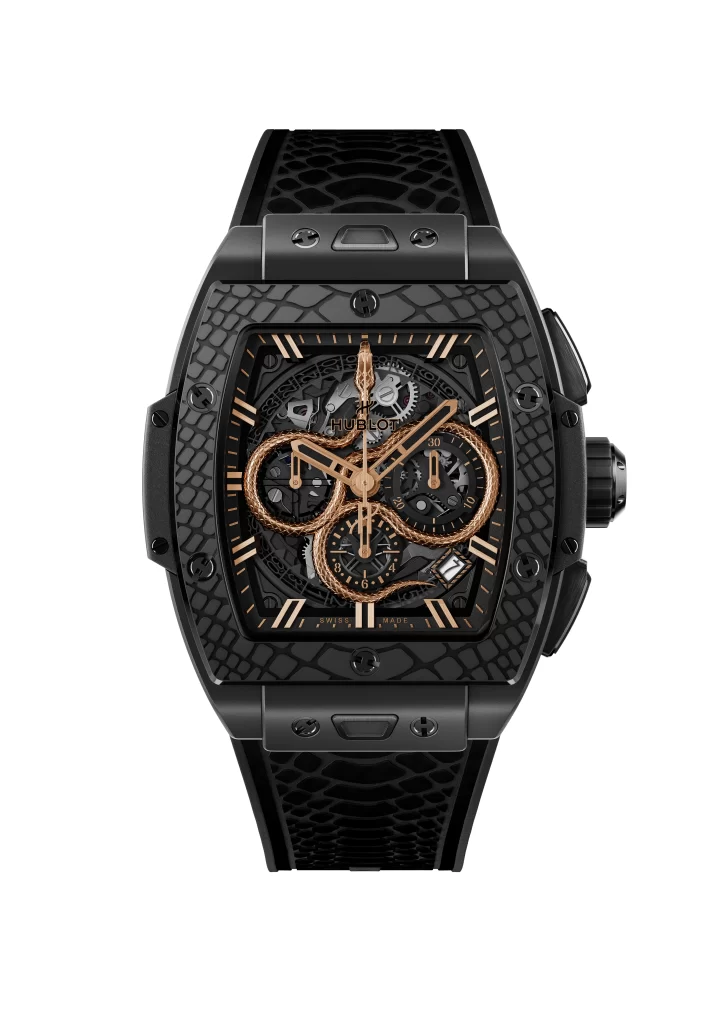
Hublot continues it’s tradition of celebrating the zodiac animals of the Chinese lunisolar calendar in creative and surprising ways with the Spirit of Big Bang Year of the Snake.
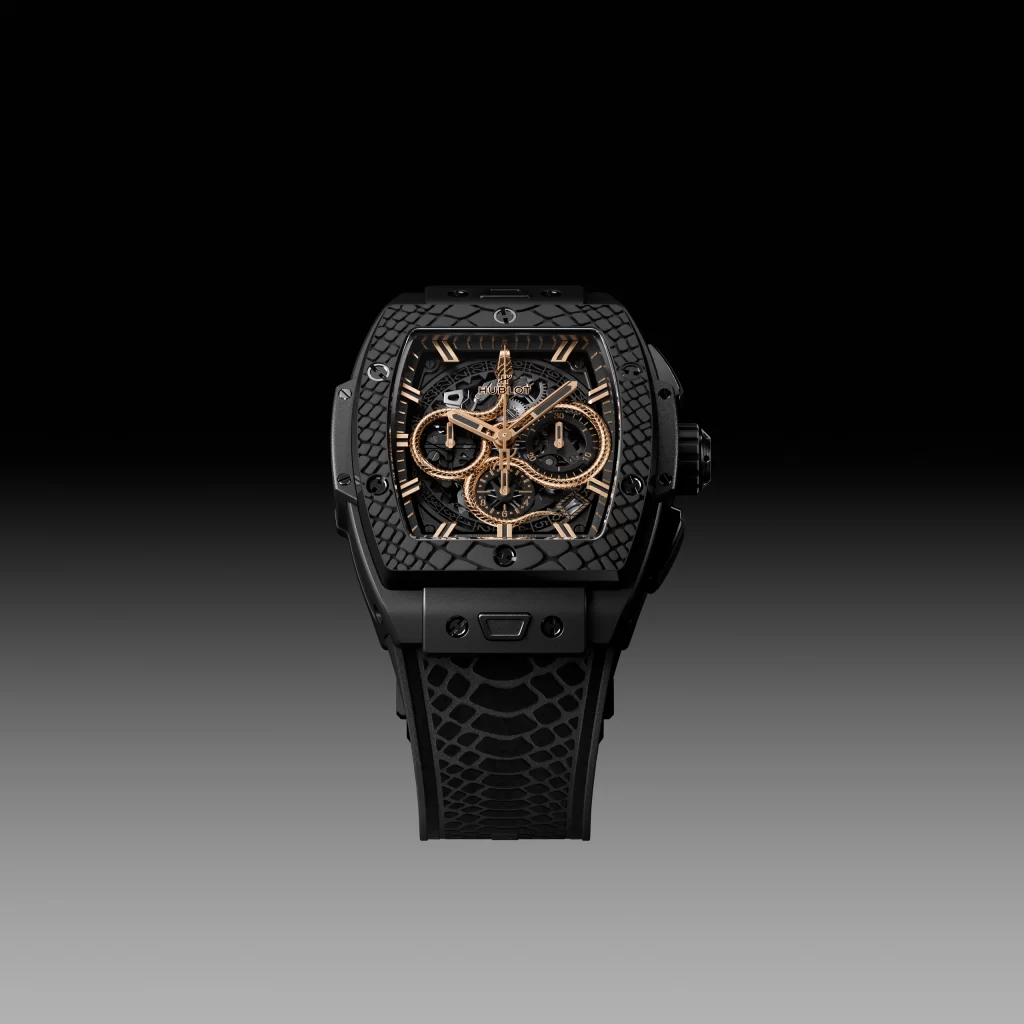
A symbol associated with wisdom, charm and transformation, the snake holds a special place in the Chinese zodiac system. Since 2016, Hublot has celebrated each Chinese new year with an artfully rendered special edition of the Spirit of Big Bang. Reinterpreting these symbolic animals in contemporary and unexpected ways, Hublot has crafted an ornate rendition of the snake that extends from the dial to the case and even the strap in the Spirit of Big Bang Year of the Snake, a limited edition of 88 pieces.
The Spirit of Big Bang’s signature open dial revealing the inner working of the chronograph movement is inhabited by a golden snake. Striking and three-dimensional, the gold-plated snake is crafted with lifelike details that have been engraved with astounding precision thanks to the latest advancements in laser technologies. Carefully positioned as if slithering around the chronograph’s three counters, the serpent immediately catches the eye and intrigues.
The black barrel-shaped ceramic case features Hublot’s patented One-Click strap changing mechanism, and is topped by a screwed ceramic bezel that is engraved to reveal a pattern of snake scales. This pattern extends to the black rubber strap, which has a uniquely velvet finish with a slight shimmer, even though it is entirely made of a single piece of rubber with an innovative embossing technique.
The Spirit of Big Bang Year of the Snake is powered by the Hublot automatic skeleton chronograph calibre HUB4700, which ia s modernized descendant of the historic and highly prized El Primero, considered the first Swiss high-frequency integrated chronograph calibre ever made. Visible from both the open dial and sapphire display back, the movement hosts a number of technical innovations and advancements compared to the original from 1969, including a low-friction silicon escape wheel.A limited edition of 88 pieces, the Spirit of Big Bang Year of the Snake is available at Hublot boutiques and authorized retailers around the world.
SPIRIT OF BIG BANG YEAR OF THE SNAKE
REFERENCE: 642.CI.0180.RX.CNY25
Limited to 88 pieces
CASE: Microblasted and Polished Black Ceramic
Diameter: 42 MM
Thickness: 14.1 MM
Water resistance: 10 ATM / 100 M
CASEBACK: Microblasted and Polished Black Ceramic
BEZEL: Microblasted and Polished Black ceramic
Engraved with Snake Skin Texture
DIAL: Sapphire Crystal with Gold-plated Snake Applique
MOVEMENT: HUB4700 Self-winding Skeleton Chronograph
Frequency (HZ): 5 (36’000 A/H)
Power reserve (hours): 50
Number of components : 278
Jewels : 31
STRAP AND CLASP:Black Rubber with Snake Skin Texture Black Ceramic and Black-plated
Titanium Deployant Buckle