The Classics Moneta collection has swiftly established itself as the new benchmark of Frederique Constant’s offering. The Manufacture has chosen to give the collection a new mechanical, vintage-inspired charm. The new Classics Moneta Handwinding introduces a 38.5 mm case and is powered by a hand-wound movement developed by La Joux-Perret, delivering an impressive 63-hour power reserve. Its smoked salmon gradient dial is paired with a vintage-style alligator leather strap featuring a small-scale pattern, creating an elegant and distinctly neo-retro aesthetic. Produced in a limited edition of just 999 pieces, this new model is available for under €2,000.
The Classics Moneta: A Distinctive Case Design
No one can predict what will make a collection successful. Yet one thing is certain: since its launch in 2024, the Classics Moneta has made a striking impression. Its greatest strength lies in the geometry of its case. A watch case is typically distinguished by its shape or finishing. Here, the secret lies in the inner rehaut, whose profile is subtly sculpted with fluting reminiscent of the edge of a coin – the detail that inspired its name. The aesthetic is both familiar and distinctive, showcasing a traditional hallmark of fine watchmaking in an unexpected location on the case, creating a striking sense of originality.
The same balance defines this first mechanical edition, limited to just 999 pieces: a carefully judged harmony between the finest elements of contemporary watchmaking and the inspiration of the great classics of the last century.
The First Mechanical Movement
The first notable development is the introduction of the collection’s first mechanical movement. Produced by La Joux-Perret in La Chaux-de-Fonds, Switzerland, and customised exclusively for Frederique Constant, it is a finely crafted hand-wound calibre. As La Joux-Perret and Frédérique Constant are both part of the Citizen Group, it can truly be considered an in-group movement.
Côtes de Genève Decoration and 63-Hour Power Reserve
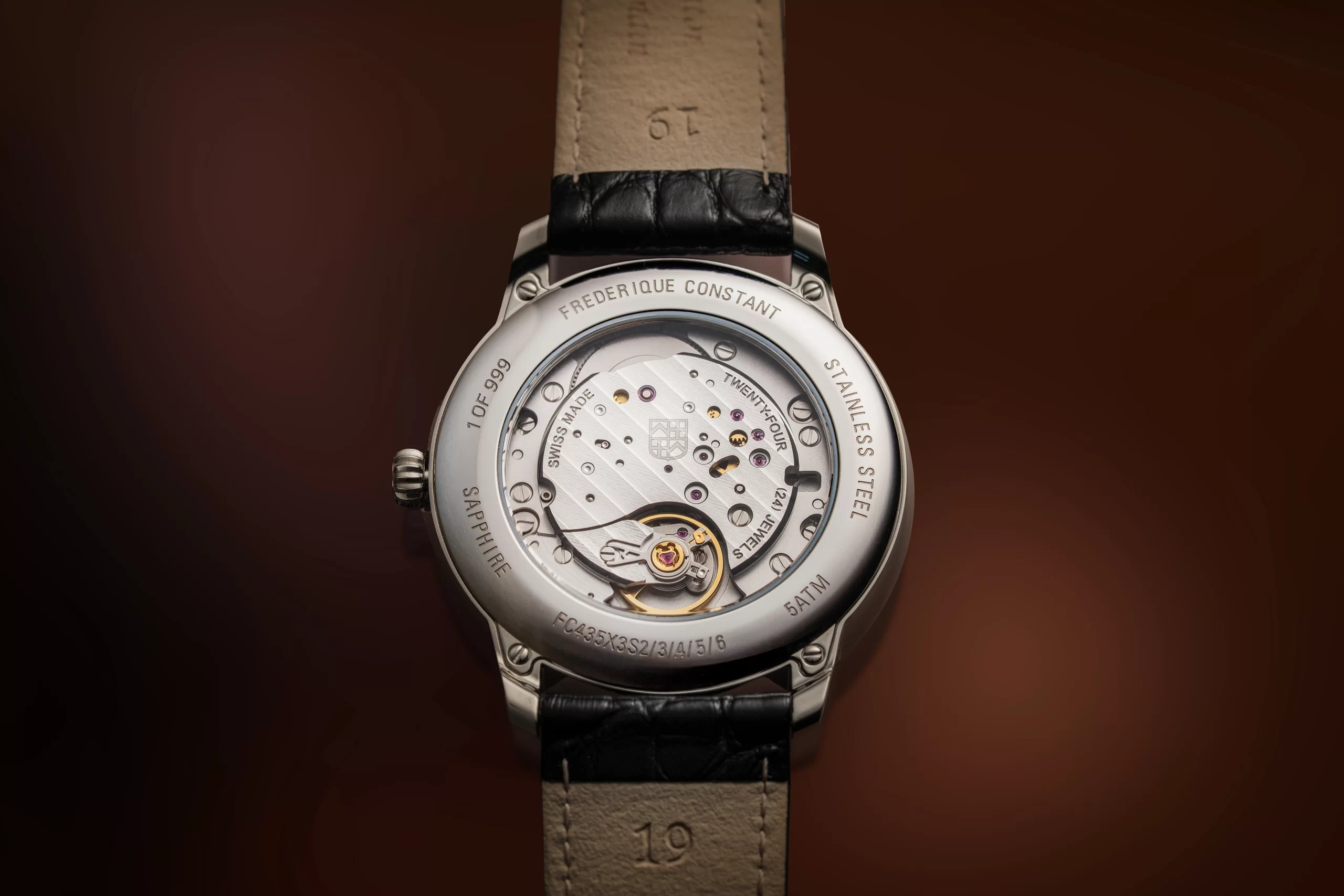
Visible through the sapphire case back, the movement is adorned with Côtes de Genève decoration, a fitting tribute to Frederique Constant’s Genevan heritage. At its centre is the coat of arms that the brand has proudly displayed since 1988. On the opposite side of the movement sits the escapement, beating at 28,800 vibrations per hour (4 Hz) to ensure excellent chronometric stability. At the other end, part of the generously sized barrel is visible, providing the new Moneta with an impressive 63-hour power reserve. The choice of a hand-wound calibre not only allows its finishing to be fully appreciated, unobstructed by an oscillating weight, but also helps preserve the watch’s slim profile and neo-retro character, remaining true to the charm of the 1950s.
A Vintage-Inspired Smoked Salmon Dial
Among the watch’s vintage-inspired features, the new dial stands out most prominently. It showcases a subtle smoked salmon gradient, transitioning to deep black around the edges. This darker outer ring allows the applied, mirror-polished hour markers to stand out more clearly, ensuring excellent legibility. In keeping with its distinctly neo-retro character, the Moneta features two central dauphine hands, complemented by a small seconds display at 6 o’clock. Together, they follow the classic design codes of 1950s watchmaking, combining simplicity with timeless vintage elegance.
A Vintage-Style Alligator Leather Strap
Finally, Frederique Constant has taken this aesthetic exercise to its conclusion with a new black alligator leather strap featuring small-scale patterning, offering both superior suppleness and a patinated look. The result is a well-balanced composition that gives contemporary watchmaking a piece imbued with a delightfully vintage refinement and strong added value.
What happens when 70 years of watchmaking history is condensed into a 19mm mechanical jewel?
Blancpain answers with the Lady B, a distinctly contemporary interpretation of the idea that gave birth to the Ladybird collection in 1956.
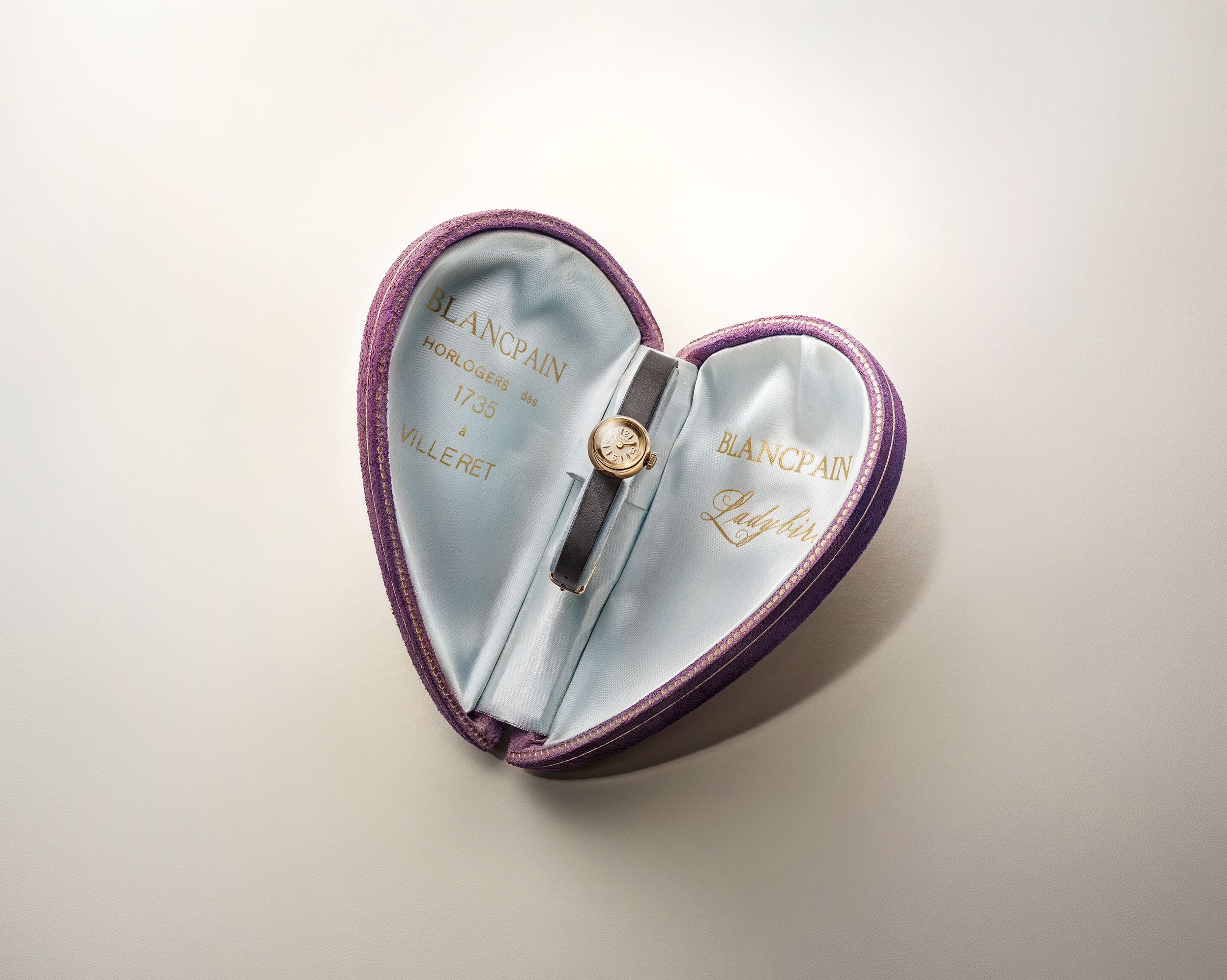
Created under the leadership of Betty Fiechter, the first woman to lead a Swiss watch manufacture, the original Ladybird Bullet was built around an extraordinary ambition: create a remarkably small yet robust mechanical movement. Its R52/R55 calibre measured just 11.85mm in diameter and became the world’s smallest round mechanical movement produced in series, according to Blancpain’s historical account.
Seven decades later, Blancpain isn’t simply bringing that watch back.
It is rethinking the idea behind it.
From Ladybird Bullet to Lady B
The new Blancpain Lady B is explicitly described as a contemporary reinterpretation rather than a reissue of the 1956 Ladybird Bullet. Its design takes the original watch’s philosophy of miniaturisation and translates it into an entirely new architecture.
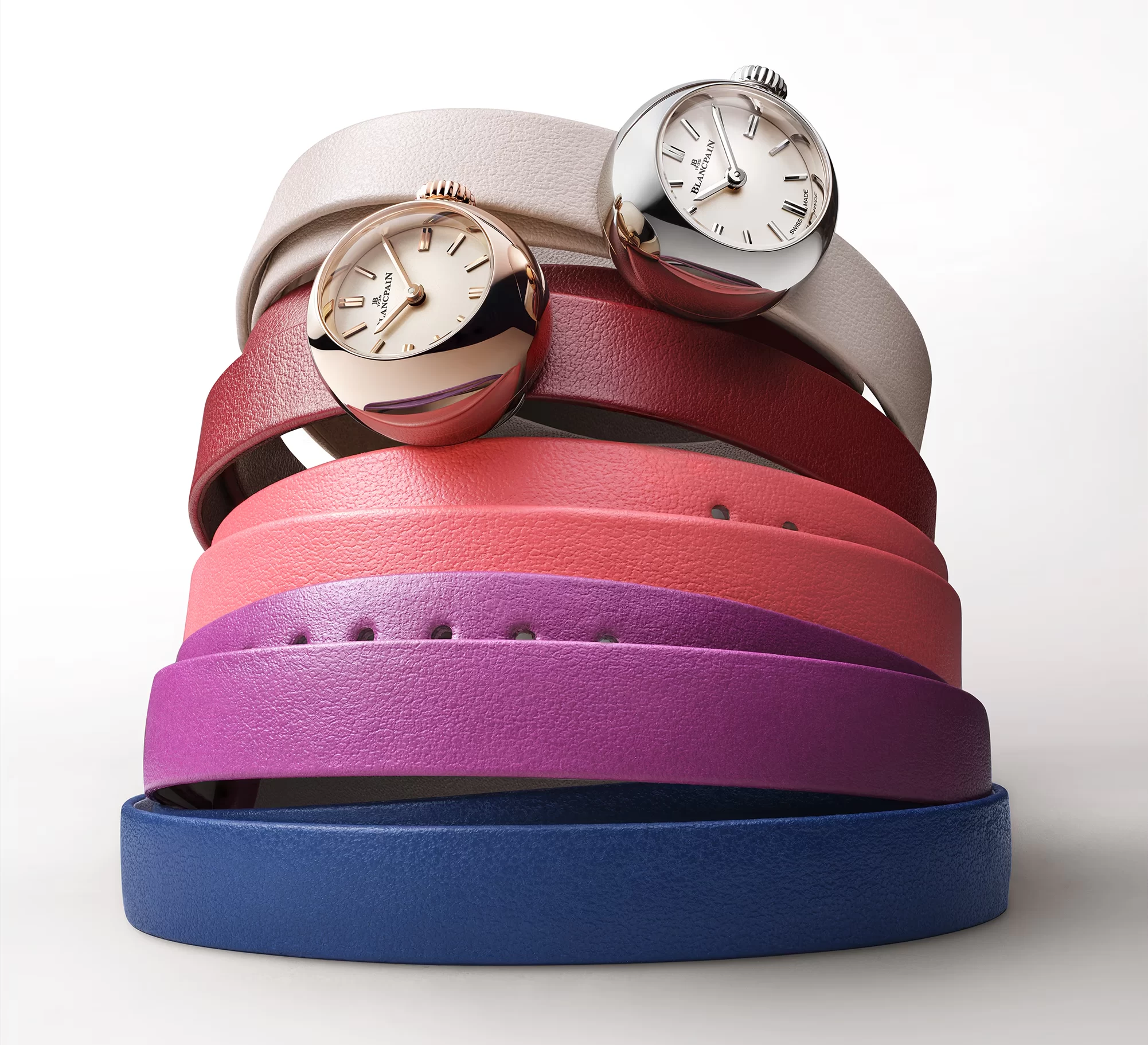
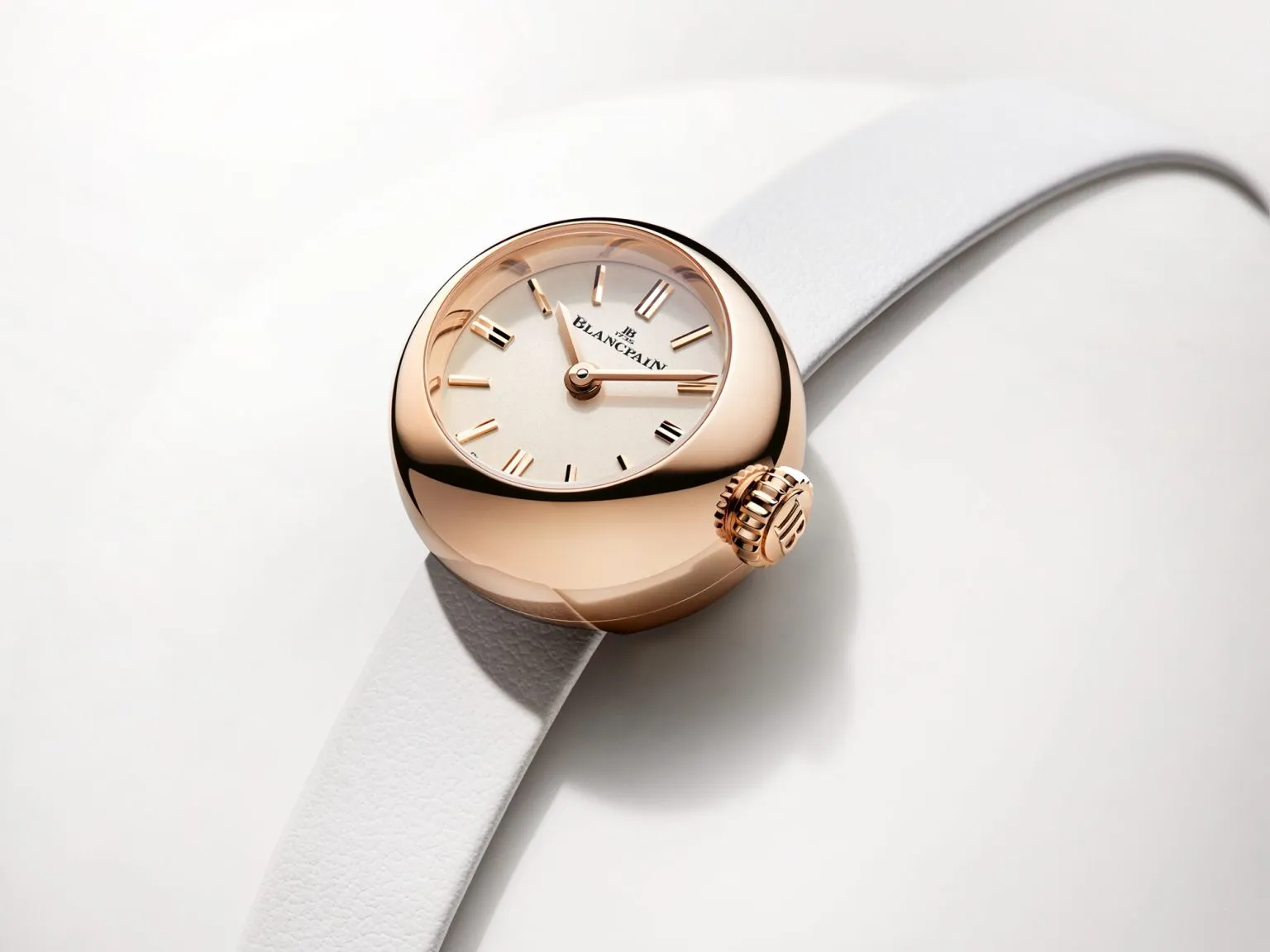
Its most immediately striking feature is its spherical case.
Measuring only 19mm in diameter, the case has a thickness of 13.20mm and a volume of just 2.9cm³. Rather than treating the watch as a flat object defined primarily by its diameter, Blancpain conceived Lady B in three dimensions.
The result is closer to a polished mechanical pebble or jewel than a conventional round wristwatch.
And that is precisely the point.
A Mechanical Heart in a Tiny Space
Inside the spherical case is Blancpain’s Manufacture Calibre 615, an automatic movement measuring 15.70mm in diameter and 3.90mm thick.
It contains 180 components and 29 rubies, operates at 3Hz, or 21,600 vibrations per hour, and delivers a 38-hour power reserve. Its plates are finished with Côtes de Genève, while a silicon balance spring is part of its evolution.
The movement’s compact architecture wasn’t simply placed inside an existing case.
The entire watch was developed around it.
Blancpain says the spherical case, sapphire crystal, polished rehaut, integrated strap passage and water resistance were developed in parallel to accommodate Calibre 615.
That makes the Lady B’s small dimensions more than an aesthetic exercise. They are the consequence of designing the watch around its mechanical core.
No Lugs. No Conventional Case Architecture.
Perhaps the most unusual aspect of Lady B is what it leaves out.
There are no traditional lugs.
Instead, the calf leather strap passes directly through an opening machined into the case. The passage measures just 10 × 1.6mm, and Blancpain describes the interior as micro-blasted so the leather can glide through it. The edges and knurling are finished by hand.
This creates a continuous visual relationship between the spherical case and the strap.
The watch doesn’t look as though a strap has been attached to it.
The strap appears to emerge from it.
Minimalism Is Doing the Heavy Lifting
The dial takes an equally restrained approach.
The warm beige opaline dial is identical across the stainless-steel and 18K red-gold versions. There is no gem-setting, allowing the dial surface, gold indices and reflections from the polished rehaut to define the visual character.
The applied stick indices are made from gold and measure only 1.82 × 0.39mm.
The hands remain deliberately simple, displaying only the hours and minutes.
This restraint is important because the case is already doing most of the visual talking. The polished spherical architecture creates changing reflections across its surface, while the clean dial prevents the watch from becoming visually busy.
Seven Straps, One Tiny Wrist Presence
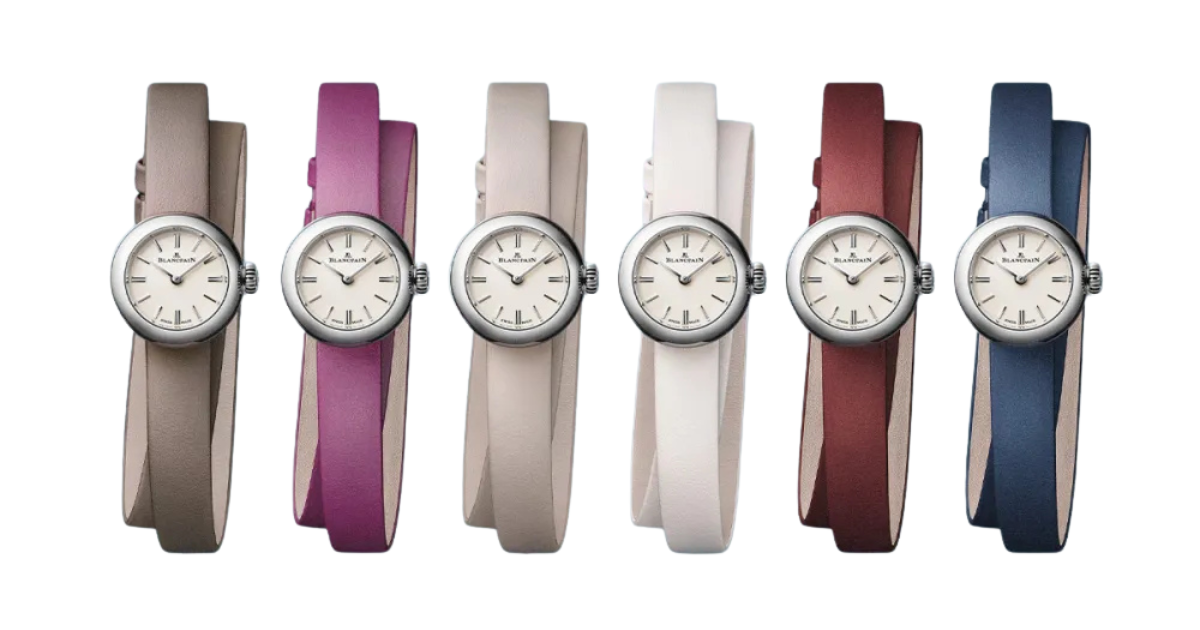
The Lady B arrives on a double-tour calf leather strap, reinforcing its jewellery-like character.
There are seven colour options:
White
Beige
Mocha
Burgundy
Blue
Coral
Purple
The strap fits through the rear of the watch and can be changed easily.
The double-tour construction also changes how the 19mm case sits visually on the wrist. Instead of functioning simply as a tiny watch, the strap becomes an integral part of the design language.
Betty Fiechter: The Woman Behind the Original Vision
The Lady B story becomes considerably more interesting when you look back at Betty Fiechter.
Fiechter entered Blancpain’s workshop in Villeret as a 16-year-old apprentice in 1912. By 1933, she had become co-owner of the Manufacture, and she ultimately became the first woman to own and lead a Swiss watch manufacture.
Her contribution wasn’t limited to keeping the company operating through difficult economic and historical circumstances.
She also recognised the importance of mechanical watches for women.
Blancpain’s historical account notes that Fiechter believed women’s watches deserved the same ingenuity and mechanical integrity as other timepieces, making this area one of Blancpain’s defining strengths.
In 1956, the Ladybird emerged from this philosophy.
The Lady B now connects that history to Blancpain’s contemporary approach to mechanical miniaturisation.
The 1956 Technical Miracle
The original Ladybird Bullet’s R52/R55 calibre was only 11.85mm in diameter.
Its compact architecture incorporated a fifth wheel into the gear train and shock protection for the balance, allowing Blancpain to pursue extreme miniaturisation without abandoning robustness. The movement contained 133 individually machined components and operated at 3Hz.
The movement’s influence extended beyond Blancpain, with the press release noting that houses including Omega and Longines subsequently adopted it for their own creations. Its tiny footprint also enabled a wide variety of jewellery watches, bracelets, bangles, rings and pendants.
That history explains why the Ladybird is more than simply an old model in Blancpain’s archive.
Miniaturisation became a creative platform.
Lady B continues that idea in a radically different form.
Stainless Steel or 18K Red Gold?
Blancpain offers the Lady B in two case materials:
Stainless Steel
19mm diameter
13.20mm thickness
30m water resistance
CHF 9,500
18K Red Gold
19mm diameter
13.20mm thickness
30m water resistance
CHF 14,500
The watch is not a limited edition and is available through Blancpain boutiques and authorised retailers from 17 September 2026.
A New Chapter, Rather Than a Reissue
The Blancpain Lady B succeeds by resisting the obvious route.
It doesn’t attempt to reproduce the Ladybird Bullet line for line. Instead, it takes the central idea behind that watch, mechanical watchmaking on an extraordinarily small scale, and pushes it into a new design language.
A spherical 19mm case.
A tiny automatic movement.
An integrated double-tour strap.
A deliberately quiet opaline dial.
And a direct connection to Betty Fiechter and the Ladybird’s history.
Seventy years after the Ladybird first appeared, Blancpain’s smallest statement may also be one of its most conceptually interesting.
Hublot and Jeff Koons have turned the idea of creation into a mechanical work of art with the new MP-14 Origin by Jeff Koons. Unveiled in New York on 16 September 2026, the timepiece brings together sapphire architecture, gem-setting, contemporary art and Hublot’s high-horology expertise in an exceptionally complex 44 mm creation limited to just 30 pieces.
Rather than simply decorating a watch with artistic references, the collaboration attempts something considerably more ambitious: to make the watch itself behave like a miniature universe, with a central tourbillon acting as its mechanical point of origin and concentric rings appearing to expand around it.
A collaboration built around transformation
The partnership between Hublot and Jeff Koons brings together two creative disciplines that share an interest in transforming familiar ideas into something unexpected. Alongside the MP-14 Origin, the collaboration also introduces the Classic Fusion Balloon Dog, connecting Koons’ artistic vocabulary with Hublot’s watchmaking.
For the MP-14 Origin, that philosophy is expressed through an architecture combining sapphire, titanium and gem-set white gold. The result sits at the intersection of high jewellery and high watchmaking, while its visual concept is rooted in the creation and expansion of the cosmos.
The watch also represents an important technical development for Hublot: the introduction of the manufacture’s first automatic central tourbillon.
Why “MP-14”?
The name MP-14 is not simply a sequential designation. According to Hublot, the number 14 references an important moment in Jeff Koons’ early artistic career.
Koons held his first solo exhibition in 1980 at the New Museum in New York, which was then located at 65 Fifth Avenue at 14th Street. Hublot connects this address with the MP-14 name, making the number part of the artistic story behind the watch.
The MP-14 also belongs to Hublot’s Exceptional Timepieces collection, the brand’s experimental high-horology laboratory dedicated to unconventional architectures, advanced materials and radical mechanical concepts.
A miniature universe constructed in sapphire
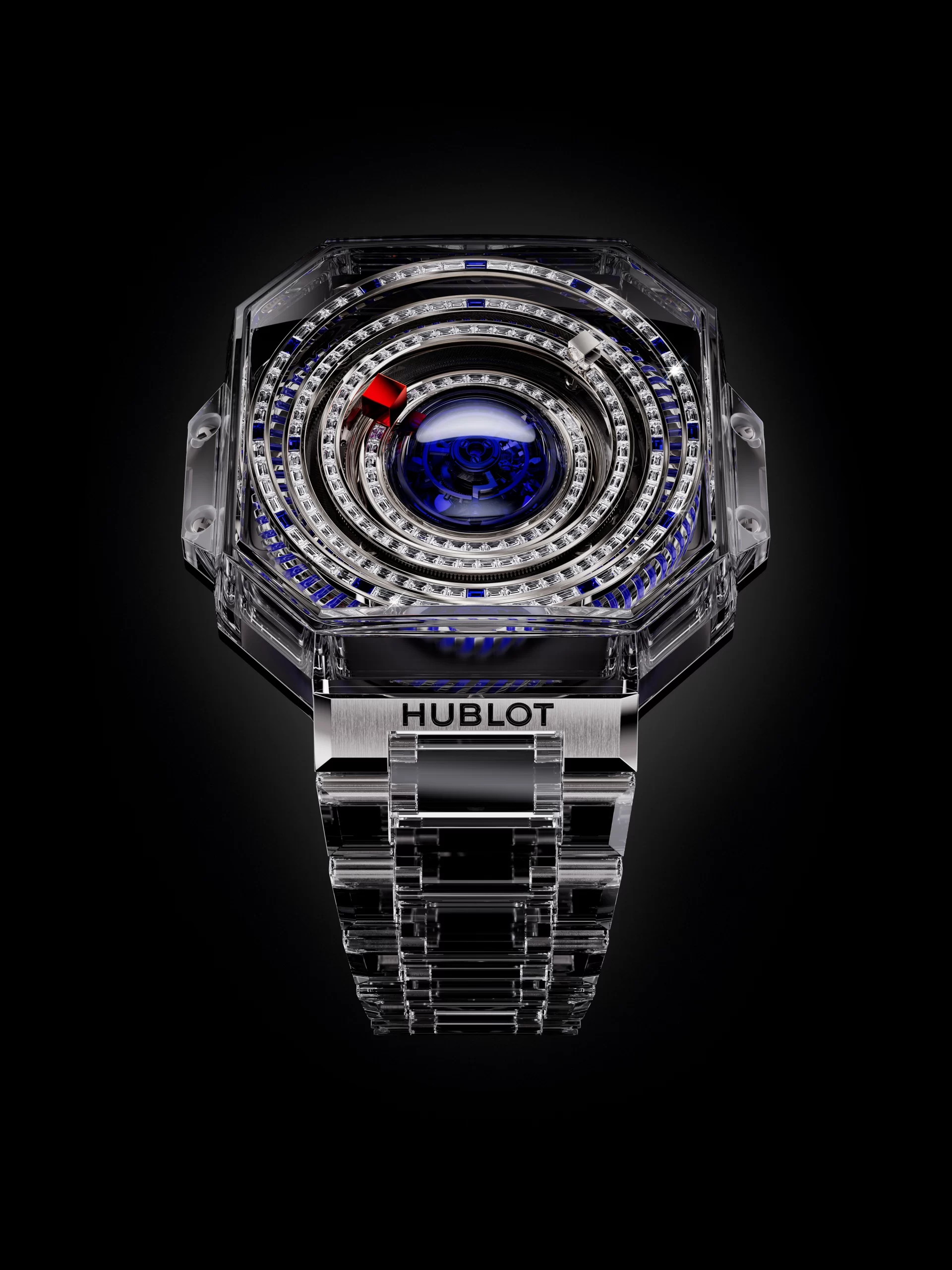
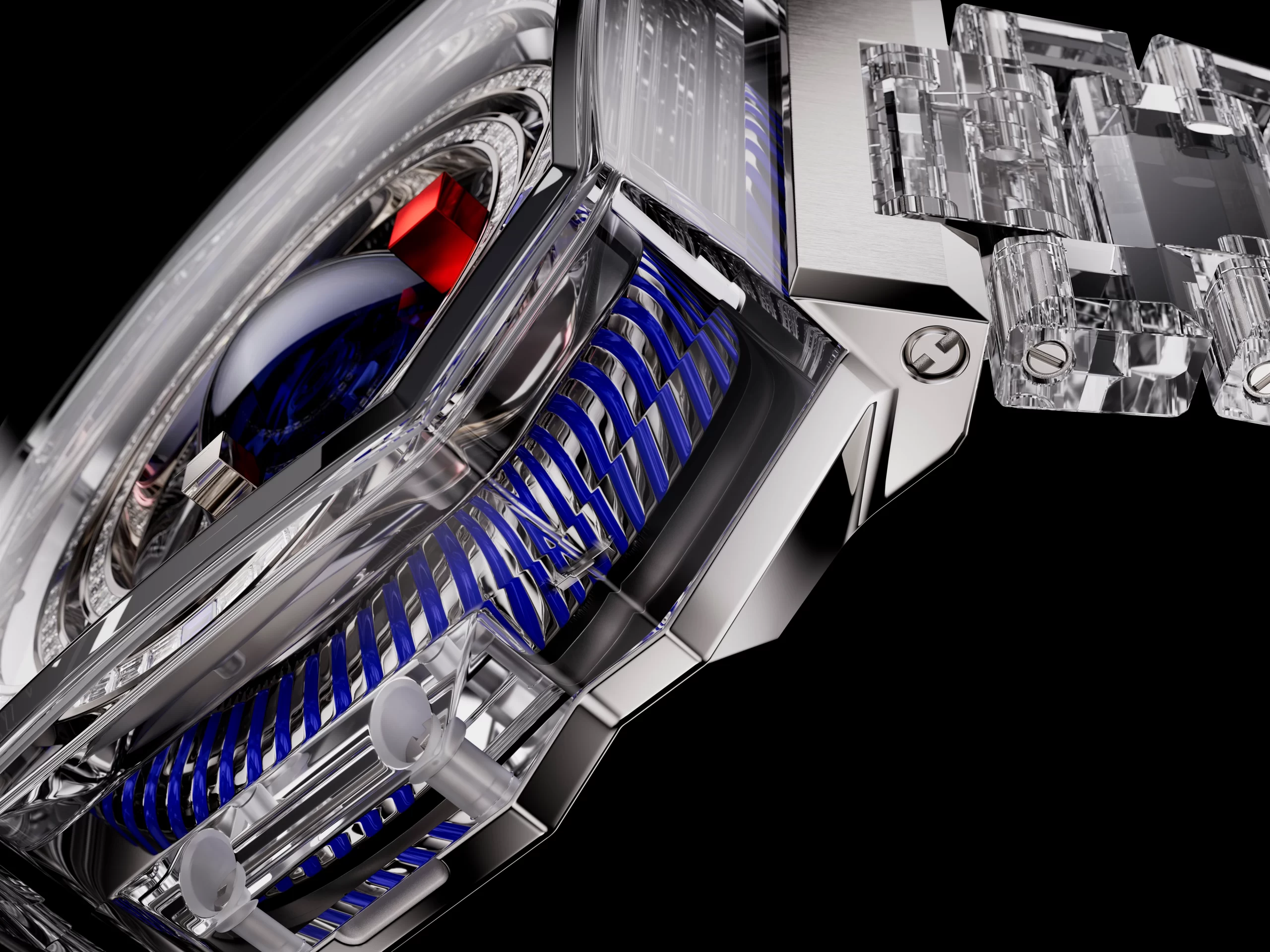
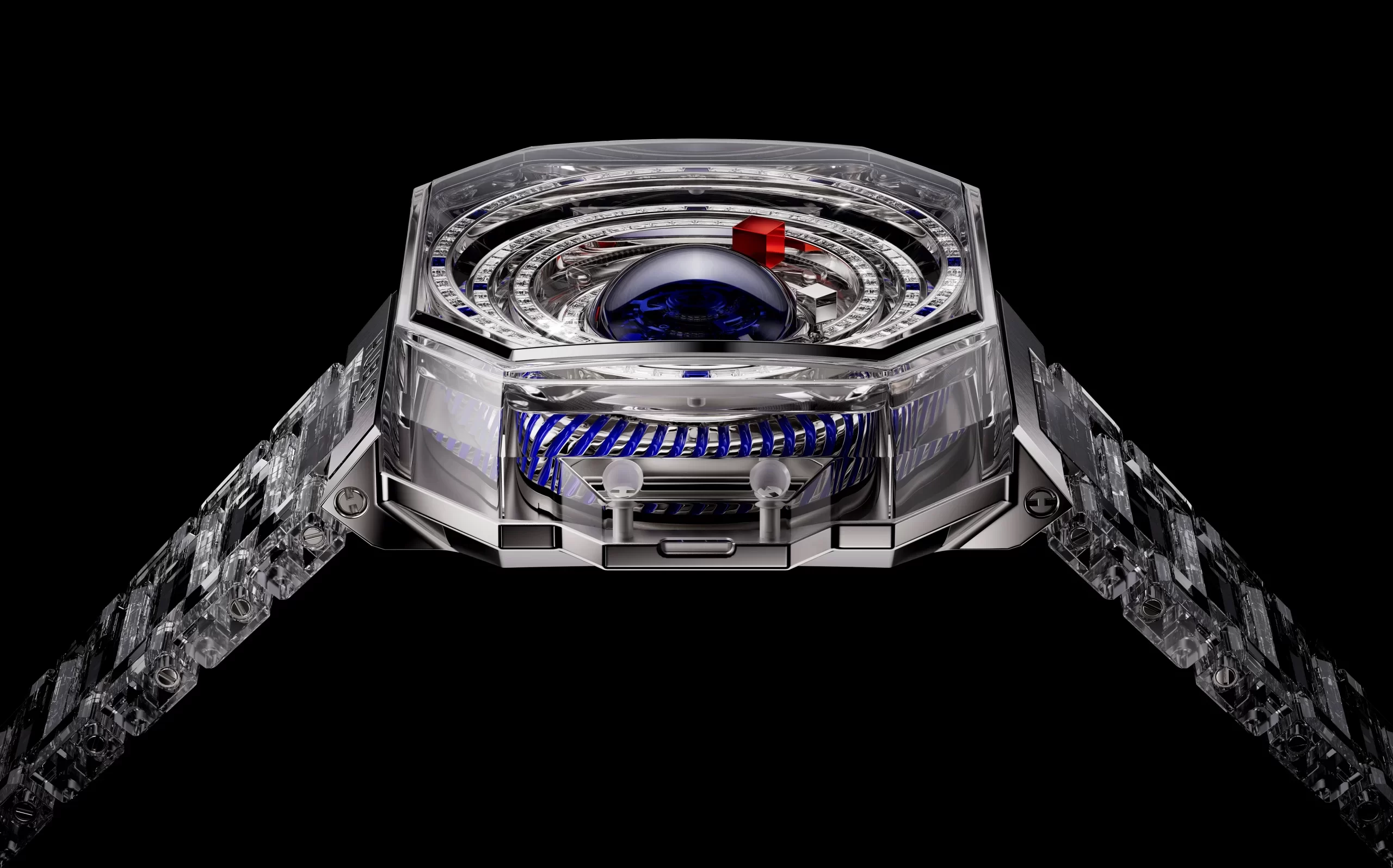
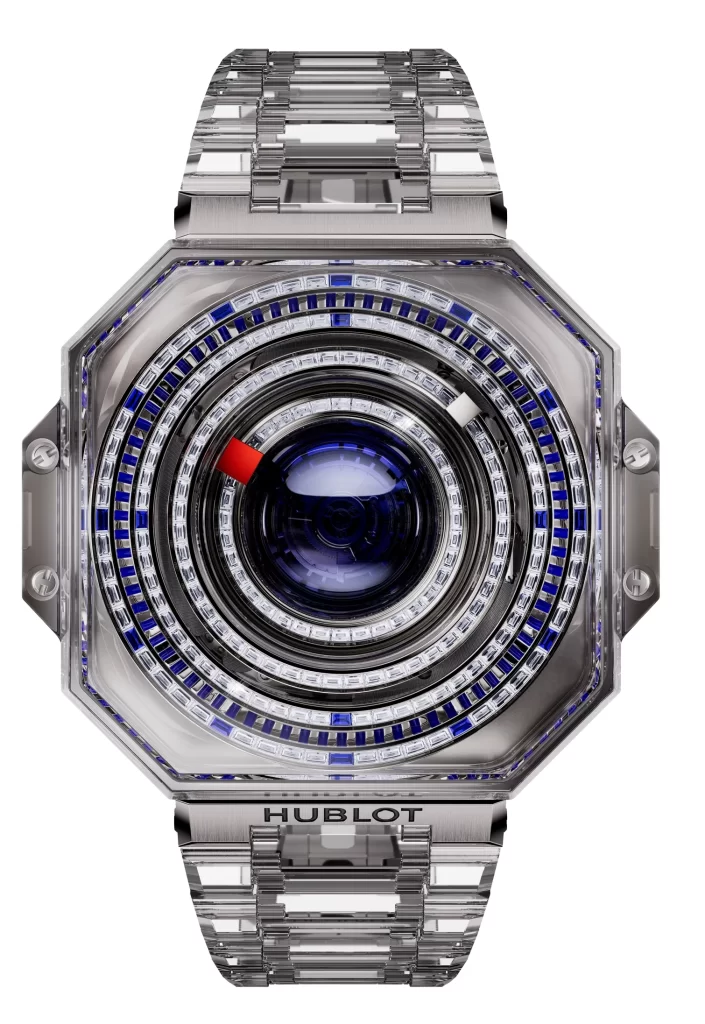
The MP-14 Origin measures 44 mm and uses an octagonal case made from polished sapphire crystal and titanium. Its transparent sapphire structure is central to the design rather than merely a material choice.
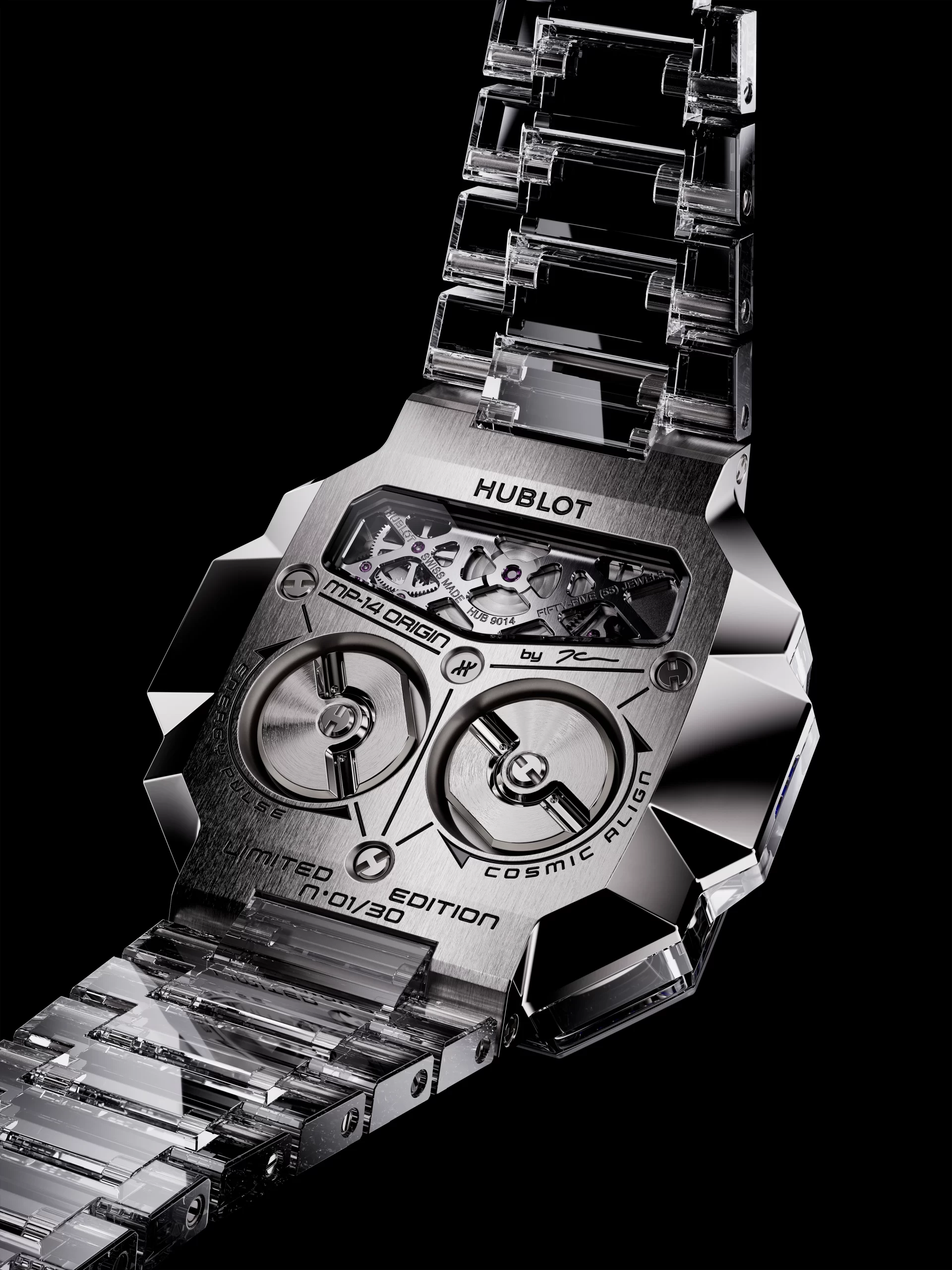
According to Hublot, machining the sapphire case requires approximately 534 hours. A titanium case back, H-shaped polished titanium screws and Hublot’s characteristic case “ears” at 3 and 9 o’clock complete the architecture.
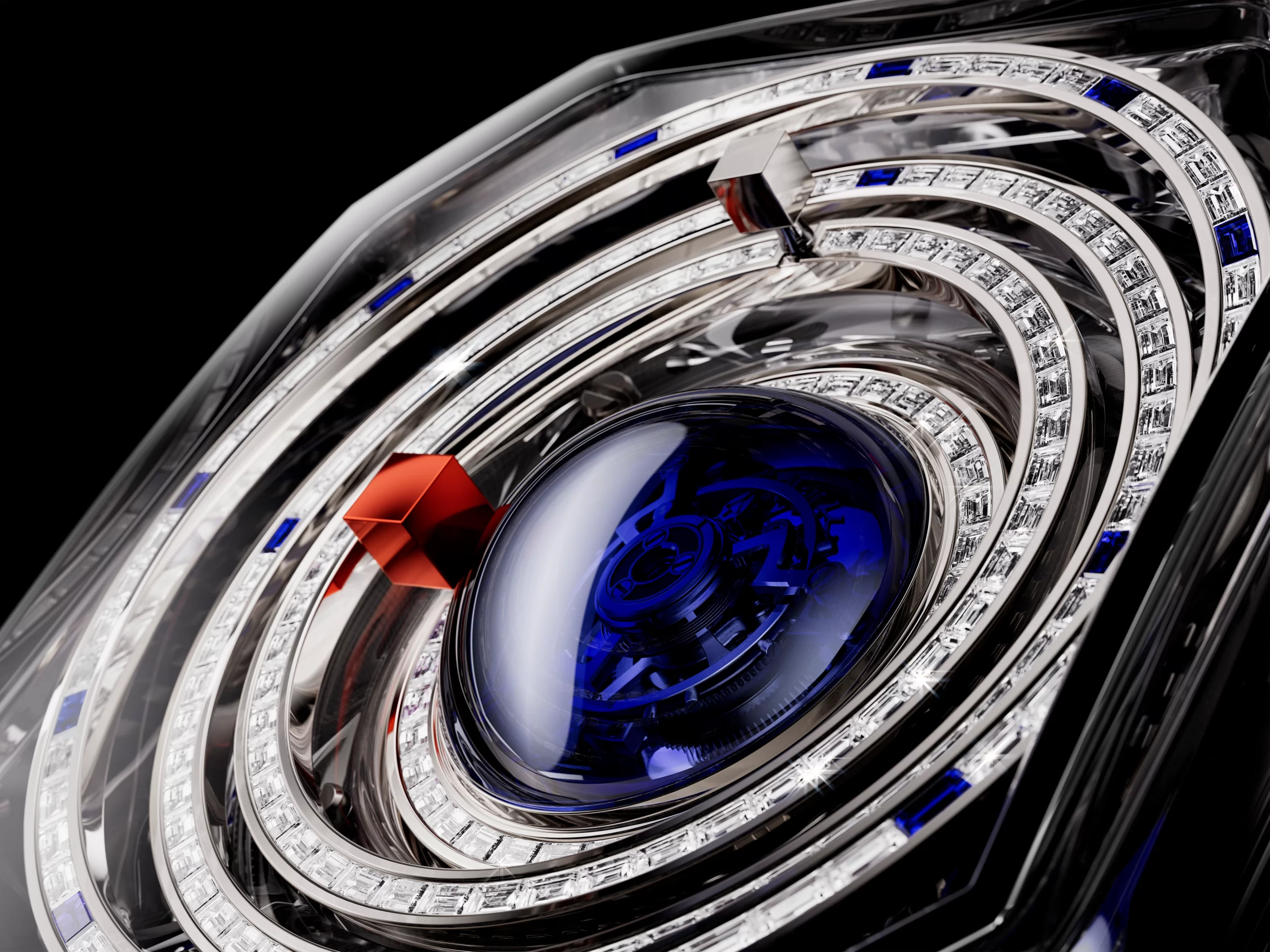
Inside, the transparent construction reveals a series of concentric rings that create the impression of orbital movement. The rings are crafted in white gold and set with baguette-cut diamonds and blue sapphires, gradually directing the eye towards the centre of the watch.
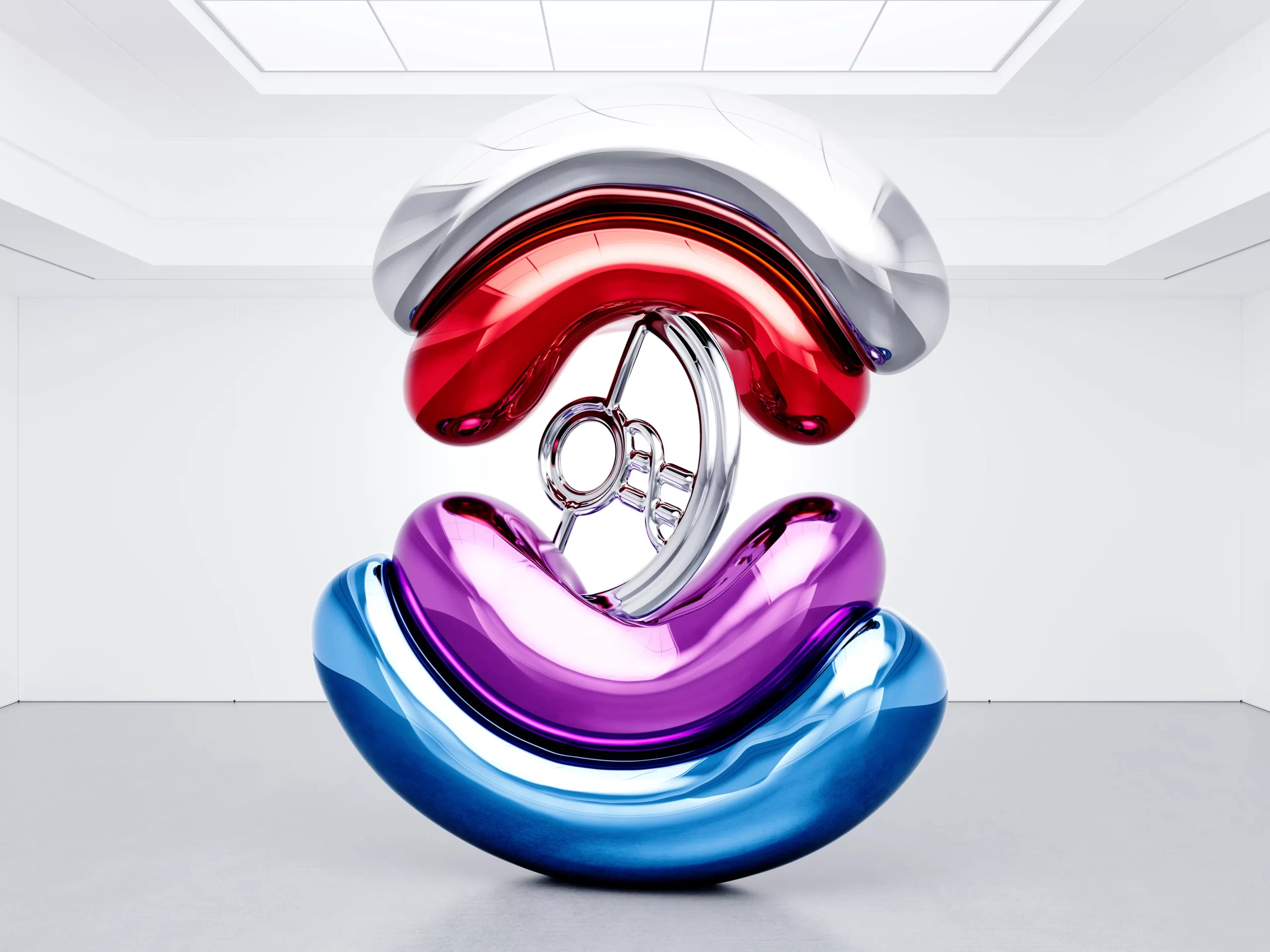
At that centre sits the tourbillon, positioned beneath a transparent sapphire dome. The dome takes inspiration from Jeff Koons’ Gazing Ball works and is hand-coated in translucent blue varnish by a micropainter.
It is a clever visual metaphor. Instead of representing the universe through a conventional celestial dial, Hublot places mechanical motion at the heart of the composition.
Time appears to orbit the movement
The MP-14 Origin takes an unconventional approach to displaying the hours and minutes.
Two suspended rotating rings carry floating indicator cubes. The hour indicator is a polished stainless-steel cube finished with translucent red varnish, while the minute indicator is represented by a polished grey stainless-steel cube.
Two additional rings remain fixed. Blue sapphires mark the quarters on the minute ring, while the hour ring uses blue sapphires to indicate the hours. Collectively, the four rings contain 202 gemstones, representing approximately 2.6 carats.
The result is a time display that deliberately avoids the familiar arrangement of hands moving around a stationary dial. Here, the indicators appear suspended within a layered mechanical environment.
The HUB9014: the mechanical heart
Driving this unusual architecture is Hublot’s HUB9014 manufacture movement.
It is an automatic central tourbillon equipped with a peripheral oscillating weight, operating at 3 Hz, or 21,600 vibrations per hour, with a 60-hour power reserve. The movement contains 594 components.
The peripheral winding system is particularly important to the design. By moving the oscillating mass away from the traditional central position, Hublot can preserve the open appearance of the movement while maintaining the visual continuity of the architecture.
The tourbillon cage sits beneath the sapphire dome, becoming the visual and mechanical centre of the watch. In the context of the Koons collaboration, Hublot describes this as the first pulse from which the surrounding structure appears to expand.
Even the winding system disappears into the architecture
The MP-14 Origin takes its unusual construction a step further by concealing the functions normally associated with the crown.
Two hidden crown systems are integrated into the case, allowing the wearer to wind the watch and adjust the time without interrupting its clean architectural appearance.
The winding function is associated with the engraving “ENERGY PULSE”, while the time-setting function is marked “COSMIC ALIGN.”
It is the sort of detail that makes the watch less like a conventional timepiece and more like an engineered object whose functions have been absorbed into its design.
From watch to immersive presentation
Hublot extends the cosmic concept beyond the watch itself.
The presentation case uses an infinite mirror installation, incorporating LED illumination and one-way mirror technology to create an impression of limitless depth. Its octagonal geometry echoes the shape of the watch and is topped by a transparent dome, effectively turning the presentation environment into an extension of the timepiece’s architecture.
This matters because the MP-14 Origin is designed to be experienced as more than an object on the wrist. Its visual language continues from the sapphire case to the presentation environment, reinforcing the central idea of an expanding mechanical cosmos.
Jeff Koons’ interpretation of creation
For Koons, the MP-14 Origin represents a horological interpretation of creation itself, centred on the transformation of energy into form and form into time.
The central tourbillon becomes the starting point, while the surrounding mechanical structures suggest controlled expansion. Hublot’s press material specifically connects the concept to the Big Bang, translating that idea through mechanical movement, material tension and the interaction of light with the watch’s transparent architecture.
The concept is therefore not simply about putting a cosmic image on a dial. The movement, case, gemstones and rotating indicators all participate in the same visual narrative.
Technical specifications
Specification: Hublot MP-14 Origin by Jeff Koons
Reference: 914.NJ.0100.JX.9941 Edition: Limited to 30 pieces Case: Polished sapphire crystal and titanium Case size: 44 mm Thickness: 20 mm Water resistance: 3 ATM / 30 m Winding system: Peripheral oscillating weight Movement diameter: 39.20 mm Movement thickness:14.65 mm Components: 594 Jewels : 55 Frequency: 3 Hz / 21,600 A/h Power reserve: 60 hours Gem-setting: Baguette-cut diamonds and blue sapphires Gemstone total: 202 stones / approximately 2.6 carats Crystal: Sapphire Case back: Polished and satin-finished titanium Strap: Sapphire crystal and titanium deployant buckle
A 30-piece expression of experimental watchmaking
The Hublot MP-14 Origin by Jeff Koons is limited to just 30 pieces and is available through selected Hublot points of sale. The press release lists pricing at CHF 405,000, EUR 479,000, USD 488,000 and GBP 383,000.
At its most interesting, however, the MP-14 Origin is not about rarity or price. Its significance lies in how Hublot has attempted to make mechanical watchmaking itself tell the story.
The central tourbillon becomes the point of origin. The sapphire case provides the space. The gemstone-set rings create the impression of orbital structures. Floating cubes indicate the passage of hours and minutes. Even the winding and time-setting systems have been absorbed into the architecture.
In that sense, the MP-14 Origin does not simply depict a universe.
It builds one around the mechanism that makes the watch come alive.
Luxury watchmaking has never been content with simply telling time. The most interesting watches often exist somewhere between engineering, design and culture, and Hublot’s latest collaboration with Jeff Koons pushes that idea into distinctly sculptural territory.
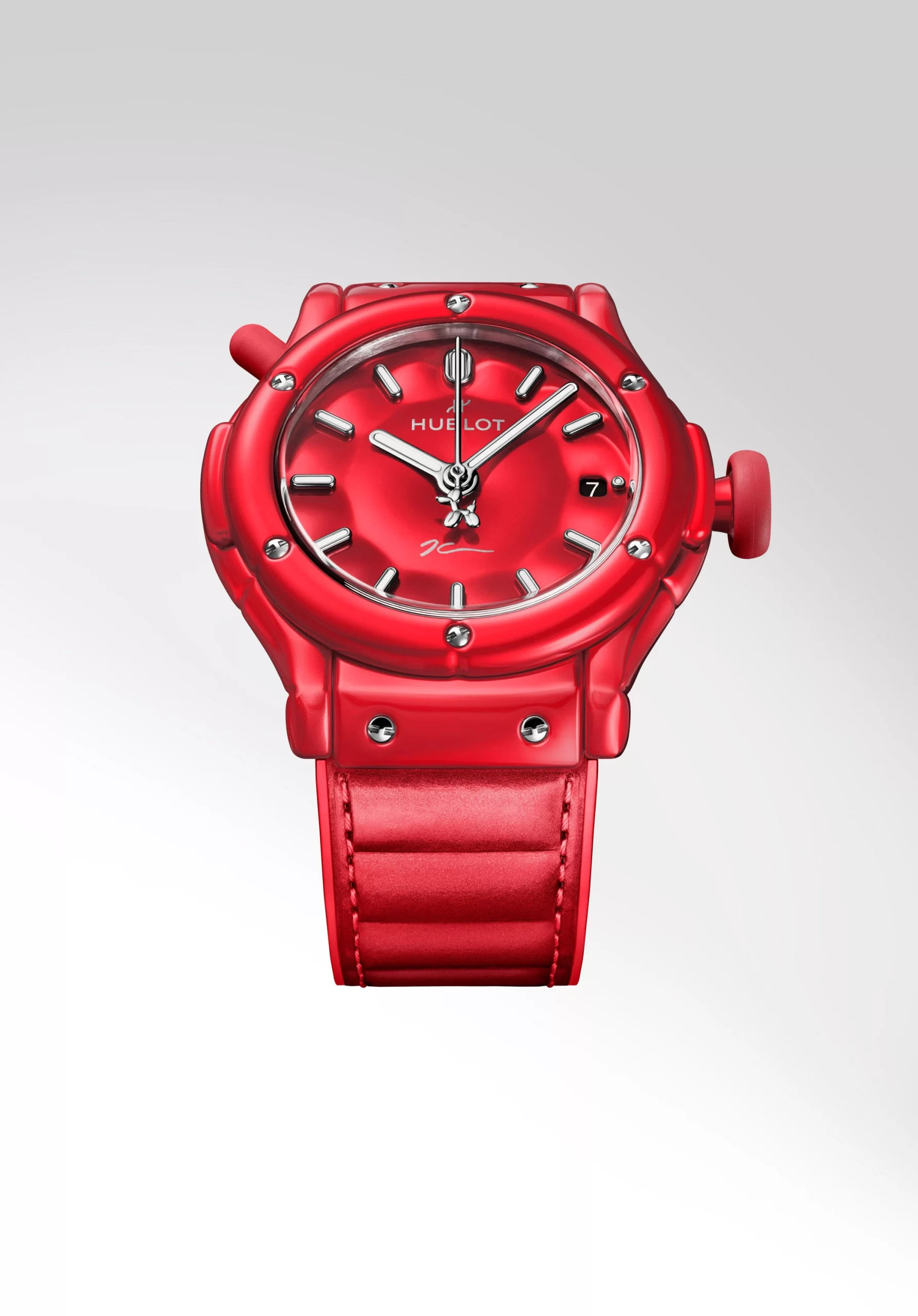
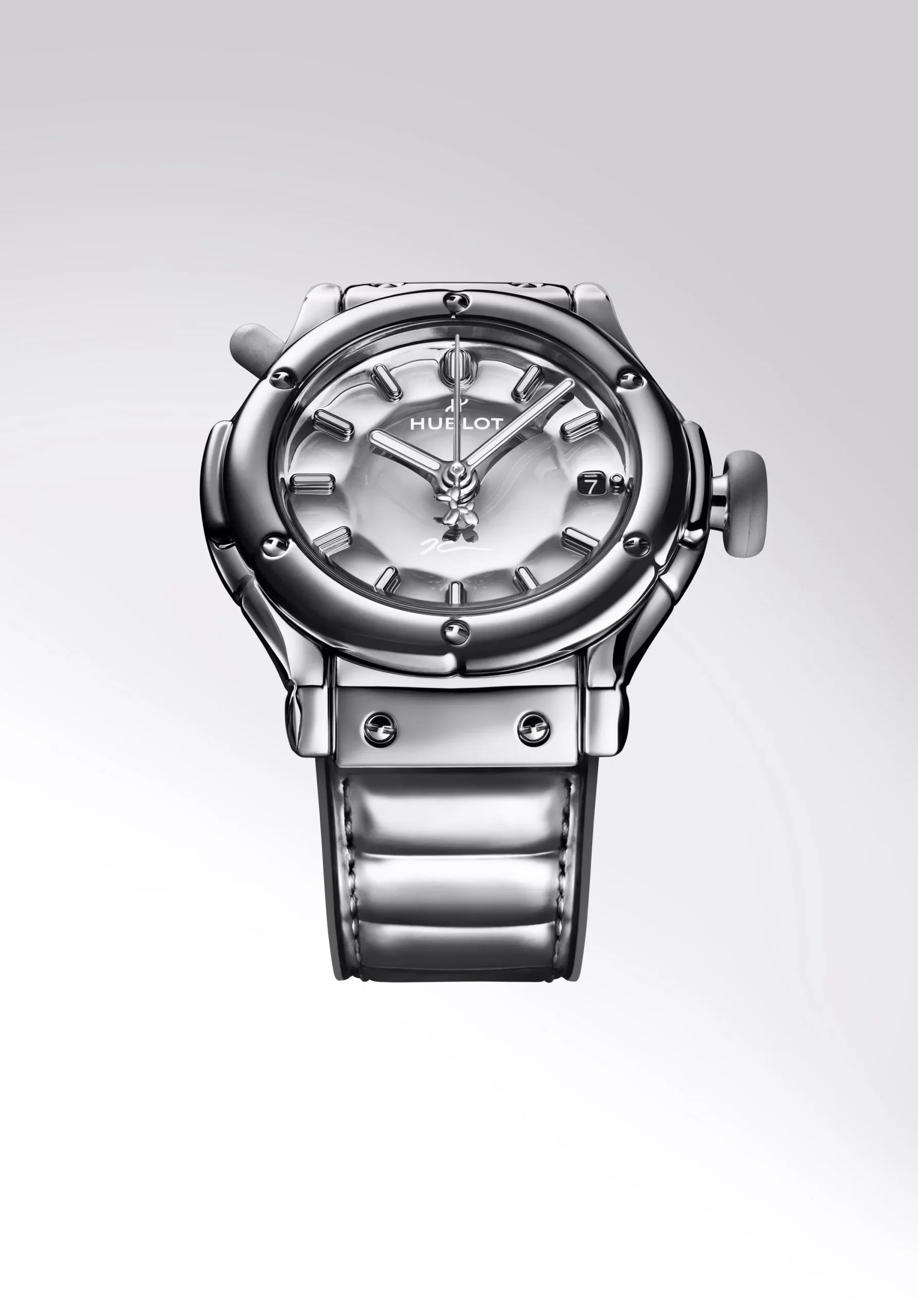
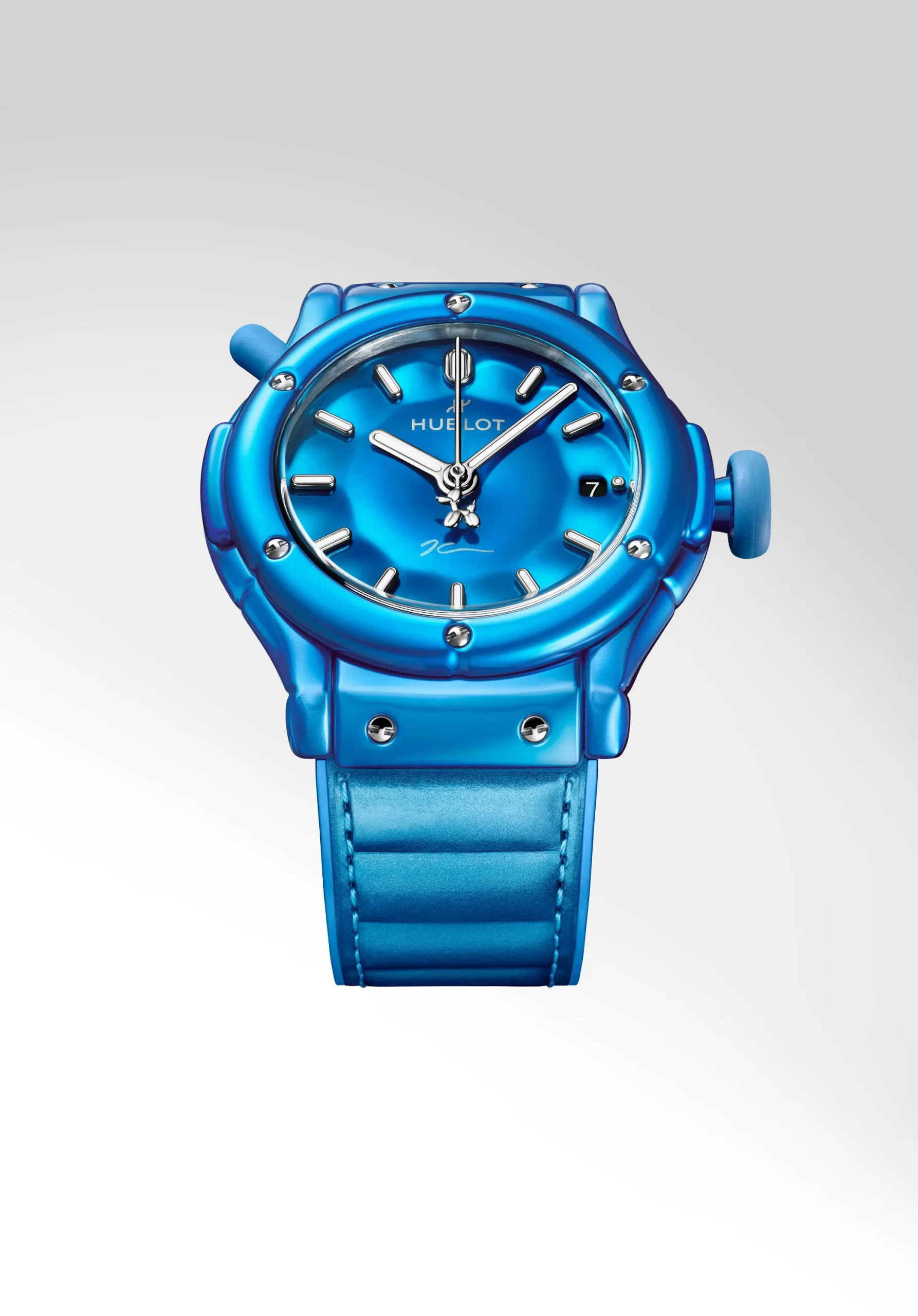
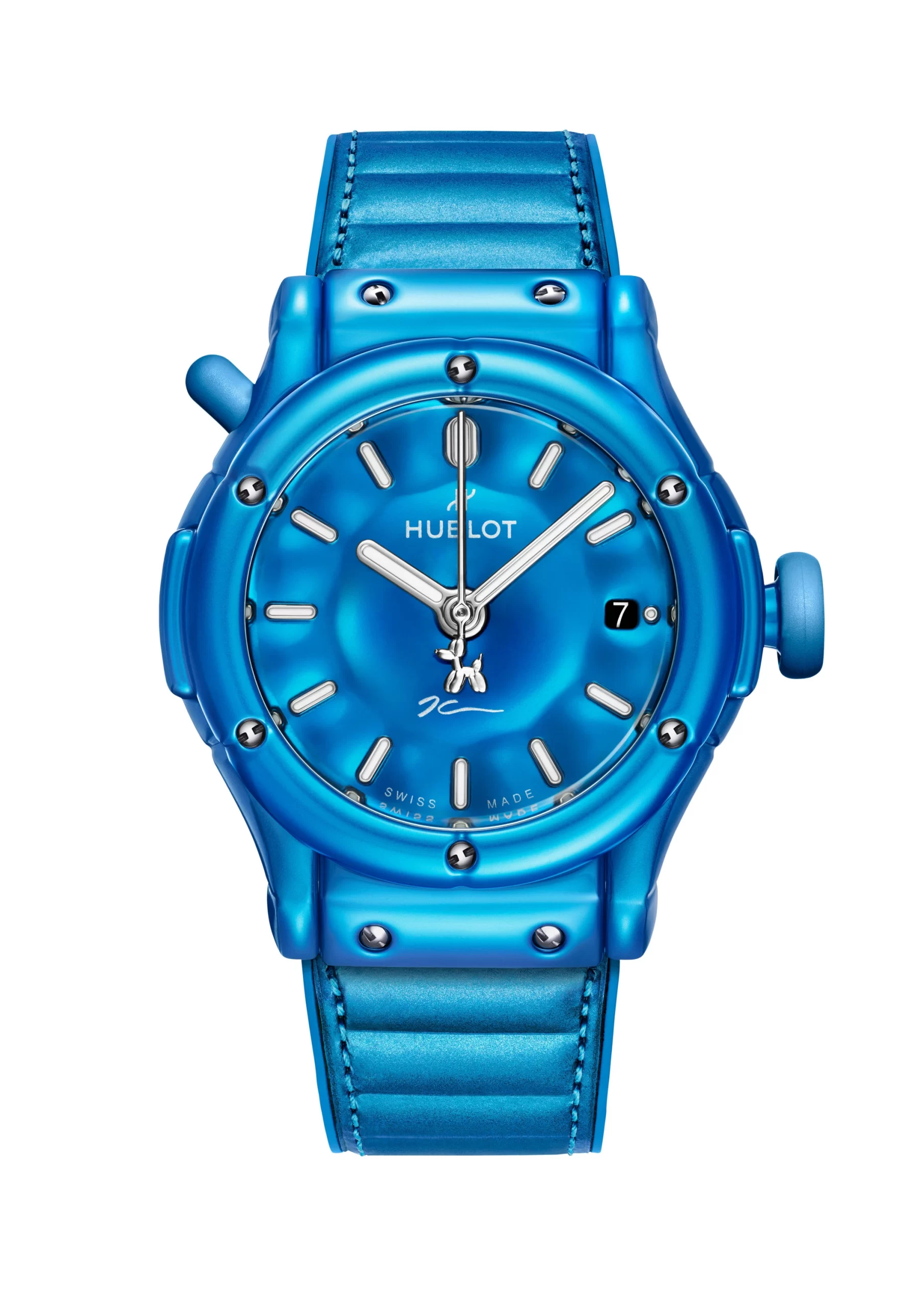
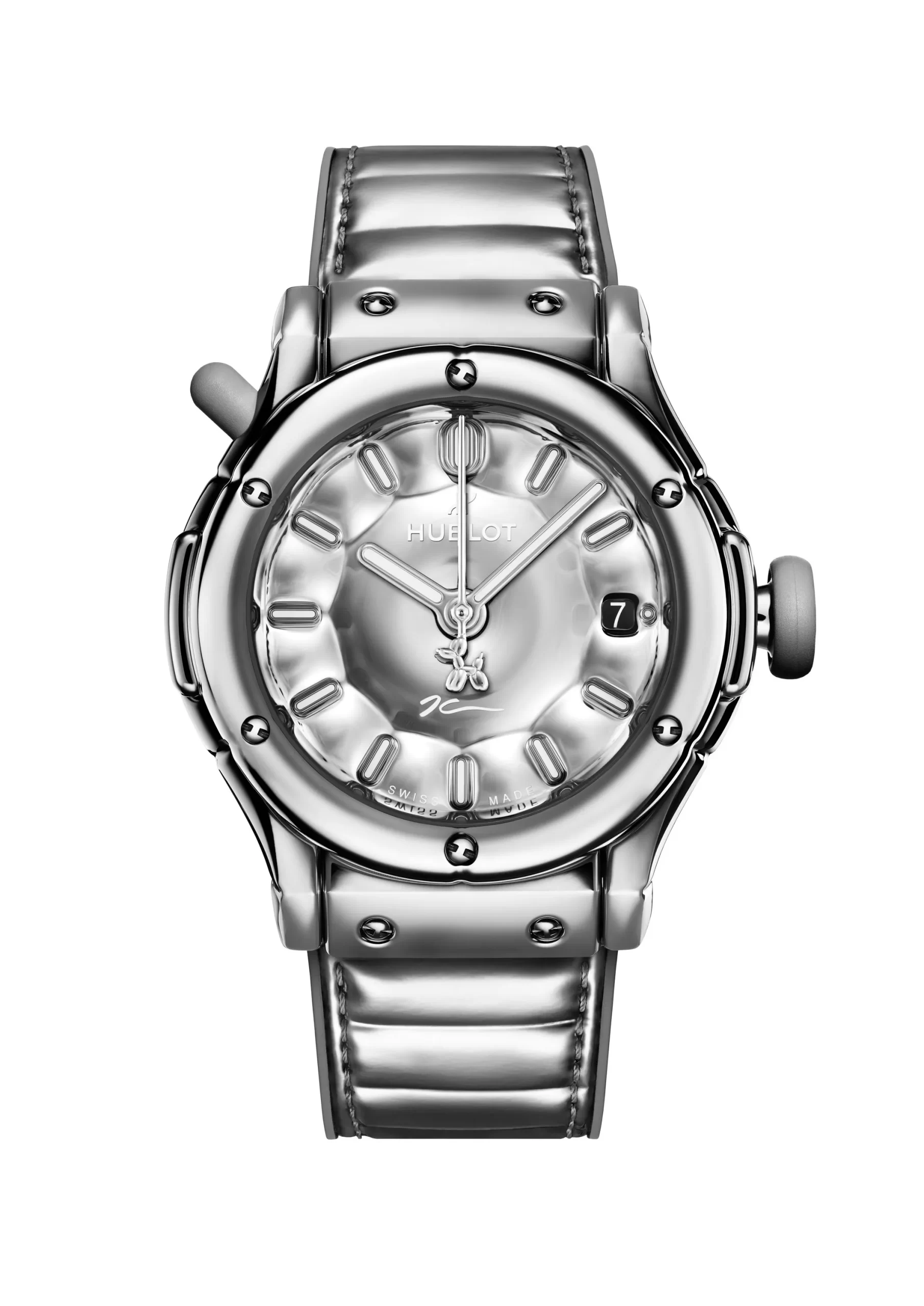
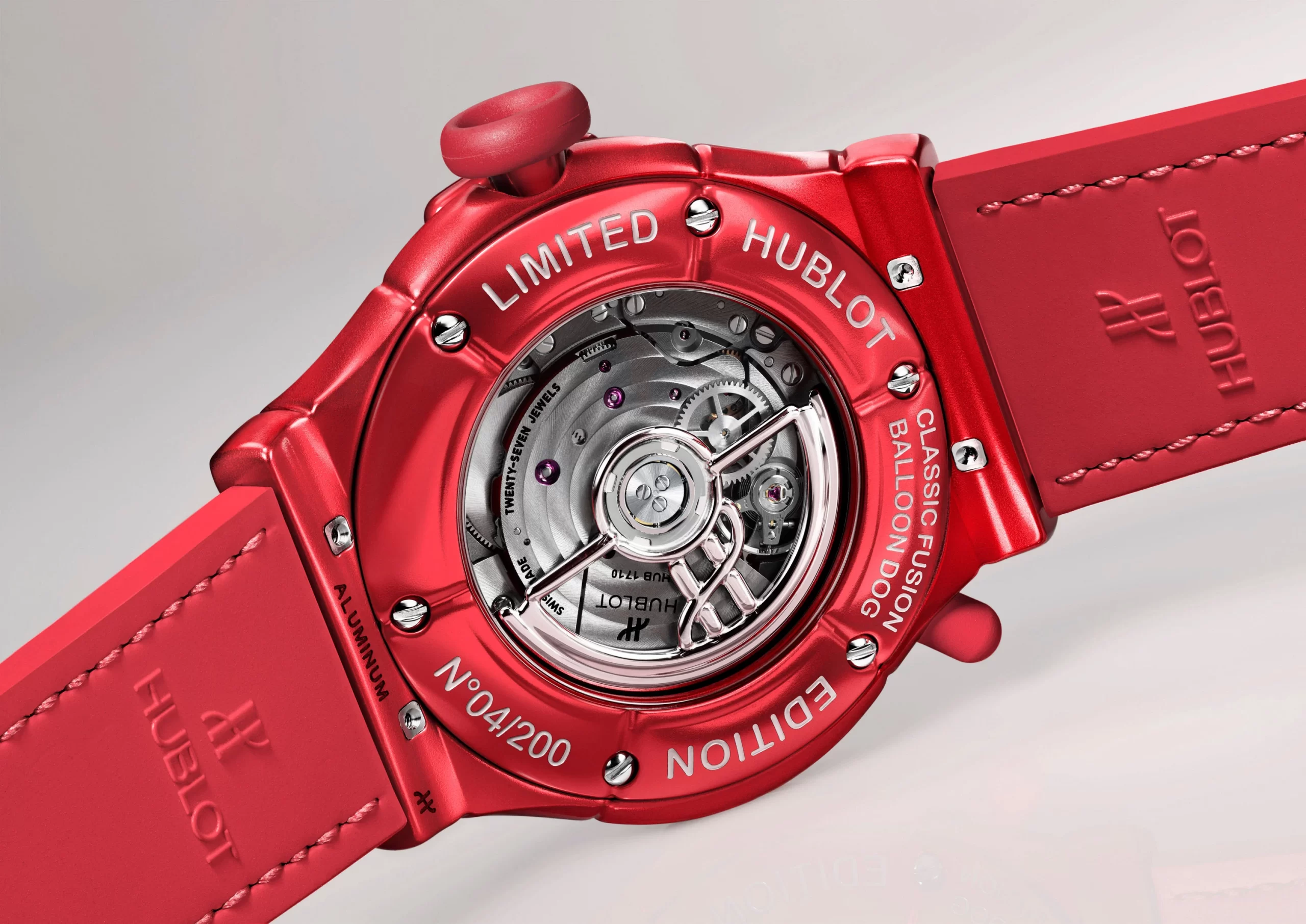
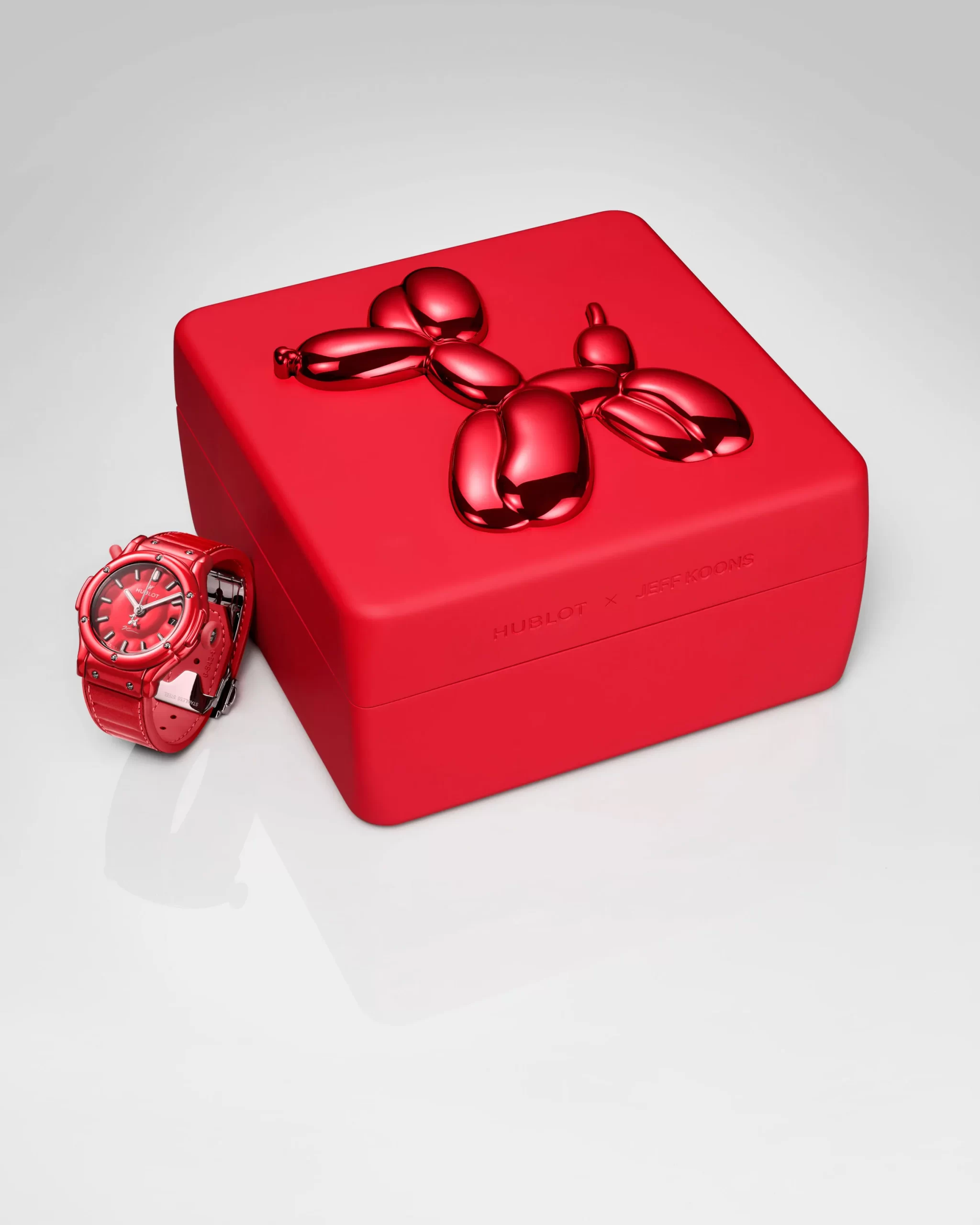
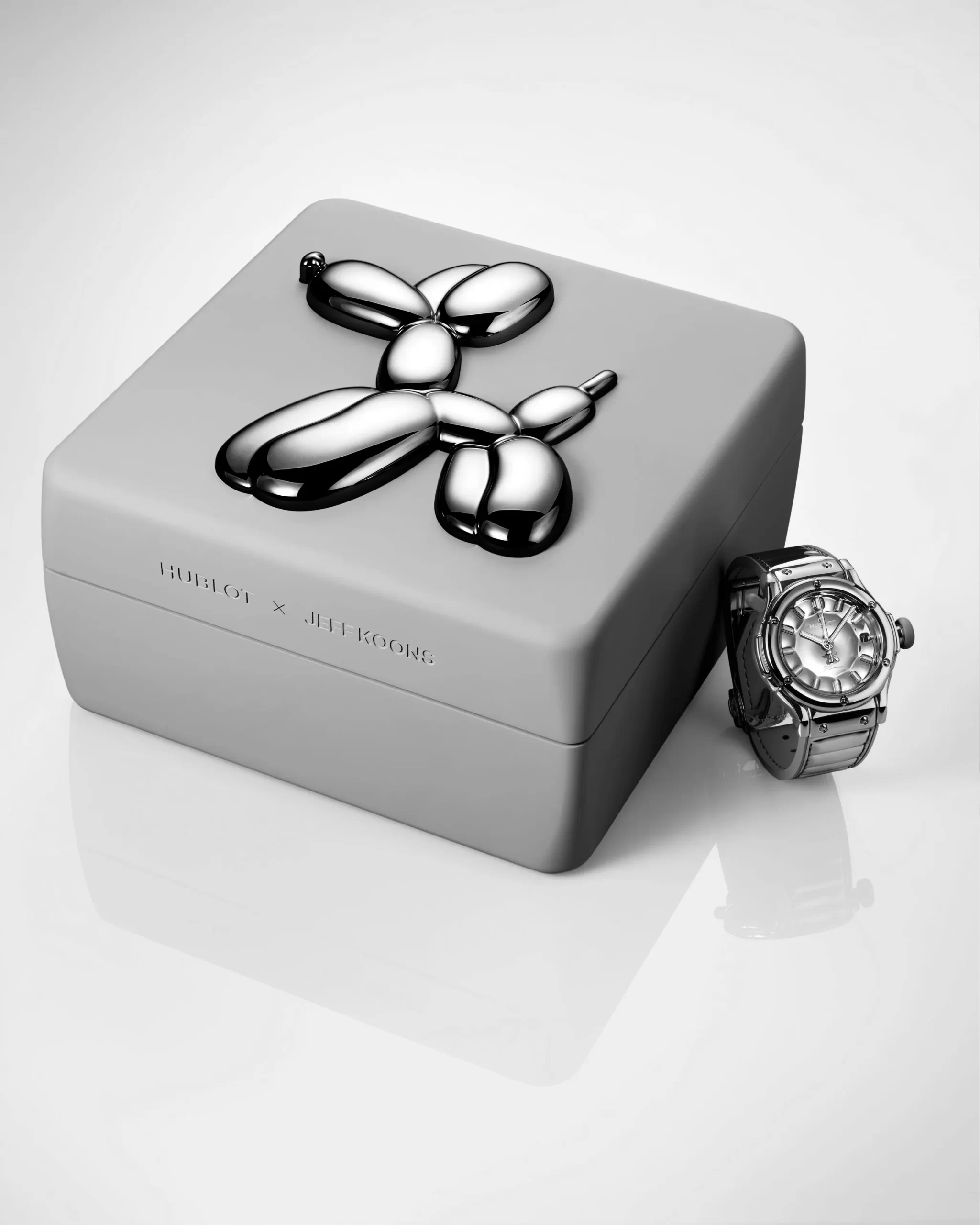
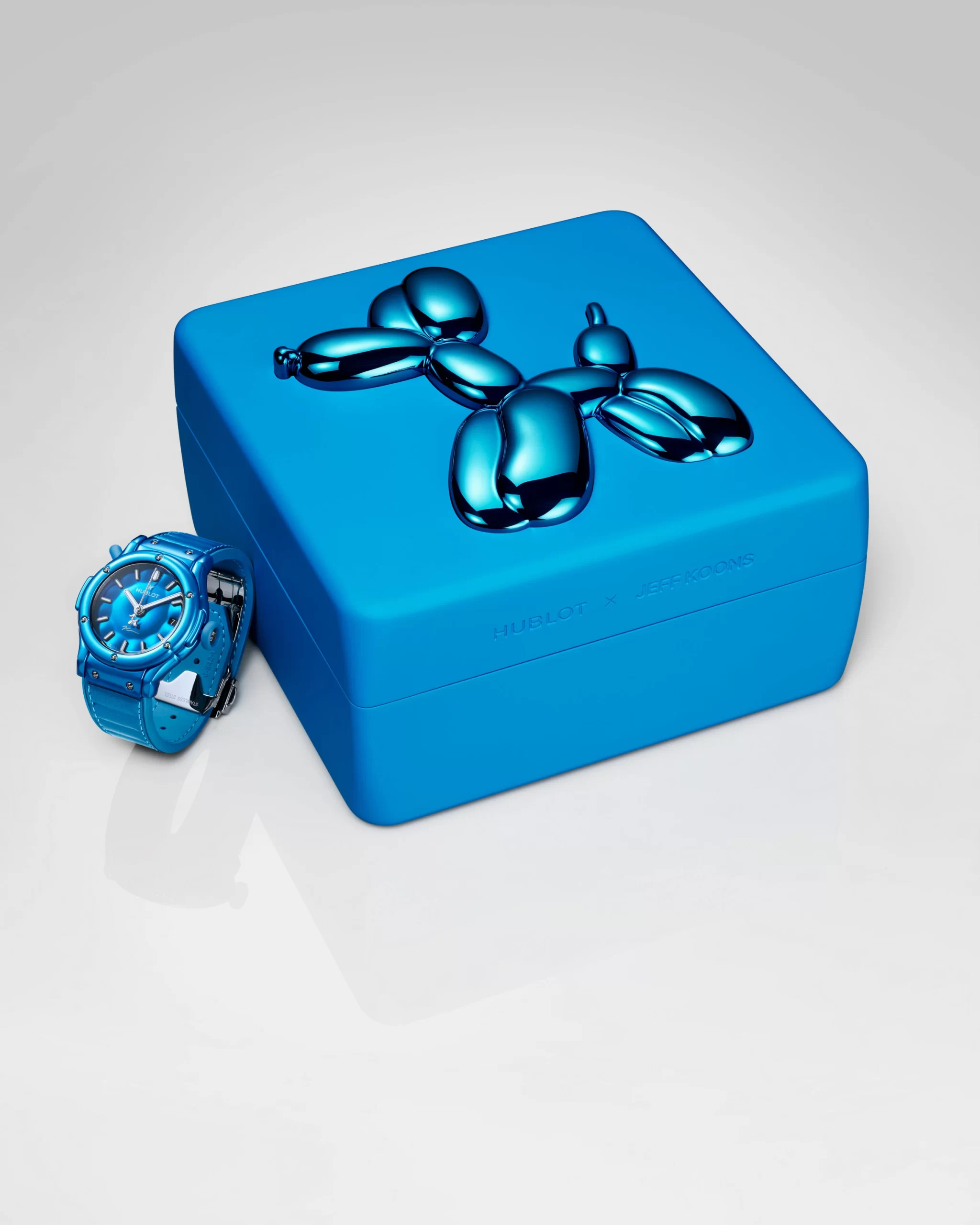
Unveiled in New York on 16 September 2026, the Hublot Classic Fusion Balloon Dog by Jeff Koons transforms Koons’ instantly recognisable Balloon Dog into a wristwatch. Available in mirror-polished stainless steel, red anodized aluminium and blue anodized aluminium, the collection is limited to 200 pieces in each edition.
The result is not simply a Classic Fusion decorated with references to an artwork. Hublot and Koons have rethought the architecture of the watch itself, creating a timepiece that appears almost as though it has been inflated.
From Balloon Sculpture to Wristwatch
Jeff Koons’ Balloon Dog, created between 1994 and 2000 as part of his Celebration series, takes one of the most familiar forms of childhood play and turns it into something permanent and monumental.
That transformation is central to Koons’ artistic language. Something temporary becomes enduring; something ordinary becomes iconic. Hublot sees a natural connection between that philosophy and its own approach to watchmaking, particularly its long-standing interest in combining unexpected materials, shapes and ideas.
For the Classic Fusion Balloon Dog, the challenge was therefore much greater than placing an artistic motif on an existing watch.
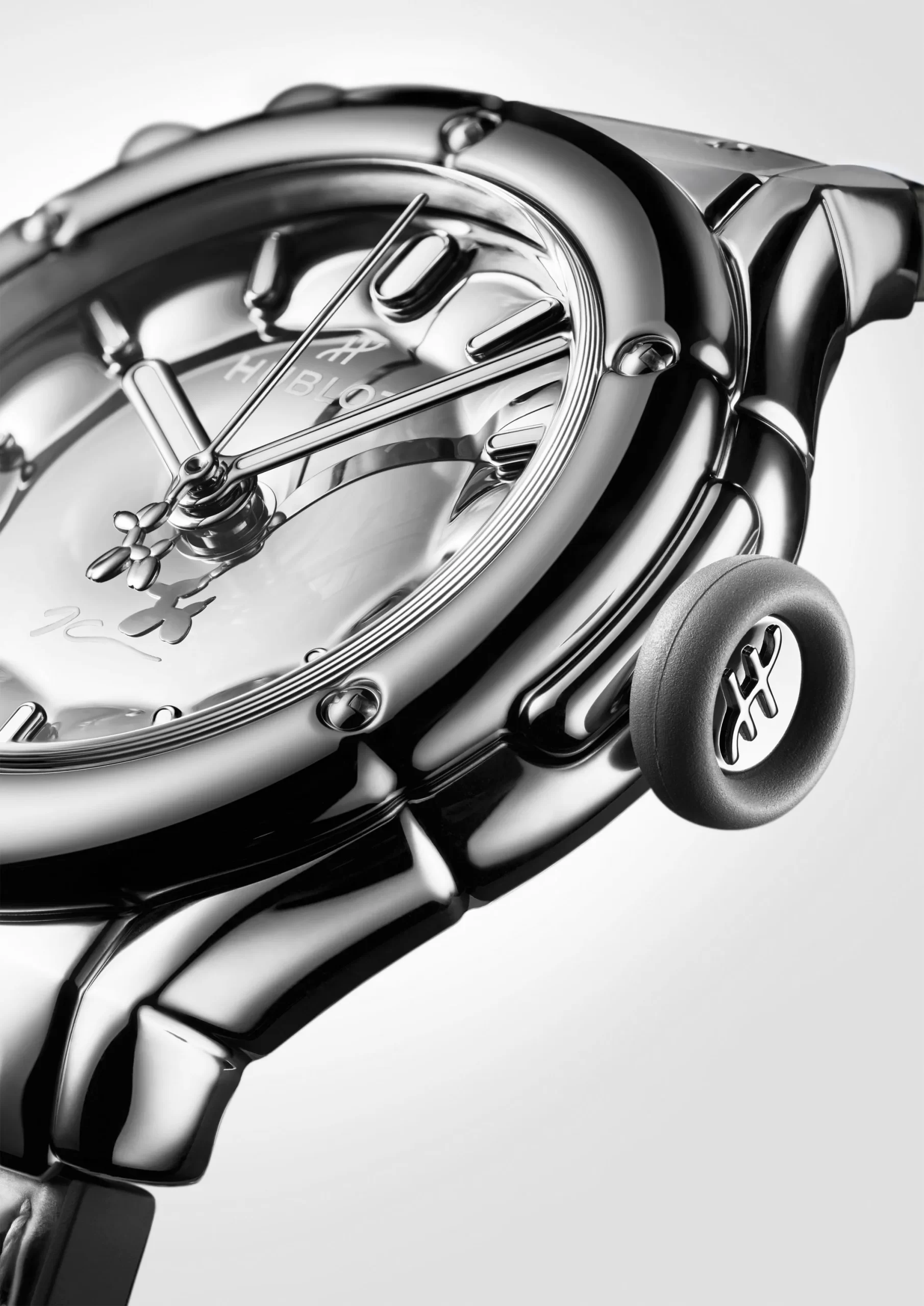
The 42mm Classic Fusion was fundamentally re-engineered around the visual language of an inflatable sculpture. Its normally sleek architecture gives way to rounded, convex and domed forms designed to create the impression of volume and internal pressure.
That distinction matters. This is not a conventional art-inspired dial. The artwork has influenced the physical architecture of the watch.
A Classic Fusion That Looks Inflated
Almost every visible component contributes to the illusion.
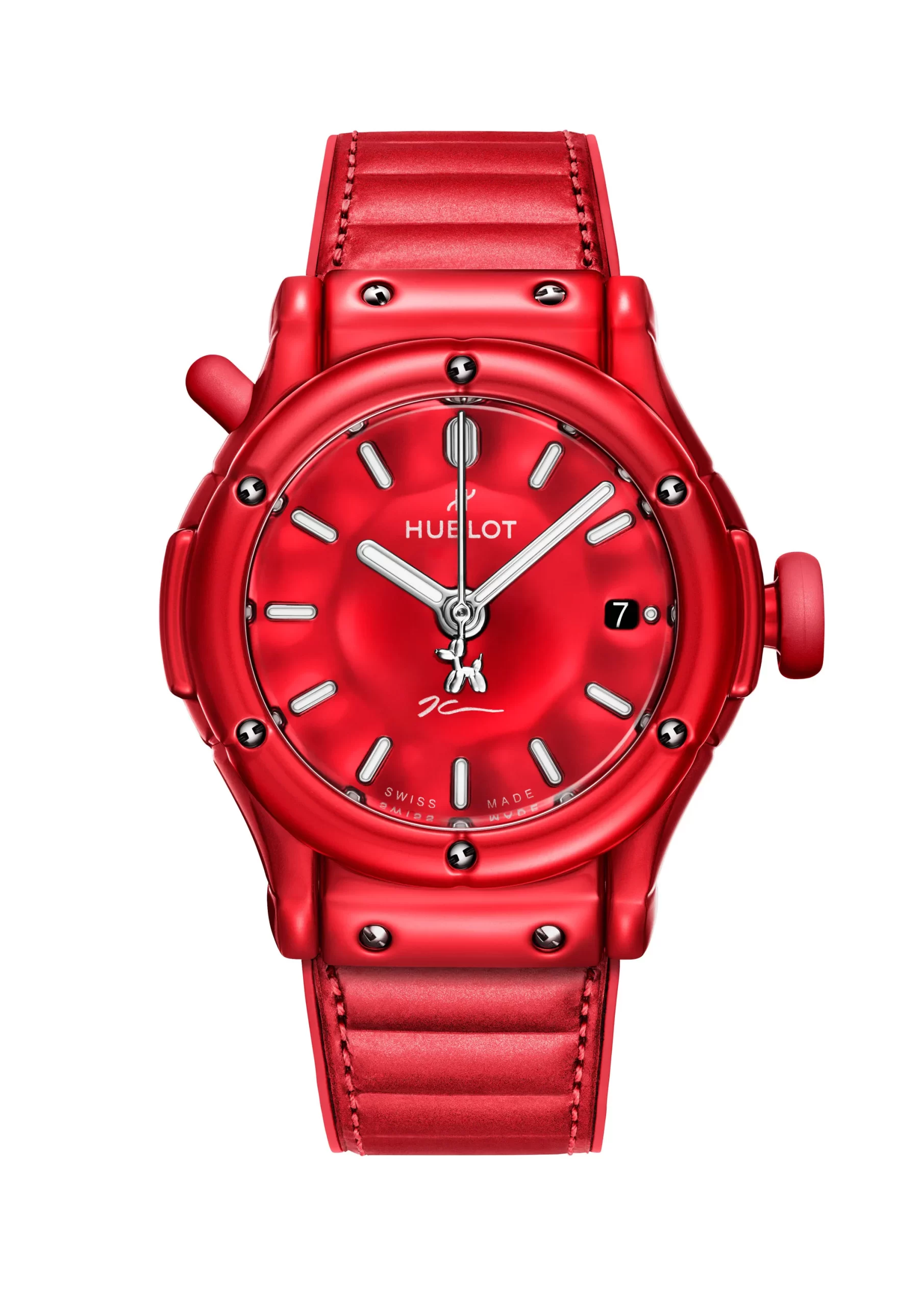
The sapphire crystal has a raised, domed profile, while the titanium H-shaped screws feature inflated heads. The dial itself adopts a convex, padded appearance, and the case follows the same rounded visual vocabulary.
Even the strap has been integrated into the concept. Its metallic leather and rubber construction continues the soft, padded aesthetic, while the attachment points have been softened rather than left with the sharper geometry traditionally associated with a sports-luxury watch.
Then come the details that make the connection to Balloon Dog unmistakable.
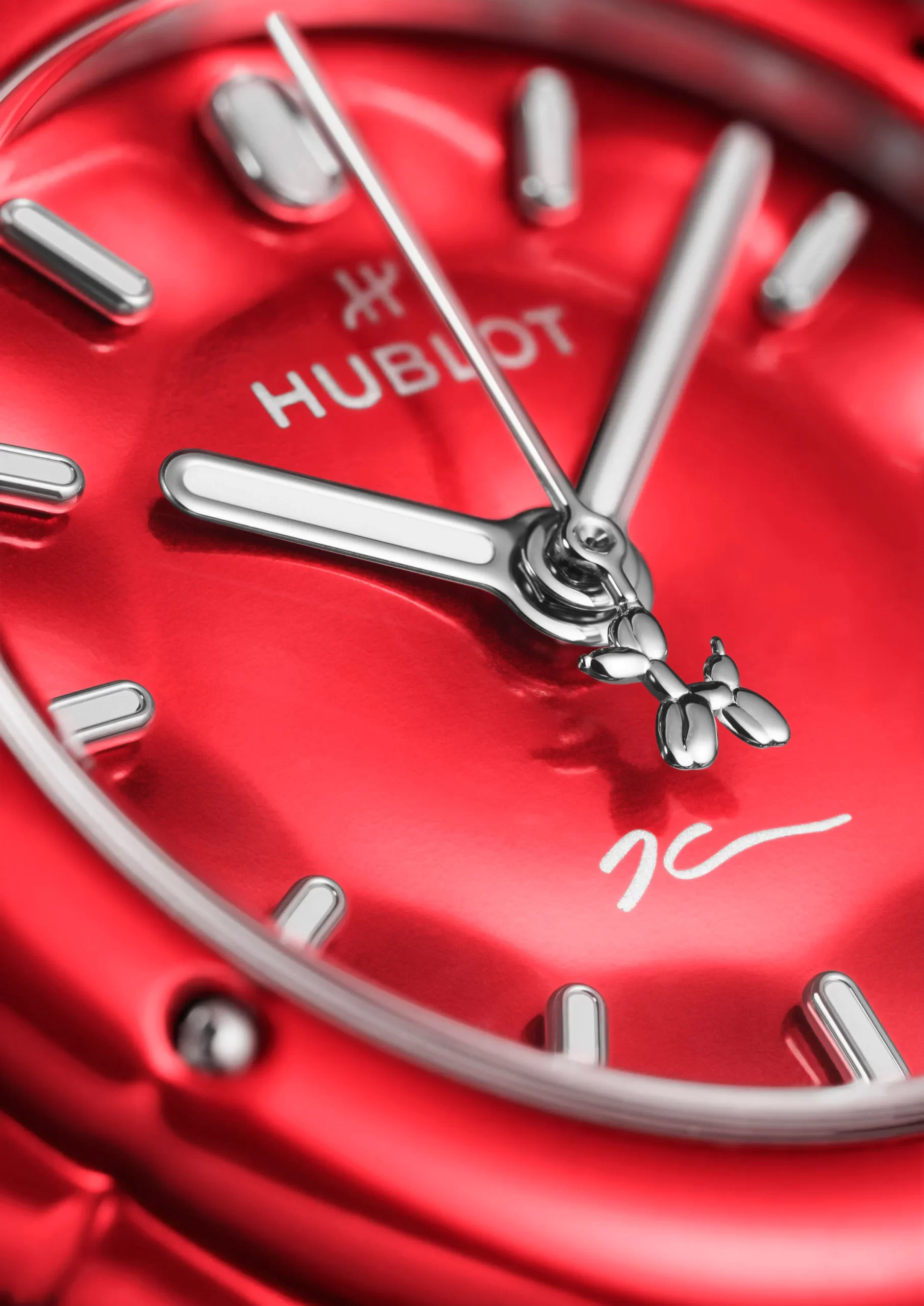
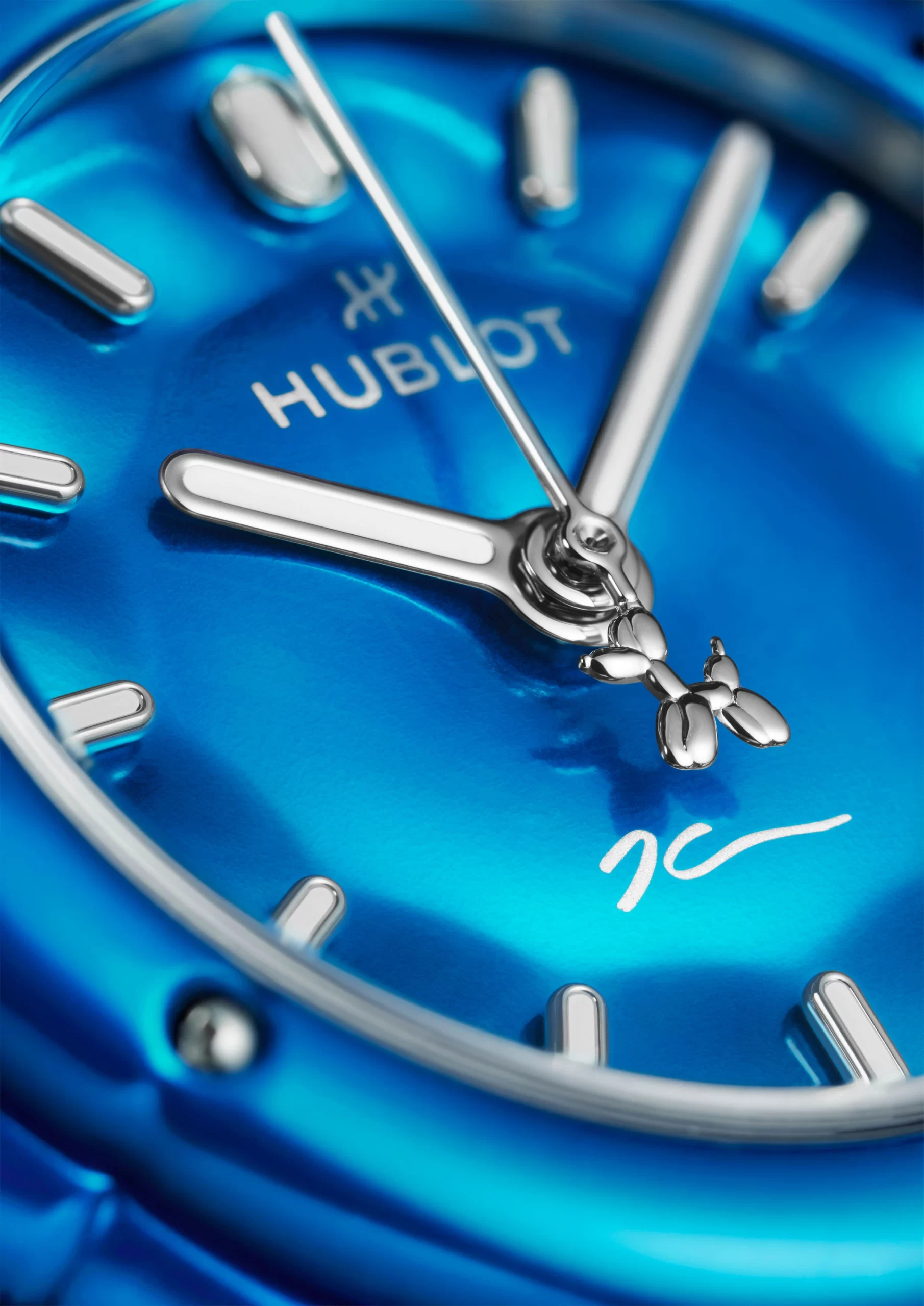
The crown is shaped like a balloon’s inflation valve. A flexible decorative “balloon tail” appears at 10:30, while the seconds hand carries a Balloon Dog-shaped counterweight. The hour and minute hands and dial indexes incorporate inflated Super-LumiNova elements.
It is playful, but the execution is anything but casual.
Three Interpretations, One Concept
Hublot has produced the Classic Fusion Balloon Dog in three distinct finishes.
Red
The red edition uses polished red anodized aluminium for the case, bezel and caseback, complemented by a red rubber balloon-tail detail. Its full red dial features domed appliques with 3D white Super-LumiNova and Jeff Koons’ signature at 6 o’clock.
Reference 542.UR.8170.NR.JKN26, it measures 42mm in diameter and 11mm thick, with 50 metres of water resistance.
Blue
The blue version follows the same sculptural construction but uses polished blue anodized aluminium. A blue rubber balloon tail, blue dial and matching strap create a monochromatic interpretation of the concept.
Its reference is 542.UB.5170.NR.JKN26, with the same 42mm diameter, 11mm thickness and 5 ATM water resistance as the red edition.
Silver
The third interpretation replaces colour with reflective metal. The 542.SX.0820.NR.JKN26 combines polished stainless steel with a rhodium-plated dial and grey accents.
Here, the mirror-like surface becomes particularly important. It echoes the reflective quality associated with Koons’ Balloon Dog sculptures while giving the watch a more restrained visual character.
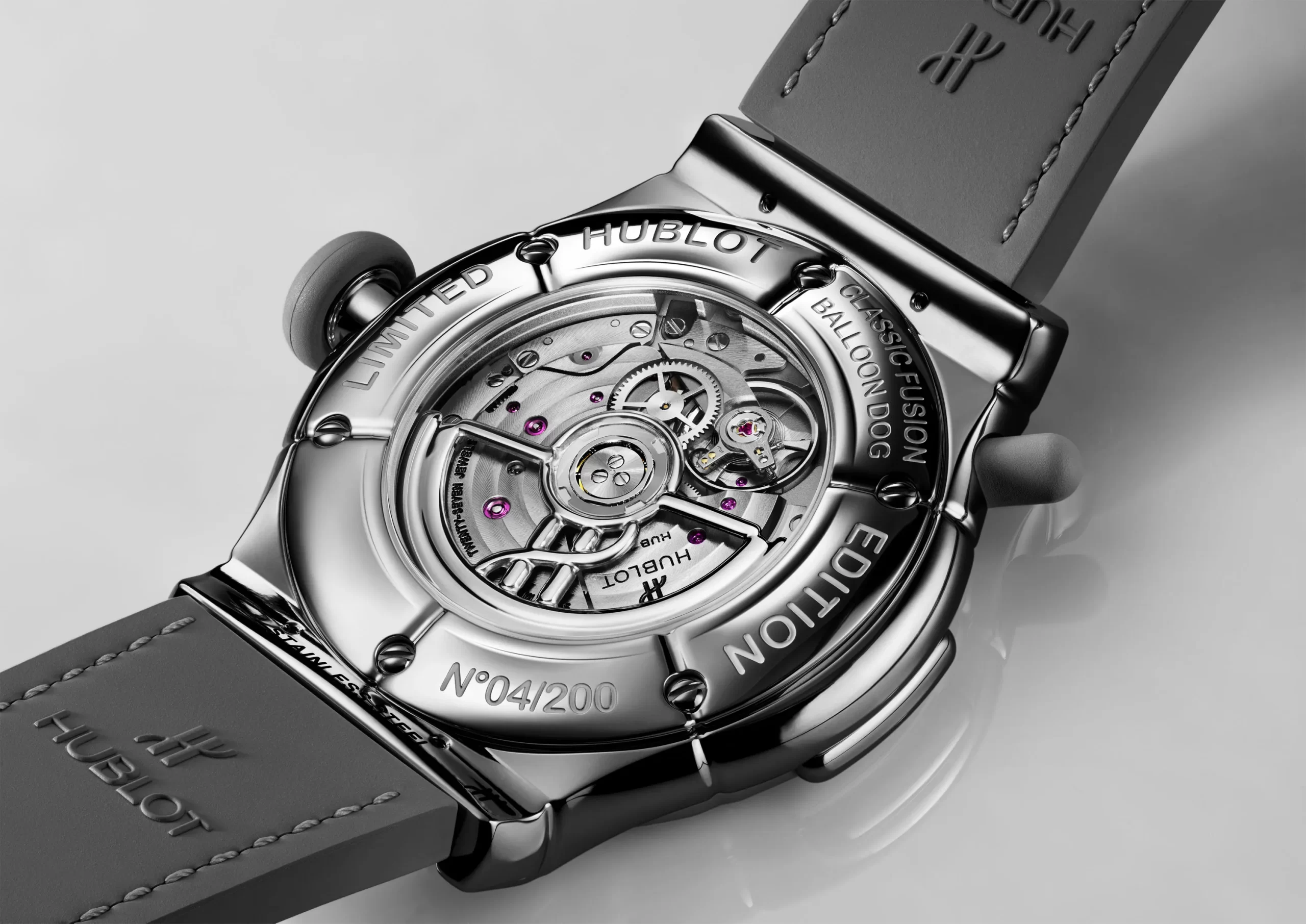
All three versions are limited to 200 pieces.
The Horology Beneath the Sculpture
For all its artistic personality, the Balloon Dog remains a mechanical Hublot.
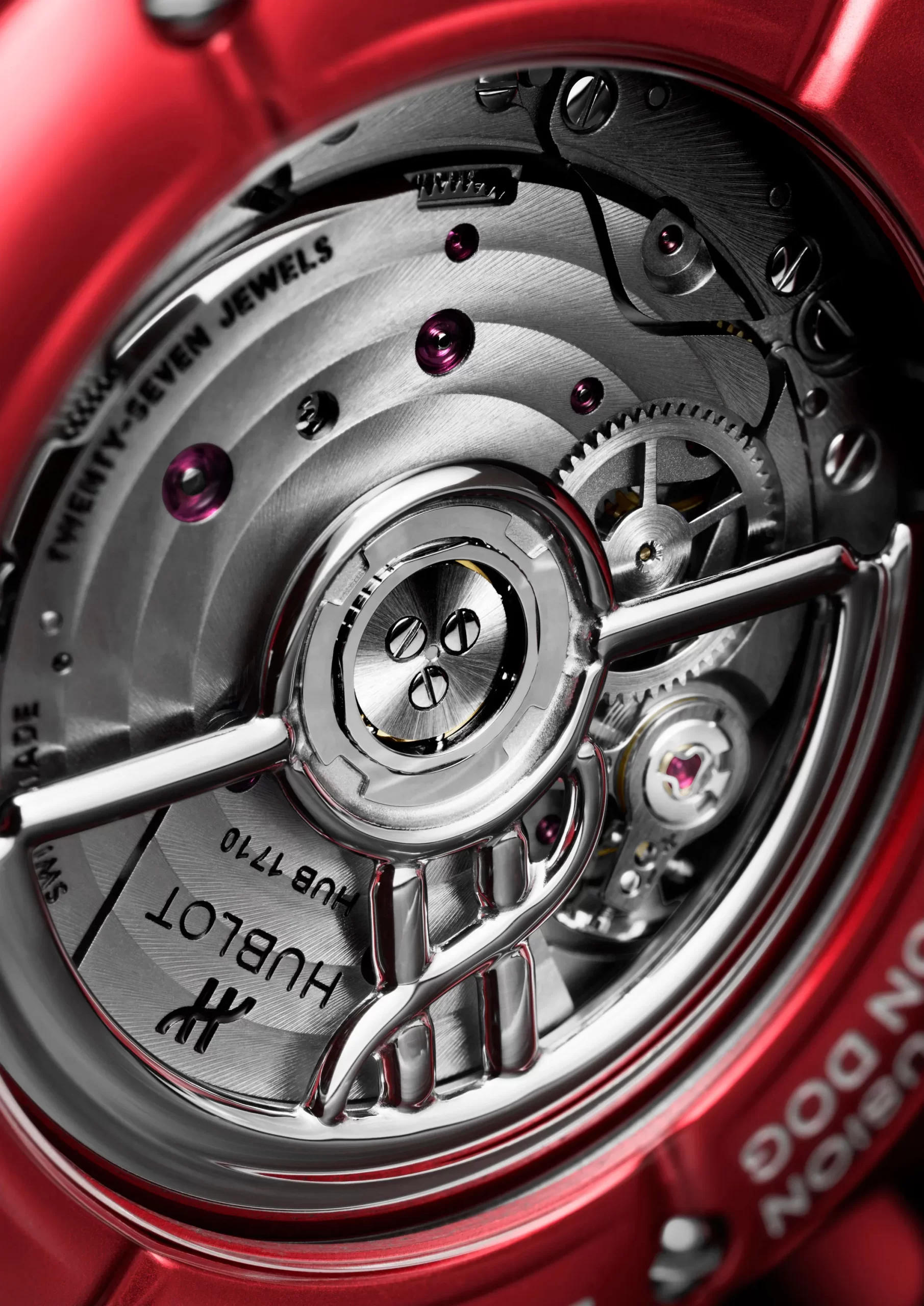
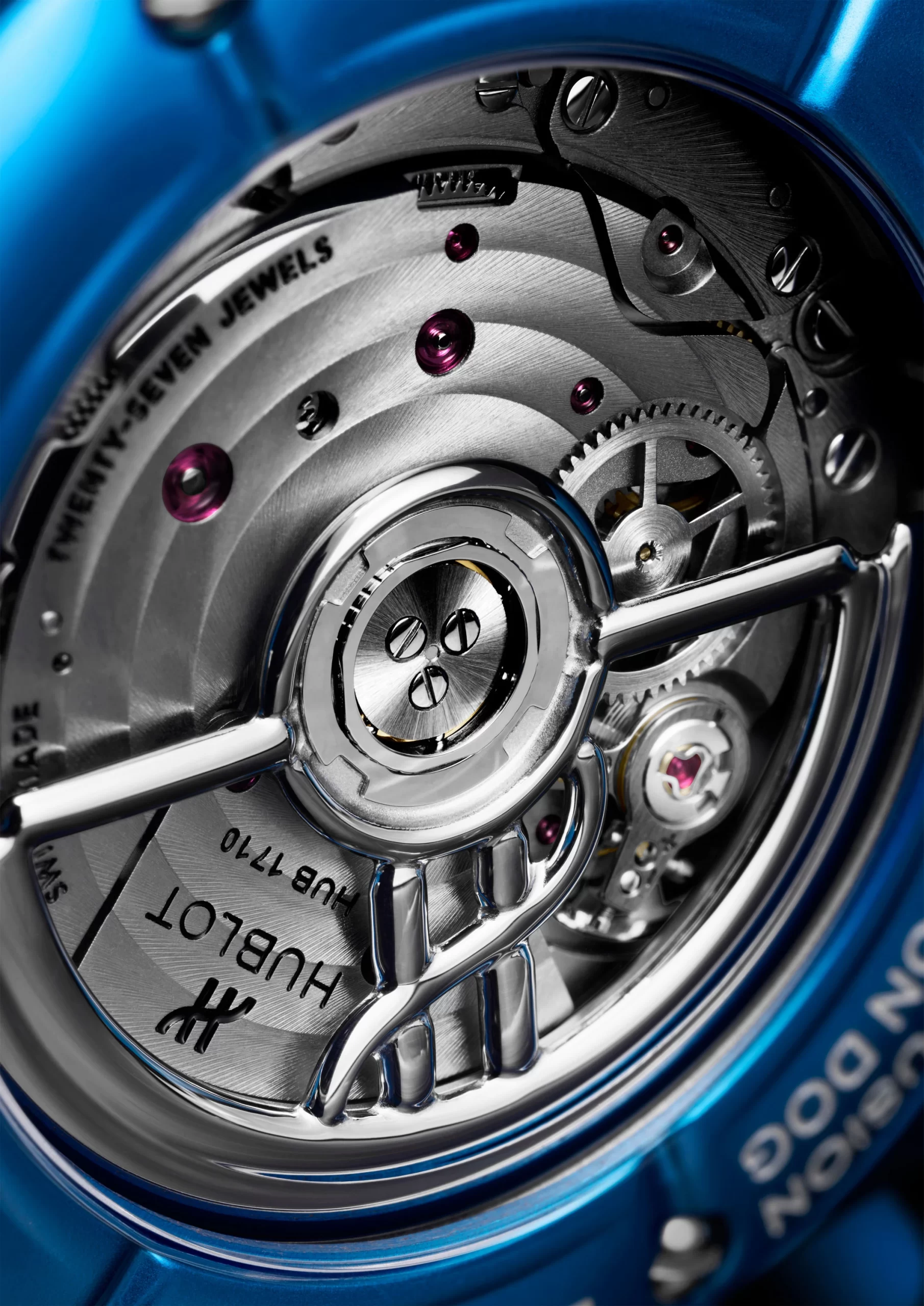
At its heart is the HUB1710 self-winding movement, with anthracite ruthenium-treated bridges and main plate. The movement incorporates a date display at 3 o’clock and a polished rhodium-plated oscillating weight designed with an inflated visual effect.
The technical specifications include:
Movement: Hublot HUB1710 automatic
Diameter: 25.6mm
Thickness: 3.7mm
Components: 185
Jewels: 27
Frequency: 4 Hz / 28,800 vibrations per hour
Power reserve: 50 hours
Date: 3 o’clock
Case diameter: 42mm
Water resistance: 50 metres
There is also an important technical point hidden beneath the playful exterior. The movement’s oscillating weight continues the visual language established by the case, creating a relationship between the mechanical heart of the watch and its external sculpture.
In other words, the Balloon Dog concept does not stop at the dial.
Where Art Meets Engineering
Perhaps the most interesting aspect of the collaboration is the amount of engineering required to make something apparently simple look simple.
Hublot states that the components were reimagined, reshaped and refined, with 5-axis CNC machining used to create the distinctive puffed forms before the components were finished by hand.
That combination of industrial precision and hand finishing is particularly appropriate for a collaboration with Koons. His sculptures are famous for their apparently flawless surfaces, yet achieving that simplicity requires considerable control over materials, proportions and finishing.
The same principle applies here.
The watch is supposed to look effortless. Making it look effortless is the difficult part.
More Than a Limited-Edition Watch
Hublot has also extended the Balloon Dog idea beyond the wrist.
Each watch comes in packaging inspired by the sculpture, featuring a chromed Balloon Dog with a colour-matched finish. Its rubber-effect painted surface continues the tactile and playful character of the timepiece.
The watches are conceived, developed and assembled at Hublot’s Manufacture in Nyon. They are also covered by the brand’s evolved 5+5 warranty programme for eligible watches purchased from 1 January 2026, providing a five-year basic warranty with the possibility of a further five-year extension through the Hublotista programme.
The watches are priced at CHF 20,800 / EUR 24,600 / USD 25,100 / GBP 19,700 across the three editions.
The Hublot Approach to Contemporary Art
The collaboration also makes sense within Hublot’s broader history.
Since 1980, the brand has built much of its identity around the idea of “Art of Fusion”, beginning with its combination of a gold case and rubber strap. The Big Bang subsequently expanded that philosophy through its layered construction, while the Classic Fusion established a different balance between contemporary design and restraint.
The Balloon Dog takes that philosophy into another dimension, quite literally.
Here, Hublot is not merely fusing materials. It is fusing watchmaking and sculpture, mechanical precision and visual emotion, childhood familiarity and contemporary luxury.
That is what makes the collaboration particularly relevant.
Jeff Koons
Few artists have transformed popular culture into iconography as profoundly as Jeff Koons. For over forty years, he has redefined contemporary art by taking everyday objects and elevating them through scale, transformation of material, craftsmanship with great precision and care. Known for works such as Balloon Dog, Rabbit and Puppy, Koons turns the ordinary into the extraordinary, the ephemeral into the permanent and the playful into the monumental. Beneath the reflective surfaces and universally recognizable forms lies a discipline rooted in the experience of feelings and sensation and a commitment to realizing a vision through execution. Behind their playful appearance lies a profound connection to human experience and our communal history, along with a celebration of this moment in time. His work revolves around themes of self- acceptance, empowerment, and transcendence. Mirror-polished surfaces, industrial precision and attention to detail have become his signature, transforming ephemeral objects into timeless iconic symbols.
Final Thoughts
The Hublot Classic Fusion Balloon Dog by Jeff Koons occupies an unusual space in modern watchmaking. It is recognisable as a Hublot, unmistakably connected to Koons, and yet neither identity completely dominates the other.
The familiar balloon animal has become a mechanical object. The Classic Fusion has been given curves, volume and a sense of movement that make it appear almost inflated. And beneath all that visual playfulness sits a serious automatic movement produced at Hublot’s Manufacture.
In a world where luxury watches can sometimes become exercises in adding more decoration, Hublot and Jeff Koons have taken a different route: they changed the shape of the idea itself.
And that may be the most interesting thing about this collaboration. Time has not simply been placed inside a work of art. It has been inflated into one.
Half a century after its debut, the TAG Heuer Monza returns in a limited edition inspired by one of the Maison’s most celebrated racing chronographs. The TAG Heuer Monza Flyback Chronograph combines the collection’s motorsport heritage with contemporary materials, purposeful design and mechanical precision.
Presented ahead of the FORMULA 1 PIRELLI GRAN PREMIO D’ITALIA 2026 in Monza, the new anniversary edition pays tribute to the original 1976 model while embracing the technical expertise and design language of today’s TAG Heuer. Only 500 numbered pieces will be produced, bringing together fifty years of racing history in a chronograph designed for modern performance.
Born on the Circuit
The history of the TAG Heuer Monza is closely connected to Formula 1® and Ferrari. In 1971, Heuer became the Official Timekeeper of Scuderia Ferrari, becoming the first watchmaker to partner with a Formula 1® team. Four years later, Niki Lauda secured the Formula 1® World Championship, bringing Ferrari its first Drivers’ title since 1964.
To celebrate this achievement, Heuer introduced the Monza collection in 1976. The chronograph immediately stood apart through its distinctive racing appearance and character. Its bold personality and close connection with motorsport established the Monza as one of the Maison’s most recognizable chronographs. Over subsequent decades, the collection evolved through successive interpretations reflecting the technical progress and creative direction of their respective eras.
For its fiftieth anniversary, the TAG Heuer Monza enters a new chapter. The limited edition draws inspiration from the collection’s visual identity while building upon the contemporary TAG Heuer Monza Flyback Chronograph introduced in 2023. The result honors an important moment in the Maison’s history while expressing its current vision of performance and precision.
Engineered for Today’s Race
The TAG Heuer Monza Flyback Chronograph offers a contemporary interpretation of one of the Maison’s distinctive racing chronographs. Its design combines modern materials, purposeful details and mechanical precision while preserving the visual cues that have defined the collection for five decades.
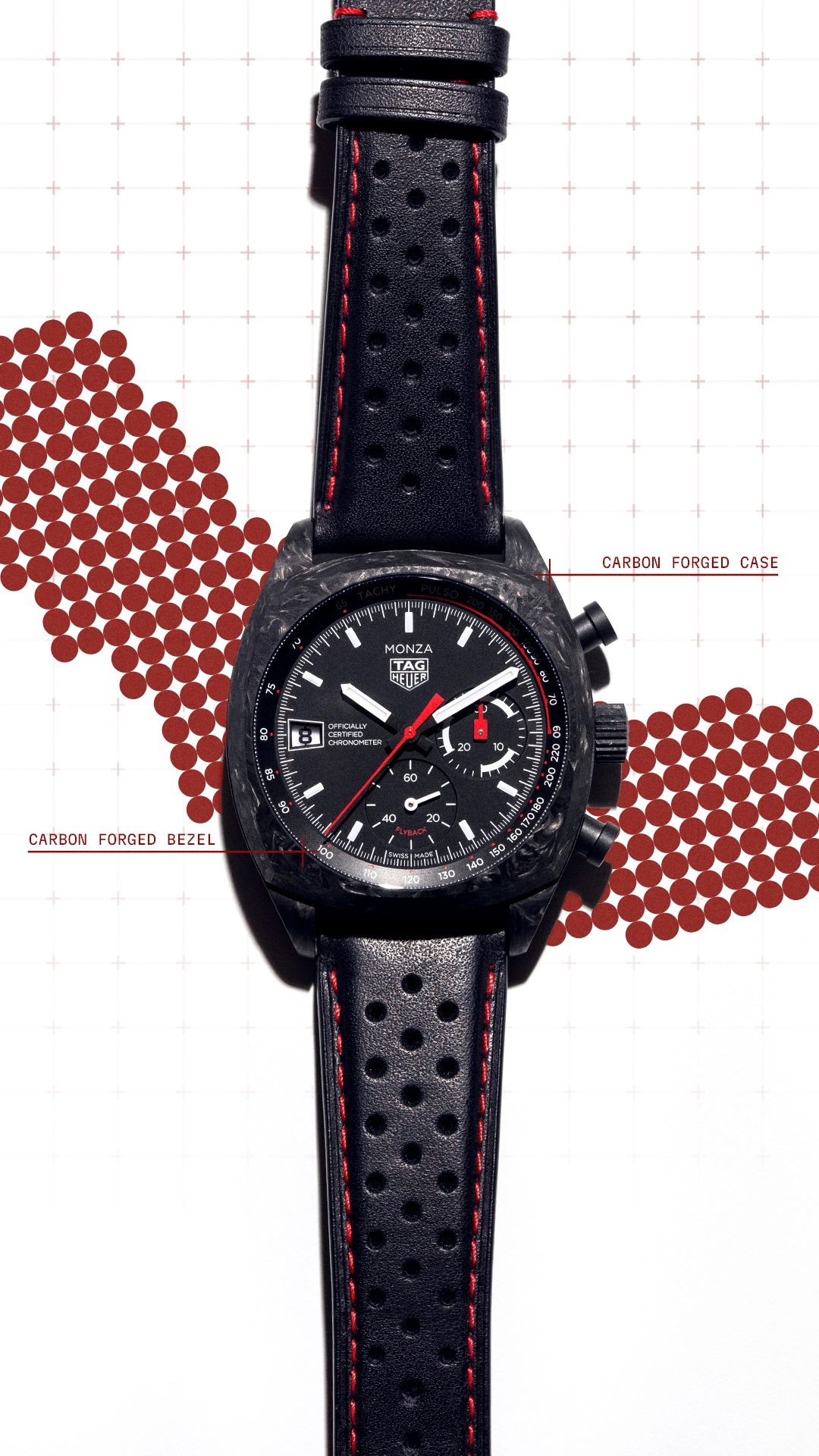
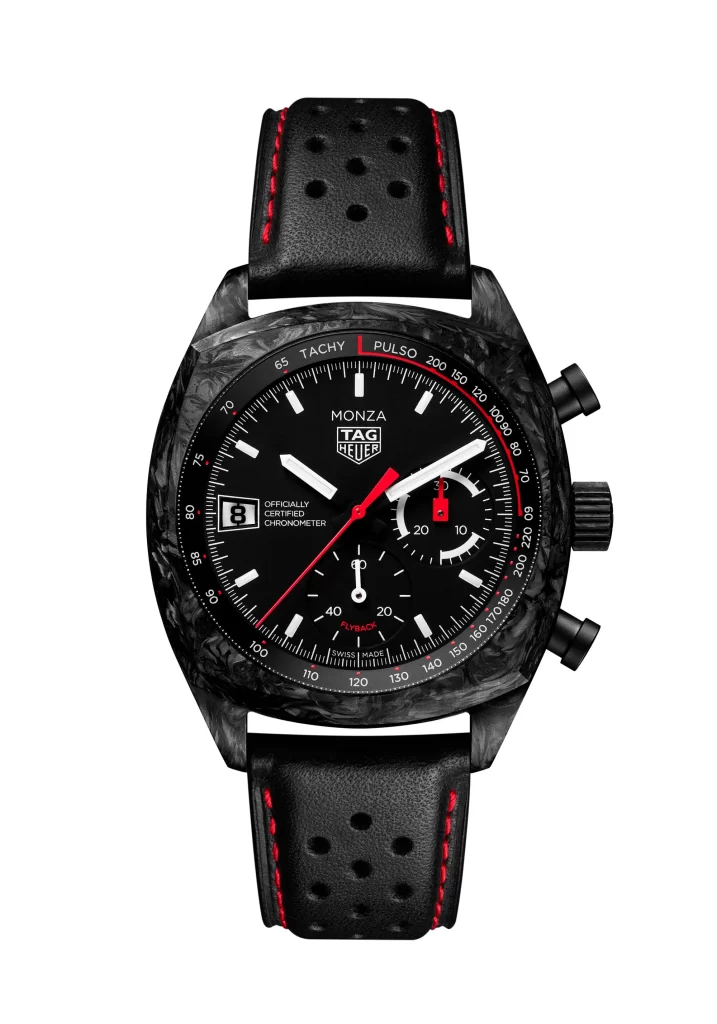
At its center is a 42 mm forged carbon case. Recognized throughout modern motorsport for its exceptional strength and remarkably low weight, forged carbon provides wearing comfort while creating a unique marbled texture. As a result, each watch has its own individual appearance. The cushion-shaped case introduced with the contemporary TAG Heuer Monza reinforces the watch’s sporting character and its connection to modern racing technology.
The case is complemented by a carbon fixed bezel and a domed sapphire crystal with double anti-reflective treatment. The watch also features a carbon crown at 3 o’clock, black DLC steel round push buttons at 2 and 4 o’clock, and a black DLC titanium-grade 2 screwed case back carrying the limited-edition engraving. Water resistance is rated at 100 meters.
A Dial Inspired by the Original Monza
The black matte dial introduces design elements inspired by the original 1976 Heuer Monza while remaining rooted in contemporary watchmaking. Matte black chronograph counters contrast with the dial to maximize legibility, while red accents recall the historic color signatures of the collection.
White lacquered hour and minute hands are treated with white SuperLumiNova® for readability. The dial layout includes a black matte minute chronograph counter with a red lacquered hand at 3 o’clock, a black matte permanent seconds indicator with a white lacquered hand at 6 o’clock, and an angled date aperture at 9 o’clock. A red lacquered central chronograph hand adds another distinctive detail.
Framing the dial is a black flange featuring both a tachymeter and pulsometer scale, referencing the functional origins of the chronograph.
The TH20-12 Flyback Chronograph
Through the sapphire crystal case back, the TAG Heuer Monza Flyback Chronograph reveals the COSC-certified manufacture Calibre TH20-12. The movement incorporates a flyback chronograph function, allowing consecutive timing intervals to be measured without interrupting the chronograph.
A single press resets and restarts the timing sequence, making the complication particularly valuable in motorsport, where fractions of a second matter.
The watch is completed by a black perforated calfskin leather strap with red stitching, a detail described by TAG Heuer as a subtle reference to the world of classic motor racing. The strap is paired with a black DLC titanium-grade 2 sandblasted folding clasp with double safety pushbuttons.
A Limited Edition of 500 Pieces
The TAG Heuer Monza Flyback Chronograph is presented as a limited edition of only 500 numbered pieces, reinforcing its position within the Maison’s collector-focused chronograph offerings. The case back carries an individual limited-edition engraving in the format XXX/500.
The model is identified as CR5092.FC8372 and measures 42 mm in diameter. It is powered by Calibre TH20-12 and features a black matte dial, carbon case and bezel, sapphire crystal, and black perforated calfskin leather strap with red stitching.
Fifty Years on the Racing Line
Unveiled during one of the most anticipated weekends of the Formula 1® season, the TAG Heuer Monza Flyback Chronograph continues the connection between the Maison and motor racing. Fifty years after the original TAG Heuer Monza celebrated a World Championship victory, the anniversary edition carries that story forward with a contemporary flyback chronograph focused on performance, precision and racing heritage.
TAG Heuer Monza Flyback Chronograph (42mm)
CR5092.FC8372
Movement
Caliber TH20-12
Dial
Black matte dial
Black flange with pulsometer, tachymeter 2 counters :
– 3 o’clock : black matte minute chronograph counter ; red lacquered hand
– 6 o’clock : black matte permanent second indicator ; white lacquered hand
White indexes printed with white Superluminova®
Hour and minute hands with black and white lacquer with white Superluminova®
Red lacquered central chronograph hand
White TAG HEUER printed logo
9 o’clock angled date
“MONZA”, “OFFICIALLY CERTIFIED CHRONOMETER”, “FLYBACK “ & “SWISS MADE” printed
Case 42 mm diameter Carbon case
Carbon fixed bezel Domed sapphire crystal with double anti-reflective treatment Carbon crown at 3 o’clock Black DLC steel round push button at 2 o’clock Black DLC steel round push button at 4 o’clock Black DLC titanium-grade 2 screwed case back with limited edition engraving (XXX/500)
Water resistance : 100 meters
Bracelet Black perforated calfskin leather strap with red stitching Black DLC titanium-grade 2 sandblasted folding clasp with double safety pushbuttons
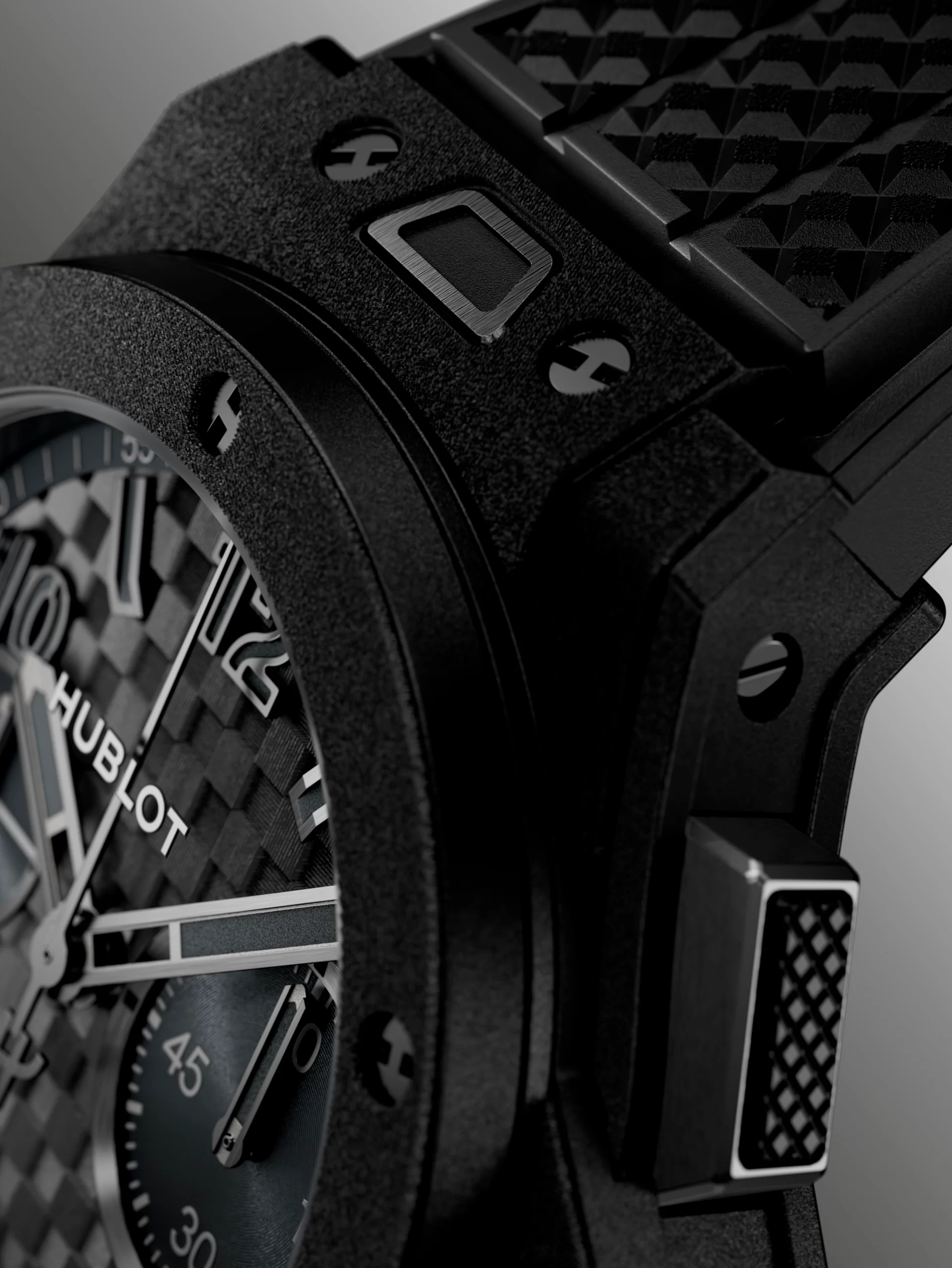
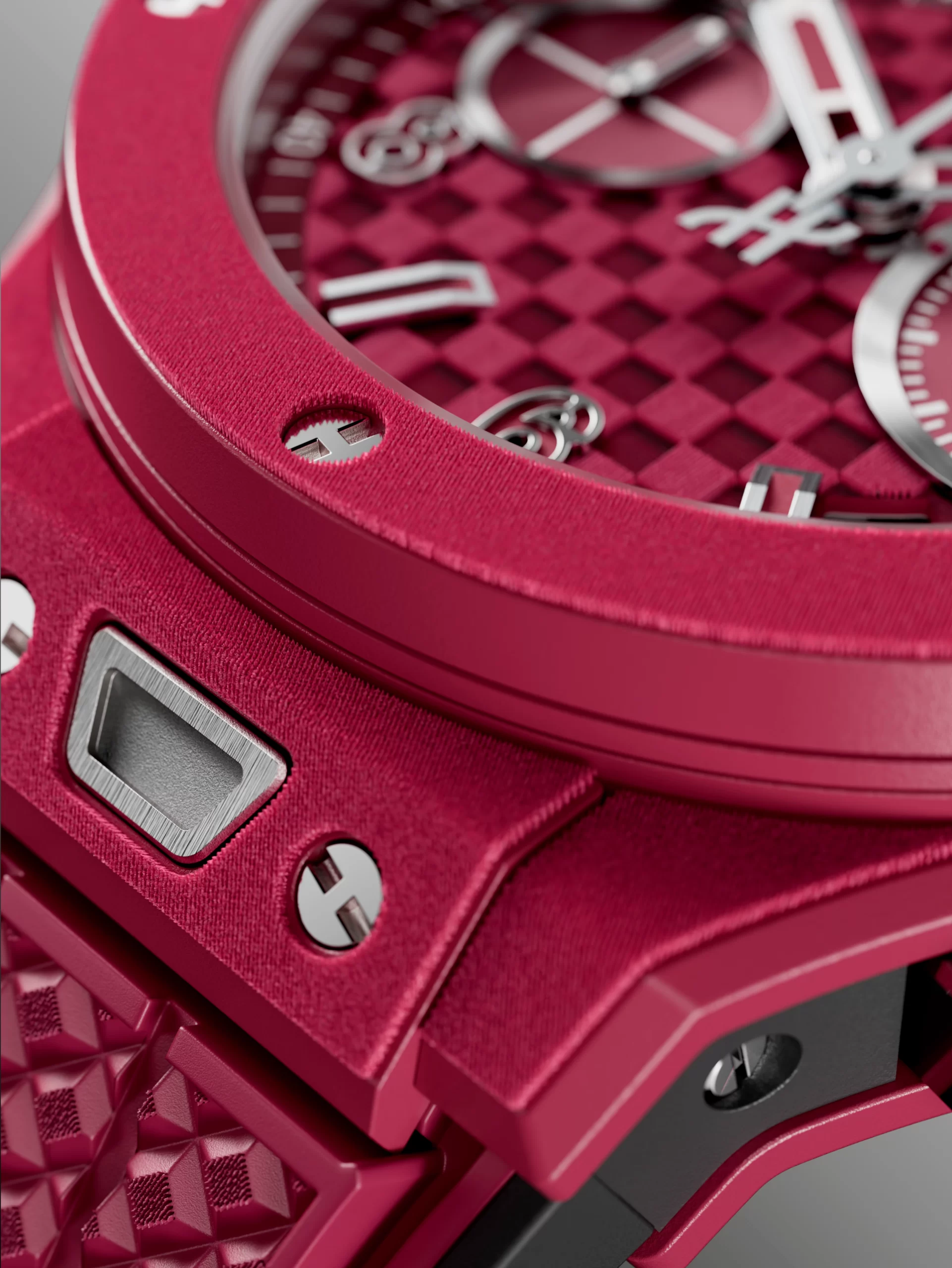
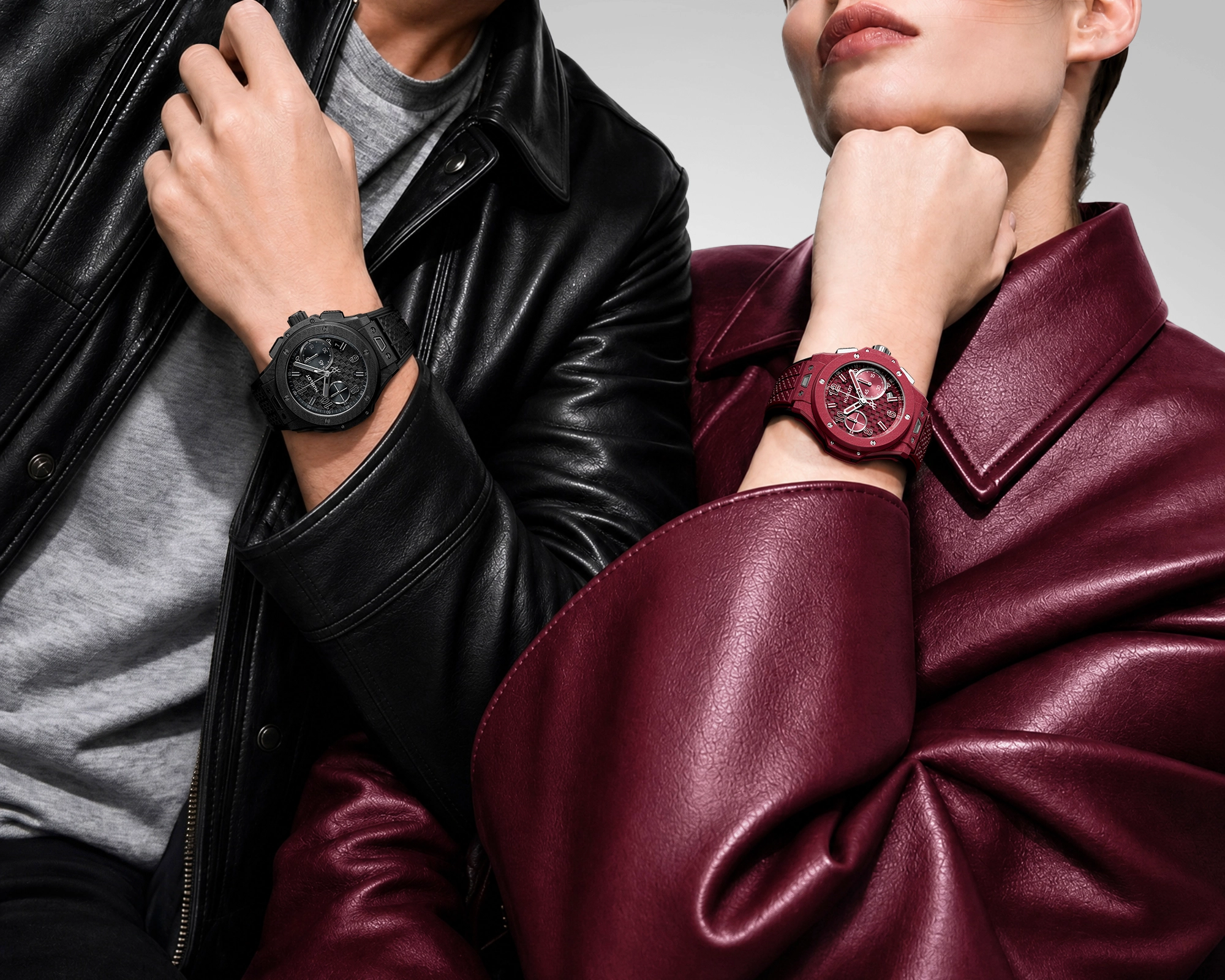
Hublot introduces the Big Bang Original Soft Touch, a new interpretation of its iconic Big Bang Original that brings a tactile dimension to the collection. Available in All Red and All Black, the new watches use an exclusive textured rubber compound across the case, bezel, dial and strap, creating a distinctive soft-touch surface. Hublot describes the material as neither a coating nor a surface treatment, but as a new approach to constructing the watch.
A New Sensory Expression of the Big Bang Original
The Big Bang Original Soft Touch remains rooted in the unmistakable design of the original Big Bang, introduced in 2005, while incorporating two decades of Hublot innovation. For the first time, the watch is designed not only to be seen, but also to be felt.
The defining feature is Hublot’s exclusive textured rubber compound. Developed using a dedicated overmoulding process, specially engineered tooling integrates the texture directly into the material during production. Its microscopic surface structure consists of thousands of fine micro-elements, creating a remarkably soft tactile finish while maintaining the durability and resistance associated with Hublot’s signature rubber.
The textured material extends across multiple elements of the watch, including the case, bezel, dial and strap. The result is a cohesive visual and tactile identity rather than a conventional surface treatment.
Big Bang Original Soft Touch All Red
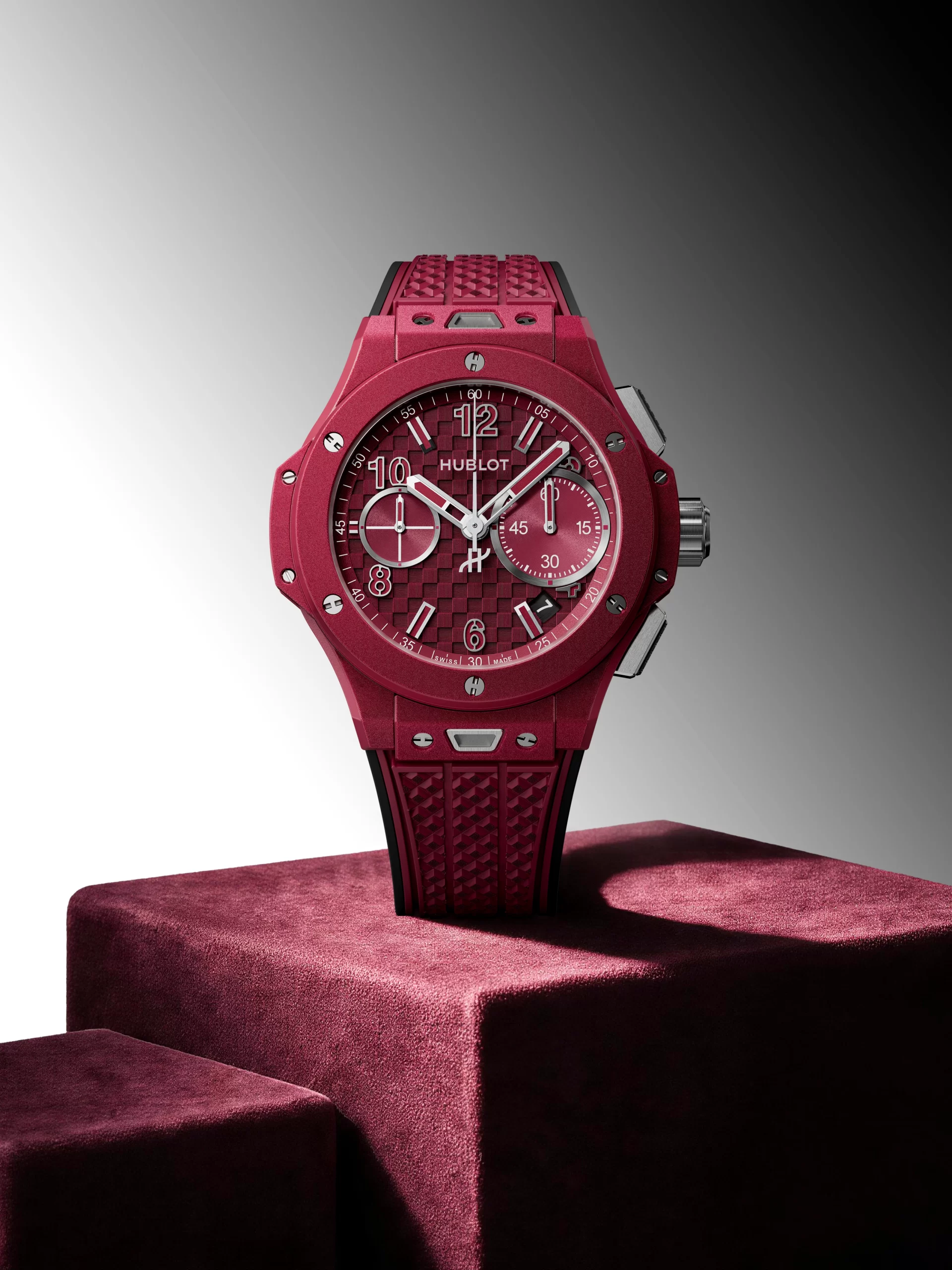
The Big Bang Original Soft Touch All Red brings Hublot’s distinctive red aesthetic into this new tactile format. Hublot positions the model as a tribute to its material expertise, particularly its development of vividly coloured high-tech ceramic, introduced in 2018. The All Red Soft Touch instead creates its visual and tactile character through titanium combined with the exclusive soft-touch rubber.
The watch features a 43 mm titanium case overmoulded in red rubber with a velvet effect, with a matching red rubber dial with a velvet effect. The strap combines black rubber with red structured rubber with a velvet effect, and the watch is secured by a titanium deployant buckle clasp.
The official reference for the All Red model is 431.RXR.2770.RX.VEL. It has a water resistance rating of 100 metres / 10 ATM and uses a sapphire crystal with anti-reflective treatment.
Powered by the HUB1280 UNICO
Inside the Big Bang Original Soft Touch is Hublot’s HUB1280 UNICO Manufacture Self-winding Chronograph Flyback Movement with Column Wheel. The movement is developed entirely in-house and incorporates a column wheel, dual-clutch architecture, layered construction, an optimised gear train and a skeletonised tungsten rotor open-worked in the shape of an H.
The movement provides an approximately 72-hour power reserve. The HUB1280 UNICO has a thickness of 6.75 mm, a diameter of 30.00 mm, 354 components and 43 jewels, with a frequency of 4 Hz, or 28,800 vibrations per hour.
The 43 mm case combines the architecture of the original Big Bang with contemporary refinements, including bevelled edges, curved and smoother lugs, a rubber-clad crown and rectangular pushers with Hublot’s signature rubber inserts. The strap also incorporates Hublot’s One Click system for interchangeability.
All Black: A Monochromatic Classic Reimagined
Alongside the All Red, Hublot introduces the Big Bang Original Soft Touch All Black. The model continues the history of Hublot’s All Black concept, which was introduced in 2006 as a monochromatic expression in which the absence of colour emphasised form, architecture and identity.
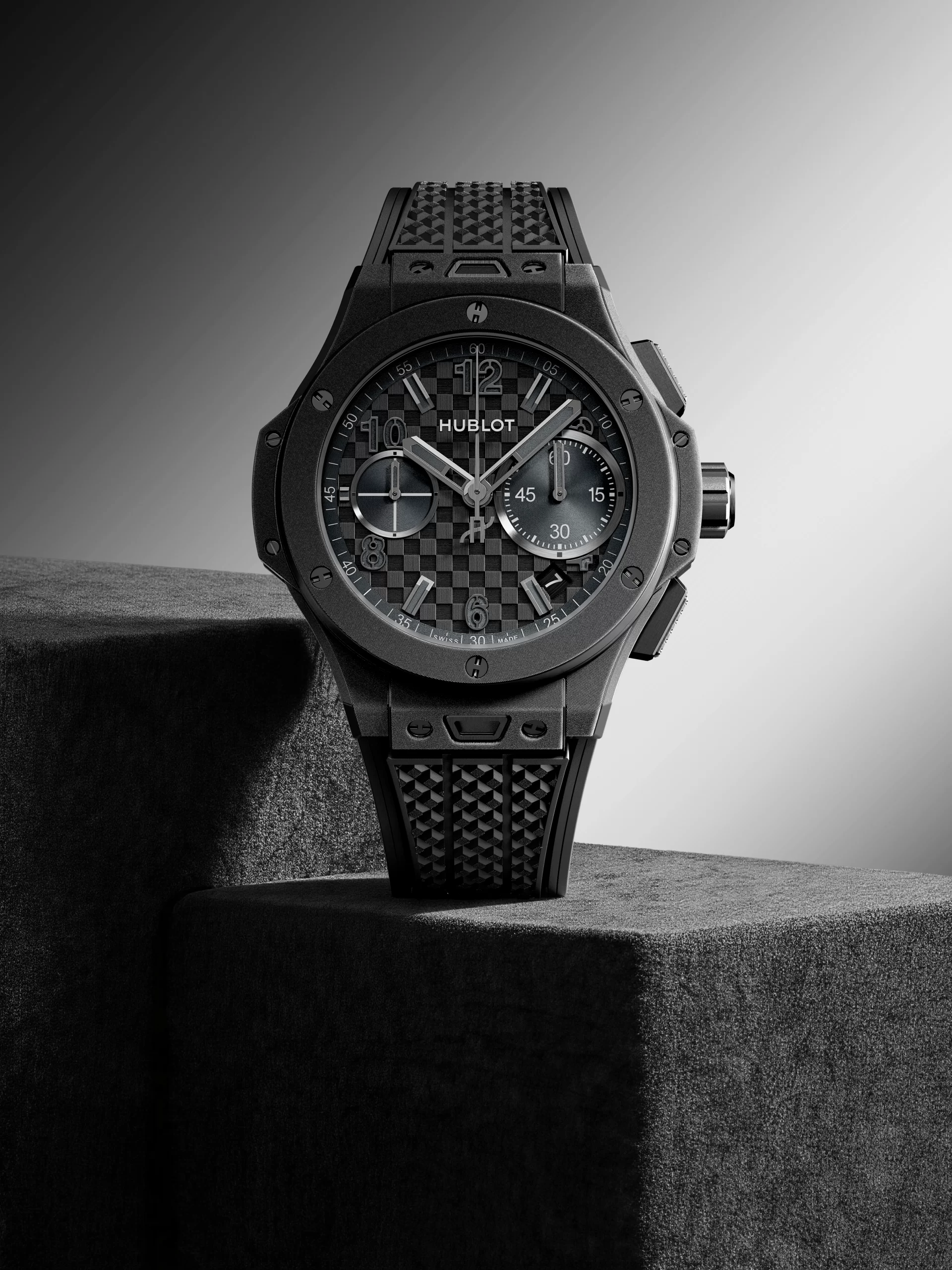
For the Soft Touch version, the monochromatic approach is combined with a deep black titanium case, black DLC-coated pushers and the new textured rubber construction. As with the All Red, the objective is not simply a change in colour, but a different sensory experience.
The All Black carries reference 431.RXN.2740.RX.VEL. It measures 43 mm in diameter and 13.2 mm in thickness, offers 100 metres / 10 ATM of water resistance and is powered by the HUB1280 UNICO Manufacture Self-winding Chronograph.
Material Innovation at the Hublot Manufacture
The Big Bang Original Soft Touch forms part of Hublot’s broader Art of Fusion approach to materials. The Manufacture has developed watches using materials including coloured ceramics, sapphire and Magic Gold, and the Soft Touch introduces another material-focused development centred on sensation as well as appearance.
The Big Bang Original Soft Touch is conceived, developed and assembled at the Hublot Manufacture in Nyon. Hublot also extends the tactile concept to the presentation case, which features a matching textured Hublot logo that echoes the surface of the watch’s soft-touch rubber.
The collection is available through selected Hublot points of sale and online.
Hublot Big Bang Original Soft Touch: Specifications
Specification
All Red
All Black
Reference
431.RXR.2770.RX.VEL
431.RXN.2740.RX.VEL
Case
Titanium overmoulded in red rubber with velvet effect
Titanium overmoulded in black rubber with velvet effect
Black rubber and red structured rubber with velvet effect
Black structured rubber with velvet effect
Conclusion
With the Big Bang Original Soft Touch, Hublot takes one of its most recognisable designs into a new sensory territory. The combination of the Big Bang’s established architecture, an exclusive textured rubber compound and the in-house HUB1280 UNICO movement gives the new collection a distinct identity centred on material innovation.
The All Red and All Black versions express the same concept through two of Hublot’s strongest colour signatures: one vivid and expressive, the other deliberately monochromatic. In both cases, the defining idea is simple: material innovation that can be seen, and felt.