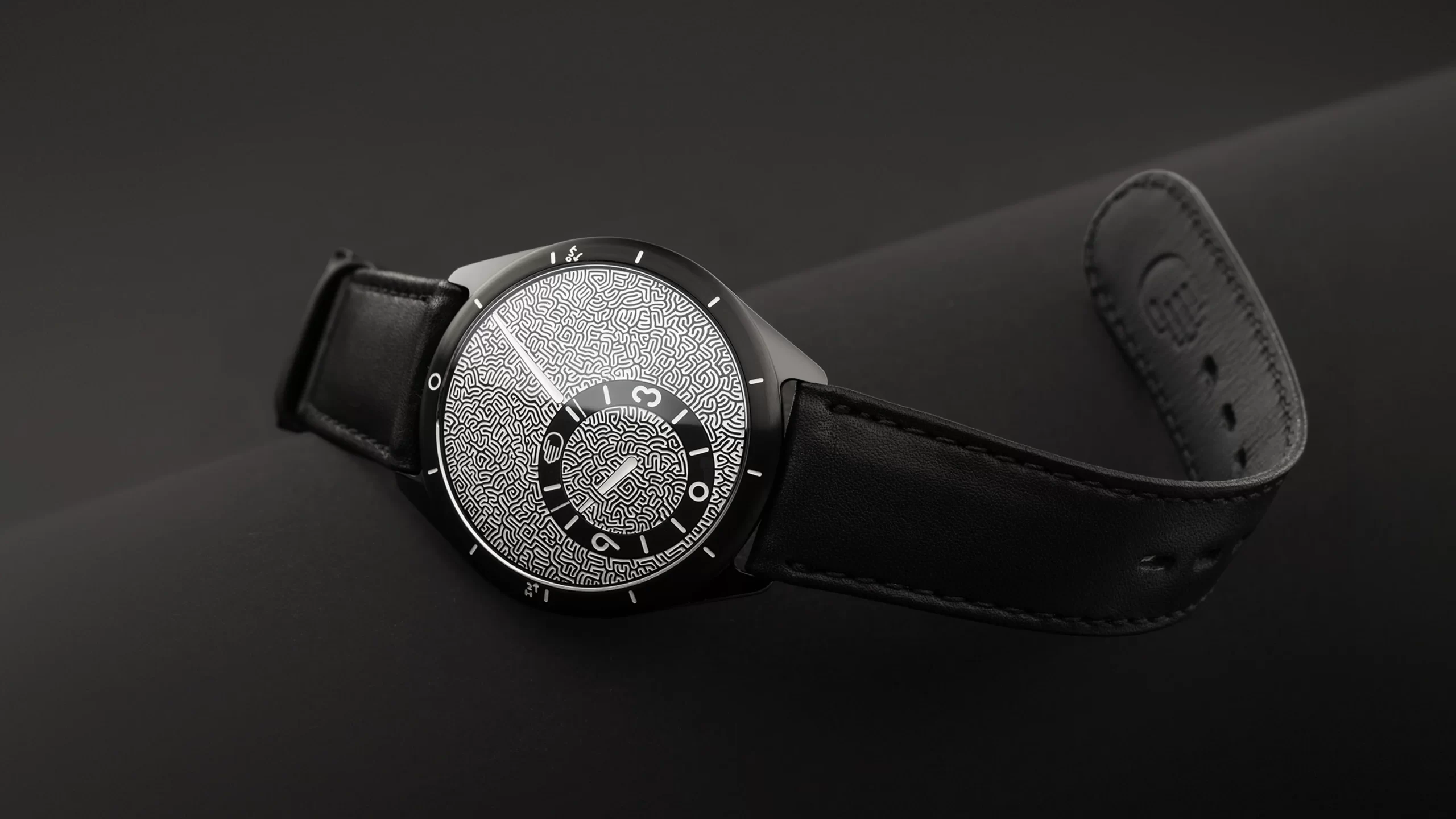
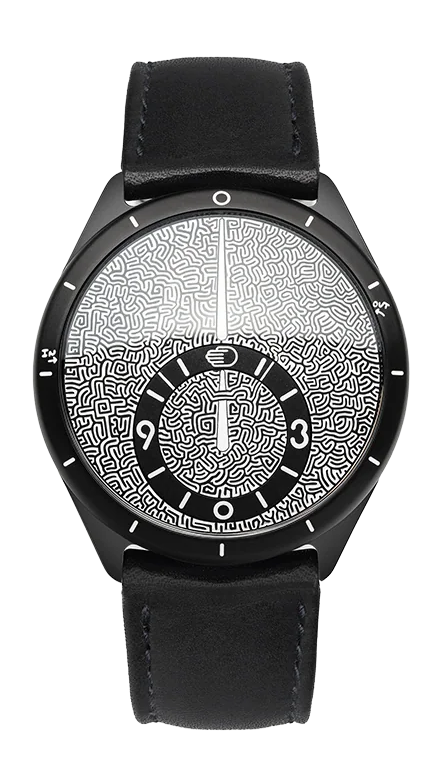
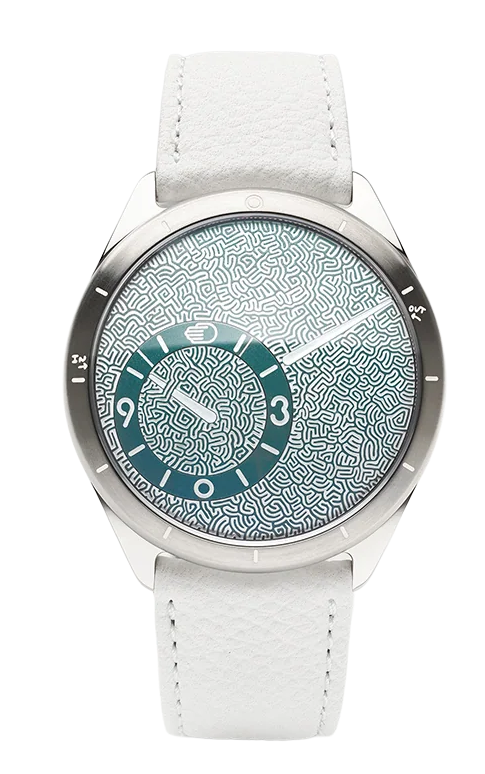
For this year’s art watch, Ressence teamed up with Belgian artist Jules Wittock to introduce a handdrawn maze onto the dial of the brand’s TYPE 9. The T9 JWE and T9 JWB – limited to 60 pieces, 30 each – is a visual experience, made to awaken the senses and wonder your way through.
Wittock is known for tracing mazes freehand. In the case of the T9 JWE (Emerald Green colourway) and T9 JWB (black), a miniaturised design offers the wearer a single entrance, a single exit, and a path between them that spells a word.
“I like hiding things in my paintings,” says Wittock. “There’s always a mystery within the maze.”
Only at midnight does the maze align to reveal its hidden message — a nod to Wittock’s childhood ritual of making a wish at times like 11:11 or 22:22. What that message is remains between the artist and those who own the piece.
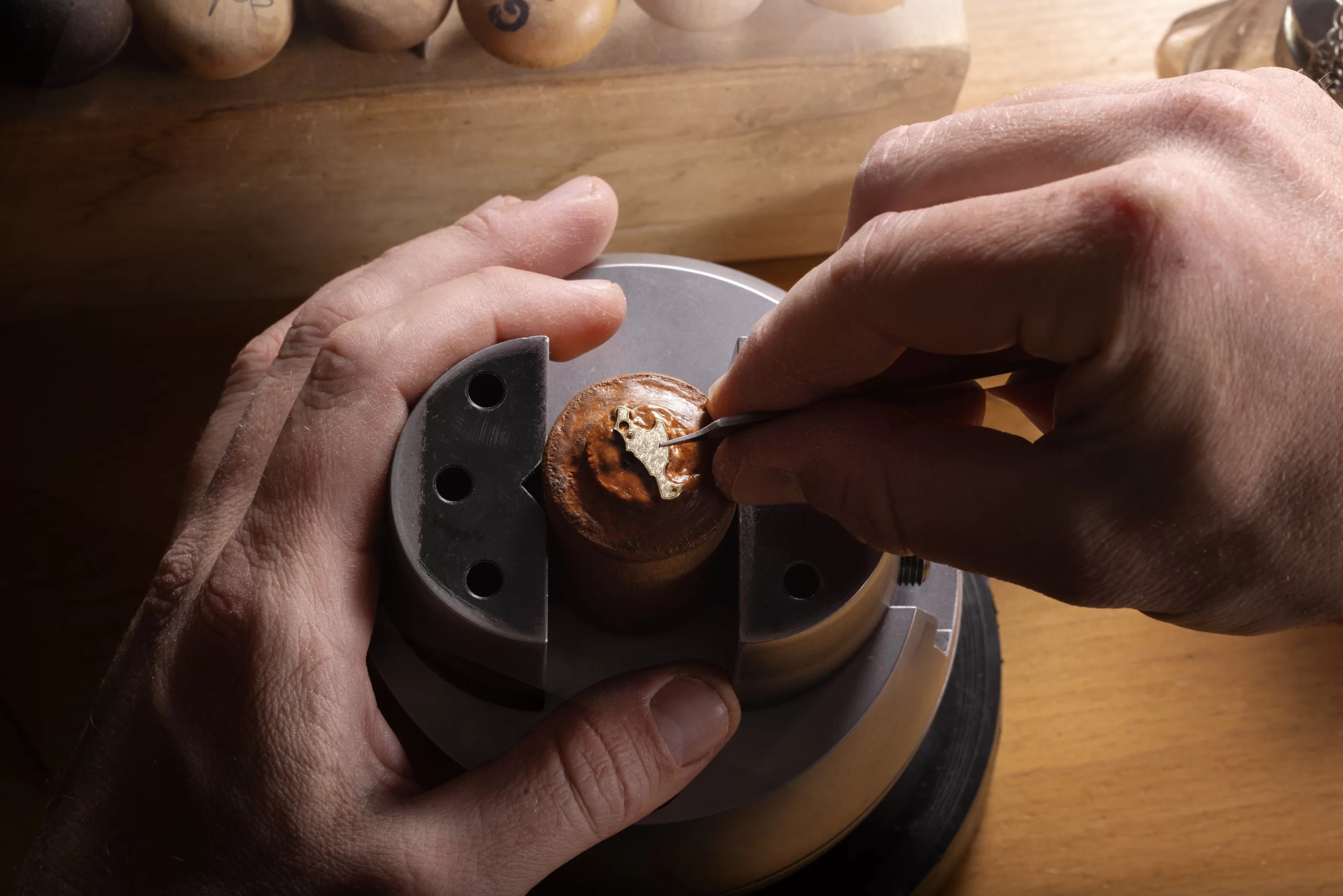
The T9 JWE features a white-filled maze on an Emerald Green ALD-coated titanium dial that changes to a purple colour depending on the angle of the watch; the T9 JWB features a white-filled maze on a black titanium dial in a black coated case. The patterns are milled directly into Grade 5 titanium and traced at 0.2 millimetres wide — made visible by the painted fill catching against the metal. Both editions debut on leather straps.
“The criteria we use to choose the artists we collaborate with run deeper than creativity or graphic impact alone,” says Benoît Mintiens, Ressence’s founder and creative mind.“We look for a visual language that translates physically onto the watch. Jules’s labyrinths are engraved into the dial and filled by hand, so the drawing lives in depth. His line stays extraordinarily consistent across every path — remarkable mastery, given that he draws each one freehand.”
The result, in watch form, draws on Ressence’s patented Orbital Convex System (ROCS) technology, which allows the dials, now carrying Wittock’s hand traced paths, to orbit in continuous motion. It’s a playful interpretation of a watch built to be handled, enjoyed, and lived with.
“A Ressence adds a fourth dimension to the canvas: time,” Mintiens adds, noting that it’s only at midnight and midday that the watch dials align for wearers to solve the labyrinth. “The artwork keeps changing. It appears differently with every glance.”
Being in the Now
Wittock has drawn labyrinths since childhood to find a path through complexity. “When I create my work, it’s a moment when I am in the present,”Wittock explains. “I don’t think about what I am doing, what I need to do, or what I did. I’m just doing right now, and I love being part of right now.”
It is a philosophy of clarity drawn from complexity — and it is where his world meets Ressence’s. Both strip away the noise to reach the essential. Both make objects meant to be lived with that reward attention over time. “I love how they think,”Wittock says of Ressence.“They are starting over with watchmaking, rethinking the whole concept. The way they work is minimalist, optimal, efficient — and I have exactly that in my paintings: the maximum space given to the logic, never to empty space.”
For Mintiens, that shared instinct is the point. “We move through life guided by instinct, and the coherence reveals itself in hindsight,” he says. “The labyrinth stays intricate. Then a moment comes when the pattern resolves and the word can finally be read.”
Art Watch Series
Each guest edition watch begins with a shared way of seeing between Ressence and its collaborators. Ressence partners only with artists whose work already speaks its language — clarity, curiosity, and the conviction that an object is made to be experienced as much as owned.
Previous guest editions include Shantell Martin’s TYPE 1 Square White, featuring her fluid line drawings and “Enjoy Life” mantra for TimeForArt 2024. Stefan Sagmeister’s TYPE 3X Look Up (2020) embedded his “Now is Better” philosophy into the dial, while Alain Silberstein’s TYPE 1 S REV Grail Watch (2022) offered a symbolic exploration of “Carpe Diem.” More recently, Daniel Engelberg’s TYPE 8 DE1 and DE2 (2025) brought the artist’s “Inside Out” concentric circles into kinetic form, and
Terumasa Ikeda’s TYPE 9 IKE (2026) brought his urushi lacquer and mother-of-pearl craft to the rotating dial.
The brand’s “art in motion” philosophy underscores Ressence’s belief that a watch should engage the wearer emotionally as much as technically.
“My work is based on challenge,” says Wittock.“The more complex the process, the more satisfying it is at the end.”
Ressence TYPE 9
Built on the TYPE 9 design — Ressence’s smallest and lightest watch to date — the new editions exemplify the brand’s ‘Less is More’ philosophy, focusing on simplicity in both form and function. By distilling watchmaking to its essence, the TYPE 9 offers a pure time-reading experience with hours and minutes displayed through the patented Ressence Orbital Convex System (ROCS).
The T9 JWE and T9 JWB will be available from 17.09.2026 through Ressence’s online store and select global retailers. As the latest release in Ressence’s art series, they continue Ressence’s ongoing dialogue with contemporary art, affirming a vision of watchmaking as a meaningful form of creative expression.
Technical Specifications
Name TYPE 9 JWB – TYPE 9 Jules Wittock Black
Functions
• Hours
• Minutes Movement
• Patented ROCS 9 — Ressence Orbital Convex System — module driven by the minute axle of a customised automatic base calibre
• Self-winding
• 36 hours power reserve
• 28,800 vibrations per hour
• 31 jewels
• 20 gears
• 4 ball bearings Dial
• Grade 5 titanium dial (75mm diameter) running on a jewel ball bearing with eccentric satellites rolling on jewel ball-bearings inclined at 9.75° (hours)
• Engraved indications hand-filled with white lacquer and Grade A Super-LumiNova® on a Black PVD-coated titanium dial Case
• Polished Grade 5 titanium
• Domed sapphire crystal with anti-reflective coating inside
• 39 mm (diameter) x 11 mm (thickness)
• 1 ATM splash-resistance
• Manual winding over 12° and set-up via caseback
• Rotating two directions Buckle & Strap
• Titanium ardillon buckle
• Leather strap (20/18 mm) Components
• 182 components Weight
• 42 grams (strap included)
Name TYPE 9 JWE – TYPE 9 Jules Wittock Emerald Green
Functions
• Hours
• Minutes Movement
• Patented ROCS 9 — Ressence Orbital Convex System — module driven by the minute axle of a customised automatic base calibre
• Self-winding
• 36 hours power reserve
• 28,800 vibrations per hour
• 31 jewels
• 20 gears
• 4 ball bearings Dial
• Grade 5 titanium dial (75mm diameter) running on a jewel ball bearing with eccentric satellites rolling on jewel ball-bearings inclined at 9.75° (hours)
• Engraved indications hand-filled with white lacquer and Grade A Super-LumiNova® on an Emerald Green ALD-coated titanium dial Case
• Polished Grade 5 titanium
• Domed sapphire crystal with anti-reflective coating inside
• 39 mm (diameter) x 11 mm (thickness)
• 1 ATM splash-resistance
• Manual winding over 12° and set-up via caseback
• Rotating two directions Buckle & Strap
• Titanium ardillon buckle
• Soft calf leather strap (20/18 mm) Components
• 182 components Weight
• 42 grams (strap included)
About Jules Wittock
Jules Wittock is based in Brussels and raised in a family of artists. He is known for hand-drawn labyrinths painted onto large-scale linen canvases. He has drawn labyrinths since childhood to find a path through complexity — each one traced freehand. Each maze follows the same internal logic: a single entrance, a single exit, and a path between them that spells a word. Some pieces carry secondary layers — UV-revealed patterns, mechanical mechanisms, and other concealed elements — that invite the viewer to interact with the work.
Wittock works across media and techniques — from marker and paint on linen to bronze and aluminium sculpture, as well as kinetic pieces. His labyrinths run up to 10 metres in length, yet the work stays minimalistic in purpose: typically a single colour, driven by the logic of the maze.
His work has been exhibited across Europe and includes large-scale public commissions, among them a ceiling mural at the Brussels Palace of Justice. He is currently expanding into sculptural work in bronze and aluminium.
About Ressence
Founded by Benoît Mintiens in 2010, Antwerp-based Ressence is setting a new paradigm for watchmaking — rethinking what a mechanical watch would be if it were a 21st-century invention.
Known for its patented Ressence Orbital Convex System (ROCS), which replaces hands with rotating discs, Ressence crafts watches that are intuitive, legible, and deeply human. Awardwinning innovations like oil-filled dials and the absence of a crown serve a clear purpose: ergonomics, clarity, and experience.
Ressence applies design thinking to fine watchmaking, providing mechanical watches with functional meaning for those who value clarity without losing soul and functionality without compromising beauty. Ressence calls this Simplication — a dedication to innovation, minimalism, and human connection in watchmaking.
In an industry dominated by tradition and status, Ressence stands apart as a design-led independent. Its made-in-Switzerland watches are built for modern life, not the museum. Its audience is curious and optimistic, seeking watches that spark conversation without pretension.
Wearing a Ressence is a statement of optimism. A belief that the future holds more promise than the past.
What happens when 70 years of watchmaking history is condensed into a 19mm mechanical jewel?
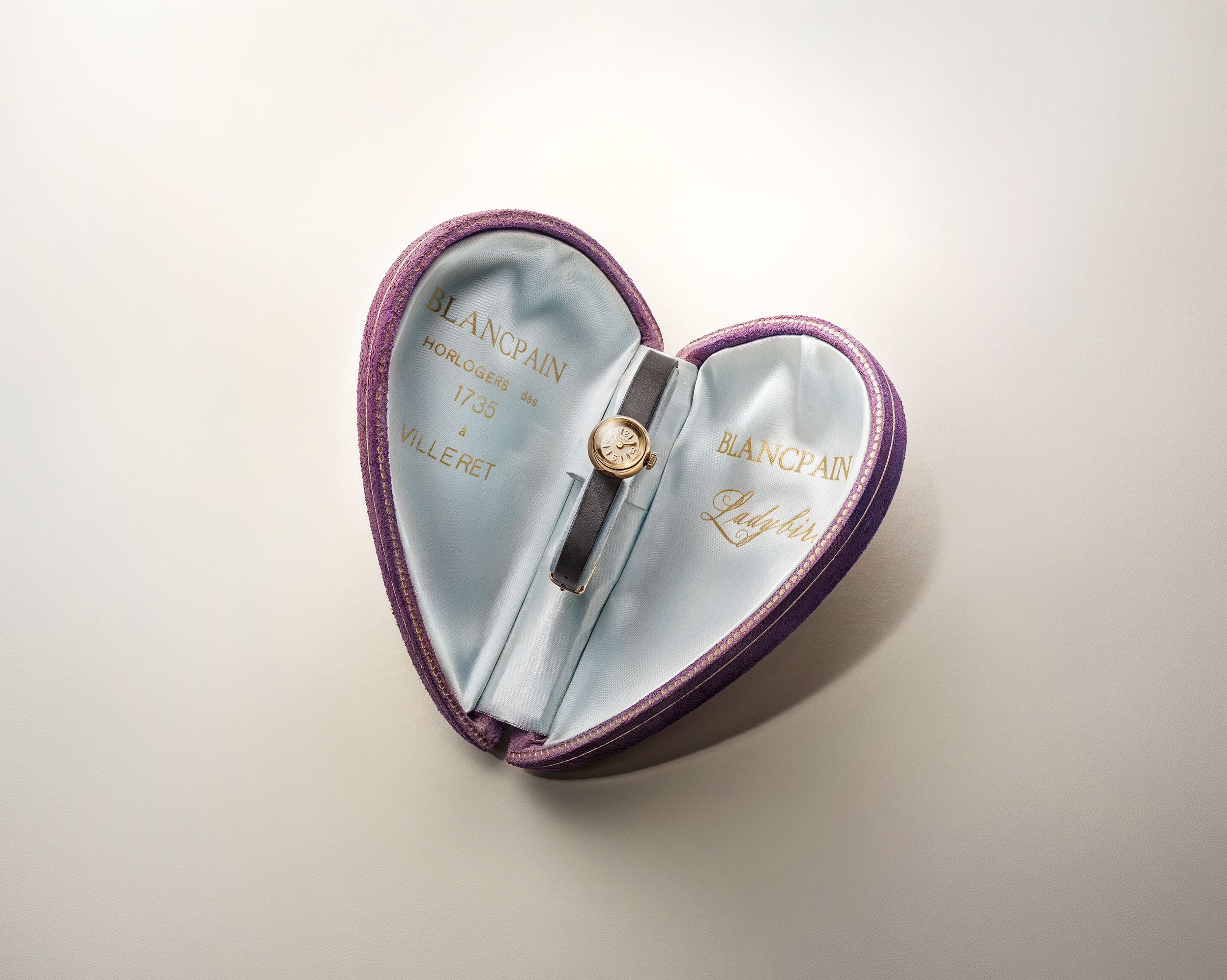
Blancpain answers with the Lady B, a distinctly contemporary interpretation of the idea that gave birth to the Ladybird collection in 1956.
Created under the leadership of Betty Fiechter, the first woman to lead a Swiss watch manufacture, the original Ladybird Bullet was built around an extraordinary ambition: create a remarkably small yet robust mechanical movement. Its R52/R55 calibre measured just 11.85mm in diameter and became the world’s smallest round mechanical movement produced in series, according to Blancpain’s historical account.
Seven decades later, Blancpain isn’t simply bringing that watch back.
It is rethinking the idea behind it.
From Ladybird Bullet to Lady B
The new Blancpain Lady B is explicitly described as a contemporary reinterpretation rather than a reissue of the 1956 Ladybird Bullet. Its design takes the original watch’s philosophy of miniaturisation and translates it into an entirely new architecture.
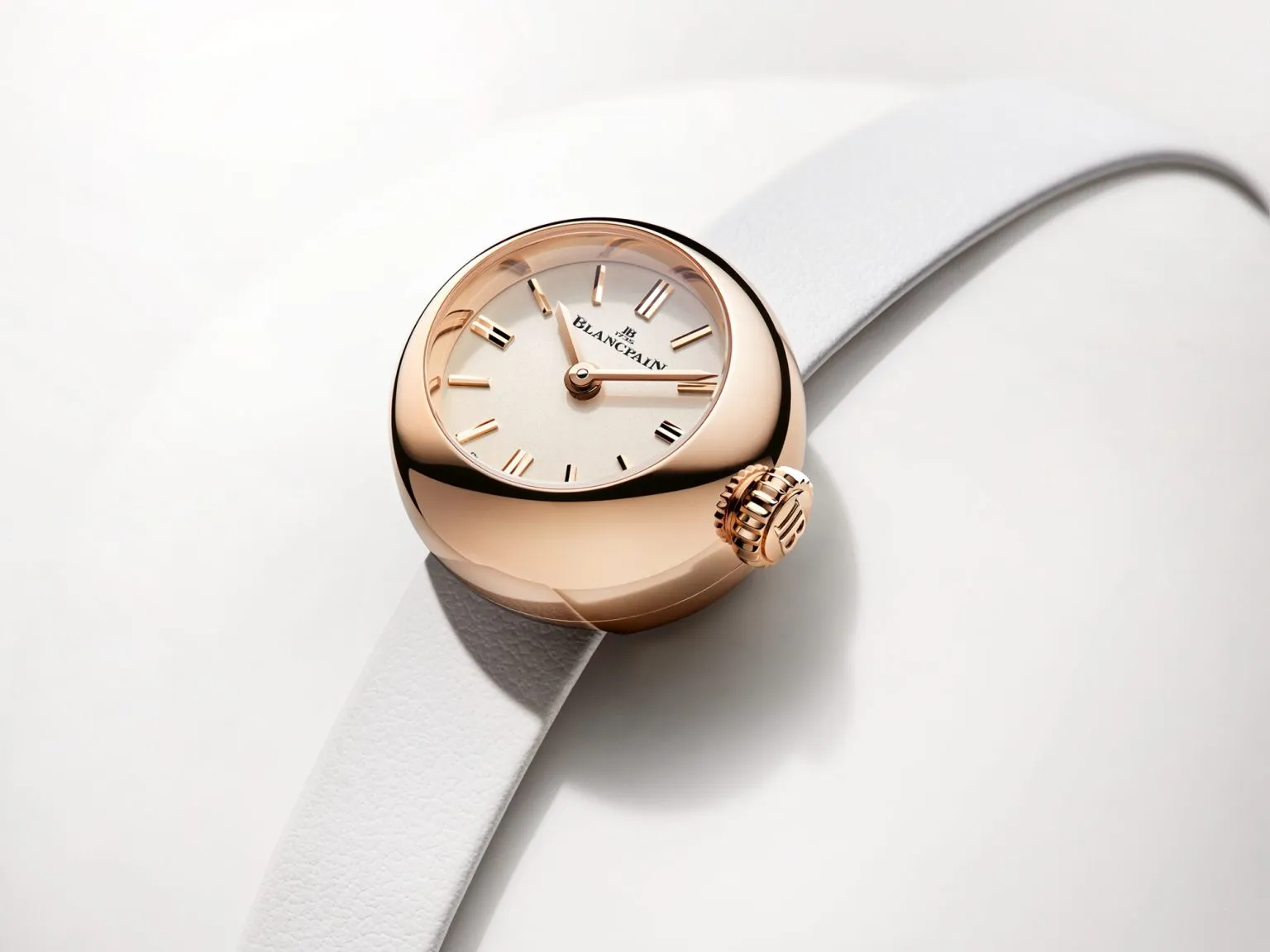
Its most immediately striking feature is its spherical case.
Measuring only 19mm in diameter, the case has a thickness of 13.20mm and a volume of just 2.9cm³. Rather than treating the watch as a flat object defined primarily by its diameter, Blancpain conceived Lady B in three dimensions.
The result is closer to a polished mechanical pebble or jewel than a conventional round wristwatch.
And that is precisely the point.
A Mechanical Heart in a Tiny Space
Inside the spherical case is Blancpain’s Manufacture Calibre 615, an automatic movement measuring 15.70mm in diameter and 3.90mm thick.
It contains 180 components and 29 rubies, operates at 3Hz, or 21,600 vibrations per hour, and delivers a 38-hour power reserve. Its plates are finished with Côtes de Genève, while a silicon balance spring is part of its evolution.
The movement’s compact architecture wasn’t simply placed inside an existing case.
The entire watch was developed around it.
Blancpain says the spherical case, sapphire crystal, polished rehaut, integrated strap passage and water resistance were developed in parallel to accommodate Calibre 615.
That makes the Lady B’s small dimensions more than an aesthetic exercise. They are the consequence of designing the watch around its mechanical core.
No Lugs. No Conventional Case Architecture.
Perhaps the most unusual aspect of Lady B is what it leaves out.
There are no traditional lugs.
Instead, the calf leather strap passes directly through an opening machined into the case. The passage measures just 10 × 1.6mm, and Blancpain describes the interior as micro-blasted so the leather can glide through it. The edges and knurling are finished by hand.
This creates a continuous visual relationship between the spherical case and the strap.
The watch doesn’t look as though a strap has been attached to it.
The strap appears to emerge from it.
Minimalism Is Doing the Heavy Lifting
The dial takes an equally restrained approach.
The warm beige opaline dial is identical across the stainless-steel and 18K red-gold versions. There is no gem-setting, allowing the dial surface, gold indices and reflections from the polished rehaut to define the visual character.
The applied stick indices are made from gold and measure only 1.82 × 0.39mm.
The hands remain deliberately simple, displaying only the hours and minutes.
This restraint is important because the case is already doing most of the visual talking. The polished spherical architecture creates changing reflections across its surface, while the clean dial prevents the watch from becoming visually busy.
Seven Straps, One Tiny Wrist Presence
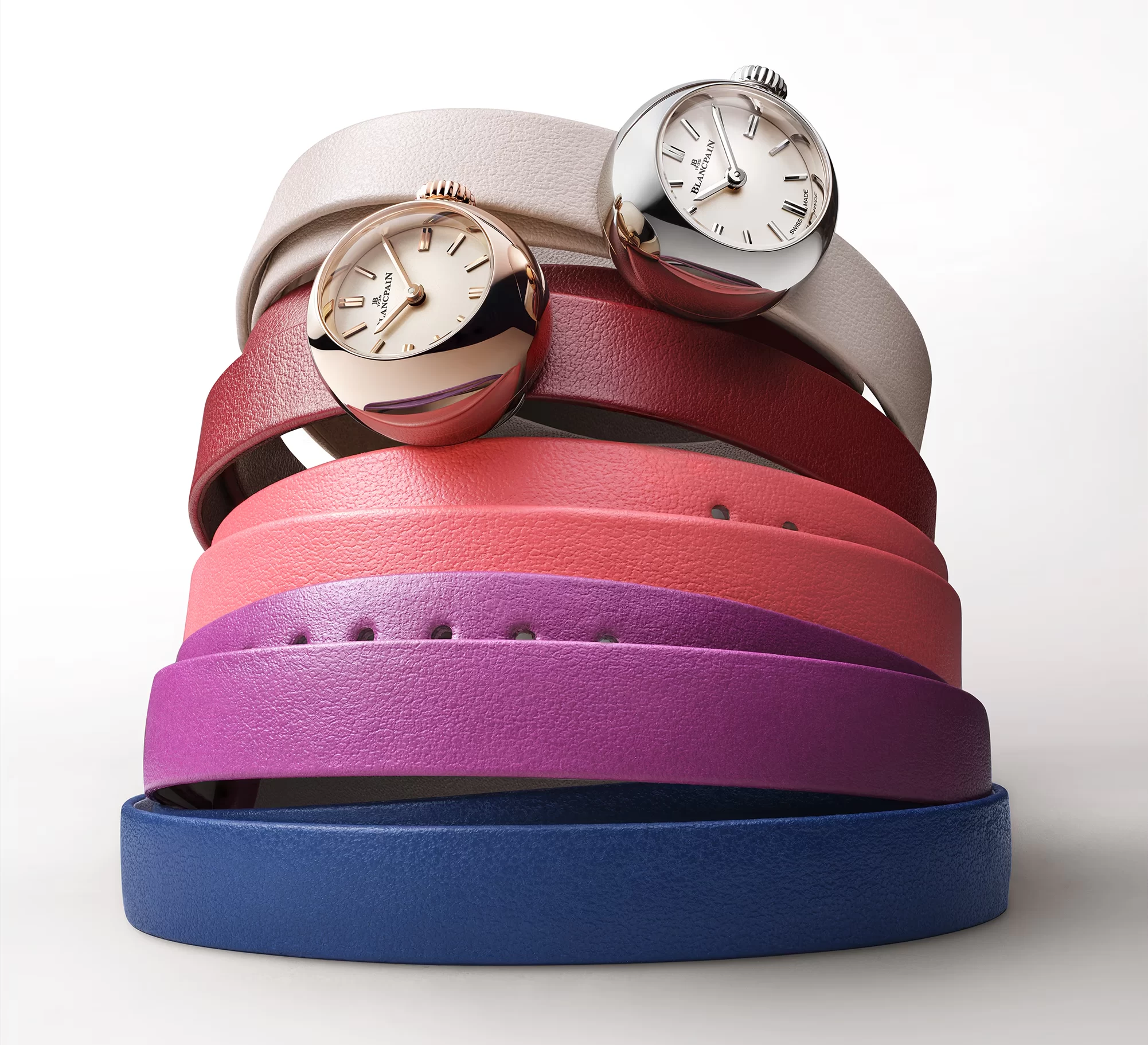
The Lady B arrives on a double-tour calf leather strap, reinforcing its jewellery-like character.
There are seven colour options:
White
Beige
Mocha
Burgundy
Blue
Coral
Purple
The strap fits through the rear of the watch and can be changed easily.
The double-tour construction also changes how the 19mm case sits visually on the wrist. Instead of functioning simply as a tiny watch, the strap becomes an integral part of the design language.
Betty Fiechter: The Woman Behind the Original Vision
The Lady B story becomes considerably more interesting when you look back at Betty Fiechter.
Fiechter entered Blancpain’s workshop in Villeret as a 16-year-old apprentice in 1912. By 1933, she had become co-owner of the Manufacture, and she ultimately became the first woman to own and lead a Swiss watch manufacture.
Her contribution wasn’t limited to keeping the company operating through difficult economic and historical circumstances.
She also recognised the importance of mechanical watches for women.
Blancpain’s historical account notes that Fiechter believed women’s watches deserved the same ingenuity and mechanical integrity as other timepieces, making this area one of Blancpain’s defining strengths.
In 1956, the Ladybird emerged from this philosophy.
The Lady B now connects that history to Blancpain’s contemporary approach to mechanical miniaturisation.
The 1956 Technical Miracle
The original Ladybird Bullet’s R52/R55 calibre was only 11.85mm in diameter.
Its compact architecture incorporated a fifth wheel into the gear train and shock protection for the balance, allowing Blancpain to pursue extreme miniaturisation without abandoning robustness. The movement contained 133 individually machined components and operated at 3Hz.
The movement’s influence extended beyond Blancpain, with the press release noting that houses including Omega and Longines subsequently adopted it for their own creations. Its tiny footprint also enabled a wide variety of jewellery watches, bracelets, bangles, rings and pendants.
That history explains why the Ladybird is more than simply an old model in Blancpain’s archive.
Miniaturisation became a creative platform.
Lady B continues that idea in a radically different form.
Stainless Steel or 18K Red Gold?
Blancpain offers the Lady B in two case materials:
Stainless Steel
19mm diameter
13.20mm thickness
30m water resistance
CHF 9,500
18K Red Gold
19mm diameter
13.20mm thickness
30m water resistance
CHF 14,500
The watch is not a limited edition and is available through Blancpain boutiques and authorised retailers from 17 September 2026.
A New Chapter, Rather Than a Reissue
The Blancpain Lady B succeeds by resisting the obvious route.
It doesn’t attempt to reproduce the Ladybird Bullet line for line. Instead, it takes the central idea behind that watch, mechanical watchmaking on an extraordinarily small scale, and pushes it into a new design language.
A spherical 19mm case.
A tiny automatic movement.
An integrated double-tour strap.
A deliberately quiet opaline dial.
And a direct connection to Betty Fiechter and the Ladybird’s history.
Seventy years after the Ladybird first appeared, Blancpain’s smallest statement may also be one of its most conceptually interesting.
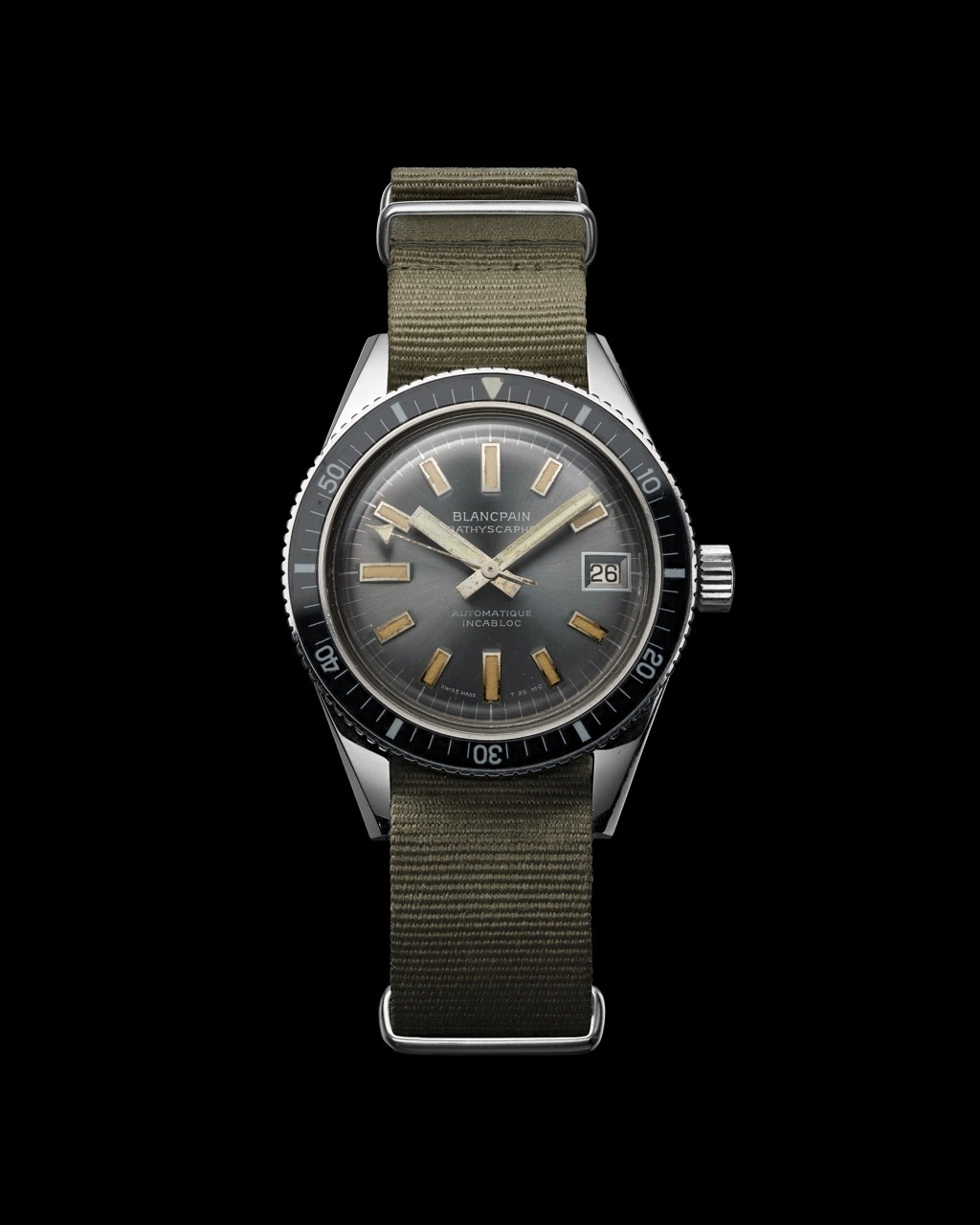
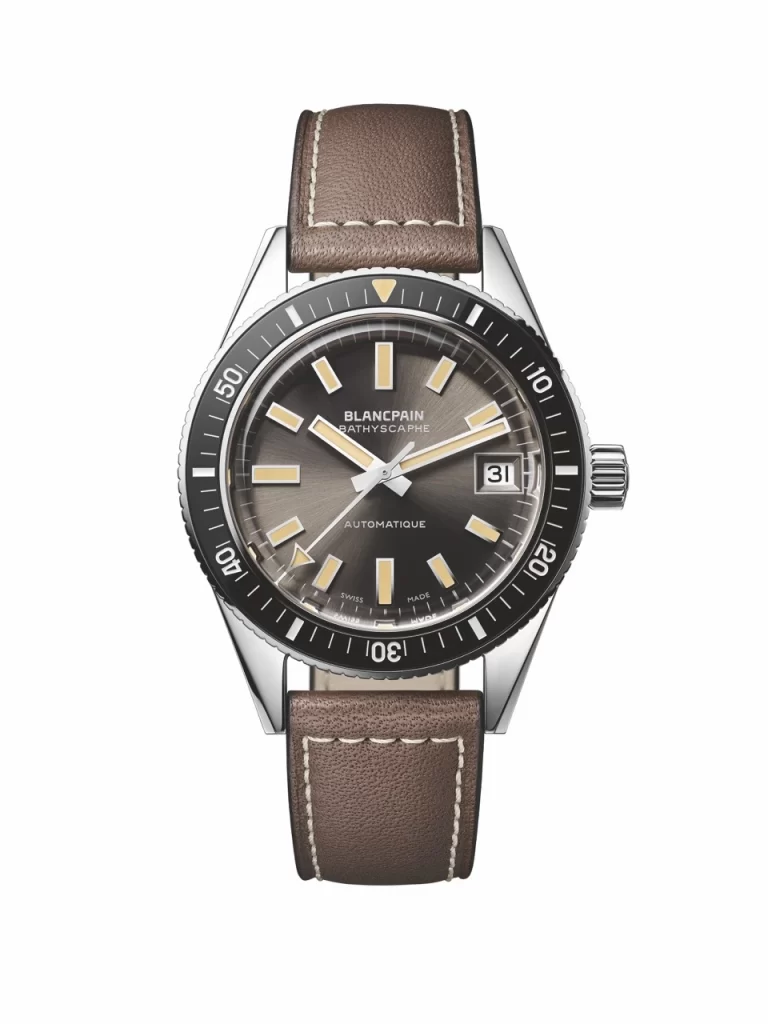
Born from the golden age of recreational diving, the Bathyscaphe embodies the typical skin diver codes through its balance of elegance and everyday wearability. Created in 1956 as the civilian counterpart to the Fifty Fathoms, the model bore a name that had already been registered in 1953 by Blancpain’s then-CEO and passionate diver, Jean-Jacques Fiechter, reflecting his early vision of creating a diving watch designed not only for professional use but also for enthusiasts. Seventy years after its creation, Blancpain celebrates this legacy with a reproduction of a landmark model from 1968. A timepiece that bridges the aesthetic design of the past with watchmaking excellence, this 300-piece limited edition pays tribute to a defining chapter in the evolution of the diver’s watch.
The Skin Diver Style: A New Relationship with the Underwater World
During the 1950s and 1960s,a new generation of watches emerged alongside the growing popularity of recreational diving: the skin diver. More than purely technical instruments, these watches reflected a new relationship with the underwater world, one shaped by leisure, enjoyment, and a growing fascination with this emerging lifestyle. They captured the spirit of a time when diving became not only a professional activity, but also a source of personal adventure. Characterized by more compact proportions, clean lines, and a refined aesthetic, skin diver watches combined essential diving features with a more understated and daily- wear design.
Emerging from that philosophy, the Bathyscaphe was created in 1956 – despite the name having already been registered in 1953 – by Jean-Jacques Fiechter, then CEO of Blancpain and creator of the Fifty Fathoms, bringing Blancpain’s pioneering diving expertise into
a civilian expression designed for everyday wear.
The Bathyscaphe: The Diver Legacy
The name “Bathyscaphe” refers to the pioneering deep-sea exploration vessel conceived by Swiss scientist Auguste Piccard in the 1940s. Designed to reach the greatest depths of the ocean, the Bathyscaphe represented a major milestone in humanity’s exploration of the underwater world, an achievement that resonated with Jean-Jacques Fiechter’s own passion for diving and exploration.
While the Fifty Fathoms, introduced in 1953, was developed as a professional diving instrument for military forces, professional divers, and underwater specialists, the Bathyscaphe offered an everyday interpretation of the same heritage yet preserving the essential features of the diver’s watch. The distinction between the two models was particularly evident through their proportions. Measuring slightly over 41 mm in diameter, the original Fifty Fathoms was created to be a robust professional instrument. With a more compact 35 mm case, the first Bathyscaphe adopted a slimmer profile, reflecting a more civilian style while maintaining the reliability expected from a true diver’s watch. Over seven decades, the Bathyscaphe has evolved through various interpretations but has always remained faithful to its original identity.
The Spirit of 1968, Reborn
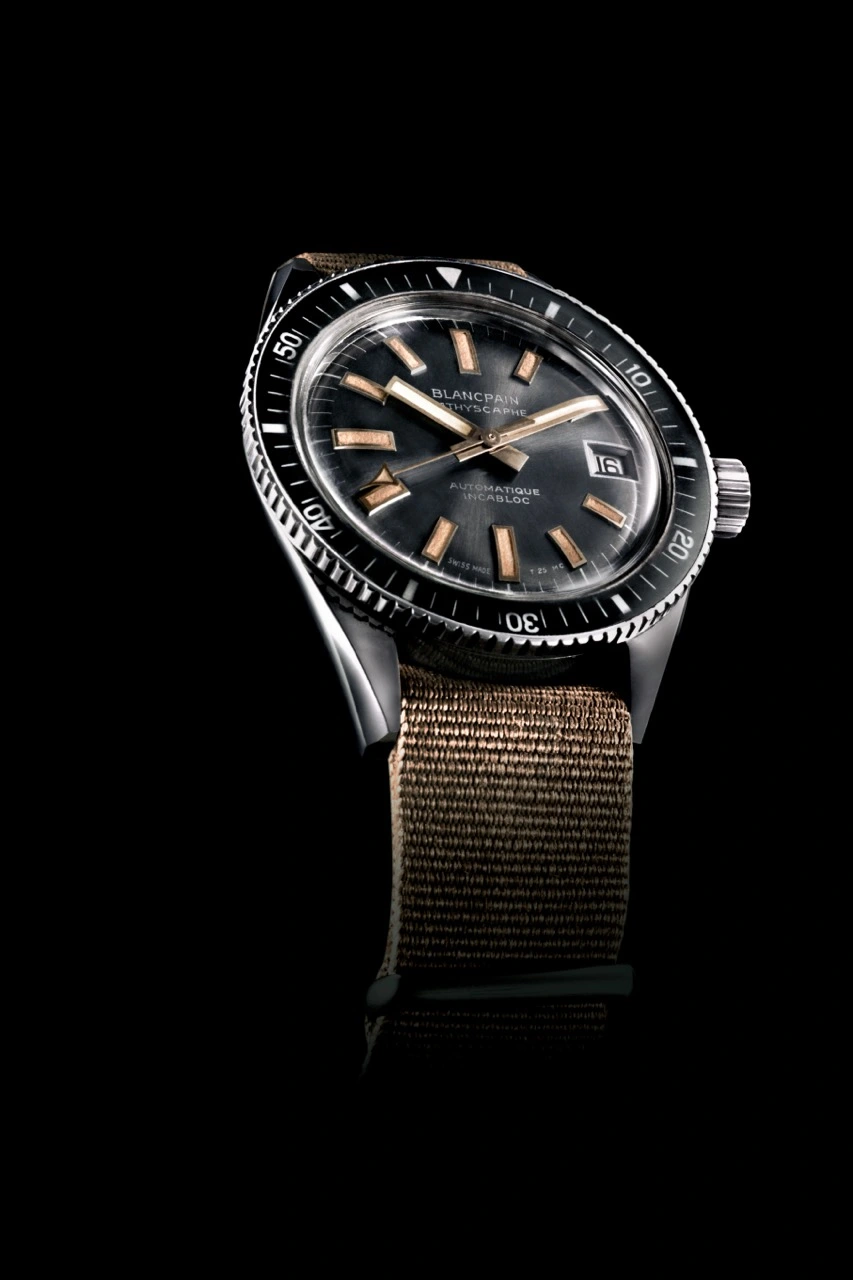
For the model’s 70th anniversary, Blancpain turns to one of the most emblematic expressions of the Bathyscaphe’s history with a watch from 1968. This timepiece was selected for the way it embodied the collection’s defining qualities: balanced proportions, functionality, and understated elegance. Fifty Fathoms Bathyscaphe, 1968
Staying as close as possible to this iteration, Blancpain translated the anniversary piece through contem- porary watchmaking standards. The new edition retains the original 37.40 mm diameter and stainless- steel construction, but its case was specifically developed around the movement to achieve the desired proportions and ergonomics. The remarkable diameter-to-thickness ratio, defined by a slender case middle, contributes to the watch’s harmonious profile on the wrist. The polished finishing, curved surfaces, and carefully shaped lugs enhance its refined aesthetics.
The bezel continues this dialogue between heritage and innovation. Made of steel with a ceramic insert and lacquered numerals – replacing the original black hesalite material – it reinforce durability and legibility.
Every element has been considered to reinforce the aesthetic codes of the original design, from the mid-20th century Blancpain logo to the baton hands and indexes enhanced by vintage-coloured Super-LumiNova®, which recalls the warm tones of the luminous materials used in the past. The hand- stitched chocolate calf leather strap further drives this heritage-inspired spirit, developing a natural patina over time.
The result is a faithful contemporary Bathyscaphe reproduction carrying the unmistakable character of its 1968 inspiration.
Vintage Soul, Contemporary Performance
Beneath its vintage-inspired exterior, this anniversary edition reveals the expertise of Blancpain’s contemporary watchmaking. The Manufacture calibre 1150 was selected to equip this timepiece, offering a combination of reliability, precision, and exceptional autonomy with a 100-hour power reserve.
Its silicon hairspring provides antimagnetic properties, contributing to the movement’s stability and long- term performance.
Visible through the sapphire crystal case back, the movement showcases the meticulous Haute Horlogerie finishing. Inspired by the design of that of the original Fifty Fathoms, its open worked 18K gold oscillating weight highlights the beauty of the mechanical architecture. Unlike the 1968 inspiration piece, which featured a closed case back, this new interpretation allows the movement to become part of the experience of ownership, emphasizing the daily- wear DNA of the piece. This choice reflects Blancpain’s desire to offer not only a connection to the past, but also a direct appreciation of the watchmaking expertise behind the timepiece.
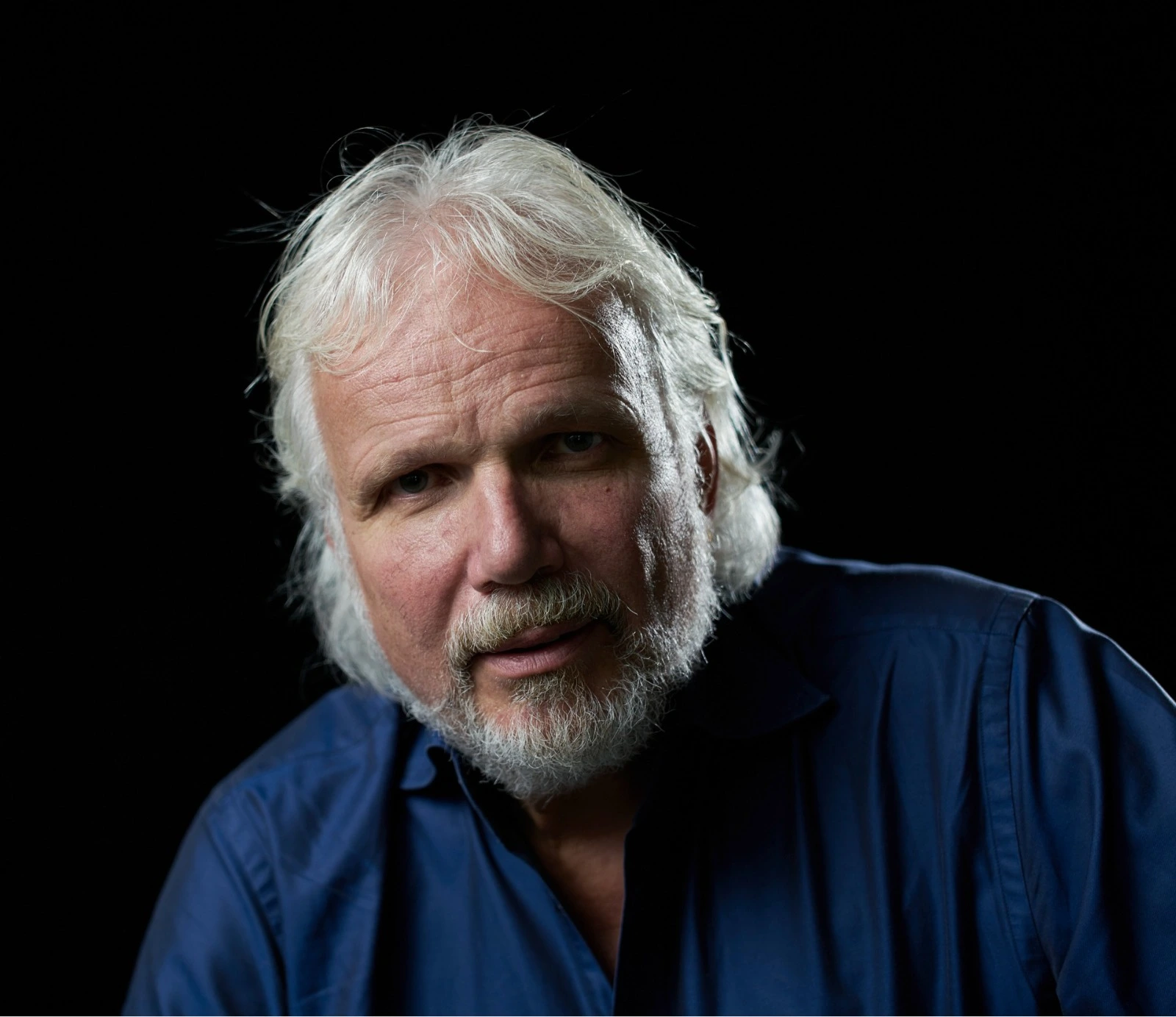
An exclusive EyesOnTime conversation with HYT’s co-founder on risk, fluidic innovation, the future of independent watchmaking and why mechanical timekeeping is becoming an art of expression.
Lucien Vouillamoz is a Swiss engineer, inventor, entrepreneur, and philanthropist.
He is best known as the original creator of the mecano-fluidic technology behind HYT watches—a world-first innovation that united fine watchmaking with the poetry of fluids, redefining the boundaries of timekeeping.
He has also significantly invested in Kairos Technologies Switzerland (KTS), the company that revived the HYT brand. While not a member of its Board of Directors, this commitment reflects his strong belief in HYT as the proud standard-bearer of fluidic watchmaking—the modern heir to the ancient clepsydra, which measured time through water more than 3,500 years ago.
Beyond HYT, Vouillamoz has co-founded and supported several ventures at the crossroads of Swiss precision and innovation, yet his true passion remains the art of horology and the dialogue between mechanics, fluids, and time.
Living in Feusisberg, Switzerland, he is married, with four children and ten grandchildren. A passionate sailor, he spends several weeks each year exploring the seas of the world. Committed to giving back, he founded Ganydar.org, a philanthropic initiative supporting education for young people in Latin America.
At the intersection of invention, heritage, and vision, Lucien Vouillamoz embodies both the spirit of Swiss innovation and the timeless pursuit of horological excellence.
What happens when you put liquid inside a mechanical watch?
For HYT’s co-founder, the answer is wonderfully dramatic: “bringing the devil into the machine.”
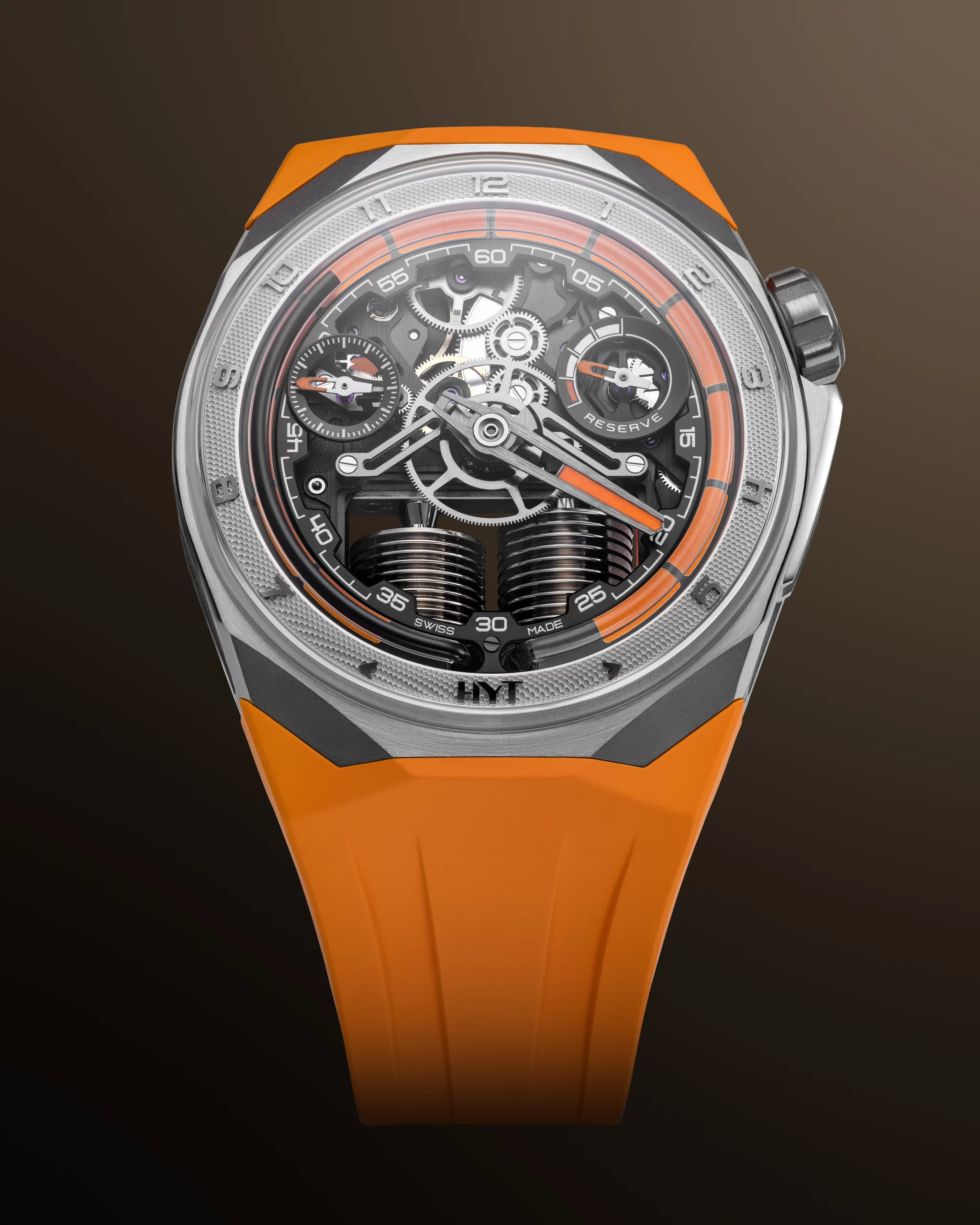
It is also an accurate description of the technological challenge that has defined HYT from the beginning. A mechanical wristwatch is expected to be watertight, precise and reliable. HYT chose to introduce liquid into that equation and, more radically, make the movement of that liquid the means of displaying time.
The idea sounds simple when reduced to a sentence.
Making it work was anything but.
The development required flexible, watertight bellows derived from aerospace technology, precision-formed borosilicate glass, specialised surface treatments to control the interaction between different liquids and glass, and an interface capable of transferring mechanical energy into fluidic motion using very little energy.
HYT was not merely designing a new watch display. It was creating technologies to make that display possible.
And even after the first watches reached the market, the story was far from finished. The company developed the fluidic mechanism as a replaceable module, allowing early owners to have it upgraded as the technology evolved. According to the interview, approximately eight years were required to resolve the fluidic, mechanical and synchronisation challenges.
Today, that history gives HYT an unusual perspective on innovation. The brand has already taken the risk of doing something that traditional watchmaking had never done before. The question now is what happens when that disruptive technology has been mastered.
In this exclusive conversation with EyesOnTime, HYT’s co-founder discusses the risks behind the brand, what a future without liquid might look like, the misconceptions surrounding hydromechanical watchmaking, the company’s turbulent leadership history, the balance between chaos and engineering discipline, and the surprising applications of HYT’s fluidic technology beyond watches.
Because HYT has already done the seemingly impossible once.
The more interesting question now is: what will it do with time next?
“Many independent brands innovate, but HYT disrupts”
EyesOnTime: Many independent brands innovate, but HYT disrupts. How do you decide which risks are worth taking in a category that already sees you as the outlier?
HYT: It was a very big risk.
To integrate or put liquid inside a wristwatch, which is supposed to be watertight, is, technologically speaking, bringing the devil into the machine.
When we launched HYT, practically none of the technologies we needed existed in the form required for a high-end wristwatch.
Take the bellows, for example. These reservoirs use technology from the space industry. They have to be watertight but extremely flexible because the watch does not have a lot of available energy.
And then there is aesthetics.
The military industry does not necessarily need these bellows to be beautiful. In a high-end wristwatch, they have to be aesthetically pleasing as well. You have to combine functionality, physical difficulties and aesthetics.
There were many other challenges.
HYT uses different liquids, and we had to compensate for their expansion and contraction with temperature. The capillary is made of borosilicate glass, and nobody before us had formed that glass with the precision required by Swiss watchmaking. We had to develop a machine specifically for it.
Even the interaction between the liquids and the glass created a problem. One liquid behaves more like oil and the other more like water, so we needed a special surface treatment inside the capillary to make both behave correctly.
Then there was energy.
Normally, you have enough energy in a mechanical movement to move a needle or a hand. Here, we had to move an entire system. We therefore had to develop an interface between the mechanical movement and the fluidic movement that could move a relatively important amount of liquid with very little energy.
That is what made HYT so risky.
The collectors who took the risk with HYT
There was another group taking a risk alongside the company: its earliest customers.
HYT knew that it was impossible to wait for perhaps ten years of development before putting the technology on the market. The real world had to become part of the development process.
The solution was to separate the mechanical movement from the fluidic system and make the fluidic module replaceable. Early owners could return their watches and have the module replaced as technological problems were resolved.
That meant HYT’s first collectors were not simply buying an unconventional watch.
They were trusting an unconventional technology.
According to the interview, around eight years were required to resolve the various challenges, including the fluidic system, mechanical components and synchronisation between the two. By 2017, the technological problems had been resolved to the point where the wearer could focus on the beauty, history and emotion of the watch rather than the technology itself.
For an independent watchmaker, that is an extraordinary way to build a collector relationship.
The customer did not merely witness the evolution.
The customer became part of it.
What happens if HYT removes the liquid?
EyesOnTime: The fluidic module is HYT’s signature. If you had to reinvent HYT without fluids, but with the same rebellious spirit, what would that vision look like?
HYT: That is exactly the body of the next ten years of HYT.
We are working on using some very unusual technologies to reinterpret the primordial ways humans have used to show time.
I cannot be too precise because we have to be a bit secret about that, but we have a plan for the next ten years with three major jumps.
The spirit will remain exactly the same: disruptive and technologically ambitious. One direction will continue with liquids, while another will explore something without liquids, but with exactly the same spirit.
There is another important lesson we have learned from being on the market.
We have to go smaller.
We are working on technologies that could fit into watches around 36 or 38 millimetres, ideally below 40 millimetres.
Smaller. Thinner.
We are also looking at lower entry prices, ideally from CHF 35,000.
That may be one of the most revealing answers in the interview.
HYT is not suggesting that its future lies in abandoning its identity and becoming conventional. Instead, the challenge is to translate its disruptive philosophy into smaller, thinner watches while exploring new technologies that may not require liquid at all.
The fluidic watch was the first chapter.
It may not be the last.
Is HYT misunderstood?
EyesOnTime: What’s a misconception the industry still has about hydromechanical watchmaking that you wish would disappear?
HYT: Perhaps part of the misconception comes from how we are taught to read watches.
When you are a child, you learn how to read a conventional watch. You learn what the position of the hands represents. It becomes an education.
Within the watch community, there is therefore a certain bias toward hands showing the time.
What has not really been done in high-end watches is the use of gauges.
Gauges are familiar from the automotive industry, but HYT brought that language into watchmaking. We did not only bring liquids. We brought a different way of showing time.
Perhaps that can create the impression that it is a gimmick.
But if you understand that HYT is reinterpreting a water clock on the wrist, the concept becomes different.
That historical connection is something HYT now wants to explore more deeply.
The brand discussed bringing together the history of monumental water clocks, educating people about them and creating events or smaller water clocks connected with HYT. The aim is to take people back to the real origins of water-based timekeeping: the clepsydra.
It is a clever distinction.
HYT is not simply asking people to understand a strange-looking watch.
It is asking them to reconsider something much older: how humanity has always tried to visualise the passage of time.
From complexity to poetry
That historical perspective also explains something fundamental about HYT.
The brand is not trying to compete with atomic clocks on precision.
The interview makes that point quite clearly. From sundials and water clocks to mechanical watches, quartz and atomic timekeeping, humanity has progressively developed more precise ways of measuring time. Today, nobody needs a mechanical watch simply to know the correct time.
Connected watches have taken the wrist in another direction altogether, turning it into a platform for information and personal utility.
So where does that leave the mechanical watch?
For HYT, it leaves room for art.
The interview describes the brand’s contribution as adding a new chapter of “poetry” to high-end horology.
Mechanical watchmaking itself is already a combination of different crafts and forms of artistic expression. HYT adds another axis by using fluidics to create a new visual representation of time.
The evolution of the brand can therefore be seen in two stages.
First, master the complexity.
Then, once the complexity is under control, return to the poetry.
That is where HYT says it finds itself now.
Can chaos and precision coexist?
EyesOnTime: How do you balance the instinct for wild creativity, colours, materials and architecture with the engineering team’s strict performance and reliability requirements?
HYT: The ground of creativity is chaos.
You cannot put an artist or creative person into an entirely structured environment. Creativity needs chaos.
But creativity is the opposite of productivity.
Chaos allows creativity. Structure allows productivity. The secret is therefore having the right people at the right moment in the process Some people create the disruption. Others structure it and make that disruption productive through quality, reliability and cost control.
The history of HYT illustrates exactly why that distinction matters.
When the company began, it could not find a single established industry capable of providing all the technologies it required. Microfluidics, glass forming and micromechanics existed as separate disciplines.
Some of the early technologies even had to come from outside Europe. The bellows were American, while an early coating technology was developed by a company in San Diego.
The coating alone illustrates the extent of the challenge.
One application reportedly cost a significant amount, during the early development phase. It was transparent and hidden inside the glass, but without it, the system could not function.
That is the less glamorous side of disruption.
The idea may be beautiful.
Making it reliable is expensive, difficult and sometimes painfully slow.
What will redefine independent watchmaking?
EyesOnTime: What’s something in HYT’s pipeline, whether technology, material or concept, that you believe will redefine what collectors expect from independent watchmaking in the next three years?
HYT: The company is working on three major technological jumps, including approaches that continue with liquids and others that explore ways of expressing time without them. At the same time, it is working toward smaller and thinner watches, with a target of ideally staying below 40 millimetres, alongside a lower potential entry point.
That restraint is telling.
In an industry where brands often tease future products with carefully calculated hints, HYT’s answer essentially says: the future is coming, but we are not going to tell you everything yet.
What it does reveal is the direction.
Smaller.
Thinner.
Technologically disruptive.
And potentially beyond liquid.
When a watchmaking invention leaves the watch
EyesOnTime: If you could collaborate with any non-watchmaking field, whether space technology, automotive, biotech or gaming, which sector feels most HYT, and why?
HYT: The immediate answer is liquid.
Liquid is life.
When HYT developed its technology, the original concept was about mastering the precise movement of liquid on living bodies. At microlitre precision, the same principles can have applications far beyond watches, including the controlled delivery of medical fluids.
That led naturally into medical technology.
The technology company associated with HYT’s intellectual property, Preciflex, has worked in parallel with the watch industry on medical applications. The interview also refers to PreciHealth and work involving diagnostics and blood analysis.
But the applications do not stop there.
The same thinking has found its way into the cigar industry, where precise control of liquids is important, and into deep geothermal energy, where fluidic systems are used in extracting heat from the Earth.
There is even a project addressing sea-level rise and plastic pollution through platforms on the high seas.
It is one of the most unexpected revelations of the conversation.
HYT’s fluidic technology may have begun as a watchmaking experiment, but the underlying expertise is not limited to watches.
The wristwatch was the proving ground.
The technology can travel much further.
Four CEOs, one idea
EyesOnTime: HYT has gone through a revival and leadership changes. What was the hardest cultural shift you had to introduce inside the company, and what was the most rewarding?
The answer takes the question in a slightly different direction.
Rather than describing one particular cultural shift, HYT’s co-founder reflects on the brand having gone through four different CEOs, each with a distinct personality and interpretation of the same fundamental idea.
Each CEO interpreted the same concept differently.
The underlying expression of time remained, while the creative interpretation changed.
That adaptability may be one of HYT’s greatest strengths.
The concept is strong enough to survive different personalities.
The people who believed before HYT was proven
The story also belongs to the collectors and retailers who were willing to take the risk.
The first customers purchased a completely new type of watch at considerable cost, knowing that the technology was still evolving. HYT remains deeply appreciative of those early owners.
Retailers were equally important.
The interview specifically mentions Laurent Picciotto as one of the early adopters who was willing to believe that HYT’s disruption was strong enough to persuade customers to embrace it.
It is an important reminder about independent watchmaking.
Disruption does not happen because an inventor has an idea.
It happens when enough people are willing to believe in that idea before the market has decided that it makes sense.
And HYT has always had a story that begins with the question of why a mechanical watch should look and behave the way it traditionally does.
When inspiration comes from outside watchmaking
That same philosophy can also be seen in HYT’s more unusual collaborations and limited editions.
The interview discusses an S1 cigar-inspired watch whose design translates elements of cigar culture into horological details.
The brown alligator strap recalls cigar leaves. The rose-gold case references the rings associated with cigars, while the red fluid evokes the fire of a lit cigar. A Havana-chocolate dial and rose-gold indexes complete the visual connection.
The edition is limited to eight pieces worldwide.
Here again, the fluid is not merely functional.
It becomes part of the narrative.
That is perhaps the clearest demonstration of HYT’s evolution from complexity toward poetry.
What does the mechanical watch become in a digital world?
EyesOnTime: In a world shifting toward digital timekeeping, how do you ensure that HYT stays relevant while still being unapologetically analogue and mechanical?
The answer lies in rejecting the idea that a mechanical watch must compete with digital technology on digital technology’s terms.
Nobody needs a mechanical watch simply to know the time.
The modern world already has more precise and convenient solutions.
The value of the mechanical watch therefore moves elsewhere.
Into craftsmanship.
Into mechanics.
Into design.
Into the experience of watching something mechanical come alive on the wrist.
For HYT, that means adding another dimension to the artistic language of watchmaking.
The brand’s fluidic display takes one of humanity’s earliest methods of measuring time and places it inside an extraordinarily sophisticated mechanical object.
That is why the future of HYT will not be defined by liquid alone.
If the company’s philosophy is to reinterpret the primordial ways humans have represented time, then liquid is only one possible language.
The next could be something entirely different.
HYT’s story began with an audacious question:
What if time could flow?
Answering it required years of technological development, the creation of components and processes that did not previously exist for watchmaking, the patience of early collectors and the willingness of retailers to support an idea that was far from conventional.
The company has also endured leadership changes and bankruptcy, while continuing to refine the technology at the heart of its identity.
Now, however, the challenge is changing.
The technology has been mastered.
The next stage is about imagination.
HYT’s co-founder describes that transition particularly well: the early years were dominated by the complexity of making the system work. Now, having mastered that complexity, the brand can focus once again on poetry.
That may be the most important thing to understand about HYT.
The liquid is not the destination.
It is a language.
And if HYT’s next decade delivers what this conversation hints at, the brand may eventually prove that its greatest innovation was never simply putting liquid inside a watch.
It was convincing us that there is no single correct way to show time.
Jewellery as a timekeeping art: the Rendez-Vous Jewellery Night & Day masterfully fuses miniature hand-painting, precision gem-setting, and the poetic Night & Day complication; adorned with 48 baguette-cut diamonds, it epitomizes Jaeger-LeCoultre’s unparalleled mastery in feminine watchmaking
Contemporary elegance: the Rendez-Vous Hour-Minute reimagines the collection’s signature codes with a refined aesthetic tailored for modern femininity; at a mere 7.47mm, one of the slimmest timepieces in the Rendez-Vous collection
Exceptional craftsmanship: a showcase for Jaeger-LeCoultre’s Métiers Rares™ expertise, the collection highlights unique mastery through intricate decoration and meticulous hand-finishing
Jaeger-LeCoultre unveils two new Rendez-Vous models, highlighting the collection’s versatility and distinct expressions of feminine elegance.
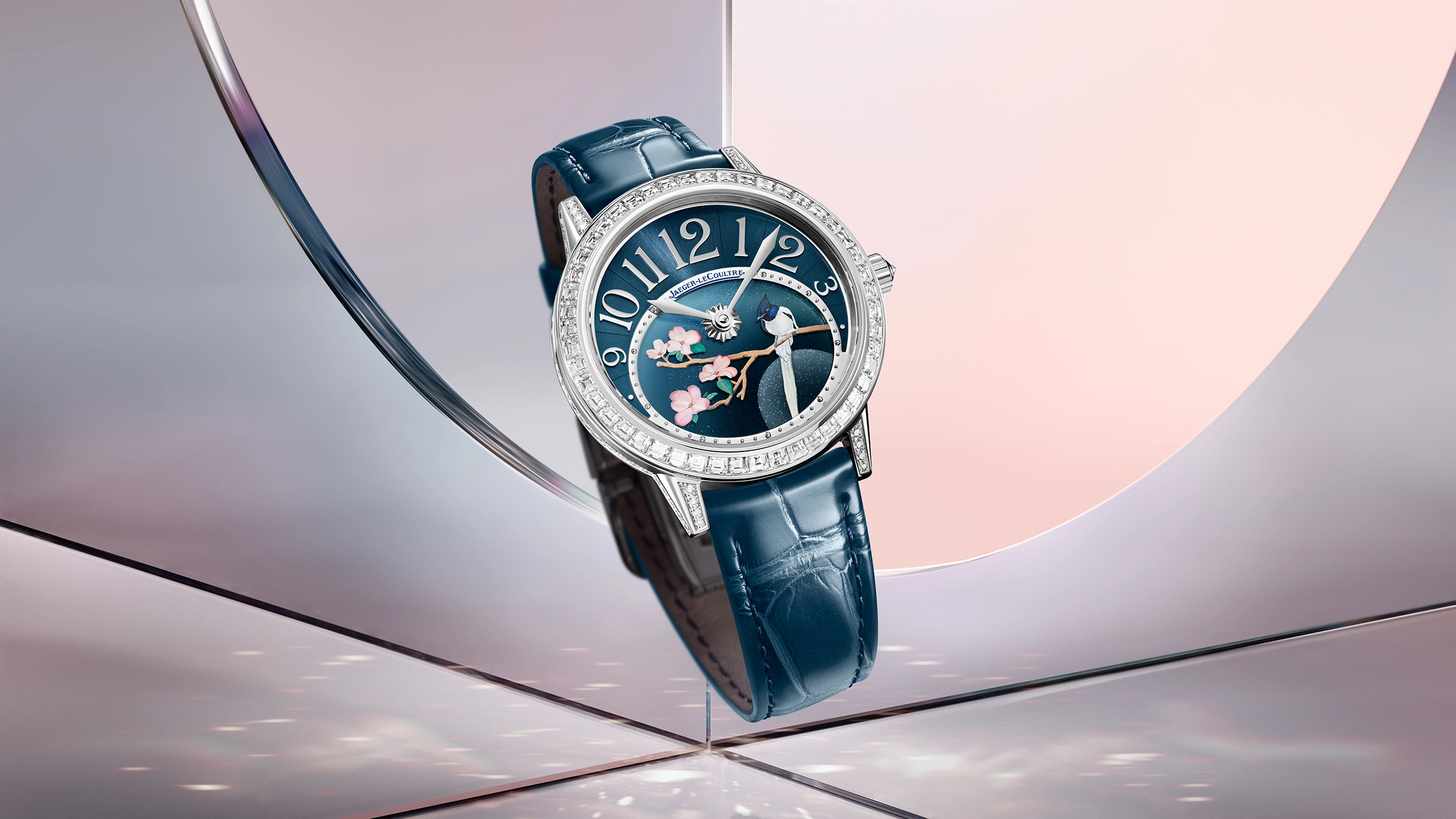
The Rendez-Vous Jewellery Night & Day, in a limited edition of just 10 pieces. Its multi-layered dial, miniature-painted in lacquer, is encircled by baguette-cut diamonds, all housed within a 34mm platinum case, offering an evocative new expression of the Night & Day complication.
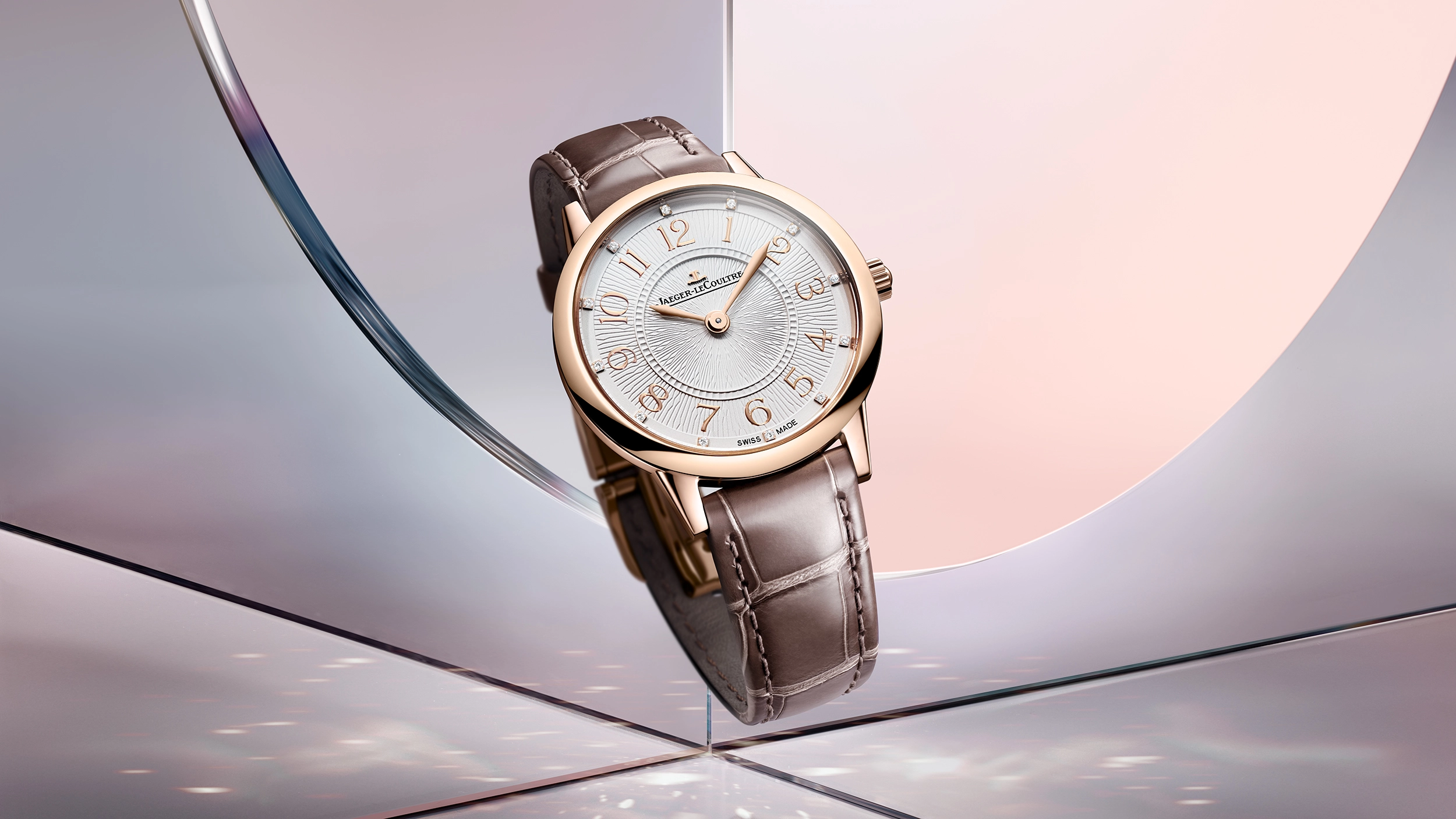
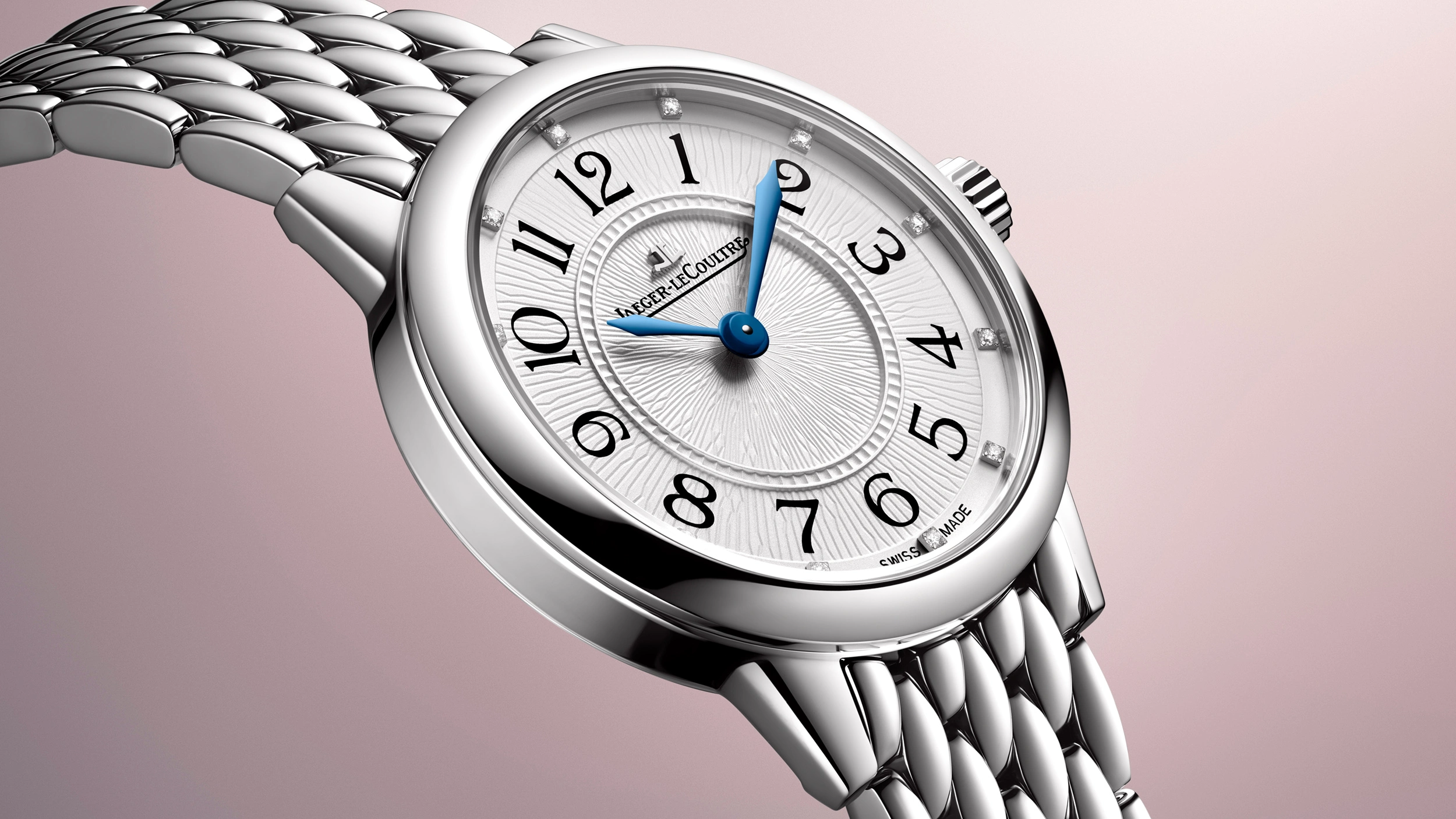
In contrast, the Rendez-Vous Hour-Minute presents the collection’s signature feminine elegance in a new, minimalistic style. It features a 29mm case in steel or 18K (750/1000) pink gold, a smooth polished bezel, an engraved caseback and a supple ‘second skin’ bracelet available in matching metal or polished alligator leather.
Defining Modern Feminity
When introduced in 2012, at a time when very few mechanical watches were created exclusively for feminine wrists, the first Rendez-Vous was hailed as a groundbreaking timepiece, combining elegance and beauty with technical sophistication.
This approach has defined the Maison since its earliest years, when it created watches for women as well as men. Recognising the aesthetic and technical potential of timepieces that could also be worn as jewels, Jaeger-LeCoultre has continually responded to women’s evolving desires, reflected societal shifts and anticipated new trends. A contemporary expression of this philosophy, the Rendez-Vous collection embodies a modern and confident vision of femininity. Fourteen years after its debut, two new Rendez-Vous models demonstrate the art of subtle evolution, reinterpreting the collection’s original codes while remaining true to its spirit.
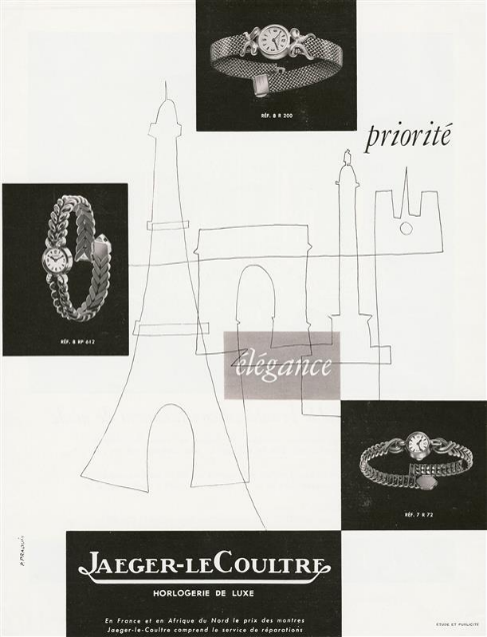
Jaeger-LeCoultre feminine advertising, 1937
Rende-vouz Jewellery Night & Day
A rendez-vous between art and eternity: introducing a 34 mm platinum 950 case to the collection, the Rendez-Vous Jewellery Night & Day unites the technical and aesthetic sophistication of fine watchmaking with the richness of gem-setting and miniature hand-painting.
In a delightful ode to nature, the dial features an image of an Asian Paradise Flycatcher perched on a branch of Korean Dogwood blossom. Hand-painted in lacquer on a transparent sapphire dial, the composition brings to life one tiny brushstroke at a time, creating lifelike detail and a remarkable sense of visual depth. On a disc, set beneath the image of the bird, an ethereal rendition of the moon and sun is also hand-painted in lacquer. A new expression of the Night & Day complication, this disc completes one rotation every 24 hours, tracing the daily transition from sunlight to moonlight. This profound immersion masterfully crafts the perception of two distinct dials – one for day, one for night – each gracefully claiming a third of the total dial’s expanse.
Defining the asymmetrical dial layout, the sinuous Floral numerals – a signature of the Rendez-Vous collection – are graduated in size to form a crescent that wraps around the upper section. Beneath the applied numerals, a fine oval-shaped ring of grain-set diamonds draws the eye to the delicately painted image and Night & Day display. The captivating tableau is enhanced by diamonds, set into the platinum case by the specialist gem-setter in the Manufacture’s in-house Métiers RaresTM atelier: the bezel lights up with a glittering circle of 48 baguette-cut diamonds; these are complemented by brilliant-cut diamonds on the case sides and lugs.
In keeping with the Rendez-Vous codes, an additional brilliant-cut diamond is reverse-set in the crown.
This poetic expression of femininity is brought to life by Jaeger-LeCoultre’s self-winding Calibre 733, whose finely decorated components are revealed through the transparent sapphire caseback. The automatic movement features a rotor, meticulously crafted from 22-carat gold (916/1000), a testament to horological excellence.
A blue alligator strap with a glowing ‘satin’ finish is matched to the blues of the dial and features Jaeger-LeCoultre’s proprietary interchangeability system, enabling the owner to change straps in an instant to create a different look if wished. The Rendez-Vous Jewellery Night & Day is unveiled as a truly exceptional offering, produced in a highly exclusive series of only 10 pieces.
Rende-vouz Hour-Minute
Daily wear, redefined: with the introduction of the Rendez-Vous Hour-Minute, Jaeger-Lecoultre pares the Rendez-Vous aesthetic back to its essence, achieving a fine balance: minimalistic in spirit yet finely detailed; decorative without being elaborate; perfect for daily wear while dressy enough for evening. The 29 mm case, offered in either steel or 18K (750/1000) pink gold, features a convex bezel – polished, rather than diamond-set. The closed metal caseback is engraved with a stylised image of the sun.
Displaying hours and minutes only, the dials are designed as a series of concentric circles and feature the Rendez-Vous signature Floral numerals and sunray guilloché texture. On the outer edge of this, diamonds have a discreet presence as the hour markers, in keeping with the collection’s codes, while the inner edge is defined by a ring of deeply textured embossing.
The precious metal case of the 18K (750/1000) pink gold model is matched by the colour of the hands and numerals, which harmonise with the warm, creamy tone of the dial. The tone-on-tone palette is enhanced by an alligator strap in a soft taupe colour with a subtly glowing ‘satin’ finish. The strap also features the signature interchangeability system. Infused with a delicate jewellery essence, this timepiece is destined for daily wear, providing a discreet yet unwavering presence through every facet of life.
Metal bracelet, with a new aesthetic: The steel model, where blue hands contrast with the snow-white dial and cool tone of the case metal, is fitted with a new style of bracelet. Introduced exclusively for the Rendez-Vous collection in 2025.
Its modern lozenge-shaped links are designed for maximum flexibility, so that it drapes around the wrist as softly as a ribbon. The links are highly polished, with discreet areas of brushing to create visual depth and the bracelet is fitted with Jaeger-LeCoultre’s proprietary interchangeability mechanism to enable quick changes with a simple hand gesture.
More than simply marking the time, the new Rendez-Vous models offer two graceful and distinctly different interpretations of timekeeping for women. From the intricate detail and precious gem-setting of the Rendez-Vous Jewellery Night & Day to the relaxed, everyday elegance of the Rendez-Vous Hour-Minute, these new expressions of femininity are crafted to capture the imagination.
Technical Characteristics
Rende-vouz Jewellery Night & Day
Case: Platinum 950
Dimensions: 34 mm diameter x 9.5 mm thick
Calibre: Automatic Jaeger-LeCoultre Calibre 733
Functions: Hours, minutes, 24h night & day display
Power Reserve: 70 hours
Dial: Miniature painting
Gemstones: Baguette and brilliant-cut diamonds (3,04 carats)
There are few watches in Rolex’s Professional collection that divide opinion quite like the Yacht-Master II. Introduced in 2007 as one of the world’s few purpose-built mechanical regatta chronographs, it stood apart with its programmable countdown timer and unmistakable blue Cerachrom bezel. While admired for its technical ingenuity, its bold styling was never universally embraced.
For 2026, Rolex has taken a fresh approach.
Rather than simply updating the outgoing model, the brand has comprehensively re-engineered the Yacht-Master II, refining its appearance, simplifying its operation and introducing a new movement designed specifically for competitive sailing. The result is a watch that remains unmistakably a Yacht-Master II while becoming significantly more intuitive and contemporary.
A Cleaner Look Without Losing Its Identity
The most noticeable transformation is the dial.
Rolex has removed much of the visual complexity that characterised the previous generation. The countdown scale has been relocated from the bezel to a precisely positioned flange surrounding the dial, creating a more balanced and easier-to-read display.
The dial itself now features a matte white lacquer finish that reduces reflections, while the Professional collection’s applied hour markers further improve readability in varying lighting conditions.
The familiar blue Cerachrom bezel remains, but its role has changed. Instead of carrying the countdown scale, it now functions as a traditional 60-minute graduated bezel, giving the watch a cleaner and more purposeful appearance.
Designed Around the Regatta Start
The Yacht-Master II has always been different from conventional chronographs.
Instead of measuring elapsed time after an event begins, it helps sailors prepare for one of the most crucial moments in competitive yacht racing: the starting sequence.
The new generation retains Rolex’s programmable countdown with mechanical memory and “on-the-fly” synchronization, allowing sailors to adjust the countdown during a race without interrupting its operation.
For 2026, Rolex has also simplified the user experience. The countdown is now programmed and controlled exclusively through the two side pushers, eliminating the Ring Command bezel interaction used on the previous generation and making operation more straightforward under race conditions.
New Calibre 4162 Powers the Next Generation
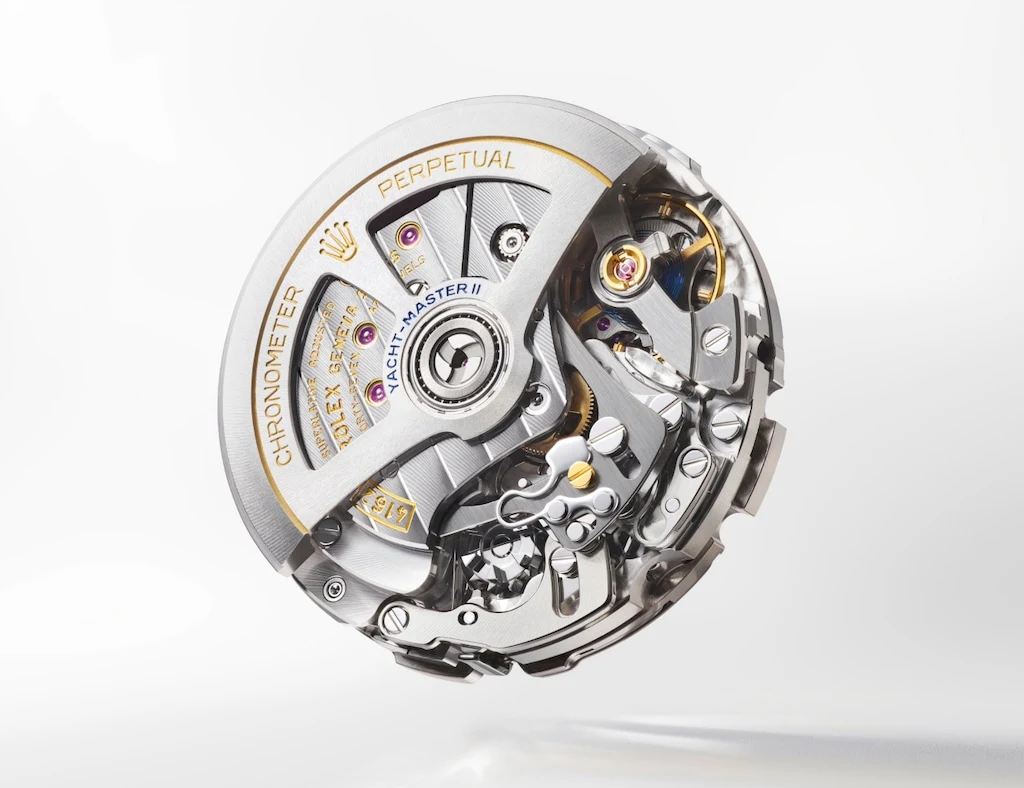
At the heart of the watch is the entirely new Rolex Calibre 4162, developed exclusively for the Yacht-Master II.
Building on the previous Calibre 4161, the new movement introduces a completely re-engineered countdown mechanism while incorporating several of Rolex’s latest movement technologies.
Among the upgrades are:
Chronergy escapement for improved energy efficiency
Rolex Côtes de Genève bridge finishing
Skeletonised oscillating weight
Enhanced reliability and precision
Self-winding mechanical architecture developed entirely in-house
Like every current Rolex, the movement meets the strengthened Superlative Chronometer standards introduced in 2026, ensuring exceptional precision and performance after casing.
Built for Life at Sea
The Yacht-Master II continues to feature Rolex’s robust Oyster architecture.
Key highlights include:
Specification
Details
Case Size
44 mm
Water Resistance
100 metres (330 feet)
Materials
Oystersteel or 18 ct Yellow Gold
Bracelet
Oyster Bracelet
Clasp
Oysterlock Safety Clasp
Extension
Easylink Comfort Extension (approximately 5 mm)
On the yellow gold model, Rolex also incorporates patented ceramic inserts inside the bracelet links, helping reduce wear while improving long-term flexibility and comfort.
Available Variants
At launch, Rolex offers two versions:
Oystersteel with a matte white dial and blue Cerachrom bezel
18 ct Yellow Gold with matching premium finishes
Both share identical functionality and the new Calibre 4162 movement.
EyesOnTime’s Perspective
The Yacht-Master II has always been one of Rolex’s most technically fascinating creations, but also one of its most polarising.
With the 2026 generation, Rolex appears to have listened carefully to years of collector feedback. The watch is noticeably cleaner, more legible and easier to operate, while preserving the unique regatta functionality that has always set it apart.
Rather than reinventing the concept, Rolex has refined it where it matters most. The redesigned countdown interface, the introduction of Calibre 4162 and the simplified aesthetics collectively make the Yacht-Master II feel more mature and purpose-driven than its predecessor.
Whether this translates into broader appeal among collectors remains to be seen, but from a technical and design standpoint, the new Yacht-Master II represents one of the brand’s most thoughtful evolutions in recent years.
What is new about the Rolex Yacht-Master II in 2026?
The 2026 model introduces a redesigned countdown display, a new Calibre 4162 movement, simplified countdown controls using only the side pushers, improved dial legibility and a cleaner overall design.
What is the Yacht-Master II designed for?
Unlike a traditional chronograph, the Yacht-Master II is specifically engineered for yacht racing and features a programmable countdown timer designed for regatta starting sequences.
Which materials are available?
The new Yacht-Master II is available in Oystersteel and 18 ct yellow gold.
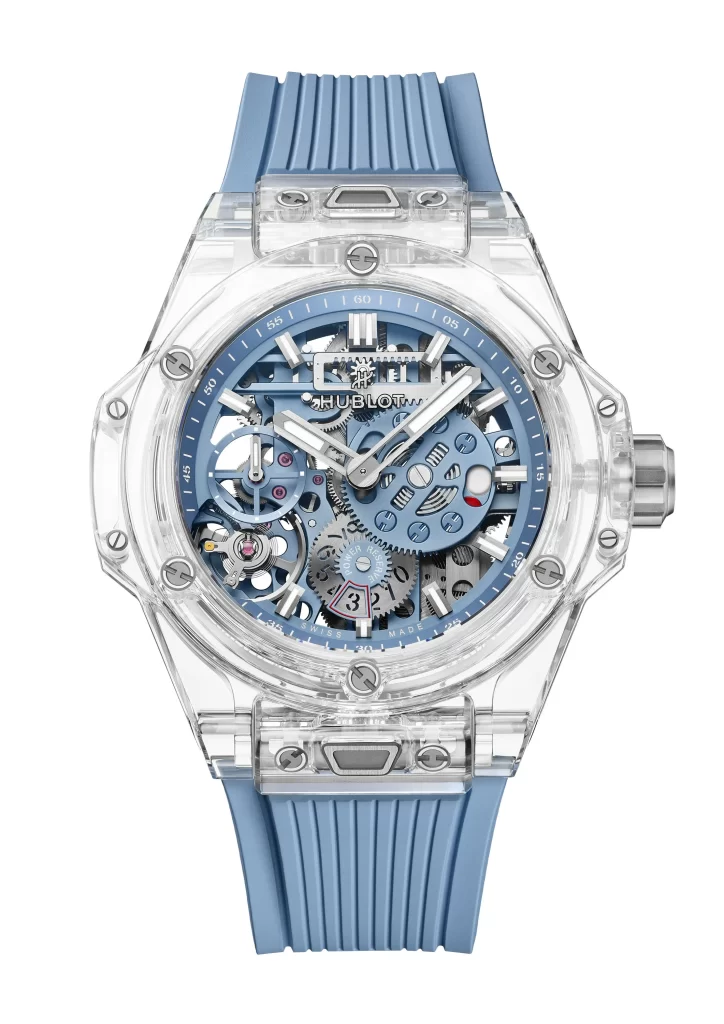
Hublot continues to redefine transparent watchmaking with the launch of the limited-edition Big Bang Sapphire Sky Blue, pairing its signature sapphire expertise with the impressive Meca-10 manufacture movement.
There are watches that tell time, and then there are watches that make a statement before you even glance at the dial. The Hublot Big Bang Sapphire Sky Blue belongs firmly in the latter category. Limited to just 100 pieces worldwide, this latest creation showcases everything Hublot has become synonymous with over the past decade: innovative materials, bold engineering and contemporary design.
Hublot’s Mastery of Sapphire Continues
Working with sapphire is no simple feat. Renowned for its exceptional hardness and transparency, sapphire is one of the most demanding materials in watchmaking. While many brands have experimented with it, Hublot has consistently expanded its possibilities, introducing coloured sapphire cases that combine technical complexity with striking aesthetics.
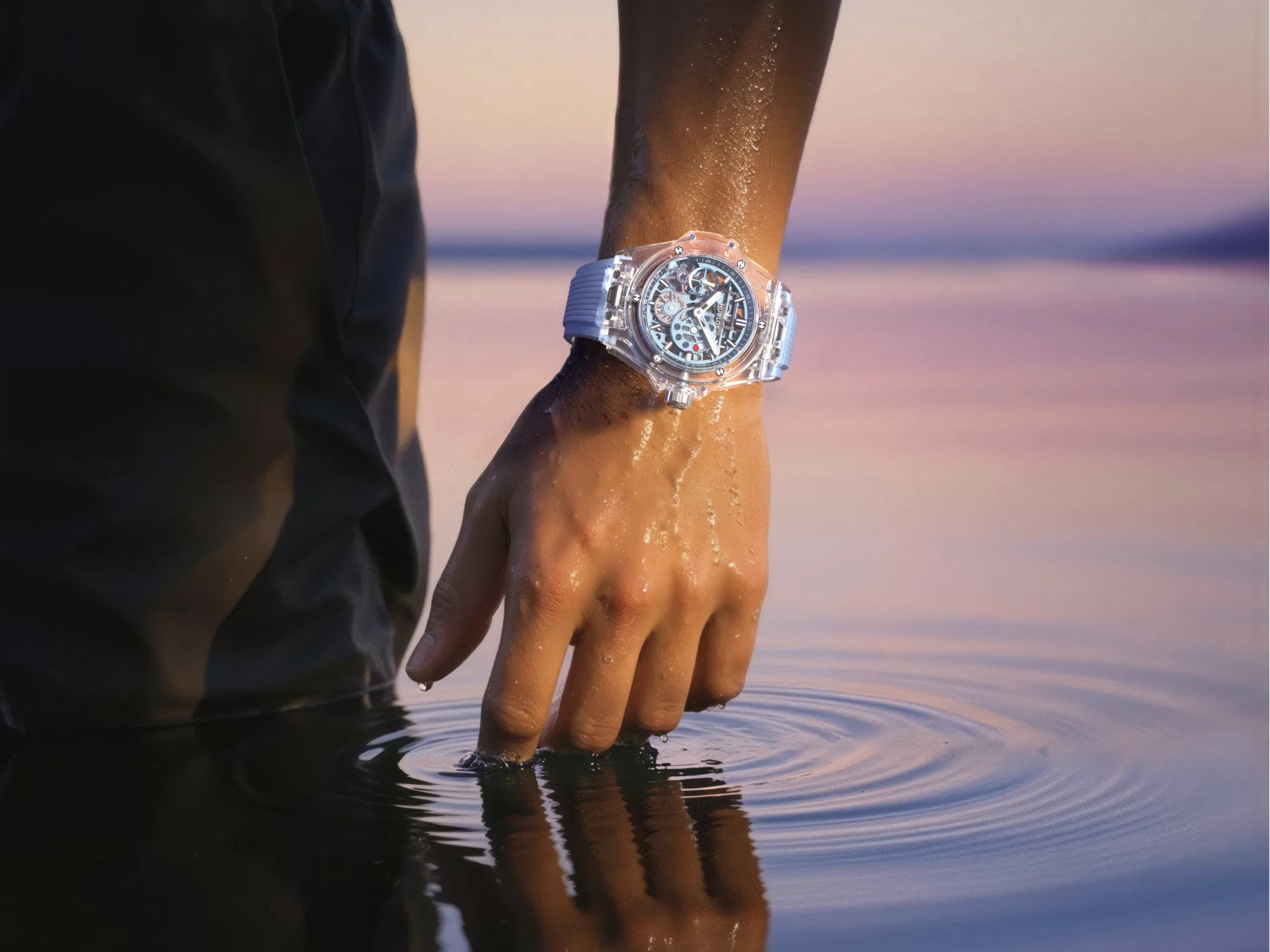
The Big Bang Sapphire Sky Blue captures the calm brilliance of a summer sky through its fully polished 44mm sapphire crystal case. Its transparent construction allows light to flow through every angle of the watch, giving it a presence that constantly changes depending on its surroundings. Titanium H-shaped screws secure the sapphire bezel, while a structured sky-blue rubber strap completes the distinctive monochromatic look.
The Meca-10 Movement Takes Centre Stage
Inside the transparent case is one of Hublot’s most celebrated in-house calibres: the HUB1201 Meca-10.
Originally introduced in 2016, the Meca-10 broke away from conventional movement architecture. Rather than hiding the mechanics beneath the dial, Hublot designed the movement to become the visual centrepiece of the watch. Inspired by mechanical construction systems, its fully skeletonised architecture reveals every functional component.
The manually wound movement consists of 223 components, delivers an exceptional 10-day (240-hour) power reserve, and uses two parallel mainspring barrels to maintain consistent energy delivery. One of its most distinctive features is the innovative rack-and-pinion power reserve display that moves horizontally across the movement, reinforcing the industrial aesthetic that has become synonymous with the Meca-10 collection.
Transparency That Reveals Every Detail
The appeal of the Big Bang Sapphire Sky Blue extends beyond its sapphire case. Its matte sky-blue skeleton dial, matching movement bridges and sapphire case-back ensure that the watch remains visually captivating from every angle.
Instead of concealing its mechanics, the watch celebrates them. Every gear, bridge and wheel becomes part of the overall design, creating a fascinating interplay between engineering and aesthetics. It is a reminder that modern haute horlogerie is as much about visual storytelling as it is about precision.
Built with Confidence
The Big Bang Sapphire Sky Blue is more than an exercise in design. It also reflects Hublot’s confidence in its manufacturing capabilities.
Eligible models purchased from 1 January 2026 benefit from Hublot’s 5+5 warranty programme, providing a five-year standard warranty with the possibility of extending coverage to ten years through the Hublotista programme. It is among the most comprehensive warranty offerings in contemporary luxury watchmaking and reinforces the brand’s trust in its products.
Limited to Just 100 Pieces
Exclusivity remains central to the appeal of this release.
The Hublot Big Bang Sapphire Sky Blue is limited to 100 pieces worldwide and will be available through selected Hublot boutiques, authorised retailers and the brand’s official online store. The watch is priced at USD 84,300, reflecting both the complexity of its sapphire construction and the sophistication of its in-house movement.
Final Thoughts
Few brands have embraced sapphire as confidently as Hublot. Over the years, the manufacture has transformed what was once considered an experimental material into one of its defining signatures. The Big Bang Sapphire Sky Blue continues that journey, combining a transparent sky-blue sapphire case with the technically impressive Meca-10 movement in a package that is both futuristic and unmistakably Hublot.
For collectors who appreciate avant-garde watchmaking, architectural movements and limited-edition craftsmanship, this latest Big Bang demonstrates exactly why Hublot remains one of the industry’s most daring innovators.
Thirty years after its founding, independent Swiss watchmaker Parmigiani Fleurier has unveiled one of its most ambitious and meaningful creations to date. The new Carillon Tourbillon is far more than an anniversary watch. It is a celebration of the Maison’s philosophy of restoration, transmission, and mechanical excellence, expressed through a remarkable combination of a four-gong minute repeater and a tourbillon.
Created to mark Parmigiani Fleurier’s 30th anniversary, this exceptional haute horlogerie timepiece is limited to just five examples worldwide. Entirely conceived, developed, assembled and finished within the Manufacture, the Carillon Tourbillon stands as a testament to the independent Swiss watch brand’s dedication to preserving traditional craftsmanship while advancing contemporary watchmaking.
A Legacy Rooted in Restoration
Few modern watchmakers can claim a foundation as unique as that of Parmigiani Fleurier. Before establishing the Maison in 1996, Michel Parmigiani built his reputation as one of Switzerland’s foremost restorers of historic timepieces, automata, clocks and mechanical masterpieces.
His approach to restoration was never driven by nostalgia. Instead, it was a process of understanding. Through decades of studying historical mechanisms, Michel Parmigiani developed a profound appreciation for the intelligence, architecture and artistry hidden within traditional watchmaking.
The Carillon Tourbillon is a direct reflection of this philosophy.
Its origins can be traced to an early nineteenth-century pocket watch created by Perrin Frères and preserved within the renowned Sandoz Collection. Restored by Parmigiani Fleurier in 2000, the historic timepiece became a source of inspiration for the Maison’s latest creation. Rather than replicating its design, Parmigiani Fleurier sought to reinterpret its acoustic architecture, mechanical ingenuity and distinctive serpentine gongs within a contemporary luxury watch.
The Art of Sounding Time
At the heart of the Parmigiani Fleurier Carillon Tourbillon lies one of watchmaking’s most revered complications: the minute repeater.
Historically, the carillon tradition originated in bell towers, where the sound of bells marked the passage of time for entire communities. The Carillon Tourbillon transforms that public experience into something deeply personal, allowing time to be heard on demand through an intricate mechanical symphony worn on the wrist.
Unlike conventional minute repeater watches that utilise two gongs, the Carillon Tourbillon employs an advanced four-gong system.
The chiming sequence consists of:
One low-pitched gong for the hours
One high-pitched gong for the minutes
Two additional gongs dedicated to the quarter hours
Together, these four gongs create a rich and distinctive four-note melody that gives the watch its unique acoustic signature.
The striking mechanism is regulated by an integrated flywheel governor that ensures a smooth and perfectly controlled cadence throughout the chiming sequence. This guarantees a fluid acoustic performance free from acceleration or slowing, preserving the purity of every note.
A Contemporary Haute Horlogerie Statement
While inspired by historical horology, the Carillon Tourbillon is unmistakably modern in its execution.
The 41.6mm case is crafted from 18-carat white gold and features vertical gadroons inspired by classical architecture, a recurring design element deeply associated with Michel Parmigiani’s aesthetic vision.
A sapphire crystal box construction allows an unobstructed view of the dial-side mechanics, including the visible hammers responsible for striking the gongs. Their presence transforms the watch into a dynamic performance, revealing the exact moment when mechanical energy is converted into sound.
One of the watch’s most distinctive visual features is its four serpentine gongs, which elegantly wrap around the dial. Inspired directly by the Perrin Frères pocket watch, these flowing curves create a powerful visual identity while simultaneously serving an essential acoustic function.
In the Carillon Tourbillon, acoustics become design.
The Beauty of Morning Blue
The dial itself represents another showcase of Parmigiani Fleurier’s artisanal expertise.
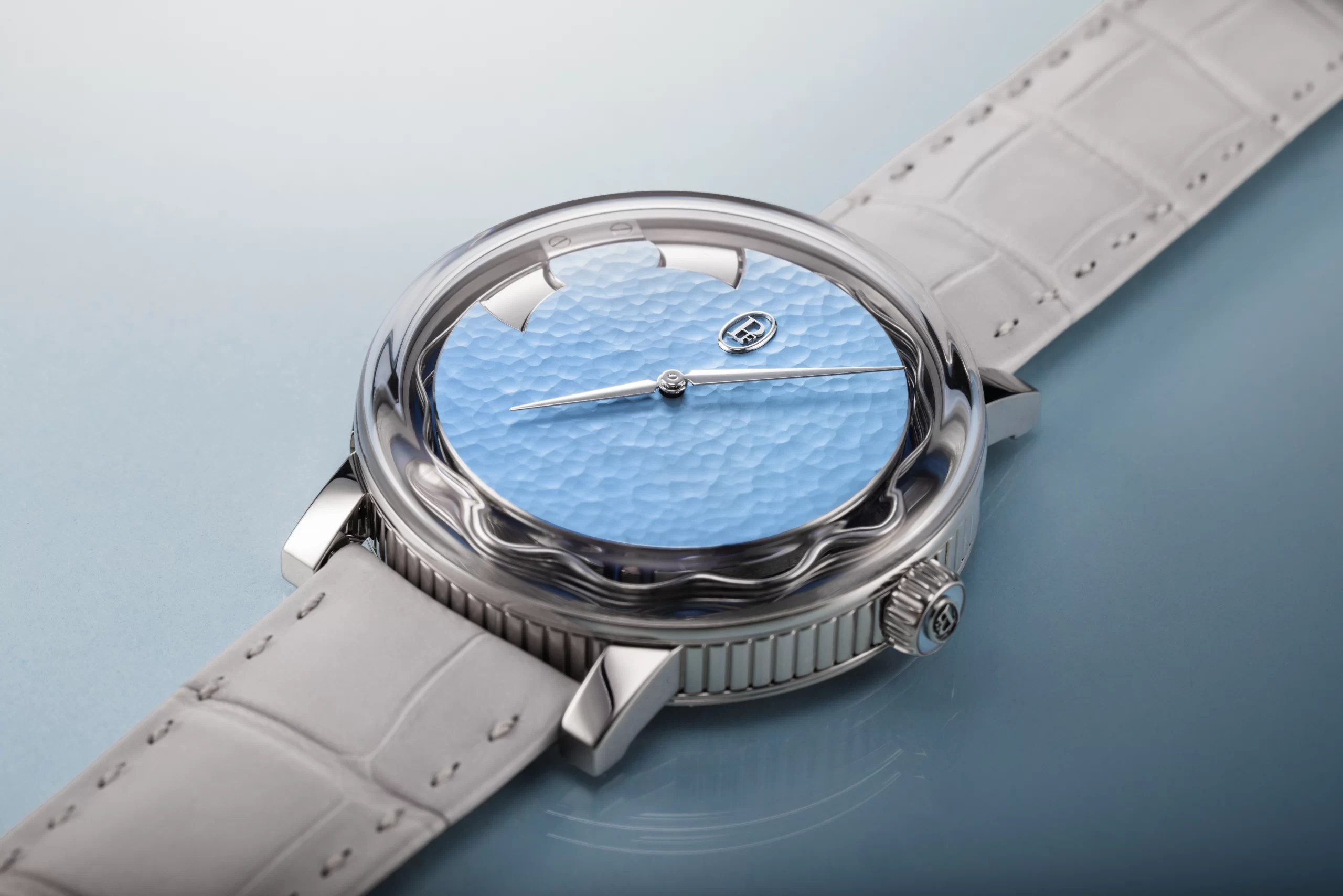
Crafted from 18-carat white gold, the dial features a hand-hammered finish and is presented in a subtle Morning Blue hue that shifts between silver and azure depending on the light.
The textured surface reflects the Maison’s belief in the value of the human hand. No two surfaces are exactly alike, ensuring each watch possesses its own individual character.
This hand-hammered finish continues the design language introduced through Parmigiani Fleurier’s recent anniversary creations and reinforces the Maison’s commitment to traditional craftsmanship.
Calibre PF950: A High-Complication Masterpiece
Powering the watch is the manually wound Calibre PF950, an extraordinary manufacture movement designed specifically for the Carillon Tourbillon.
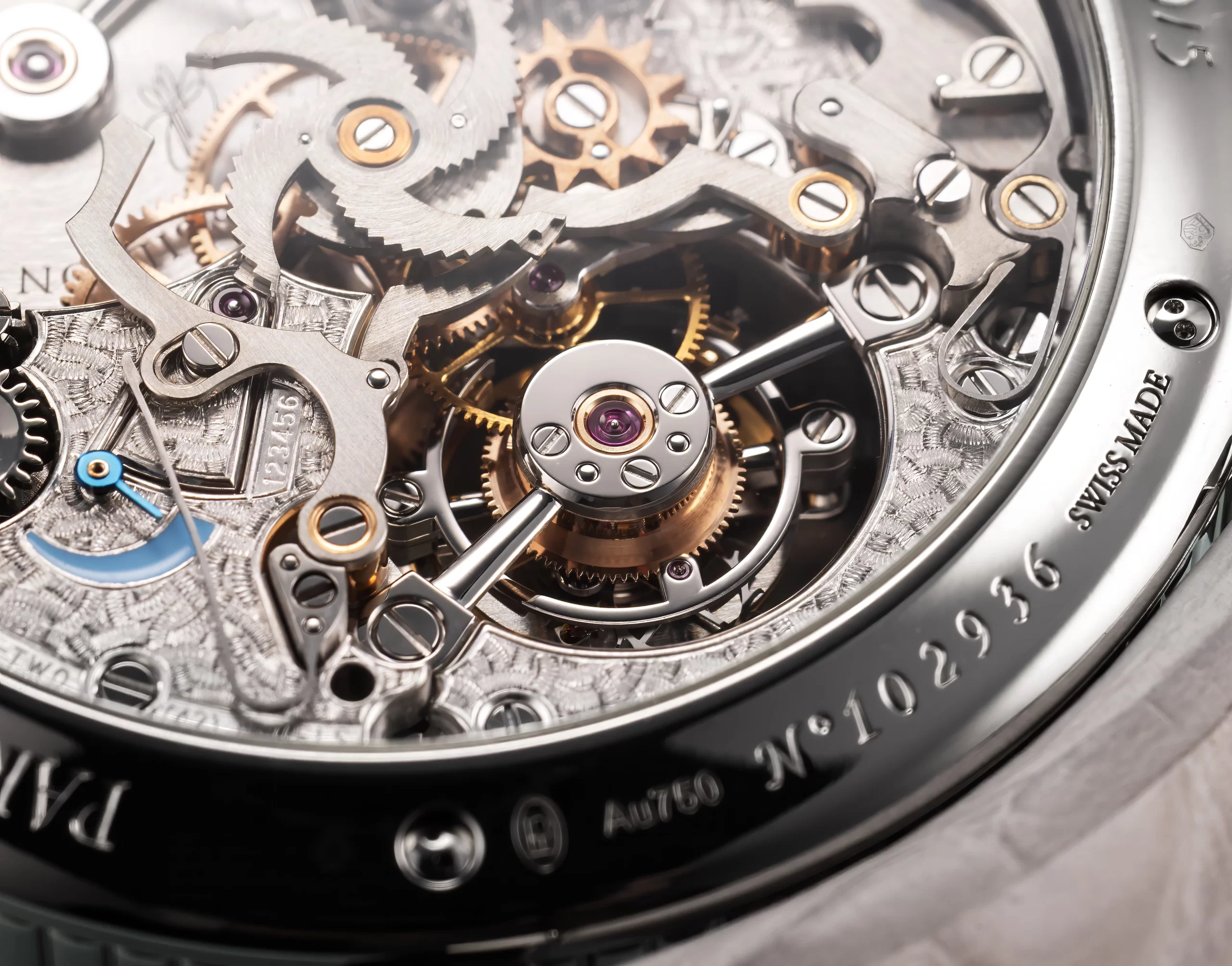
Comprising 456 components and 42 jewels, the movement integrates a minute repeater, a four-gong carillon striking mechanism and a 60-second tourbillon within a remarkably refined architecture.
The calibre operates at 21,600 vibrations per hour (3Hz) and delivers a power reserve of at least ten days, an impressive achievement for a high-complication watch featuring a chiming mechanism.
To achieve this performance, Parmigiani Fleurier developed a sophisticated three-barrel system.
Two superimposed barrels provide power to the movement, while a dedicated third barrel is reserved exclusively for the striking mechanism. This third barrel is automatically rewound each time the repeater slide is activated, ensuring optimal energy delivery whenever the chiming function is engaged.
Among modern haute horlogerie creations, combining a tourbillon and a minute repeater within a movement offering such extended autonomy remains a significant technical achievement.
Hidden Complexity and Refined Finishing
In keeping with Parmigiani Fleurier’s philosophy of restrained elegance, much of the watch’s complexity remains discreetly hidden from immediate view.
The tourbillon and power reserve indicator are positioned on the reverse side of the watch, preserving the balance and clarity of the dial while rewarding closer inspection.
The movement itself serves as a canvas for exceptional hand-finishing. Its components are decorated with the Maison’s distinctive mezzo vibrato engraving, a technique previously explored on the Armoriale Objet d’Art collection.
Executed entirely by hand, the decoration creates a visual rhythm across the movement’s surfaces, echoing the acoustic resonance generated by the chiming mechanism.
The calibre’s bridges and components are further enhanced through hand-bevelling and hand-graining, underscoring the artisanal nature of the piece.
A Case Designed for Resonance
In a minute repeater watch, the case plays a crucial role in shaping the quality of sound.
Parmigiani Fleurier selected white gold not only for its luxurious appearance but also for its controlled acoustic properties. The material contributes to the transmission, clarity and resonance of the chiming sequence, ensuring harmony between the movement and its surrounding architecture.
Integrated into the case band is the repeater slide, which activates the chiming mechanism through a deliberate and tactile gesture. The interaction creates a ceremonial connection between wearer and watch, reinforcing the emotional dimension of mechanical horology.
Why the Parmigiani Fleurier Carillon Tourbillon Matters to Collectors
For collectors of independent haute horlogerie, the Carillon Tourbillon represents far more than a limited-edition luxury watch.
It embodies everything that has defined Parmigiani Fleurier over the past three decades: restoration as a source of innovation, craftsmanship as a form of cultural transmission, and mechanical complexity pursued in the service of beauty rather than spectacle.
With only five examples produced, the Carillon Tourbillon is among the rarest watches ever created by the Manufacture. Its exclusivity is not driven by marketing, but by the extraordinary level of expertise, hand-finishing and acoustic tuning required to bring each piece to life.
Thirty Years of Independent Watchmaking Excellence
The Carillon Tourbillon serves as a fitting tribute to Parmigiani Fleurier’s first thirty years.
Combining a four-gong minute repeater, a tourbillon, a hand-hammered Morning Blue dial and a movement engineered for exceptional acoustic performance, it captures the essence of the Maison’s identity.
More importantly, it demonstrates that true innovation in Swiss watchmaking does not require abandoning tradition. Instead, the Carillon Tourbillon proves that the most compelling creations emerge when history, craftsmanship and contemporary engineering work in harmony.
For Parmigiani Fleurier, the sound of thirty years is not merely heard. It resonates.
Technical Specifications
Parmigiani Fleurier Carillon Tourbillon White Gold Anniversaire
A daring and visionary evolution of a timeless icon.
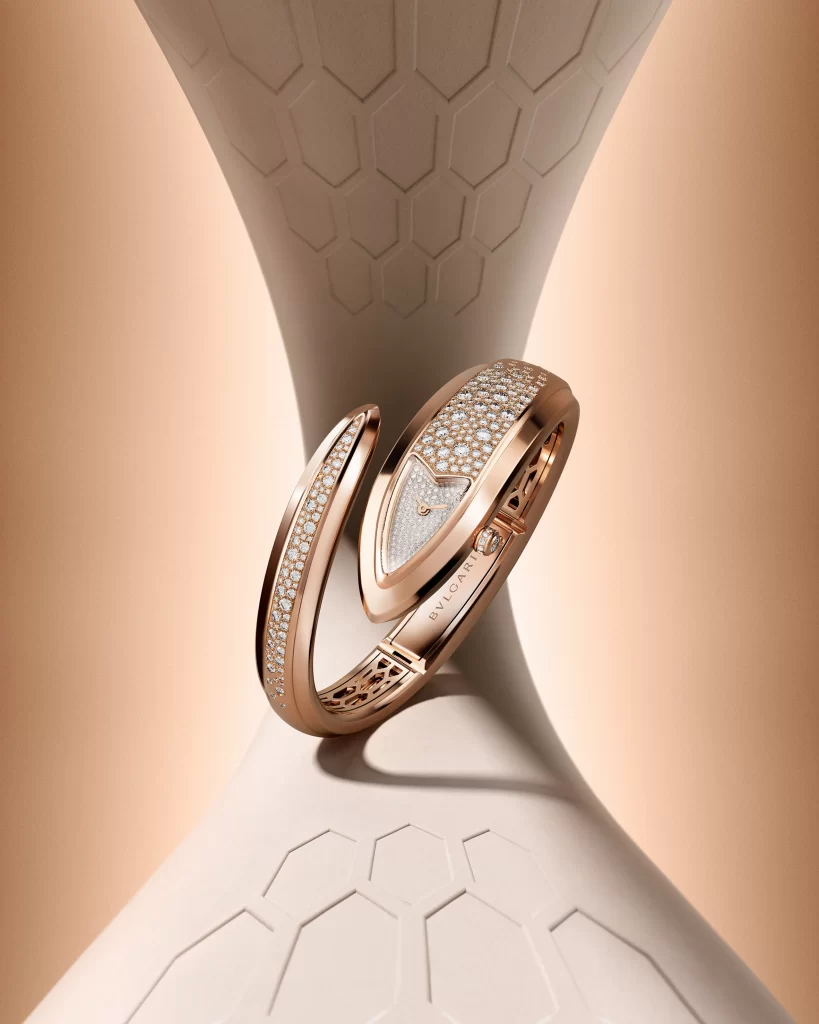
The iconic Serpenti undergoes its boldest transformation yet: Aeterna. Modern. Avant-garde. Bvlgari’s legendary serpent, stylized to the extreme, distilled to its quintessential form. The pure, powerful geometry of an original bracelet. The dawn of a new era.
• A statement of style and modernity, inspired by the heritage of Bvlgari and Serpenti, transformed by a futuristic aesthetic.
• The pure essence of Serpenti captured – an eternal symbol of rebirth.
• A bangle joins the Serpenti collection, designed to pair seamlessly with Bvlgari jewellery.
• A sculptural masterpiece of timelessness, fluidity, elegance, and precision.
The year 2025, under the sign of the snake in the Chinese calendar, heralds a profound transformation for Serpenti. With Aeterna, Bvlgari brings the reptile back to life in exquisite high jewellery, conducive to sublime creativity. Diamonds illuminate the gold of the precious animal, whose new skin expresses more than ever the foundations of Bvlgari, its inimitable Italian style and its profoundly pioneering identity. The reinvented icon captures the rich heritage that precedes it and extends it into the future, free from fashion and time. The snake becomes a language in itself: fluid and free of the superfluous.
“Aeterna is more than a timepiece or jewellery — it is the ultimate expression of Bvlgari’s avant-garde vision. I wanted to capture Serpenti’s DNA, distil it to its essence, and project it into the future.” – Fabrizio Buonamassa Stigliani, Product Creation Executive Director, Bvlgari.
No eyes, no scales, no artifice. Only the serpent’s most elemental form remains – hypnotic and commanding. Crafted in precious gold and meticulously set with diamonds, Serpenti embraces the skin as an elegant bangle.
THE CREATIVE METAMORPHOSES OF AN ICON
Since 1948, Serpenti has continually reinvented itself, embodying the essence of perpetual rebirth. It seduces, enchants, captivates, and inspires desire. As Tubogas, supple and sensually coiled around the wrist. As Infiniti, graphic and sculptural. As Seduttori, created for everyday elegance yet capable of housing an exceptional tourbillon (2020). As Misteriosi, the precious guardian of a technical feat: the Piccolissimo BVL 100 calibre – with its extremely reduced dimensions, a record in miniaturization (2022). Now, Lady Solotempo, a fully in-house automatic calibre, beats at the heart of new interpretations of Seduttori and Tubogas, and another revelation of this milestone year 2025 – a tribute to the Serpent, reviving the rich tradition of mechanical watches for women.
Today, Aeterna pushes boundaries even further. Its design, far more than merely evoking the serpent, mirrors its very soul.
THE ART OF THE ESSENTIAL
“I like to design in a pure, contemporary style, with few decorative elements – to draw lines that speak the language of eternity. Octo Finissimo is a perfect expression of this quest for the absolute through form, which now transforms Serpenti. Only a few strokes were needed to sketch Aeterna. The serpent is distilled to its essence, its own dynamic, refined to its most powerful form… with visionary modernity.”– Fabrizio Buonamassa Stigliani, Product Creation Executive Director, Bvlgari.
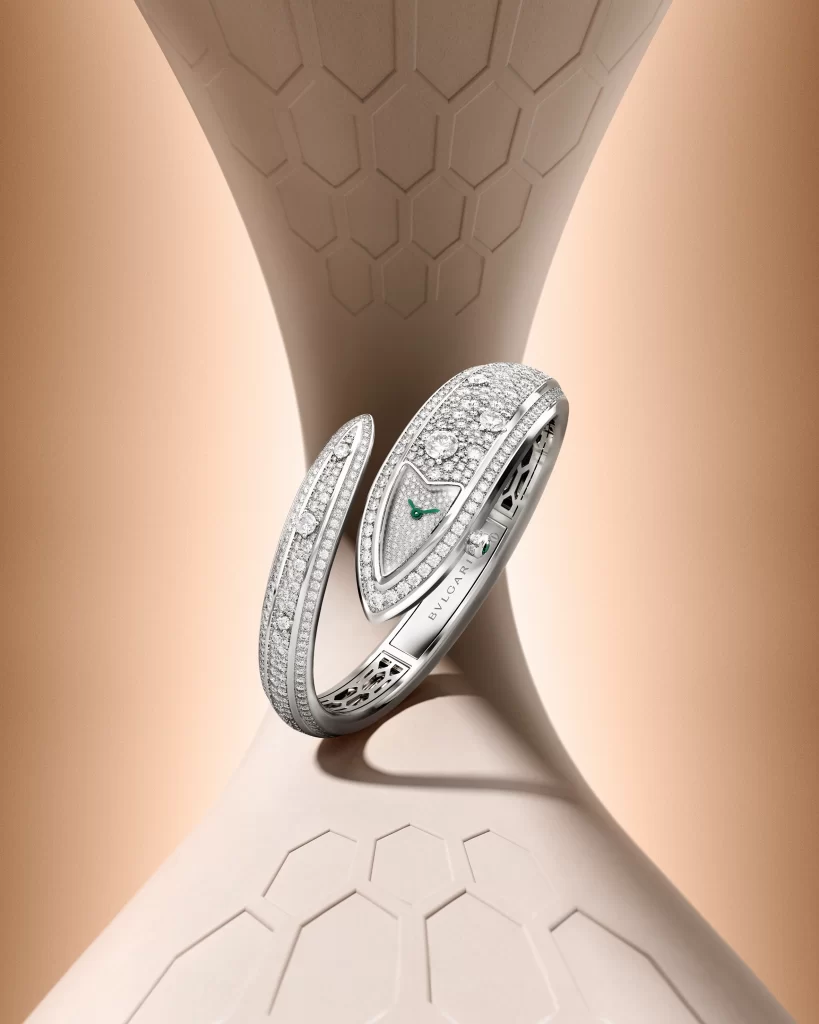
In a single gesture, Aeterna embraces the wrist, highlighting it. A fluid movement. The sensuality of gold against skin. A geometric ring of light. Tapered, intense. Serpenti Aeterna doesn’t just define itself – it asserts its distinctive character in an elegantly refined bangle. Versatile by design, it effortlessly adapts to personal style and pairs seamlessly with other Bvlgari creations. This unprecedented design daringly wraps itself around the wrist thanks to an ingenious clasp mechanism. A truly exceptional piece, it demanded two years of development to achieve perfect aesthetic integration and comfort. The iconic hexagonal scales, a hallmark of past Serpenti designs, are subtly etched into the inner contour. Invisible from the outside, this sublimely crafted detail reinforces Aeterna’s intimate connection to Serpenti’s extraordinary heritage.
AN ETERNAL ELEGANCE
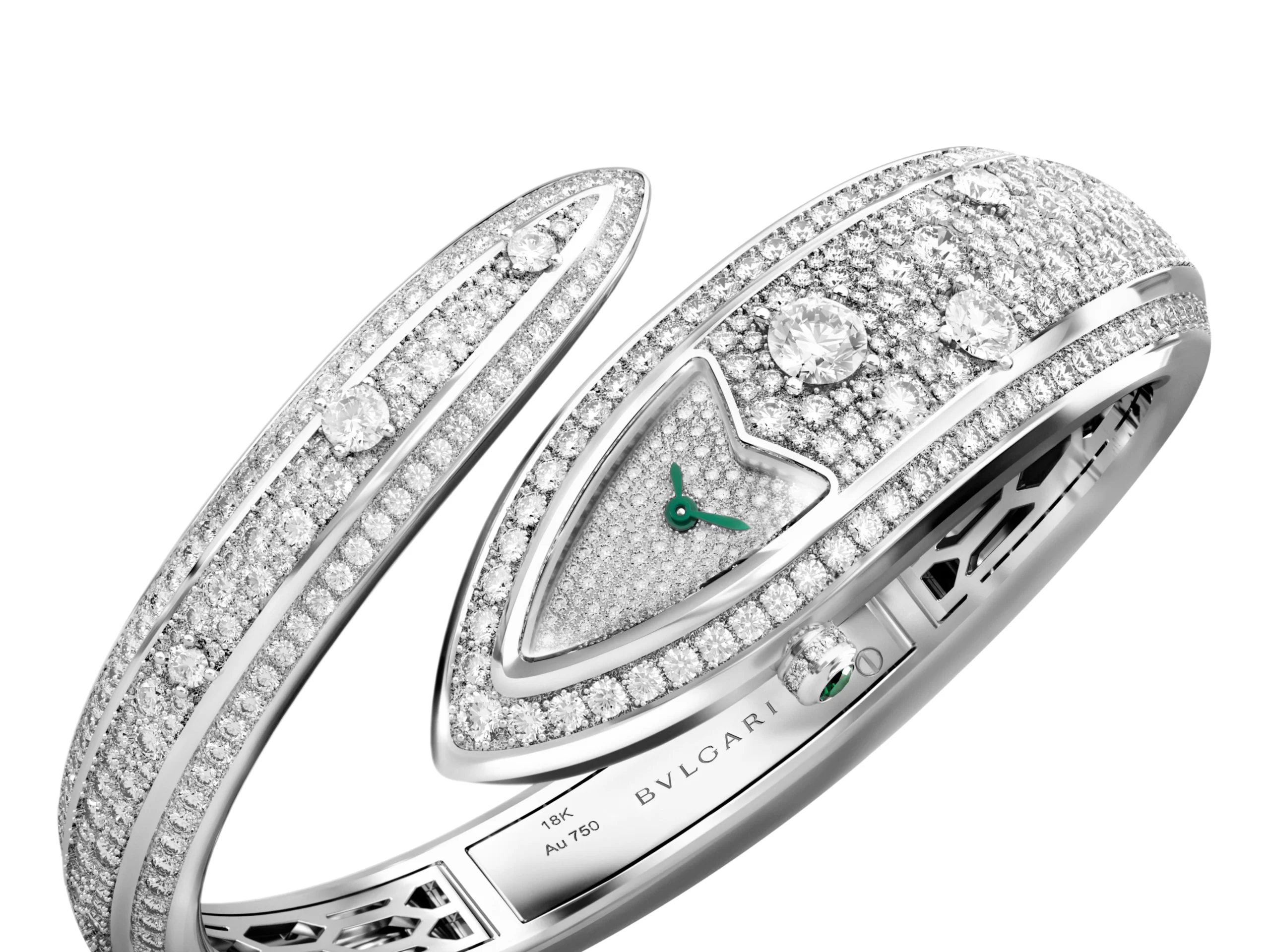
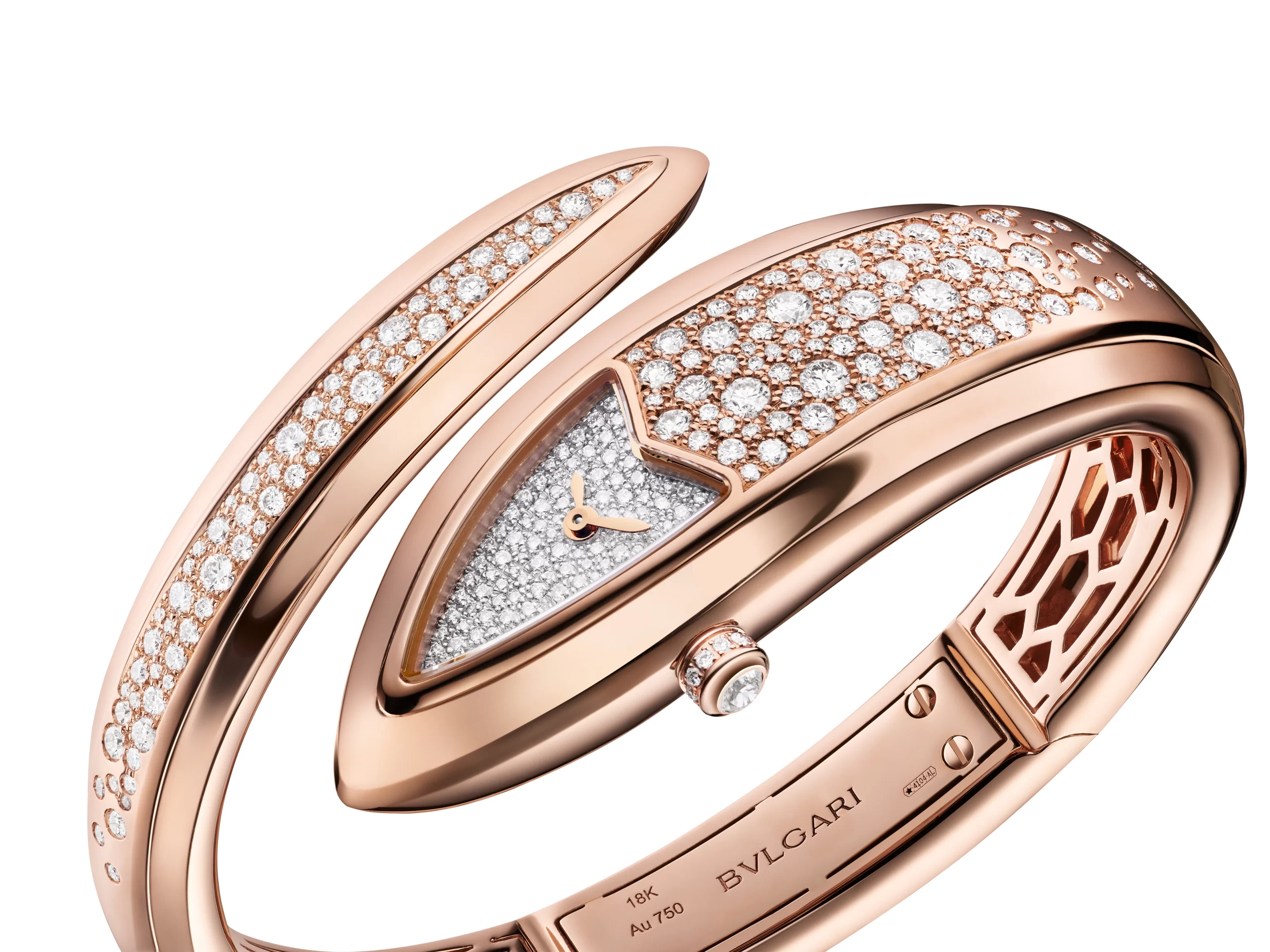
Bvlgari unveils Serpenti Aeterna in rose gold, adorned with diamonds, as well as a high-jewellery interpretation in fully pavé-set white gold. Precious gemstones illuminate the snow-set dial, extending along the spine to the very tip of the tail. On the white gold version, oversized gems create a striking three-dimensional effect, enhancing the object’s mesmerizing volumes.
Serpenti Aeterna is born of a single, visionary gesture. The quintessence of Serpenti, this avant- garde icon is meant to be experienced today, tomorrow, and for eternity. Time itself lingers, seemingly suspended.
SERPENTI AETERNA PINK GOLD 104205 (S) / 104280 (L)
Movement
Quartz movement. Functions: Hours, Minutes.
Case, Dial and Bracelet
A rose gold curve case and head set with round brilliant- cut diamonds. Rose gold crown set with diamonds and a diamond brilliant cut.
A rose gold bracelet with diamonds.
2 Sizes 104205 (S): 145mm // 104280 (L): 155mm. Brilliant-cut diamonds pavé dial. Rose gold plated hands.
SERPENTI AETERNA WHITE GOLD 104041
Movement
Quartz movement. Functions: Hours, Minutes.
Case, Dial and Bracelet
A white gold curve case, head and bezel set with round brilliant-cut diamonds. White gold crown set with diamonds and an emerald brilliant cut.
A white gold bracelet with diamonds – size (S): 155mm. Brilliant-cut diamonds pavé dial. Green hands.
The excitement was palpable and there was a buzz in the city of Geneva which woke up to the first day of Watches and Wonders. This was the day everyone was looking forward to since 2020. The wonderful novelties that were unveiled at Watches and Wonders on day 1 were long awaited. The watch was on.
All the brands were eager to welcome trade partners and watch enthusiasts and the visitors were equally elated to see the wonderful novelties displayed in all their splendor. The fruit of the hard labor was ripe, and all the innovations were ready to see the lights.
The convention was kickstarted with a beautiful opening ceremony and several brands had keynote addresses. But the moment the novelties were unveiled the magic began.
The first day saw a mix of brands and here’s a rundown on day one at the most happening event.
Armin Strom: Orbit
What is unique about this spectacularly beautiful piece?
It is the world’s first watch with an on-demand date indicated on the bezel. The pusher at 10 when pushed shows the date on the bezel for a few seconds. The date hand when in the stationary mode, remains in its fixed position pointing at 12 o’clock.
Their signature bridges, hold the micro-rotor at the one o’clock position, and the equal force barrel at the 6 o’clock position. The watch comes with transparency that is unique in the watch industry highlighting the inner workings of mechanical watchmaking on the dial-side. It comes with an integrated bracelet and a contrasting ceramic bezel. A sport-chic watch that is flaunt-worthy.
The Alpine Eagle flying tourbillion is a watch made in Lucent Steel making it 50% harder and more luminous. The well-highlighted flying tourbillon placed at 6 o’clock has no upper bridge and you can see right through to the movement.
The brushed dial starts at the tourbillion moving outwards. With an integrated bracelet, the watch is simple and yet a delightful piece.
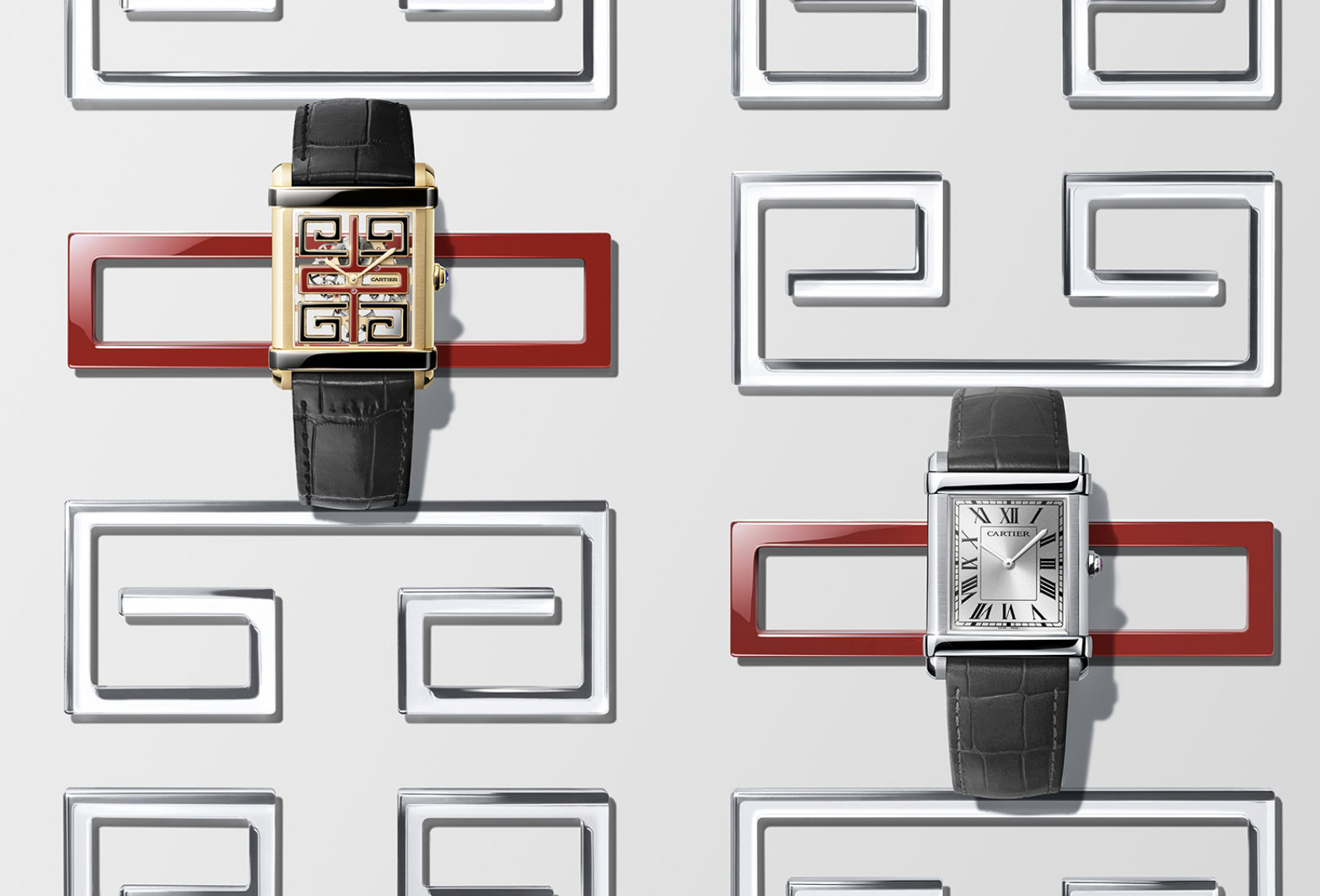
A comeback after a century, in an art-deco design, rectangular and true to its vertical brancards design the Tank Chionese is as simple and elegant as they come. With two additional brancards across the top and bottom of the square case, it evokes the portico design.
In a beautifully polished gold case, its iconic design and shape with “chemin de fer” and the hidden Cartier signature it is a watch that puts geometry in fashion.
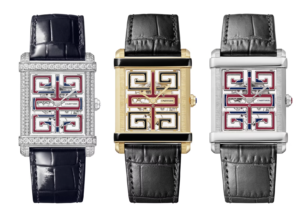
As part of the Cartier Privé collection, there are six models in this collection. Three models, in yellow gold, rose gold, and platinum. Made to a limited 150 pieces per model. There are also additional 3 models with see-through dials and skeletonized movements. The traditional Chinese window designs are eye-catching and made in a limited quantity of 100 pieces each.
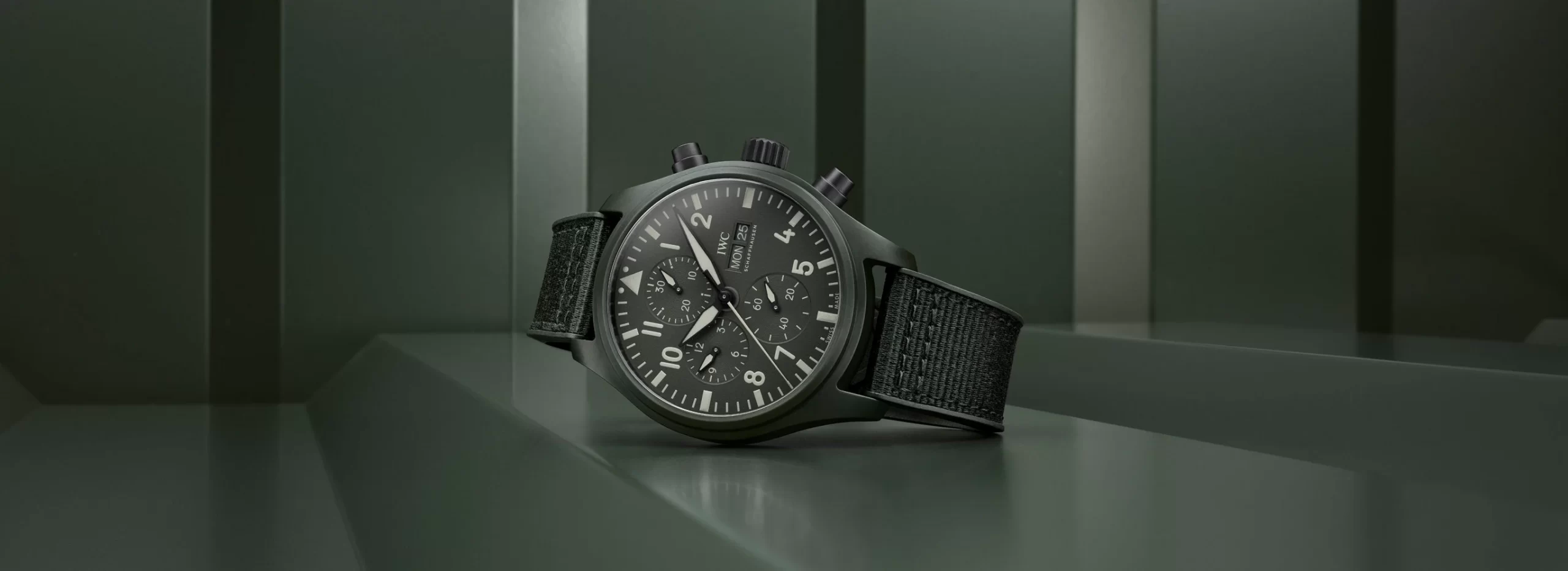
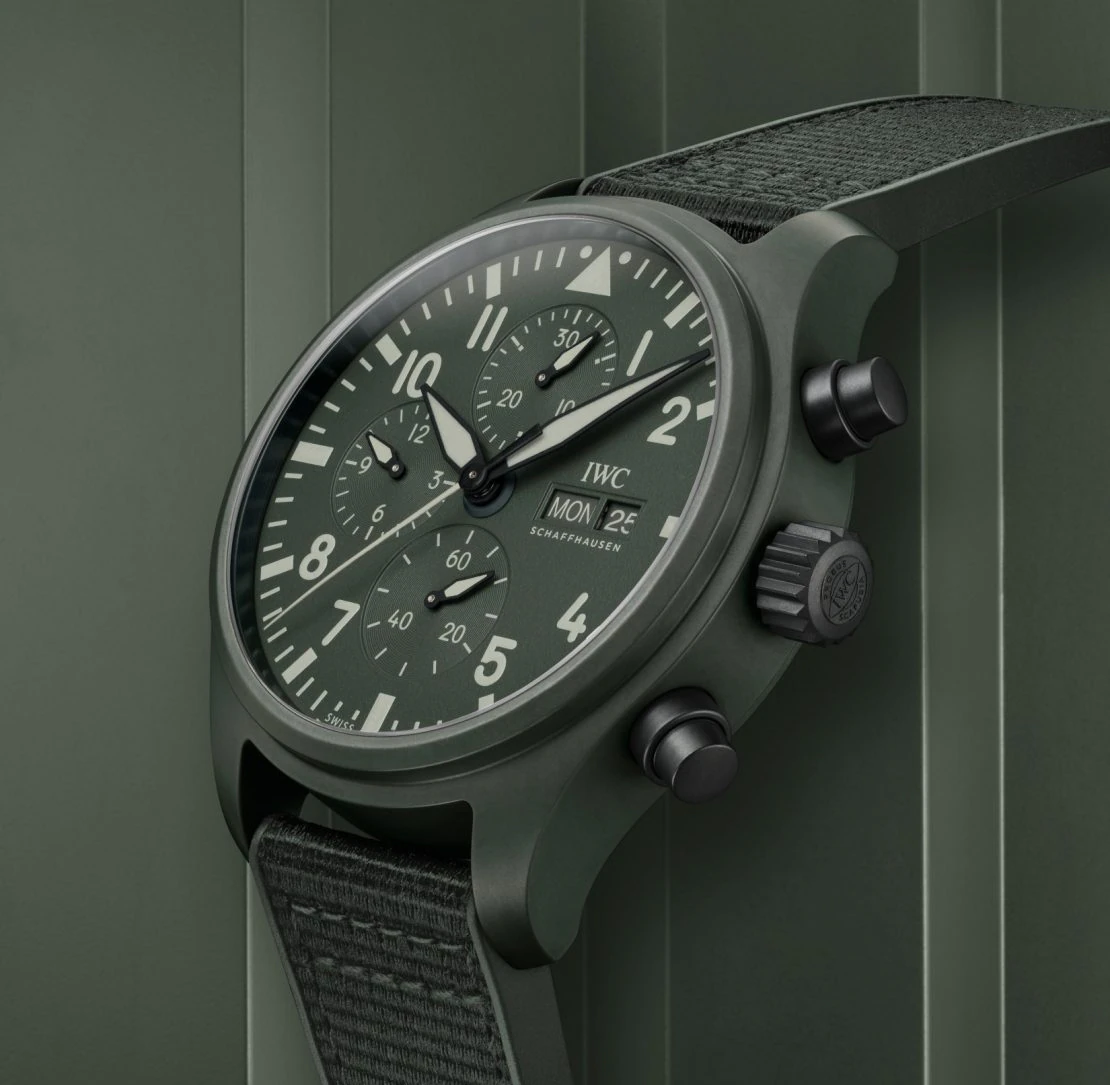
IWC Schaffhausen; Pilot’s Chronograph Top Gun Edition Woodland
IWC has new models in its Pilot’s Chronograph Top Gun Edition. We are going to talk about Woodland here. Featuring in sombre green ceramic with Ceratanium® at the case back and the pushers this watch looks as cool as the forests the pilots fly over. It is a double pusher chronograph, with the 30-minute and hour counter on the dial.
The indices look green but look nicely lit. Following the monochromatic design, the rubber strap continues to run in green with a fabric inlay. Each of the two models will be made in a quantity of 1,000 pieces.
A grade 5 Titanium, case making this an extremely light watch. The dial is in a blue gradient starting with a lighter centre and growing outwards to a darker blue. The assegai watch hands go so well with white gold indices adding to the elegance of the watch.
At the back is a see-through manual winding movement hand-finished and refined.
Tag Heuer forays into its first solar-powered watch with a TH50-00 caliber.
The dial is transparent and allows the sunlight to enter the movement to power it up. Just two minutes in full sunlight can power it up for a day. It also lightens up the Super-Luminova that features on the carbon bezel as well as indices. If the timepiece stops working exposure of 10 seconds to sunlight can restart the watch.
A sporty watch that professional divers can take down to the depth of 200 meters. Comes with a power-saving mode.
And when it’s a renowned watch brand like Bvlgari everyone sits up and takes notice.
Bvlgari has consistently been breaking records since 2014 and this year to mark its 10th Anniversary of Octo Finissimo Collection the brand dropped a watch that has created quite a stir not only in the world of watchmaking but NFTs as well.
The feat to master the thinnest ever mechanical watch was no easy task and a very patient and diligent dedication finally bore results that are not only aesthetically astounding but technically tenacious too.
The watch itself was a challenge but the integrated bracelet and the newly designed folding clasp had to match the thinness of the case. It took designer Concepto three years to accomplish something of this magnitude.
The Octo Finissimo Ultra measures 1.8mm with a 40mm diameter case in sandblasted tungsten carbide. The case back of the watch also serves as its main plate and carries the movement of the watch. The PVD-coated black hands stand out as a contrast against the grey background.
The first thing that you notice though is that the ratchet is engraved with a QR code unique to each of the 10 limited timepieces that are going to be made. The code is linked to an exclusive NFT and artwork that the watch owner will receive along with the watch opening endless possibilities to such digital partnerships in future and bridging the gap between real and virtual worlds.
The other thing you wonder is how to wind this thinner than a €0.10 coin masterpiece and then you notice the two rotating knobs for winding and adjusting the time.
While there is going to be a huge scramble to own the limited 10 watches made there will only of course be those lucky few who will proudly flaunt this wonder of a watch.
The rest of us will be left flat out and wanting more.