H. Moser & Cie. Introduces the Streamliner Tourbillon Concept Ceramic
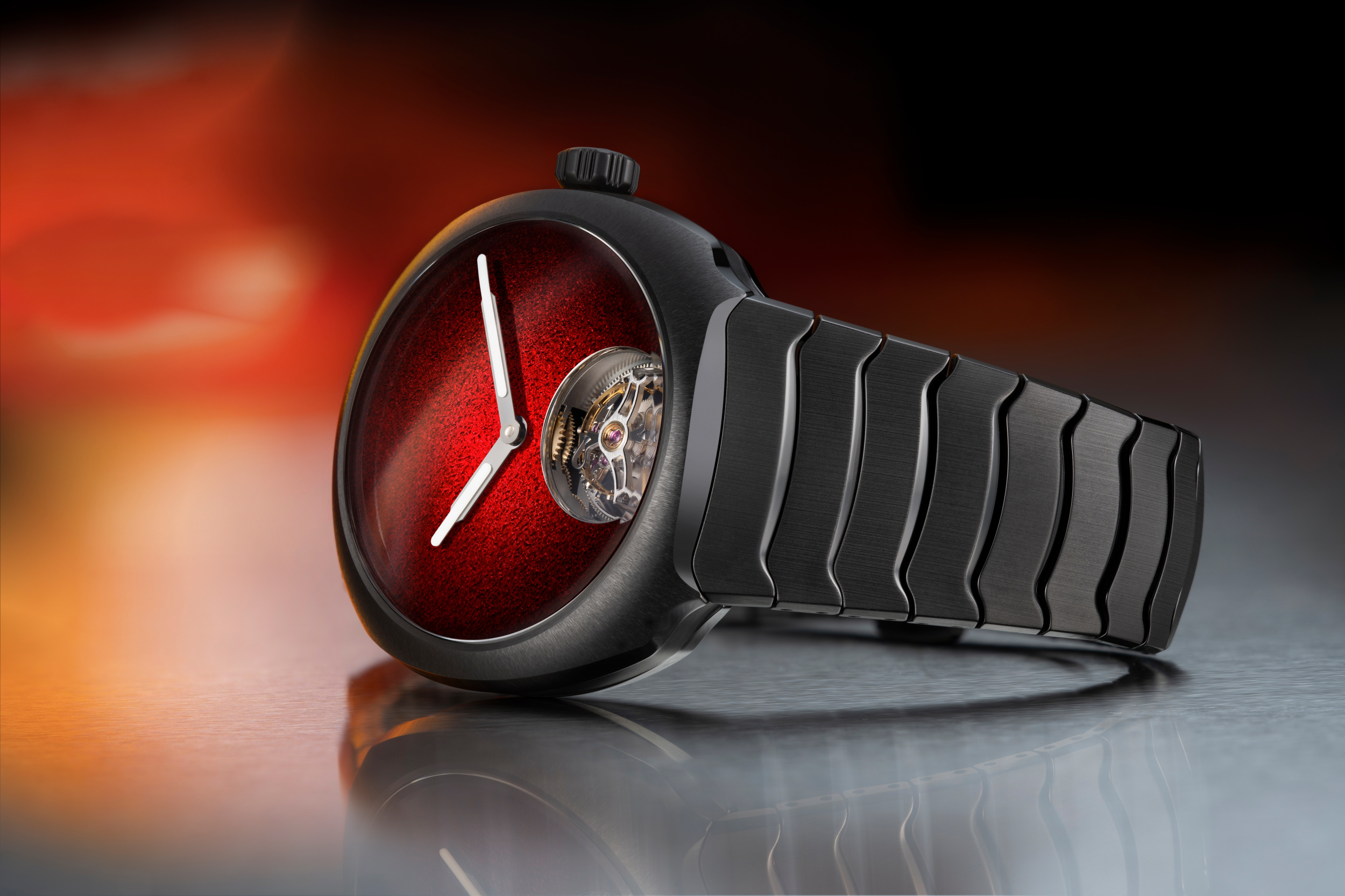
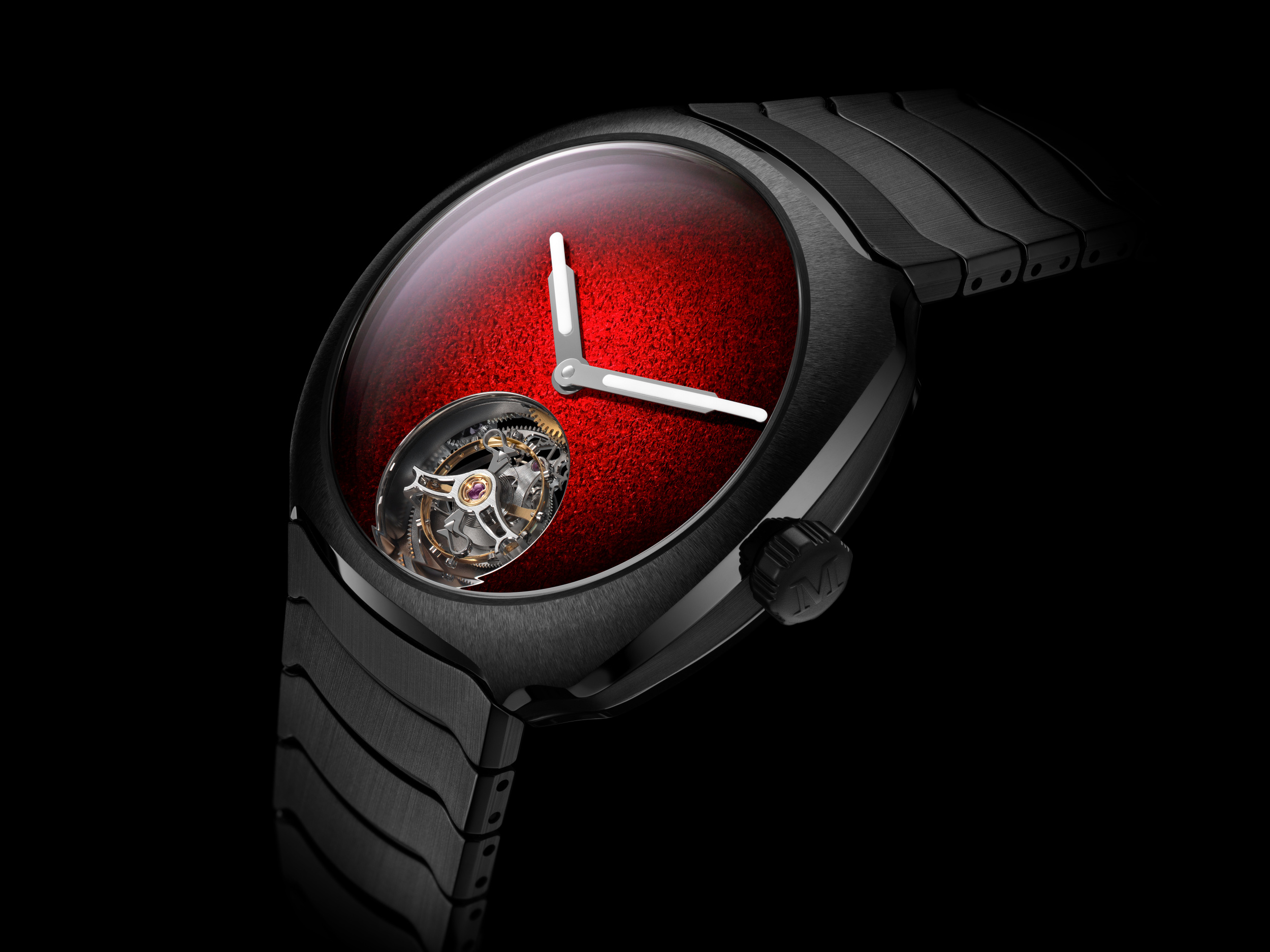
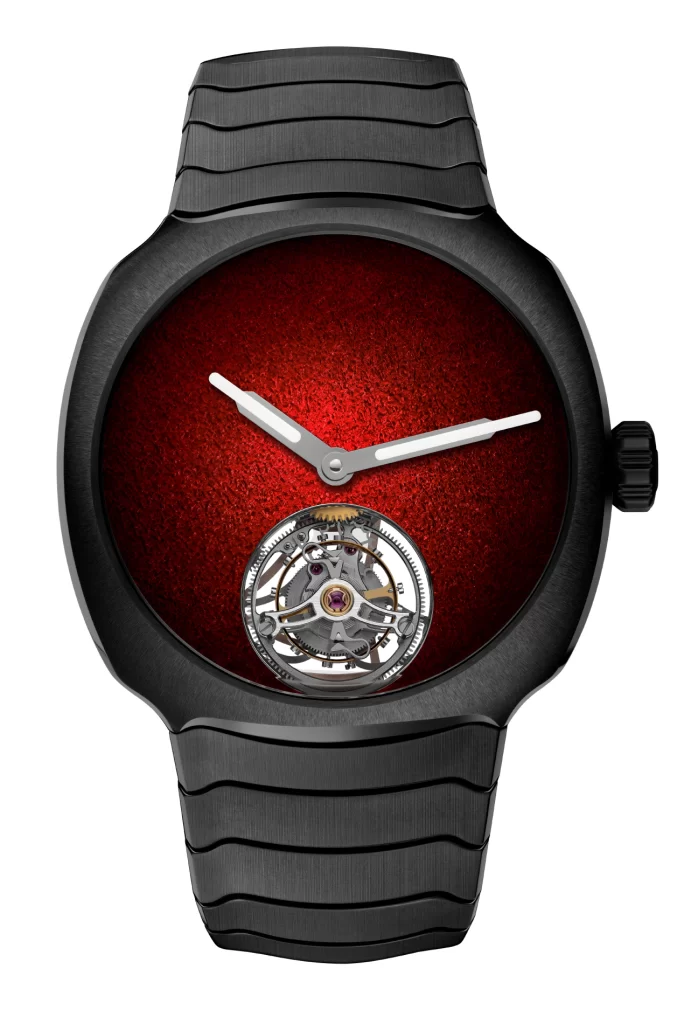
For the first time in its history, H. Moser & Cie. is venturing into the world of ceramics, opting for this technically demanding material to enhance the flowing lines of its most iconic collection: Streamliner. The cushion case and integrated bracelet are crafted from anthracite grey ceramic with alternating polished and satin-finished surfaces. With neither indices nor logo, the Red fumé Grand Feu enamel dial illuminates this crisp architecture, while the flying tourbillon with double hairspring injects dynamism. With the Streamliner Tourbillon Concept Ceramic model, the Schaffhausen-based Manufacture underscores its commitment to watchmaking that is forward-looking, precise, masterful and resolutely timeless.
Ceramic: a decisive, self-evident choice. The Streamliner collection marks H. Moser & Cie.’s entry into this new territory. With its cushion case and integrated bracelet made entirely from anthracite grey ceramic, the Streamliner Tourbillon Concept Ceramics boldly asserts its personality and character. The material naturally embraces the organic lines of the collection, cultivating the aesthetic without constraining it. The surfaces play with the effects of light in a masterful choreography. Vertical satin finishing on the bracelet, subtle polishing on the edges, circular satin finishing on the case: the characteristic finishes of the Streamliner find in ceramics a demanding medium for expression. They are hand-applied to reveal the depth of the material, its density and colour. An intense, absorbing dark anthracite grey.
Unalterable, lightweight and hypoallergenic, ceramic offers unexpected comfort and a durability suited to everyday use. Pleasant to the touch and almost warm for a mineral material, its most distinctive feature is its absolute stability. Unaffected by time, it is synonymous with mastery and precision. A material defined by its future-oriented expression.
At the heart of this restrained anthracite grey lies a striking contrast: a Red fumé dial of a rare chromatic depth. True to its unique approach, H. Moser & Cie. has reinvented the ancient art of Grand Feu enamelling, bringing it firmly into the modern era. A textured pattern is engraved on a white gold base to create a hammered effect. Two enamel pigments, washed, ground and applied in a gradient, create a vibrant colour generated by successive firings. Never pixellated, always alive. The result is an intense, luminous, almost incandescent Red fumé dial, devoid of indices and logos in line with the brand’s minimalist philosophy.
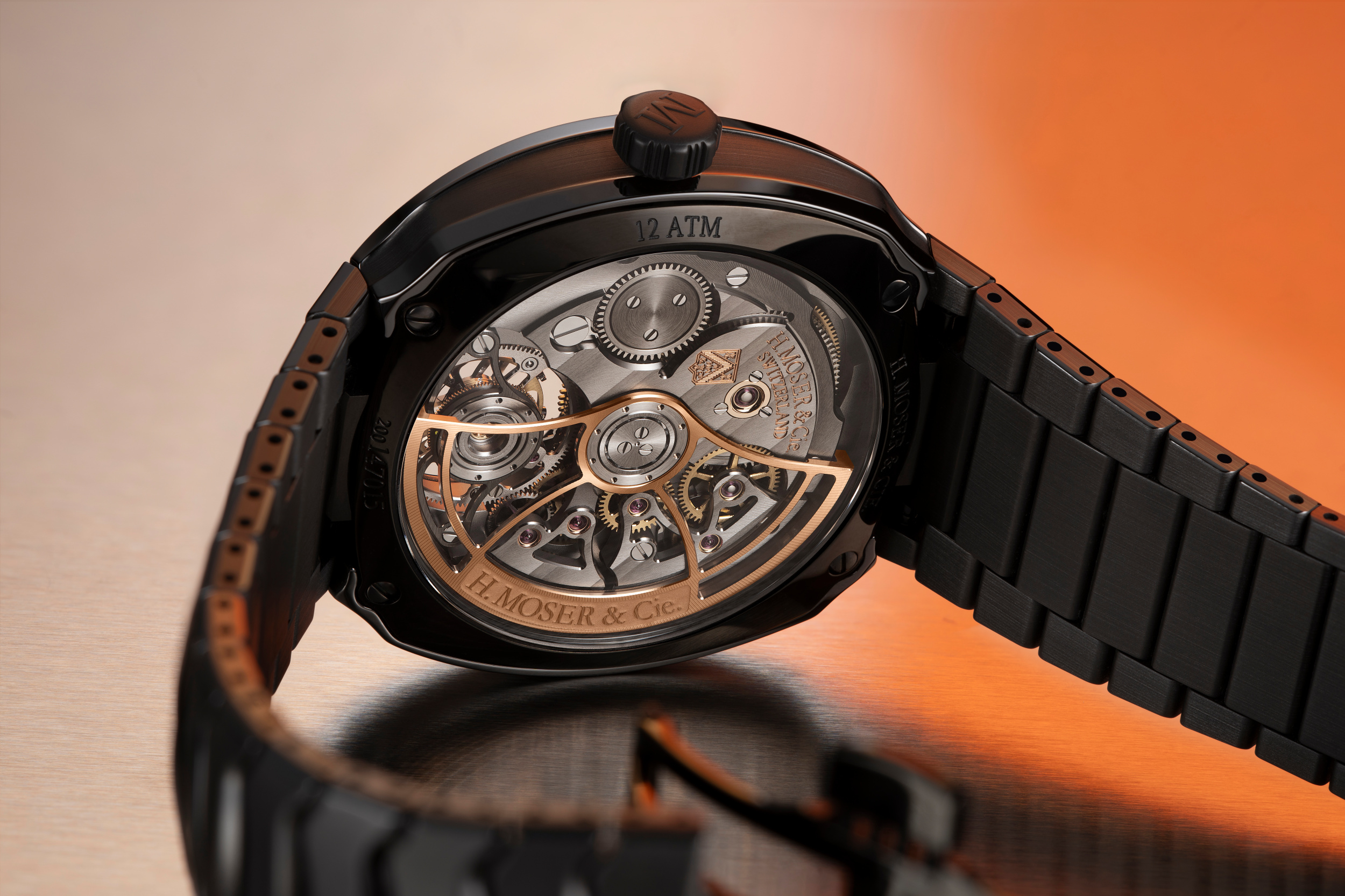
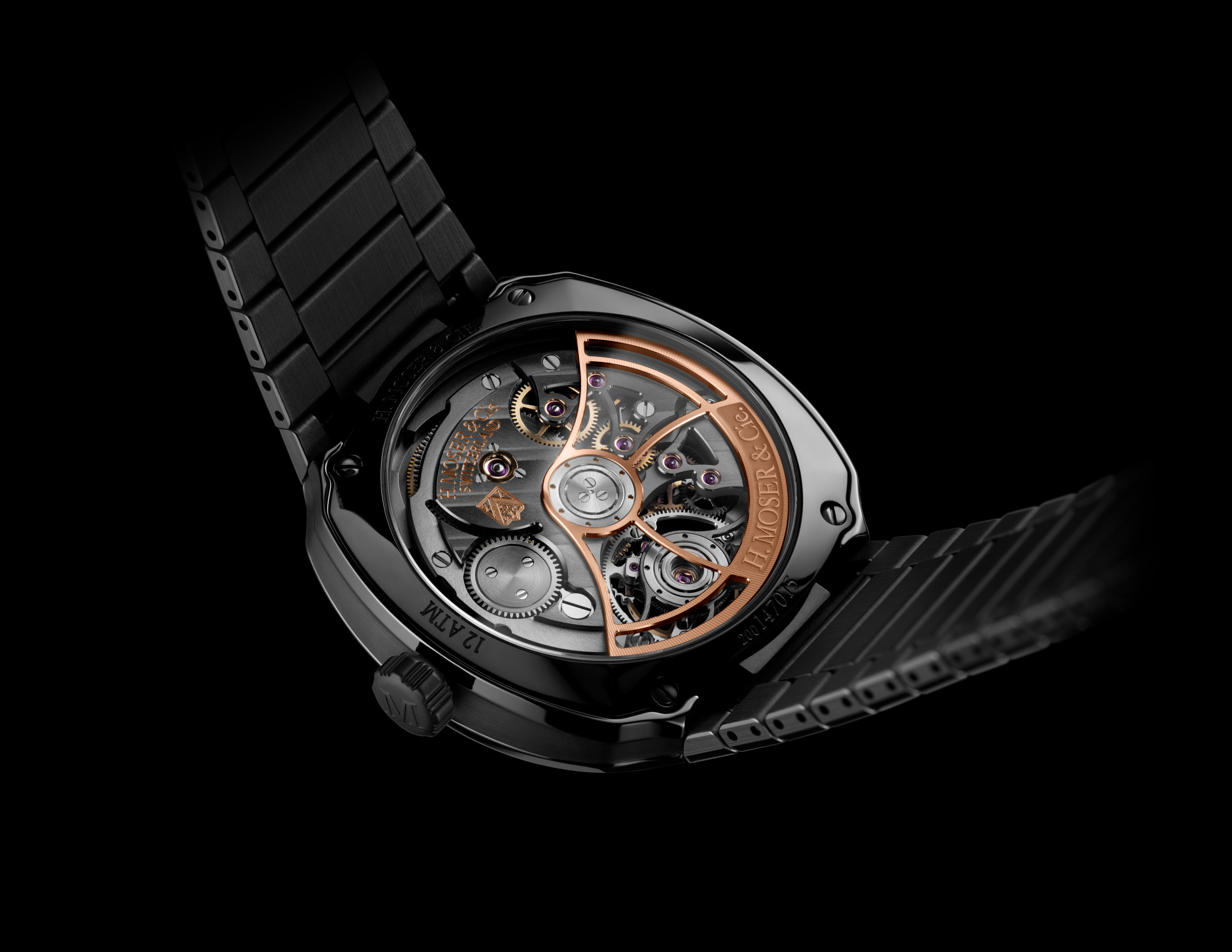
At 6 o’clock, a one-minute flying tourbillon energises the overall composition. The HMC 805 automatic calibre that drives the watch is equipped with a double hairspring designed and produced in-house by H. Moser & Cie.’s sister company, Precision Engineering AG. This pair of matching hairsprings improves accuracy and isochronism, compensating for the effects of shifts in the centre of gravity when the springs expand. The bridges and main plate, finished in anthracite grey, offer a subtle contrast to the red gold oscillating weight, emphasising the contemporary elegance of the movement.
With the Streamliner Tourbillon Concept Ceramic model, H. Moser & Cie. is embarking on a new chapter and expanding its creative horizons by incorporating a material as exacting as it is radical into its creative language.
H. Moser & Cie.’s own and unique take on Haute Horlogerie.
Reference 6805-2100, anthracite grey ceramic model, Red fumé dial, integrated bracelet in anthracite grey ceramic
Case
Anthracite grey ceramic
Diameter: 40.0 mm
Height without sapphire crystal: 11.0 mm
Height with sapphire crystal: 12.8 mm
Screw-in crown adorned with an engraved “M”
See-through sapphire crystal case-back
Water-resistant to 12 ATM
Dial
Red fumé Grand Feu enamel with hammered texture
Hour and minute hands with Globolight® inserts
Movement
HMC 805 automatic calibre
Diameter: 32.0 mm or 14 1/4 lignes
Height: 5.5 mm
Frequency: 21,600 vibrations/hour
Automatic bi-directional pawl winding system
Skeletonised oscillating weight in 18-carat red gold with engraved H. Moser & Cie. logo
Power reserve: minimum 3 days
Original double hairspring
One-minute flying tourbillon at 6 o’clock with skeletonised bridge
Anthracite finish with Moser double stripes
Partially skeletonised bridges
Functions
Hours and minutes
Bracelet
Integrated bracelet in anthracite grey ceramic
Folding clasp with three blades, engraved with the Moser logo
WHERE MYSTERY MEETS MASTERY: A HIGH HOROLOGY COMPLICATION THAT DEFIES PERCEPTION AND REDEFINES ENGINEERING.
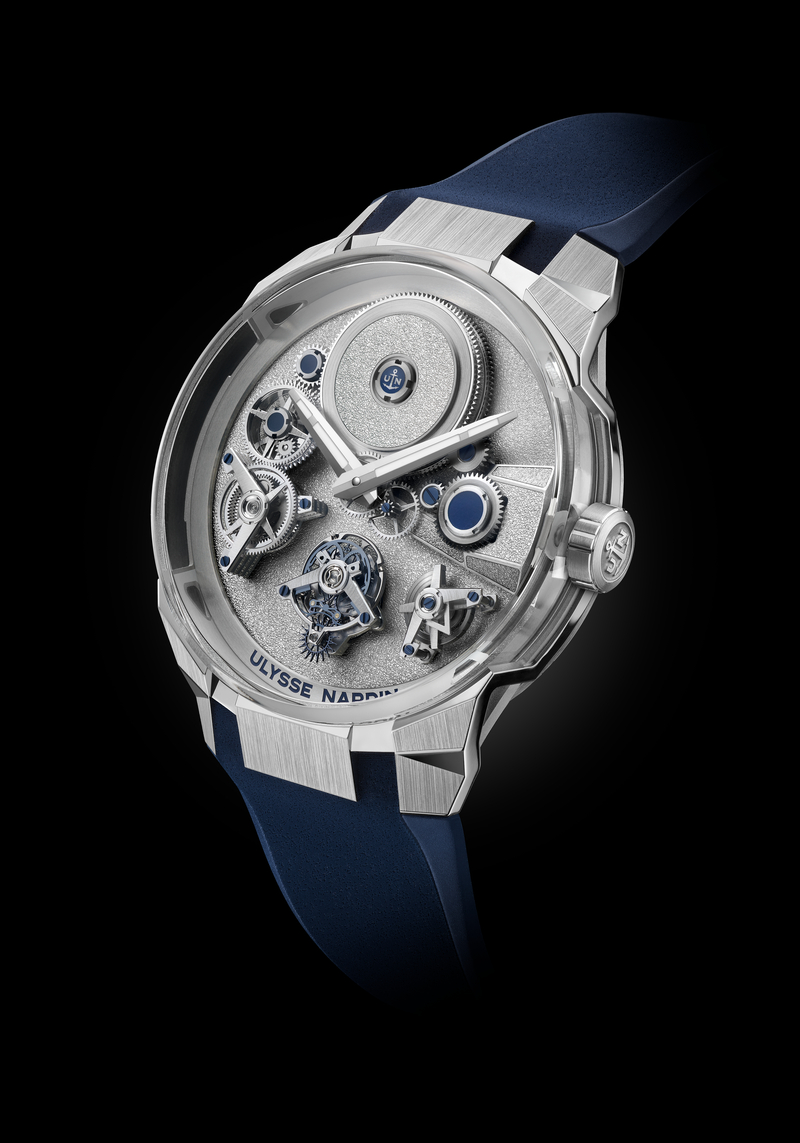
The independent Swiss watchmaking Maison Ulysse Nardin unveils the BLAST [FREE WHEEL MAILLECHORT], an exclusive timepiece limited to just 50 pieces. This unconventional horological creation pushes the boundaries of traditional watchmaking, offering a bold fusion of mysterious design and groundbreaking mechanism.
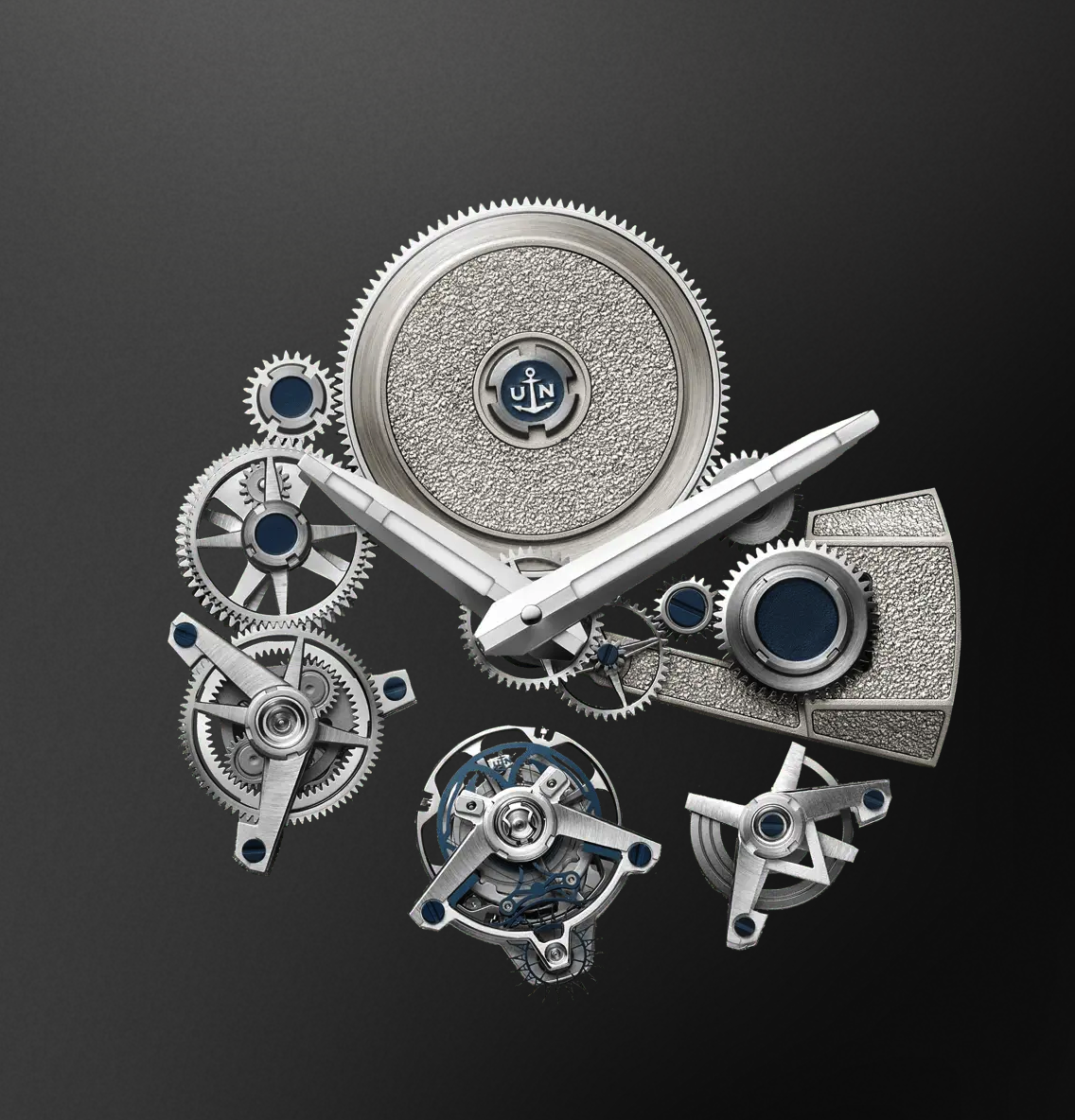
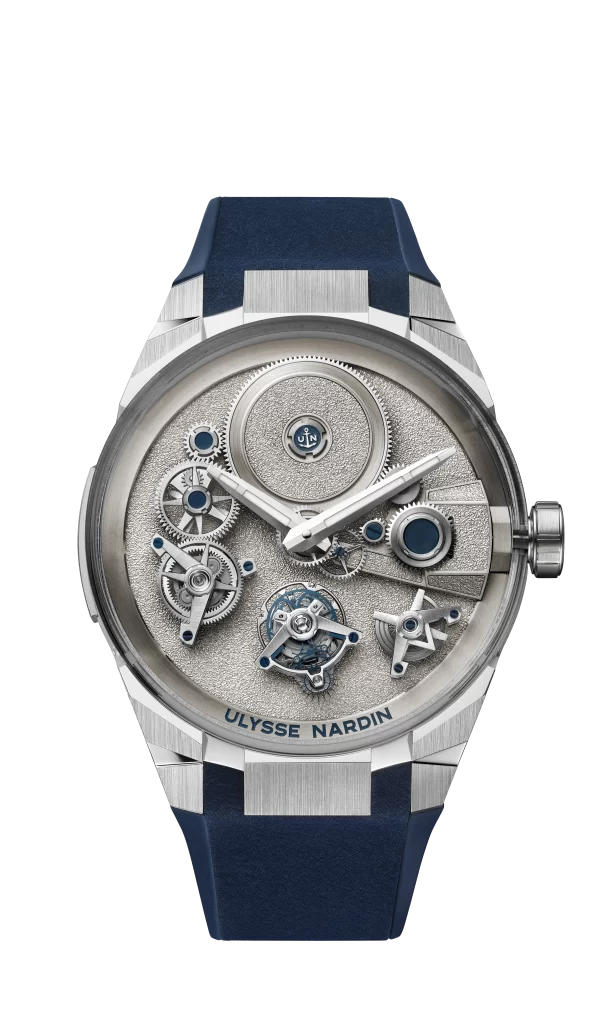
At the heart of this horological masterpiece lies a series of unprecedented flying mechanisms. From the floating double-barrel system to the award-winning Ulysse Anchor Constant Escapement, the BLAST [FREE WHEEL MAILLECHORT] challenges the conventional and elevates precision engineering to new heights. Beneath the ultra-glass box, a dial crafted from Maillechort adds depth, evolving over time into a unique expression of character and craftsmanship.
TECHNOLOGY: FREE-FLOATING MECHANISM
At the heart of this edgy Haute Horlogerie complication, the unique and innovative UN-176 calibre seems to defy not only the laws of physics, but also the very principles of watchmaking construction. Perfecting this flying movement, entirely designed by the integrated Manufacture, required two years of research and development to Ulysse Nardin’s technical department.
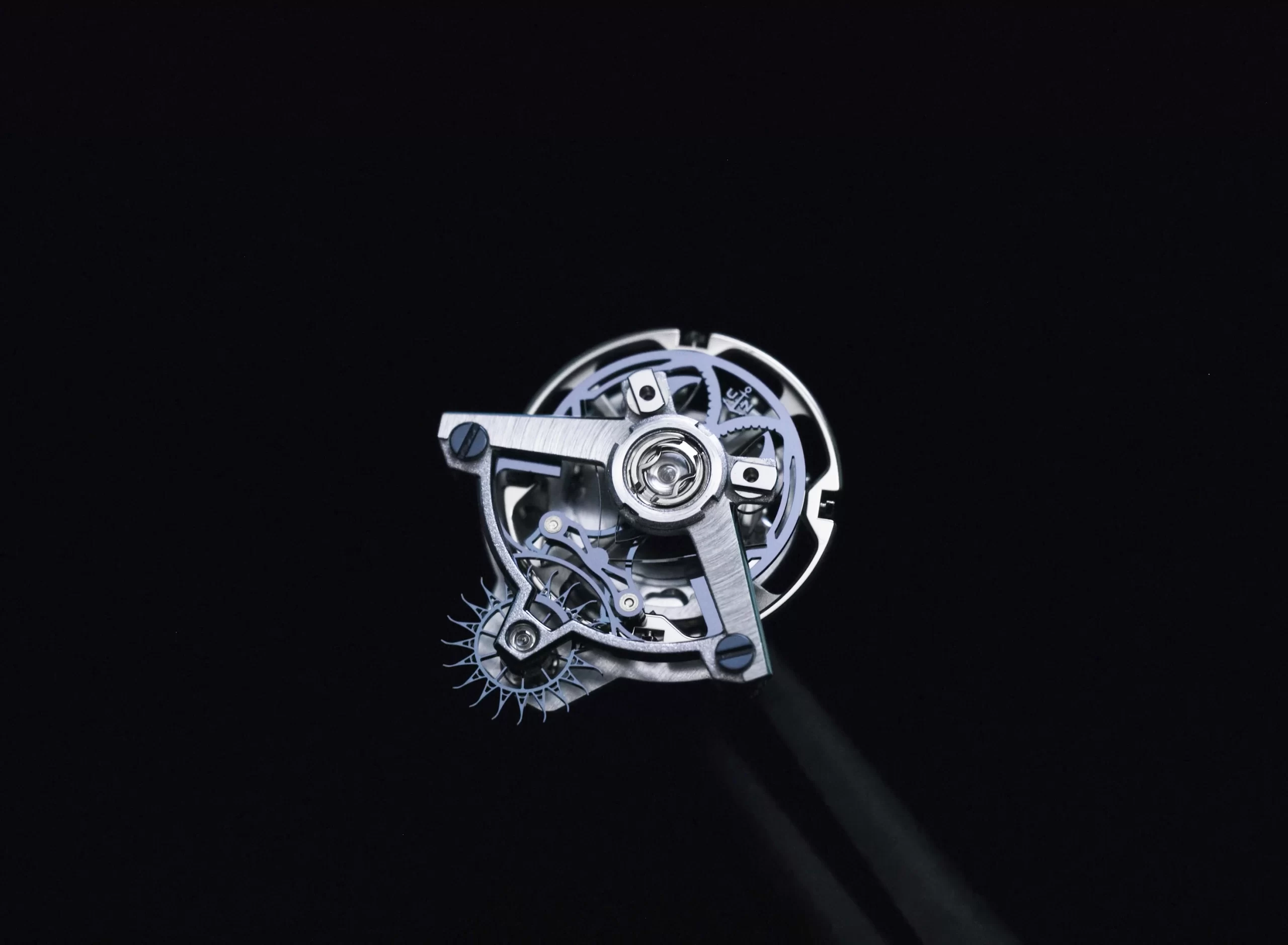
The BLAST [FREE WHEEL MAILLECHORT] presents Ulysse Nardin’s award-winning flying tourbillon with the Ulysse Anchor
Constant Escapement. Composed of 45 components, the tourbillon is located at 6 o’clock and boasts a revolutionary constant escapement. Challenging the principle of the traditional anchor escapement, the Ulysse Anchor Constant
Escapement features a circular frame with a pallet fork fixed in the center, supported in space on two blade springs less than a quarter of the thickness of a hair in diameter. Mounted perpendicular to each other, these are subjected to a bending force that curves them and maintains them. This major technical achievement directed by Ulysse Nardin guarantees a perfectly even impulse on the balance wheel, irrespective of the watch’s power reserve. Thanks to silicon technology also incorporated in the hairspring and the escapement, the jewels of the usual escapement-wheel become superfluous, as does the anchor pivot. This exceptional tourbillon, which reflects Ulysse Nardin’s triumphs in terms of innovation, proudly won the Tourbillon Prize at the Grand Prix d’Horlogerie de Genève in 2015.
At 12 o’clock, a floating double-barrel system is positioned, flying without any visible attachment on the surface. One barrel is fully exposed, while the other operates unseen. Precision ball bearings hold everything in perfect alignment. The energy it accumulates provides the timepiece with an exceptional autonomy of seven days, outlined by a highly original power reserve display at 4 o’clock. The indicator remains static, unlike the display disc: three bands opposing the indicator mean that the watch is fully wound, while a single band indicates that the power reserve is almost empty.
In addition, several additional flying mechanisms are displayed on either side of the barrel: on its left, an intermediate wheel, a power reserve differential, and a reduction gear; on its right, the winding mechanism that connects it to the crown’s winding stem, allowing the selection of the winding system train or the time setting.
DESIGN: A 360° VIEW INTO MECHANICAL MASTERY
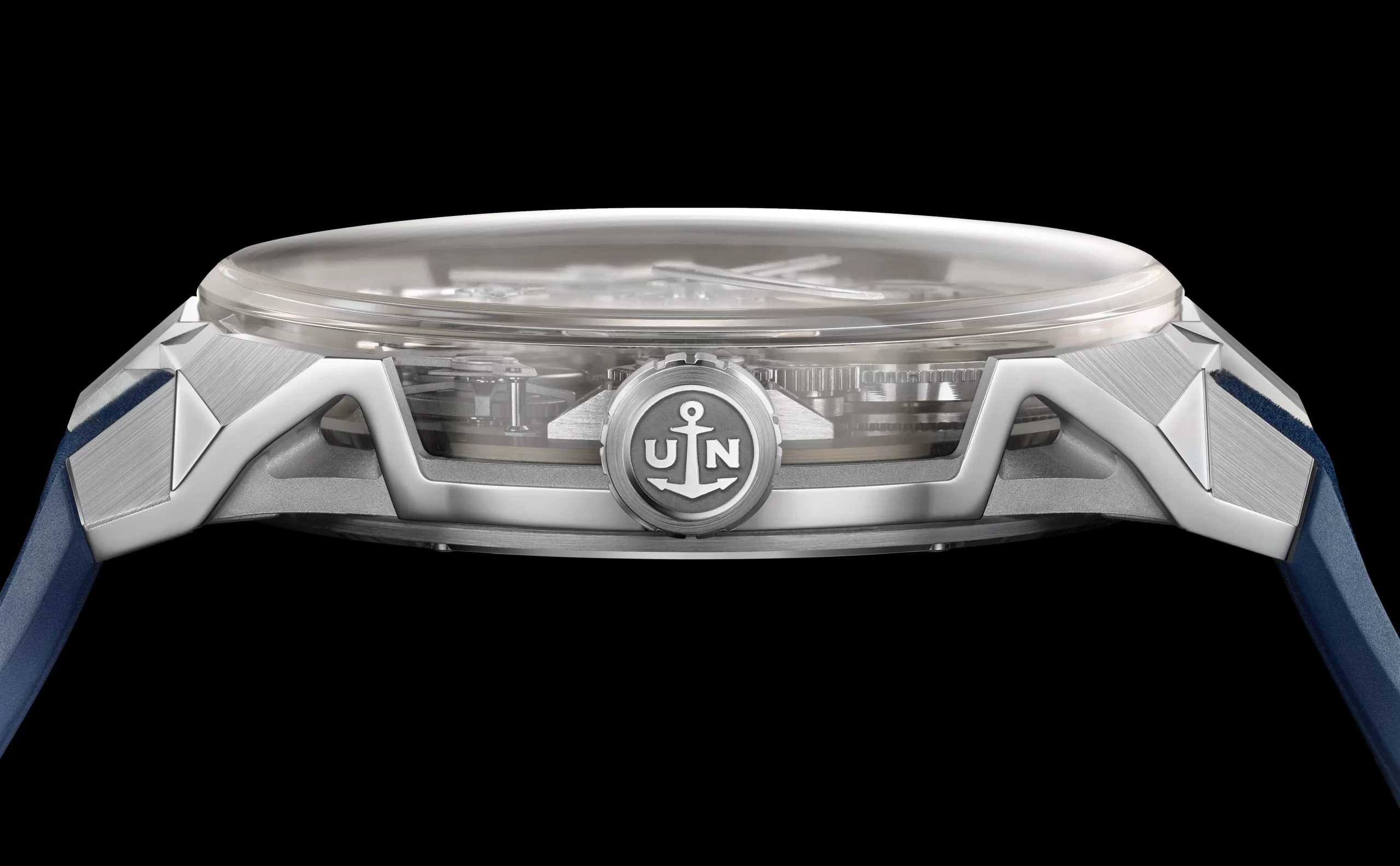
The BLAST [FREE WHEEL MAILLECHORT] is a spectacular show. Its bold 45mm case, crafted in white gold, features negative angle facets designed using a complex laser method. Renowned for its disruptive aesthetic and ergonomic properties, this satin-finished and polished BLAST case once again proves the cutting-edge know-how of the independent Manufacture.
The geometric lines feature a unique ultra-glass box in sapphire crystal that offers a wide-open view of the mysterious movement, which is also visible through the sides. The distinctive characteristic of this glass box lies in its construction: it was carved from a single block of sapphire crystal, meticulously hollowed out to form the box and achieve this unparalleled shape.
Beneath the dome glass and the flying mechanism lies a dial crafted from Maillechort, a traditional alloy of copper, zinc, and nickel. Known for its warm, silvery tones and distinctive grained texture, it is prized for its durability and unique aesthetic.
More difficult to manufacture than brass due to its hardness and complex composition, it requires craftsmanship and precision. Historically used in musical instruments for its resonant acoustic properties, Maillechort is a “living metal” that develops a one-of-a-kind patina over time, adding character and depth. This material was invented in the early 19th century by French engineers Maillet and Chorier, whose combined names became “Maillechort”.
Underscoring the meticulous attention to detail in its design, the case back of the BLAST [FREE WHEEL MAILLECHORT] is open, featuring a sapphire glass and a Maillechort plate. This exclusive limited edition of 50 pieces features a blue velvet effect and waterproof rubber strap, with a white gold folding buckle.
TECHNICAL SPECIFICATIONS
REFERENCE: 1760-401LE-4A-MAIL/3A
MOVEMENT & FUNCTIONS: UN-176 Manufacture
Manual Tourbillon Flying Movement
Hours, Minutes
Flying tourbillon with Ulysse Anchor Escapement (Constant) / Blades technology
Power reserve indicator at 4 o’clock
Escapement-wheel, anchor & balance spring in Silicon
246 components / 23 jewels
Frequency 2.5 Hz / oscillations 18’000 VPH
POWER RESERVE: 7 days
CASE: White gold satin-finished & polished case
White gold open sapphire case-back with Maillechort plate
Diameter 45 mm, Water resistance 30 m
Perceived height 8.75 mm / Overall height 12.4 mm
DIAL: Maillechort dial
Grey hands with white Superluminova®
STRAP & BUCKLE: Waterproof blue velvet effect rubber strap
White gold deployant buckle
Compatible with BLAST Tourbillon straps
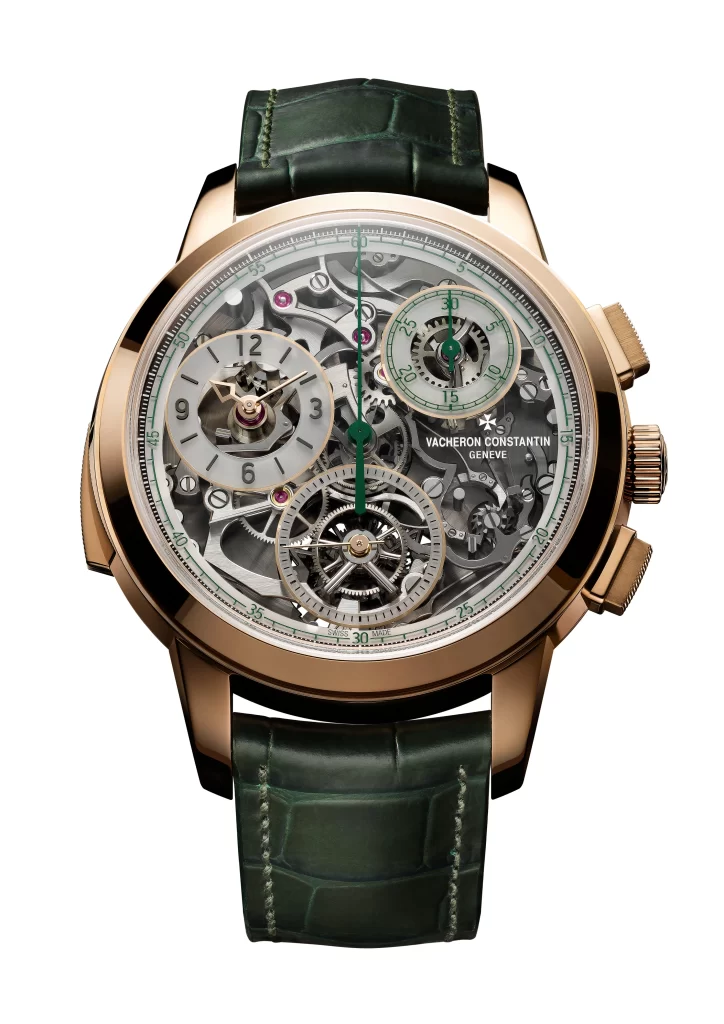
To bring together in a wristwatch a minute repeater, a split-seconds chronograph and a tourbillon regulator is a technical challenge that has rarely been met. In the Les Cabinotiers Temporis Duo Grand Complication Openface these complications benefit from Vacheron Constantin’s latest technical developments and continuous research into materials. Particular attention has also been paid to the decoration and hand-finishing of Calibre 2757 S, which comprises almost 700 components. This work is revealed through the complex sapphire dial as well as the sapphire back of the 45mm 5N pink gold (750/1000) case. This highly technical timepiece turns mechanical watchmaking into a kinetic art form that measures time.
• A single-piece edition timepiece combining mechanical excellence and aesthetics in the great tradition of the watchmaking complications that have marked the history of the Maison.
• A new open-faced sapphire dial reveals the beauty and complexity of the movement.
• A technical feat of rare complexity, Calibre 2757 S incorporates a single push-piece split-seconds chronograph, a minute repeater and a tourbillon regulator with a spherical hairspring.
• Aesthetically faithful to the Maison’s exacting standards, with fine hand-finishing on all components of the calibre, which is visible beneath an open-faced sapphire dial.
The evolution of age-old know-how
The complications of this new Les Cabinotiers timepiece epitomise the transmission of watchmaking expertise through the generations – a core value of Vacheron Constantin. In 1819, the Maison produced a pocket watch with independent deadbeat seconds and a quarter repeater, one of the first of its kind. The watch incorporated a deadbeat seconds mechanism – a device that had been developed by various watchmakers in the late 18th century as a means of more accurately measuring very small units of time. Designed as an independent mechanism with its own gear train, it enabled the seconds hand to be stopped and restarted independently of the normal timekeeping function and is thus considered to be the forerunner of the chronograph.
The split-seconds chronograph mechanism has two coaxial hands, the second of which can be stopped to calculate an intermediate time before being restarted to catch up with the first. After the system was introduced – first with a single-hand system in 1831, then with the two-hand configuration in 1838 – Vacheron Constantin quickly incorporated these developments into its pocket chronographs.
The Maison’s chiming watches draw on an equally deep history. Minute repeaters – watches that strike the hours, quarters and minutes on demand – have been part of Vacheron Constantin’s watchmaking vocabulary for more than two centuries. The first mention of a Vacheron Constantin striking timepiece in the production records is a gold quarter-repeating pocket watch recorded in 1806.
Since then, the Maison has continued to build its expertise in striking and repeating watches. Created in 1827, the first Vacheron Constantin watch with grande and petite sonneries, is an impressive example of this savoir-faire, as are Reference 4261 dating from the early 1940s, which incorporates a minute repeater in a calibre just 3.28 mm thick, and Reference 57260 which counts a grande et petite sonnerie (the former with Westminster chimes), a minute repeater, and an alarm among its 57 complications.
A similar historic evolution applies to the tourbillon. This mechanism, which significantly enhances isochronism by mitigating the effects of gravity, is first mentioned in the Maison’s archives with an order placed in 1901 by a Parisian client for a highly complicated timepiece that was to incorporate such a regulator. Over the decades, Vacheron Constantin’s watchmakers have continued to develop the tourbillon, notably by developing technical solutions with multiple axes. The Les Cabinotiers Tourbillon Armillaire bi-axial wristwatch with a spherical hairspring and the Les Cabinotiers – The Berkley Grand Complication, featuring a triple-axis tourbillon, are outstanding examples of this expertise.
While the combination of a chronograph and a minute repeater in a movement with a tourbillon regulator has been seen in some remarkable pocket watches, it has remained rare in wristwatches. Vacheron Constantin saw this as an opportunity to create such a piece, in the tradition of the grand complication watches that have made its reputation for 270 years.
Three of Haute Horlogerie’s most emblematic complications, the chronograph, minute repeater and tourbillon are among the most difficult to create, let alone combine. Meeting the challenge, in 2022 the Maison unveiled Calibre 2757 in a single-piece edition Les Cabinotiers watch offering this rare and original combination in a single mechanism.
For the Les Cabinotiers Temporis Duo Grand Complication Openface, the watchmakers of Les Cabinotiers developed a new version of the calibre, with a spherical hairspring to further improve isochronism, and set it in a one-of-a-kind watch that reveals the beauty and complexity of the movement through an open-worked dial.
Horological mastery
The highly technical Calibre 2757 S incorporates 696 components, with the design of the movement, particularly in terms of its chronograph functions, subject to the imperative of performance. Despite its complexity, the watchmakers at Vacheron Constantin have created a movement of great finesse, barely 10.4 mm high and 33.3 mm in diameter, remaining faithful to the principles of elegance that are a signature of the Maison.
When developing the original Calibre 2757, the additional split-seconds chronograph plate was specially designed with an in-depth arrangement of its components to enhance operating efficiency. This optimisation of volumes to ensure the calibre’s thinness, was complemented by the use of new materials. Some of the wheels in the gear train have been made of titanium or electroformed in nickel-phosphorus, with a toothing profile particular to Vacheron Constantin that ensures improved penetration of the gears to prevent the second hands from shaking.
After much research, the chronograph seconds hands were made of aluminium, chosen for its rigid and ultra-light properties. Silicon, another ultra-light material that requires no lubrication, was used for one of the split-seconds levers and its insulator. These savings in component weight and friction reduce the loss of energy amplitude from the barrel. This contributes to a comfortable power reserve of 50 hours with the chronograph engaged, indicated by a display on the back of the watch.
With measurements accurate to 1/5th of a second thanks to the movement’s frequency of 18,000 vibrations per hour, elapsed time is indicated on the peripheral minute track by the two central second hands, together with a 30-minute counter positioned at 2 o’clock. Because this function demands extremely high precision, Vacheron Constantin’s watchmakers opted for a construction with two column-wheels, one devoted to the chronograph and the other to the split-seconds hand.
The chronograph is controlled by a single push-piece at 2 o’clock for the basic functions (start/stop/reset) and by a push-piece at 4 o’clock for the split-seconds (stop/reset). Pressing the latter stops the second hand at an intermediate time while the first hand continues its course. When pressed again, the split-seconds hand instantly joins the first hand in the time countdown.
A centripetal regulator and spherical hairspring
The minute repeater featured in Calibre 2757 S has also benefited from technical developments at Vacheron Constantin. These include an ingenious flying strike governor. This device has two weights shaped so as to act as a brake on the governor’s rotating shaft, thus evening-out the energy released by the repeater’s spring. To achieve this, it uses opposing centrifugal and centripetal forces. When the governor spins, the centrifugal force pivots one end of the weights outwards so that the other end acts as a brake on the central shaft to bring the rotation and the strike to a steady rate.
The governor mechanism, which operates in total silence, regulates both the cadence and duration of the musical sequence so that the notes can be heard distinctly and clearly, with a complete absence of mechanical ‘background noise’. The distinctive feature of this system is its two flyweights with a shape specially designed to generate a kind of ‘motor brake’ by a centripetal force acting on the governor’s rotating shaft. This evens out the energy released by the barrel and regulated by the tourbillon.
Located at 6 o’clock, the tourbillon is fitted with a spherical hairspring, a shape that causes the spring to expand and contract concentrically, thus enhancing isochronism. The distinctive tourbillon cage is inspired by the Maltese cross, the Maison’s emblem. Held in place by a hand-bevelled bridge. the tourbillon performs one complete rotation per minute and a hand mounted on its axis indicates the small seconds.
Technical excellence enhanced by Haute Horlogerie finishes
A transparent sapphire dial is the aesthetic signature of the new Les Cabinotiers Temporis Duo Grand Complication Openface. Just 0.5 mm thick, it is distinguished by a highly complex mix of finishes: polished and frosted surfaces alternate on the counters, which are encircled by rings in 5N gold, applied by metallisation on the underside of the sapphire discs; the hour markers are treated with grey NAC and the chronograph markers are engraved and inked. The 30-minute chronograph counter hand and the two chronograph seconds hands are made of PVD-coated aluminium – their olive green colour matched by the green alligator leather strap that attaches the 45mm pink gold case to the wrist.
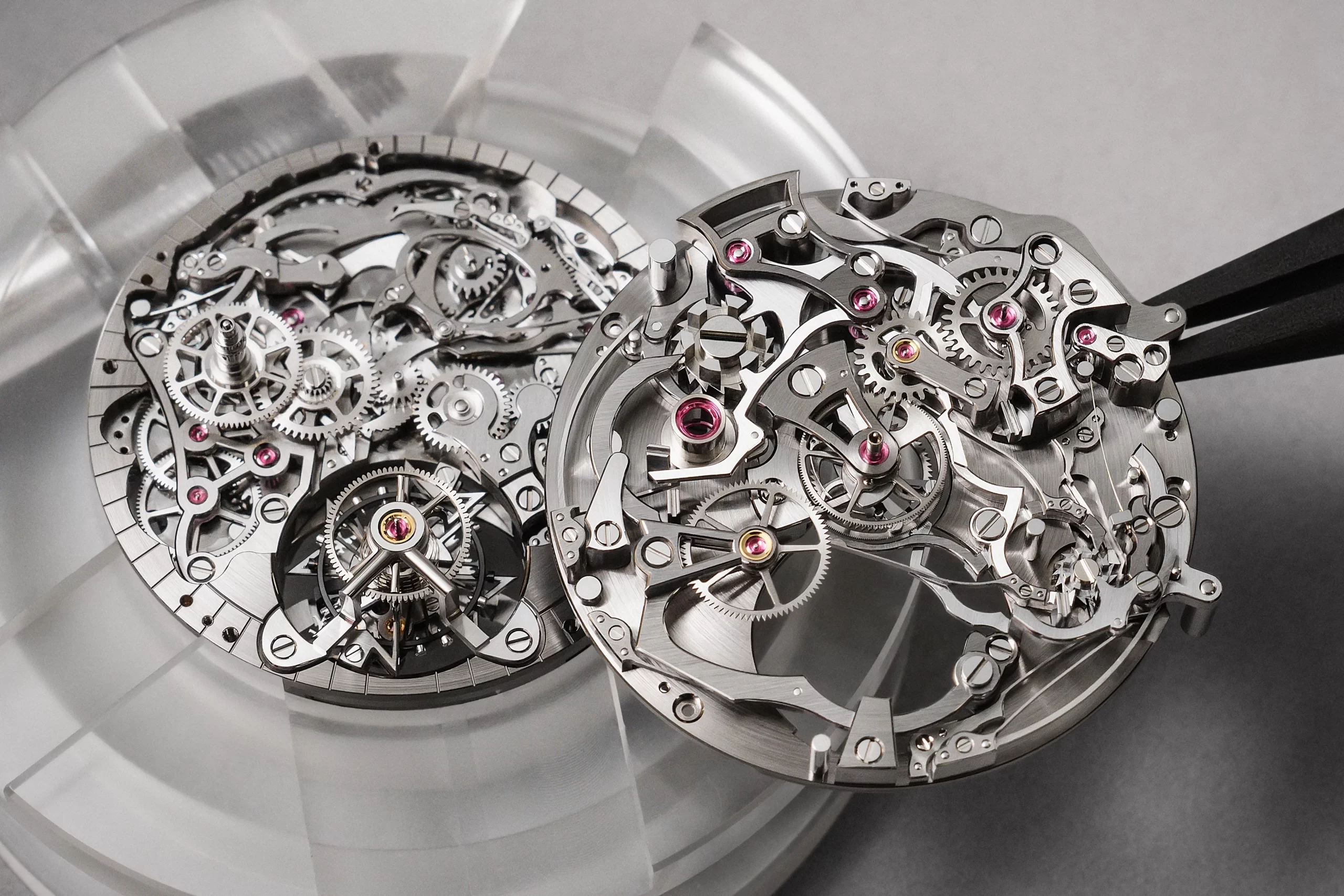
The sapphire dial and caseback reveal the quality of the hand-finishing on the movement components, highlighting the beauty of this kinetic artwork. Surfaces are, variously, bevelled, polished, satin-finished, grained, circular-grained, engraved and bead-blasted, creating a fascinating play of reflections and light.
Visible through the dial, the sides of the skeletonised bridges are hand-drawn and hand-bevelled and the surfaces are circled. The wheels, with their bevelled spokes, are rolled and polished, a delicate operation that requires special tools when wheels are made of titanium. The metallic colours of the moving parts contrasts with the black NAC coating on the bridges and main plate.
On the reverse side of the movement, the watchmaker has created a distinctive decoration. The surface of the blackened bridges was hollowed out then sandblasted by hand to a very fine grain and edged with a mirror-polished sink. The hand-chamfered sinks for the jewels and screws have also been mirror-polished. The beauty of the movement architecture is amplified by the contrast between the black bridges, their polished borders and the golden tones of the moving parts. The striking governor is engraved with the initials JMV, in homage to Jean-Marc Vacheron, and held by a semi-circular bridge that has been round-polished by hand – the polishing alone requiring eight hours of meticulous work.
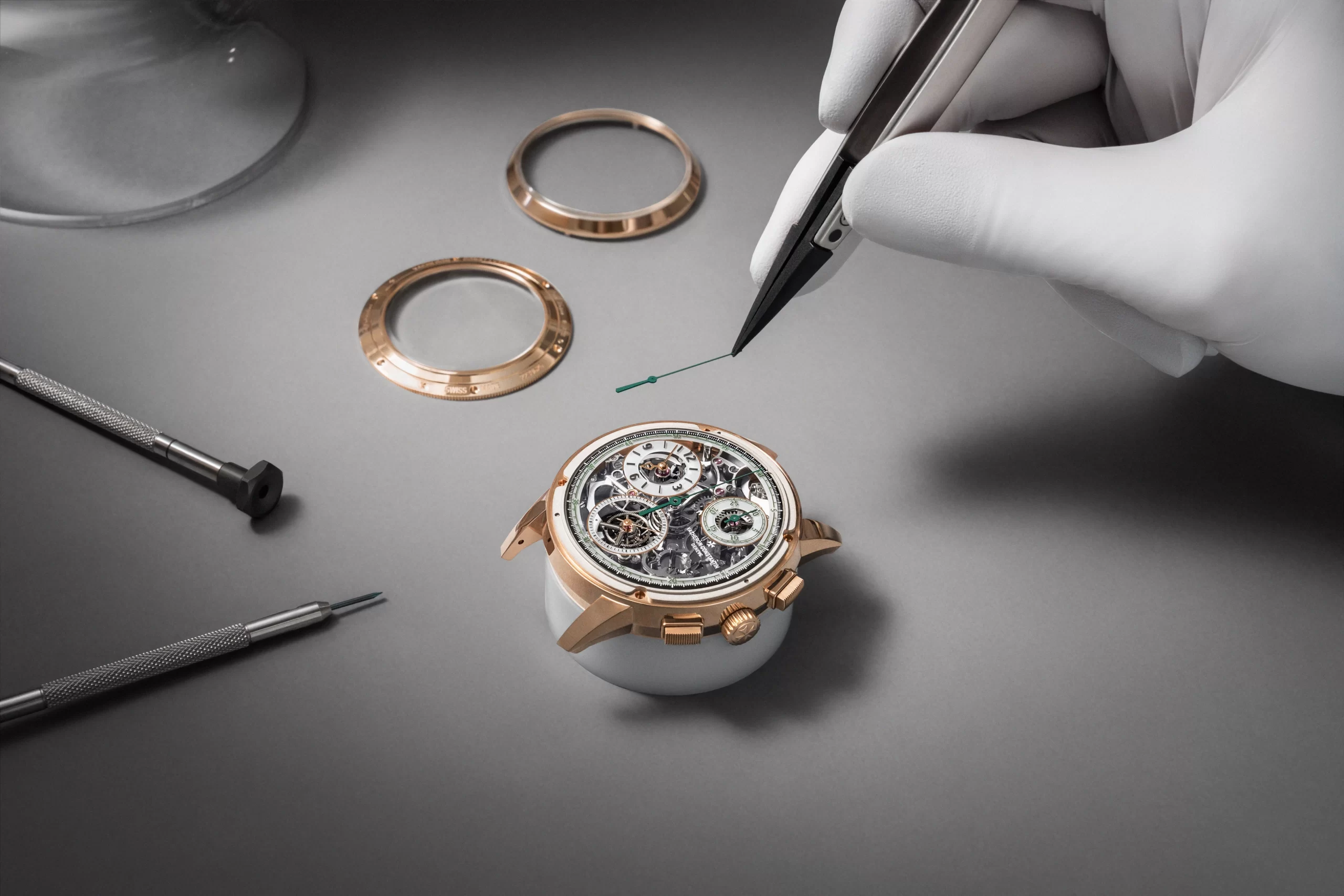
Thanks to the meticulous attention to detail dedicated to this calibre, it took twice as long for the finishing of its components as it did to assemble and fit it into the case. As was the case for the 18th-century cabinotiers, a single watchmaker was in charge of the watch, carrying out all of the component finishing, as well as every assembly operation, right down to the adjustment and casing of the calibre. This manner of working is an eloquent testimony to Vacheron Constantin’s commitment to safeguarding the transmission of watchmaking expertise through the generations.
LES CABINOTIERS TEMPORIS DUO GRAND COMPLICATION OPENFACE
Reference 9750C/000R-215C
Calibre
2757 S
Developed and manufactured by Vacheron Constantin
Mechanical, manual-winding
33.30 mm diameter, 10.40 mm thick
Approximately 58 hours of power reserve
2.5Hz (18,000 vibrations/hour)
696 components
61 jewels
NAC finishing
Hallmark of Geneva certified timepiece
Indications
Off-centre hours and minutes
Small seconds on tourbillon
Chronograph
Split-seconds chronograph
30-minute counter
Minute repeater
Tourbillon
Power reserve on the back of the watch
Case
18K 5N pink gold
45 mm diameter, 16.40 mm thick
Transparent sapphire crystal caseback
Dial
Sapphire crystal
18K 5N pink gold hours, minutes, and seconds hands
Green-coloured chronograph and split-seconds chronograph hands
Strap
Green Mississippiensis alligator leather, hand-stitched, saddle-finish, large square scales
The Square Bang adds a whole new dimension to the Tourbillon
Why are watches round? Because their most basic component– the wheel – is round. It’s as simple as that. Perhaps too simple for Hublot, though, who was certainlynot going to build the future of Haute Horlogerie on conventions from the past.
In 2022, the Nyon-based Manufacture unveiled a brand-new collection, its third, andlatest addition to the Big Bang family, made up of different shaped watches: the round Big Bang, the tonneau-shaped Spirit of Big Bang, and the Square Bang. Square. Powerful. Radical. The essence of the Big Bang encapsulated in a square case with each side measuring 42mm, now available in some twenty variations, all Manufacture chronograph pieces. Until now.
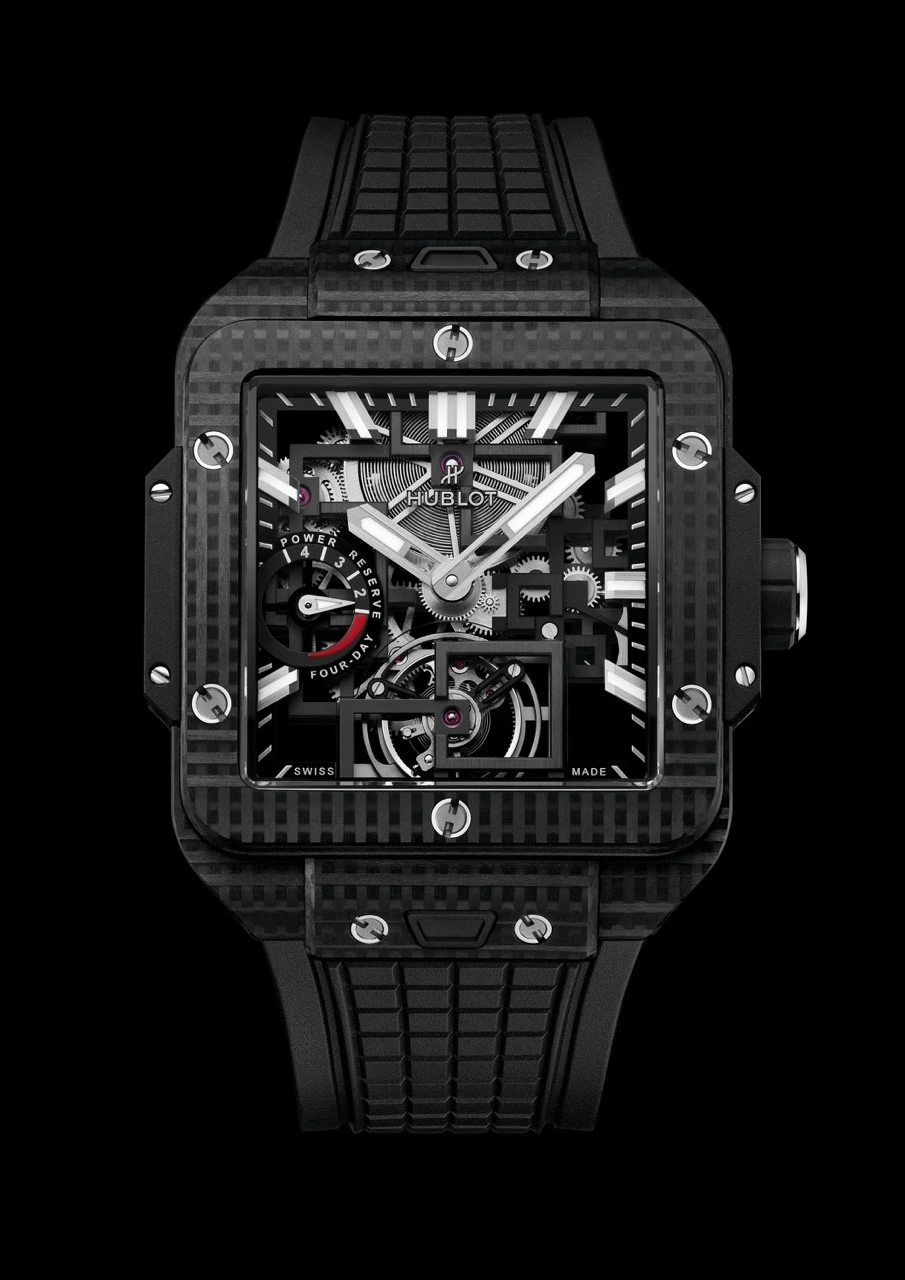
The Square Bang Tourbillon 4-Day Power Reserve is the first Square Bang with two central hands. It also features many other firsts. The first to offer a 3D carbon case. The first to be regulated by a Tourbillon.
The first to contain only square bridges.
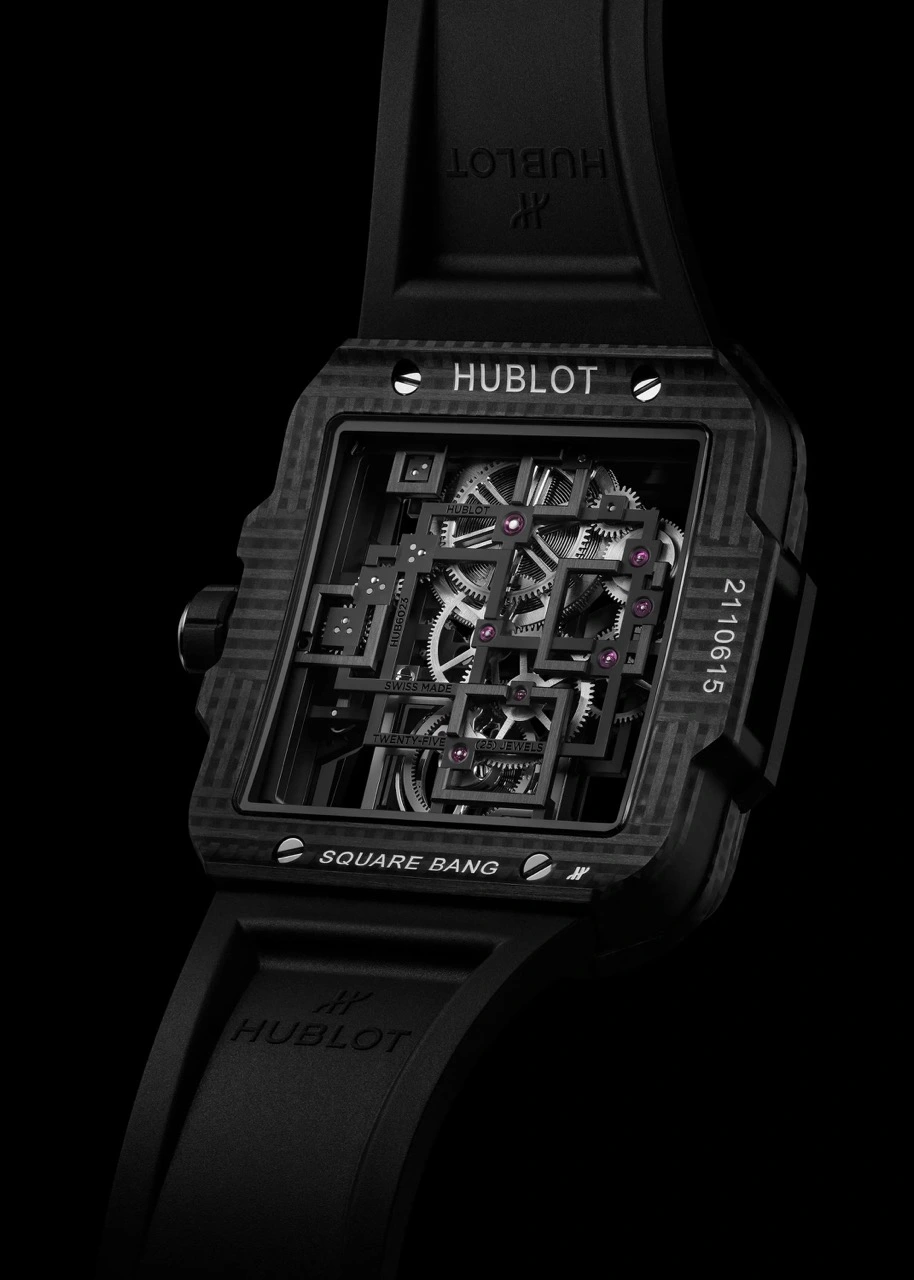
To achieve this result, Hublot made full use of the capacities of its in-house Manufacture. The MHUB6023 manual movement was especially developed for the Square Bang Tourbillon. The timepiece is the perfect fusion of form and function, technique and design. Each of the bridges are square or rectangular, bearing the 174 components essential to this calibre. Every surface also features a subtle combination of matte and satin finishes to beautifully accentuate the different depths at which the various bridges are set.
“Until now, advances in square watches have been rather timid, usually confined to the case alone. With the Square Bang Tourbillon 4-Day Power Reserve, we wanted to take the exercise to its logical conclusion, by designing a movement whose architecture is also fully right-angled. The bridges are straight, clean and sharp, as if to protect a movement that always beats to the rhythm of a perfect circle, that of the Tourbillon, barrel and power reserve. The fusion is complete,” explains Julien Tornare, CEO of Hublot.
UNCOMPROMISINGLY SQUARE
To reinforce the square geometry, the main components of the timepiece are distributed over the four sides of the square: winding on the right, power reserve on the left, large barrel on top and tourbillon below. The balance is perfect, and nothing escapes the discerning eye since the entire movement is
skeletonised. Powerful yet ethereal, the openwork composition leaves its angles and straight lines suspended in mid-air. The complex architecture is ingenious, with technical and aesthetic meetings in perfect fusion to create a mechanism whose lightness is equalled only by its uniqueness, as the first
watch composition of its kind developed by Hublot.
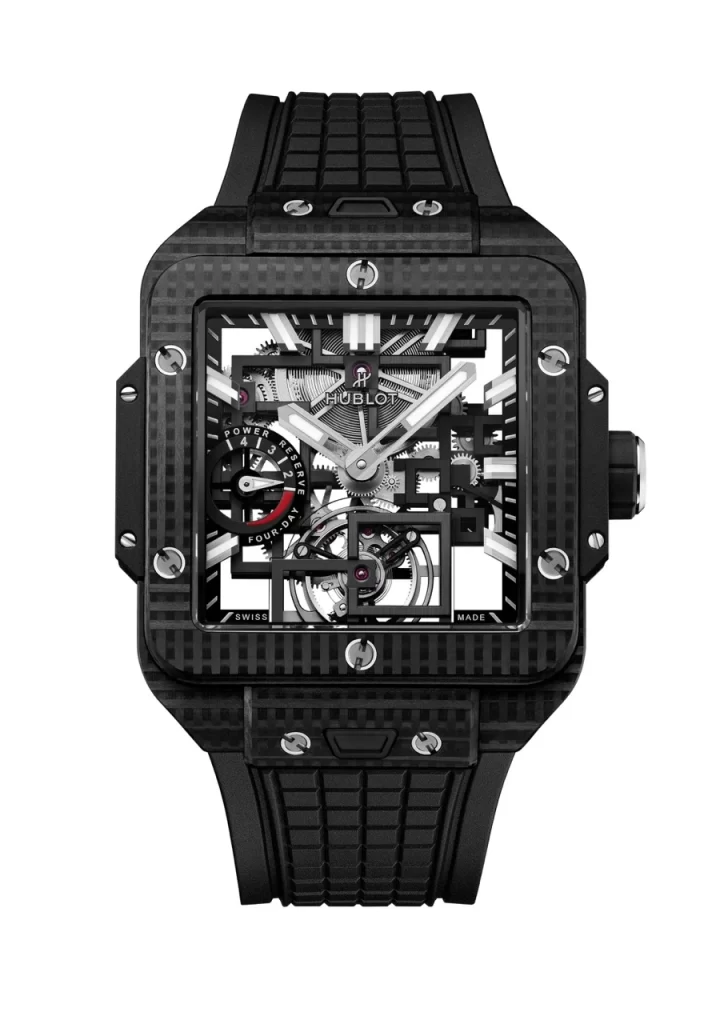
To celebrate the arrival of the first Tourbillon in the Square Bang family, Hublot has designed a bespoke case for it, made entirely from carbon and measuring 42mm. The first in the collection, its 3D finish is created using a carbon composite, woven into vertical and horizontal lines. The structure is built around a square motif, in keeping with the spirit of the Square Bang. The same inspiration is found on the rubber strap, which is also textured with square motifs, ensuring continuity between the different elements of the watch exterior and, above all, guaranteeing the perfect harmony of the piece.
The new Square Bang Tourbillon offers an extended power reserve of four days, with the indicator at nine o’clock counting down the remaining days and hours. To ensure that each of these is measured with optimum precision, its tourbillon is fitted with a silicon escapement that makes it resistant to the
magnetic disturbances and temperature variations of everyday life.
SSQUARE BANG TOURBILLON 4-DAY POWER RESERVE
REFERENCE: 805.QD.0170.RX
MOVEMENT:
MHUB6023 Manufacture
Manual winding Power Reserve
Skeleton Tourbillon
Black-plated bridges
Polished Rhodium-plated Balance
Tourbillon Escapement
Frequency: 3Hz (21’600 A/h)
Power reserve (hours): 96h minimum
Number of components: 174
Jewels: 25
DIAL:
Sapphire Crystal
CASE:
3D Carbon Fiber
“One-Click” System.
Size: 42 MM
Thickness: 13.20 MM
Water Resistance: 3 ATM / 30 M
CASE-BACK:
3D Carbon Fiber and Sapphire
Crystal with Anti-reflective Treatment
BEZEL:
3D Carbon Fiber
Screws: 6 H-shaped
Titanium
STRAP AND CLASP
Black Structured Rubber Straps
Black Ceramic and Black-plated
Titanium Deployant Buckle Clasp