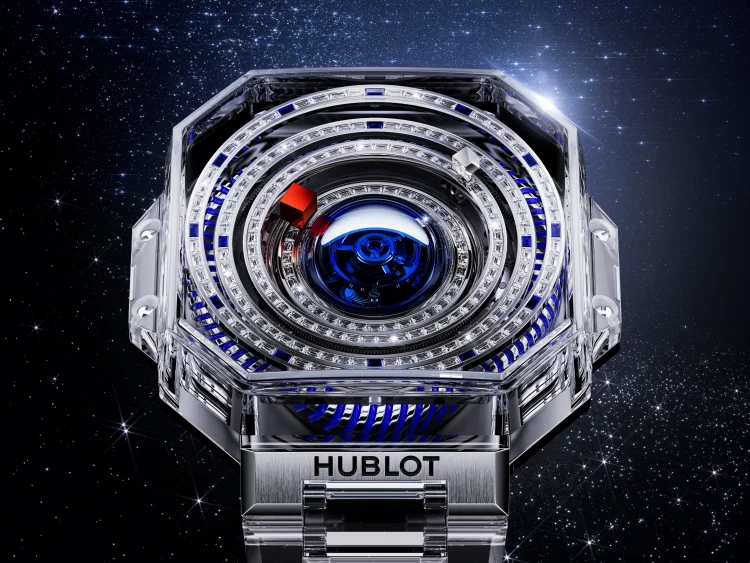
Hublot and Jeff Koons have turned the idea of creation into a mechanical work of art with the new MP-14 Origin by Jeff Koons. Unveiled in New York on 16 September 2026, the timepiece brings together sapphire architecture, gem-setting, contemporary art and Hublot’s high-horology expertise in an exceptionally complex 44 mm creation limited to just 30 pieces.
Thank you for reading this post, don't forget to subscribe!Rather than simply decorating a watch with artistic references, the collaboration attempts something considerably more ambitious: to make the watch itself behave like a miniature universe, with a central tourbillon acting as its mechanical point of origin and concentric rings appearing to expand around it.
A collaboration built around transformation
The partnership between Hublot and Jeff Koons brings together two creative disciplines that share an interest in transforming familiar ideas into something unexpected. Alongside the MP-14 Origin, the collaboration also introduces the Classic Fusion Balloon Dog, connecting Koons’ artistic vocabulary with Hublot’s watchmaking.
For the MP-14 Origin, that philosophy is expressed through an architecture combining sapphire, titanium and gem-set white gold. The result sits at the intersection of high jewellery and high watchmaking, while its visual concept is rooted in the creation and expansion of the cosmos.
The watch also represents an important technical development for Hublot: the introduction of the manufacture’s first automatic central tourbillon.
Why “MP-14”?
The name MP-14 is not simply a sequential designation. According to Hublot, the number 14 references an important moment in Jeff Koons’ early artistic career.
Koons held his first solo exhibition in 1980 at the New Museum in New York, which was then located at 65 Fifth Avenue at 14th Street. Hublot connects this address with the MP-14 name, making the number part of the artistic story behind the watch.
The MP-14 also belongs to Hublot’s Exceptional Timepieces collection, the brand’s experimental high-horology laboratory dedicated to unconventional architectures, advanced materials and radical mechanical concepts.
A miniature universe constructed in sapphire
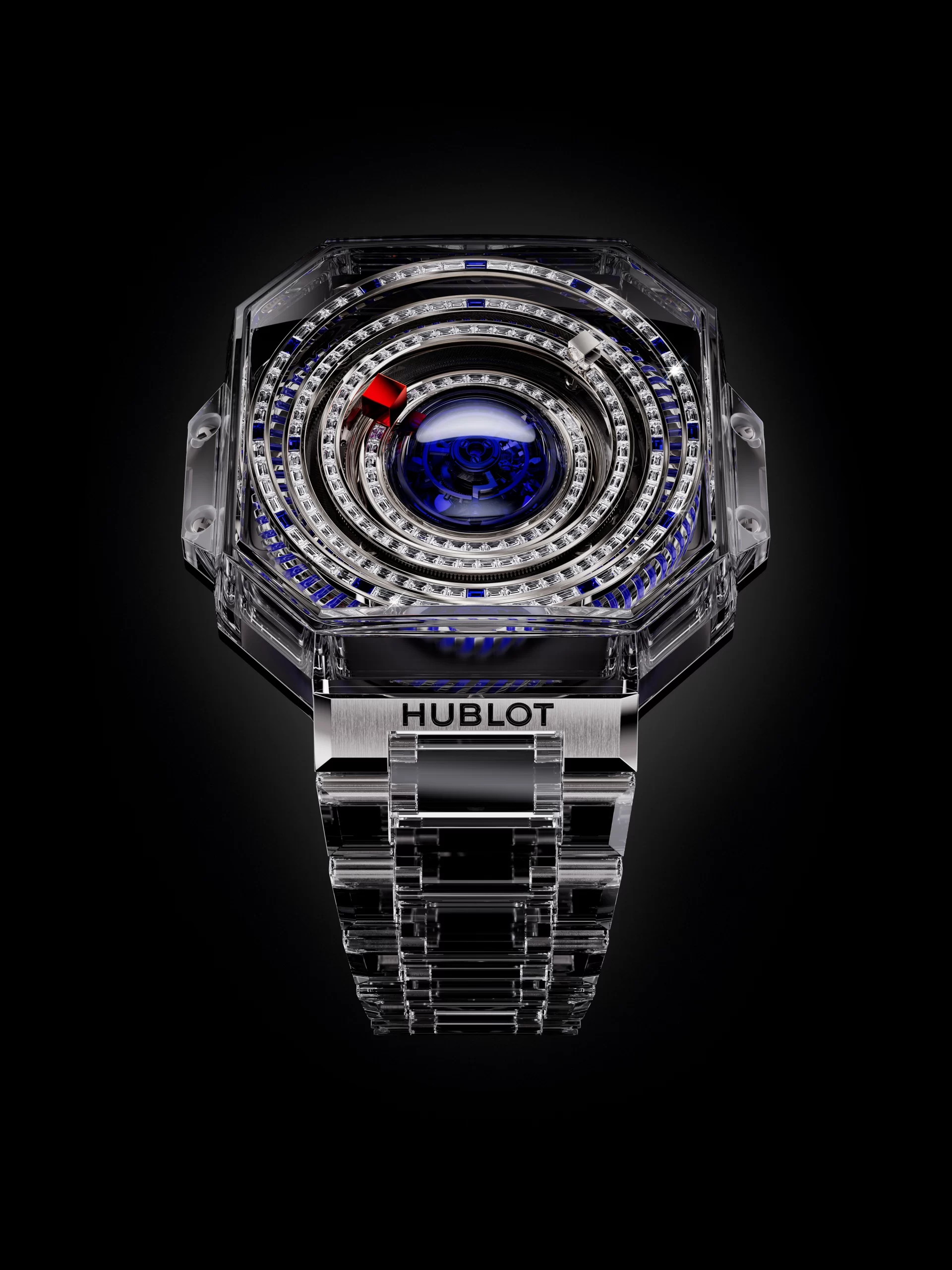
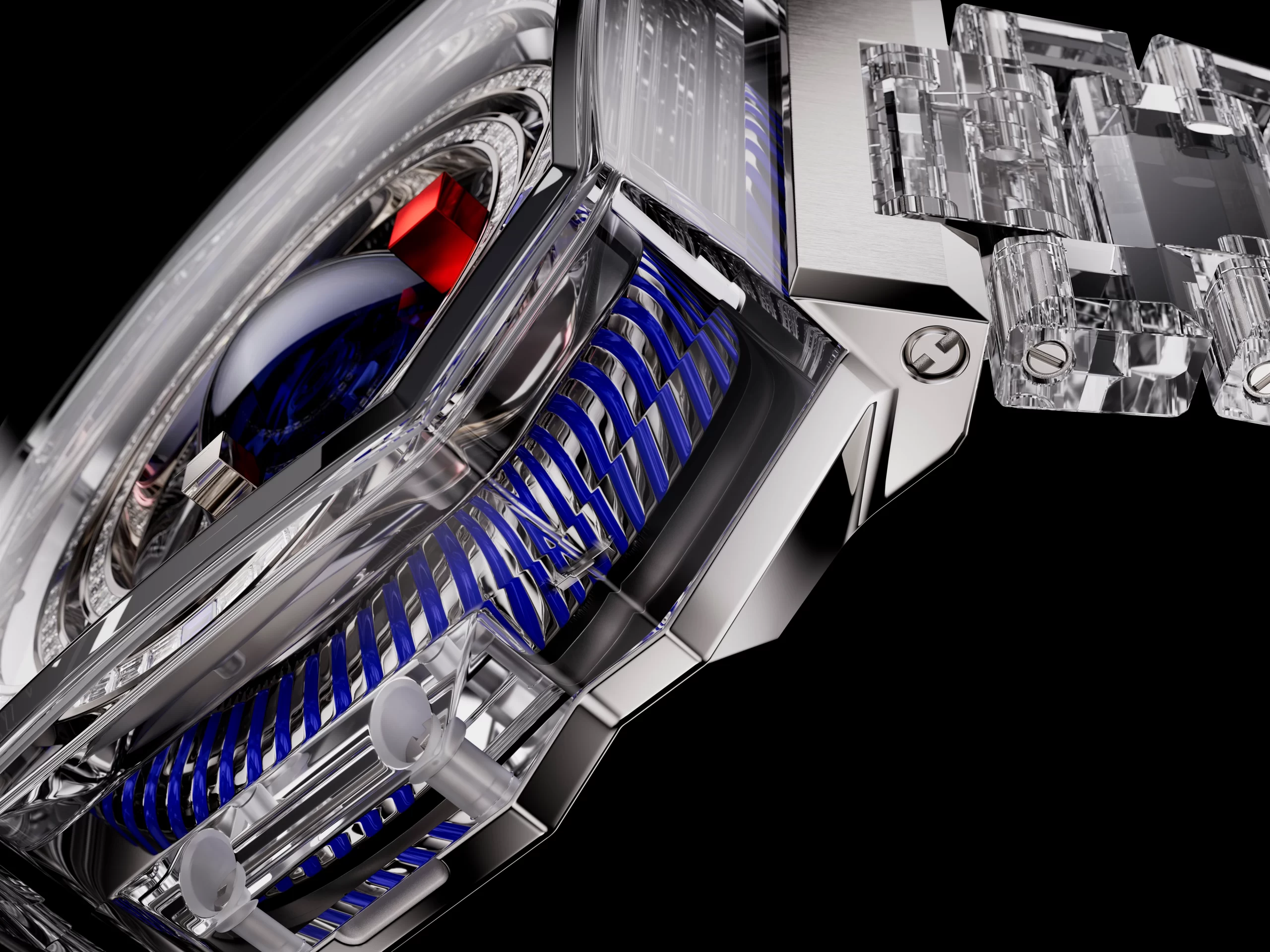
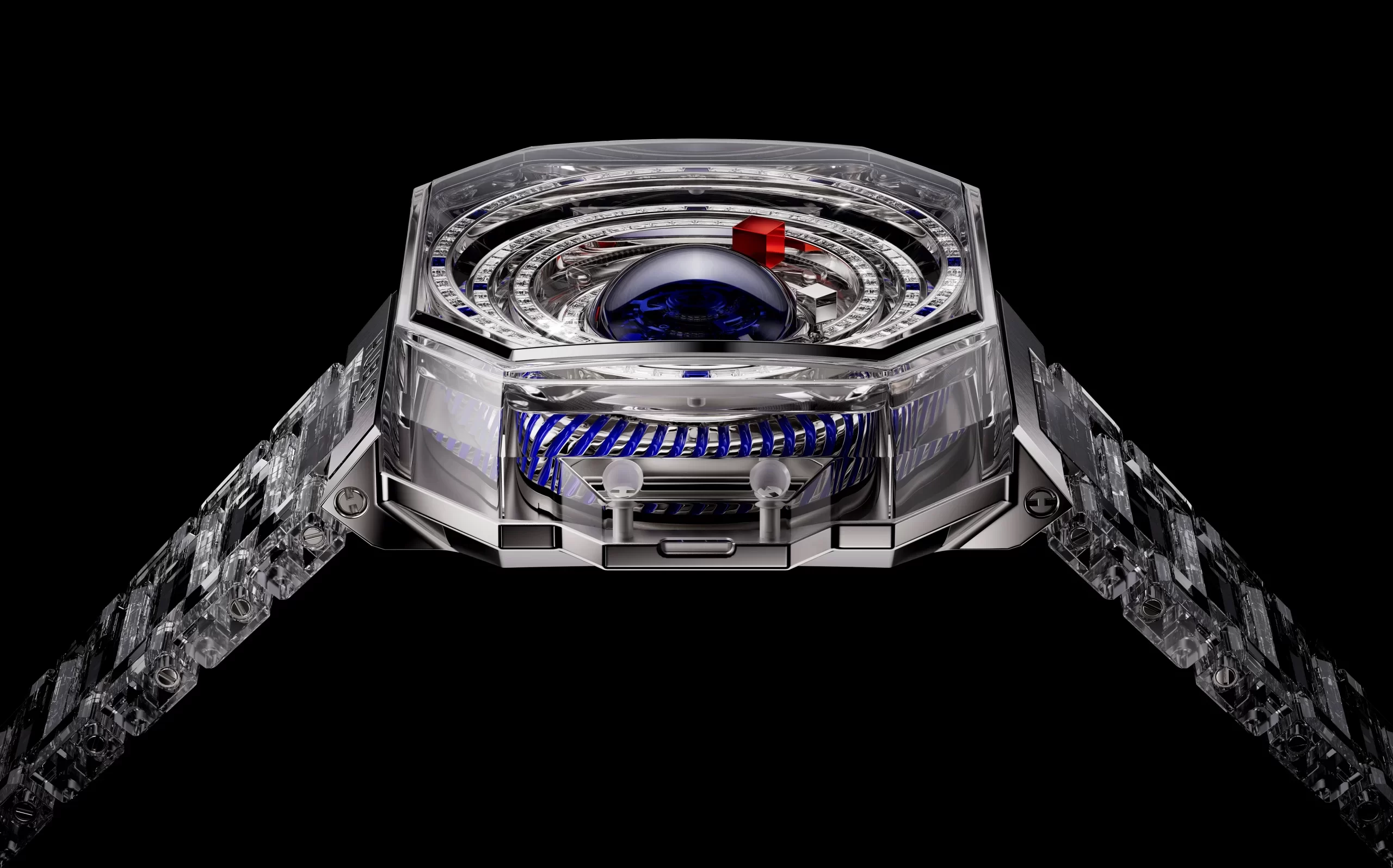
The MP-14 Origin measures 44 mm and uses an octagonal case made from polished sapphire crystal and titanium. Its transparent sapphire structure is central to the design rather than merely a material choice.
According to Hublot, machining the sapphire case requires approximately 534 hours. A titanium case back, H-shaped polished titanium screws and Hublot’s characteristic case “ears” at 3 and 9 o’clock complete the architecture.
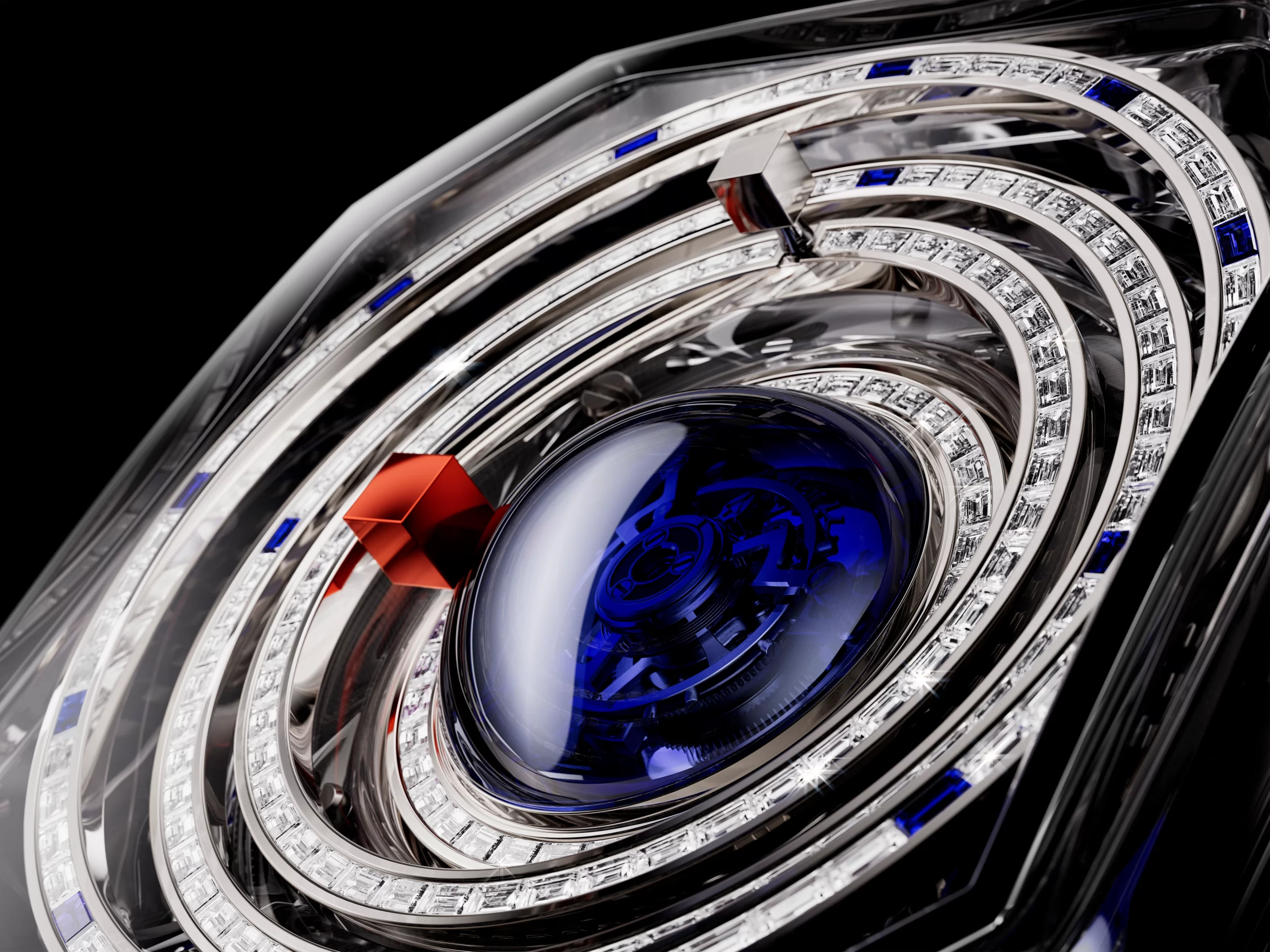
Inside, the transparent construction reveals a series of concentric rings that create the impression of orbital movement. The rings are crafted in white gold and set with baguette-cut diamonds and blue sapphires, gradually directing the eye towards the centre of the watch.
At that centre sits the tourbillon, positioned beneath a transparent sapphire dome. The dome takes inspiration from Jeff Koons’ Gazing Ball works and is hand-coated in translucent blue varnish by a micropainter.
It is a clever visual metaphor. Instead of representing the universe through a conventional celestial dial, Hublot places mechanical motion at the heart of the composition.
Time appears to orbit the movement
The MP-14 Origin takes an unconventional approach to displaying the hours and minutes.
Two suspended rotating rings carry floating indicator cubes. The hour indicator is a polished stainless-steel cube finished with translucent red varnish, while the minute indicator is represented by a polished grey stainless-steel cube.
Two additional rings remain fixed. Blue sapphires mark the quarters on the minute ring, while the hour ring uses blue sapphires to indicate the hours. Collectively, the four rings contain 202 gemstones, representing approximately 2.6 carats.
The result is a time display that deliberately avoids the familiar arrangement of hands moving around a stationary dial. Here, the indicators appear suspended within a layered mechanical environment.
The HUB9014: the mechanical heart
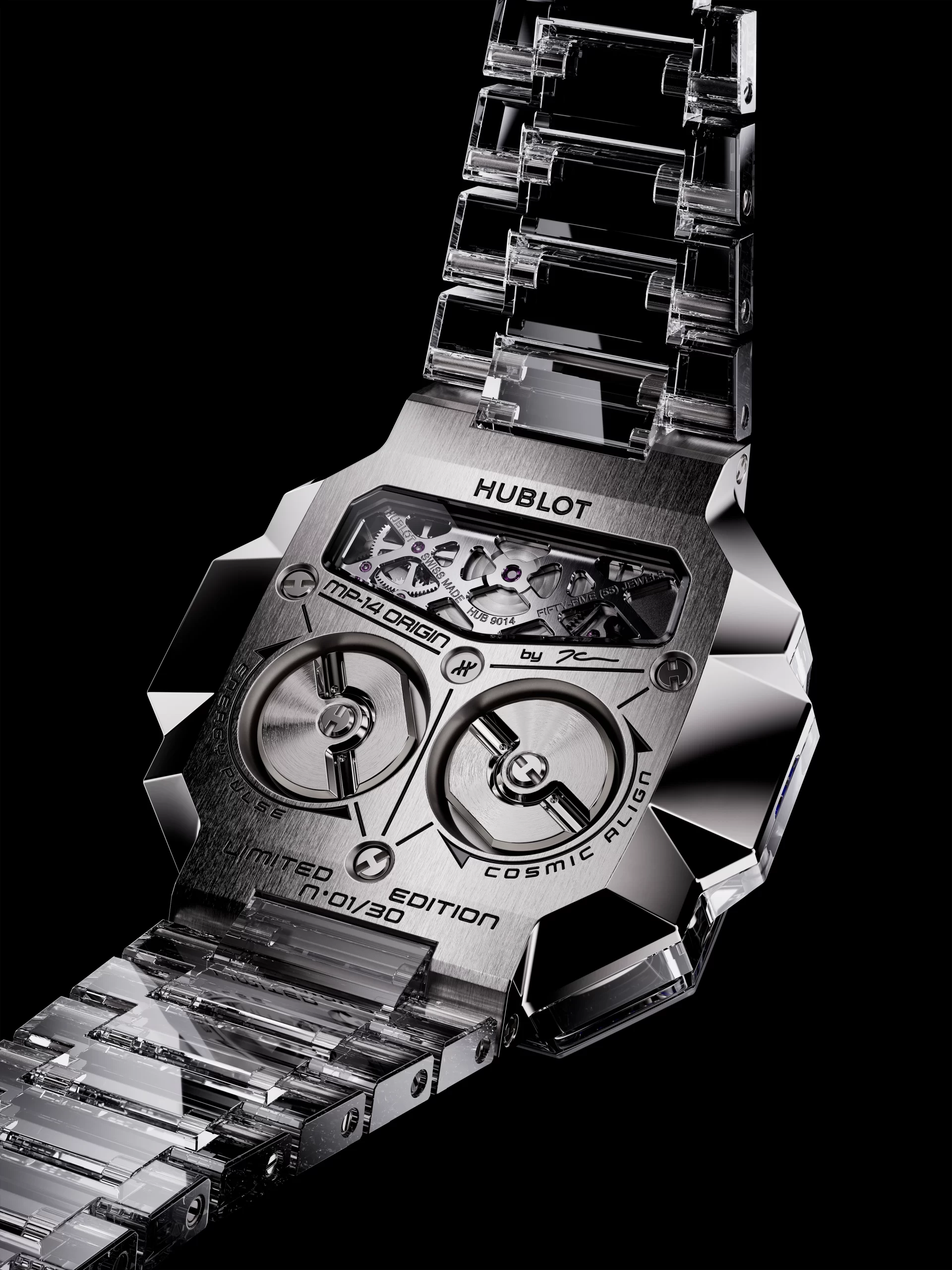
Driving this unusual architecture is Hublot’s HUB9014 manufacture movement.
It is an automatic central tourbillon equipped with a peripheral oscillating weight, operating at 3 Hz, or 21,600 vibrations per hour, with a 60-hour power reserve. The movement contains 594 components.
The peripheral winding system is particularly important to the design. By moving the oscillating mass away from the traditional central position, Hublot can preserve the open appearance of the movement while maintaining the visual continuity of the architecture.
The tourbillon cage sits beneath the sapphire dome, becoming the visual and mechanical centre of the watch. In the context of the Koons collaboration, Hublot describes this as the first pulse from which the surrounding structure appears to expand.
Even the winding system disappears into the architecture
The MP-14 Origin takes its unusual construction a step further by concealing the functions normally associated with the crown.
Two hidden crown systems are integrated into the case, allowing the wearer to wind the watch and adjust the time without interrupting its clean architectural appearance.
The winding function is associated with the engraving “ENERGY PULSE”, while the time-setting function is marked “COSMIC ALIGN.”
It is the sort of detail that makes the watch less like a conventional timepiece and more like an engineered object whose functions have been absorbed into its design.
From watch to immersive presentation
Hublot extends the cosmic concept beyond the watch itself.
The presentation case uses an infinite mirror installation, incorporating LED illumination and one-way mirror technology to create an impression of limitless depth. Its octagonal geometry echoes the shape of the watch and is topped by a transparent dome, effectively turning the presentation environment into an extension of the timepiece’s architecture.
This matters because the MP-14 Origin is designed to be experienced as more than an object on the wrist. Its visual language continues from the sapphire case to the presentation environment, reinforcing the central idea of an expanding mechanical cosmos.

Jeff Koons’ interpretation of creation
For Koons, the MP-14 Origin represents a horological interpretation of creation itself, centred on the transformation of energy into form and form into time.
The central tourbillon becomes the starting point, while the surrounding mechanical structures suggest controlled expansion. Hublot’s press material specifically connects the concept to the Big Bang, translating that idea through mechanical movement, material tension and the interaction of light with the watch’s transparent architecture.
The concept is therefore not simply about putting a cosmic image on a dial. The movement, case, gemstones and rotating indicators all participate in the same visual narrative.
Technical specifications
Specification: Hublot MP-14 Origin by Jeff Koons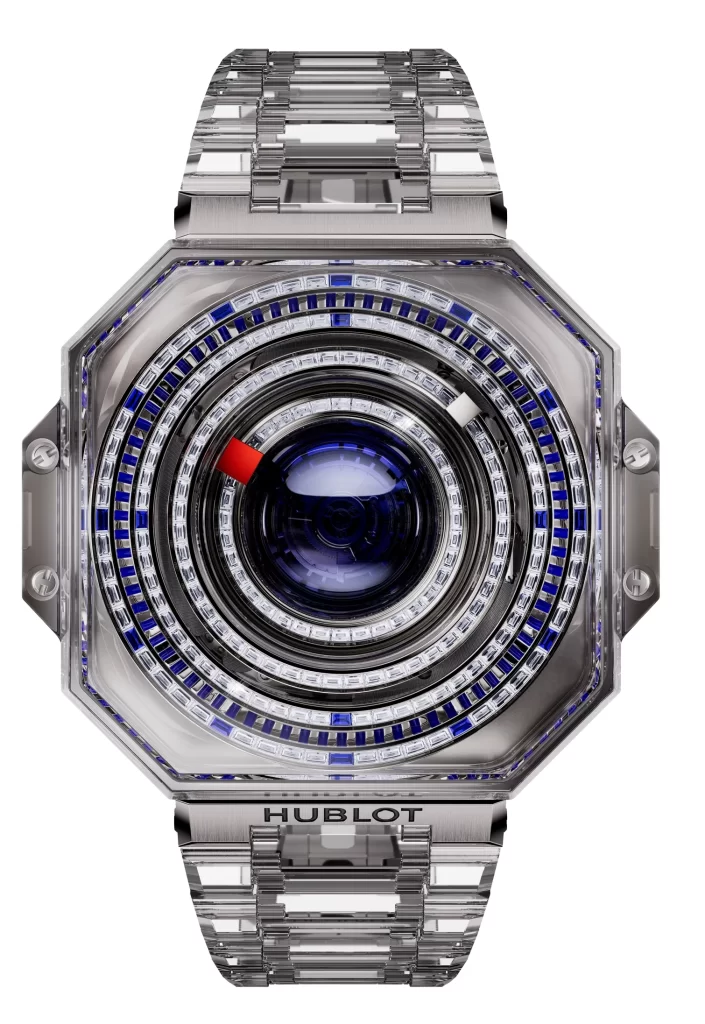
Reference: 914.NJ.0100.JX.9941
Edition: Limited to 30 pieces
Case: Polished sapphire crystal and titanium
Case size: 44 mm
Thickness: 20 mm
Water resistance: 3 ATM / 30 m
Winding system: Peripheral oscillating weight
Movement diameter: 39.20 mm
Movement thickness:14.65 mm
Components: 594
Jewels : 55
Frequency: 3 Hz / 21,600 A/h
Power reserve: 60 hours
Gem-setting: Baguette-cut diamonds and blue sapphires
Gemstone total: 202 stones / approximately 2.6 carats
Crystal: Sapphire
Case back: Polished and satin-finished titanium
Strap: Sapphire crystal and titanium deployant buckle
A 30-piece expression of experimental watchmaking
The Hublot MP-14 Origin by Jeff Koons is limited to just 30 pieces and is available through selected Hublot points of sale. The press release lists pricing at CHF 405,000, EUR 479,000, USD 488,000 and GBP 383,000.
At its most interesting, however, the MP-14 Origin is not about rarity or price. Its significance lies in how Hublot has attempted to make mechanical watchmaking itself tell the story.
The central tourbillon becomes the point of origin. The sapphire case provides the space. The gemstone-set rings create the impression of orbital structures. Floating cubes indicate the passage of hours and minutes. Even the winding and time-setting systems have been absorbed into the architecture.
In that sense, the MP-14 Origin does not simply depict a universe.
It builds one around the mechanism that makes the watch come alive.