Girard-Perregaux at the Summit of Haute Horlogerie: Cosmos, Neo Constant Escapement & Tourbillon with Three Flying Bridges
Few manufactures embody the union of invention, chronometric ambition and visual poetry quite like Girard-Perregaux. Founded in 1791, the Maison has consistently pushed the boundaries of mechanical watchmaking, not only in pursuit of precision, but also in the way time is architecturally expressed.
In its latest high-horology statements, Girard-Perregaux presents three extraordinary creations that together form a manifesto of its savoir-faire: the Cosmos (Unique Piece), the Neo Constant Escapement, and the Tourbillon with Three Flying Bridges. Each explores a different dimension of time — cosmic, constant, and architectural — yet all are unmistakably Girard-Perregaux.
Cosmos: A Mechanical Universe on the Wrist
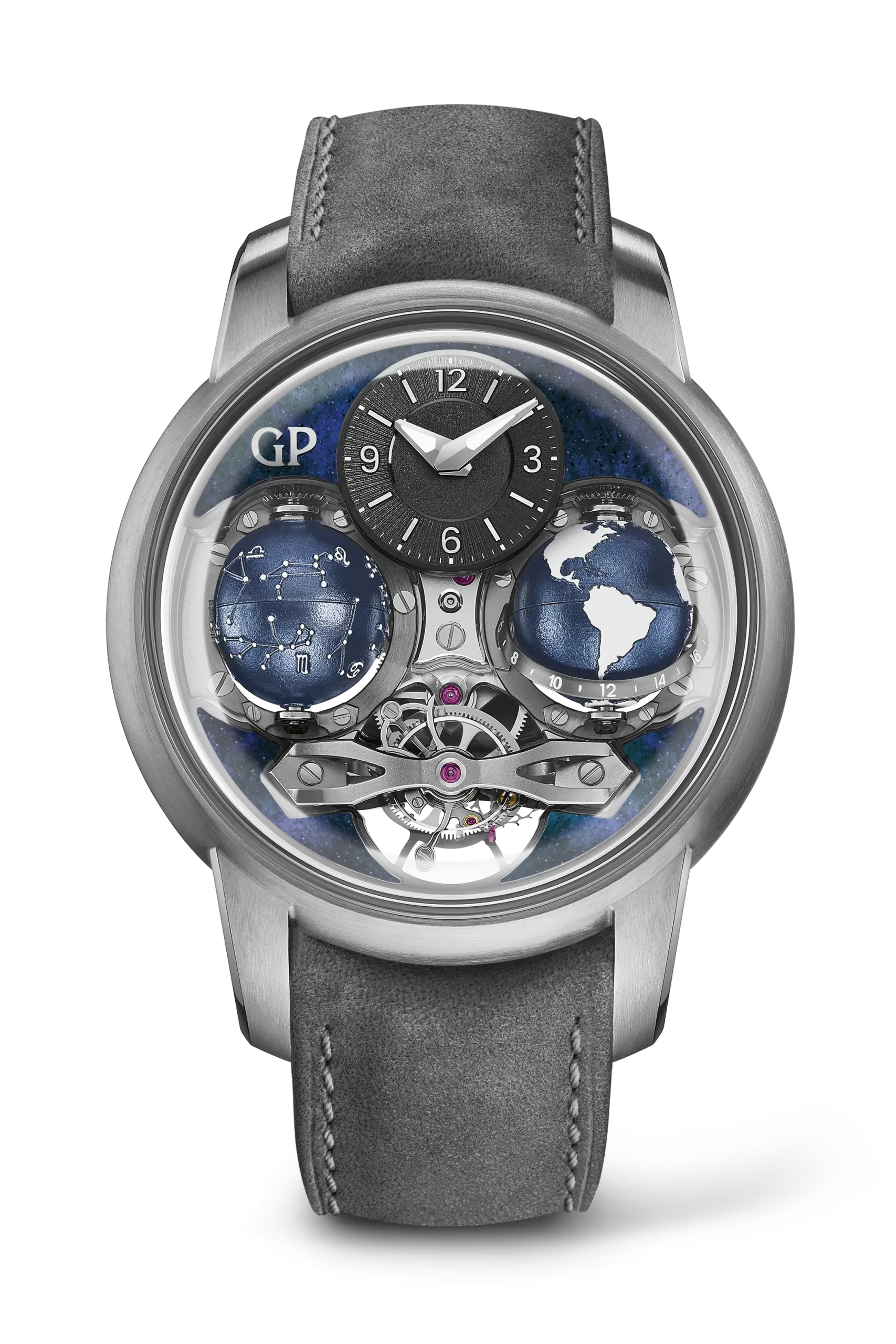
The Girard-Perregaux Cosmos returns in 2025 as a unique piece, reaffirming the Manufacture’s mastery of complex complications and poetic display. First introduced in 2019, the Cosmos stands apart for its ability to translate astronomical phenomena into three-dimensional mechanical theatre.
At the heart of this titanium-cased timepiece lies three major complications:
-
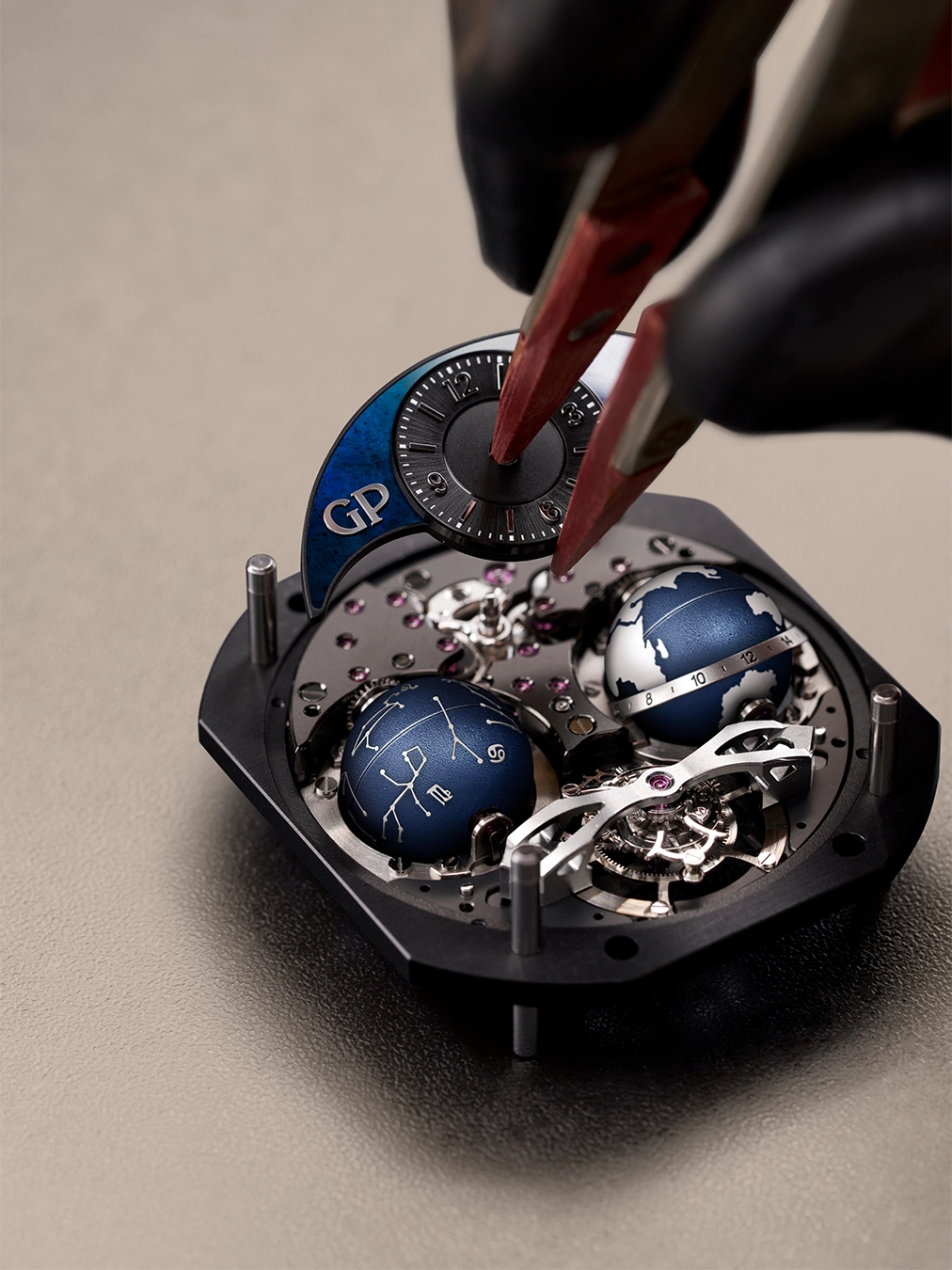
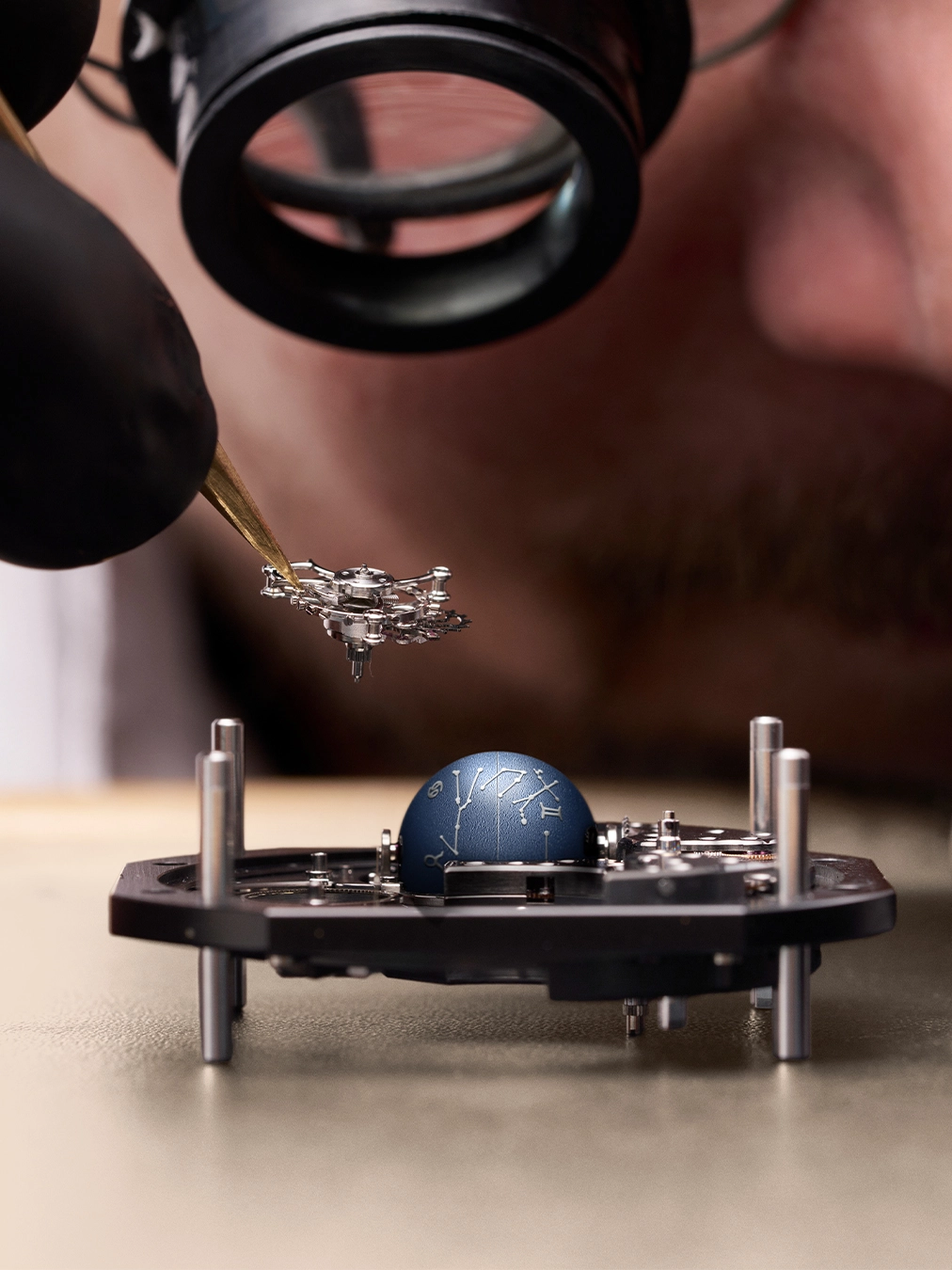
A tourbillon positioned at six o’clock, housed within a lyre-shaped cage and supported by a titanium Neo Bridge — a contemporary interpretation of Constant Girard’s historic arrow-shaped bridges.
-
A terrestrial globe at three o’clock, rotating once every 24 hours and offering a day/night indication, encircled by an hour ring inspired by Saturn’s rings.
-
A celestial globe at nine o’clock, mapping the Zodiac constellations and completing a rotation in a true sidereal day (23h 56m 4s).
The dial construction is equally evocative: a two-part surface combining Tahitian mother-of-pearl with a reduced-thickness layer of blue aventurine, allowing light to interact with shimmering mineral textures. The off-centred time display, rendered in black with white-gold hands and luminescent accents, ensures legibility amid the cosmic complexity.
Powering the watch is the in-house Calibre GP09320, a hand-wound movement finished to the highest standards, featuring circular graining, bevelled bridges and a power reserve of at least 57 hours. Even the act of winding becomes an experience, thanks to four rotating bows (“bélières”) on the case back, replacing a conventional crown.
The Cosmos is not merely a complication showcase — it is a miniature universe, engineered with scientific precision and poetic intent.
Neo Constant Escapement: Engineering Absolute Stability
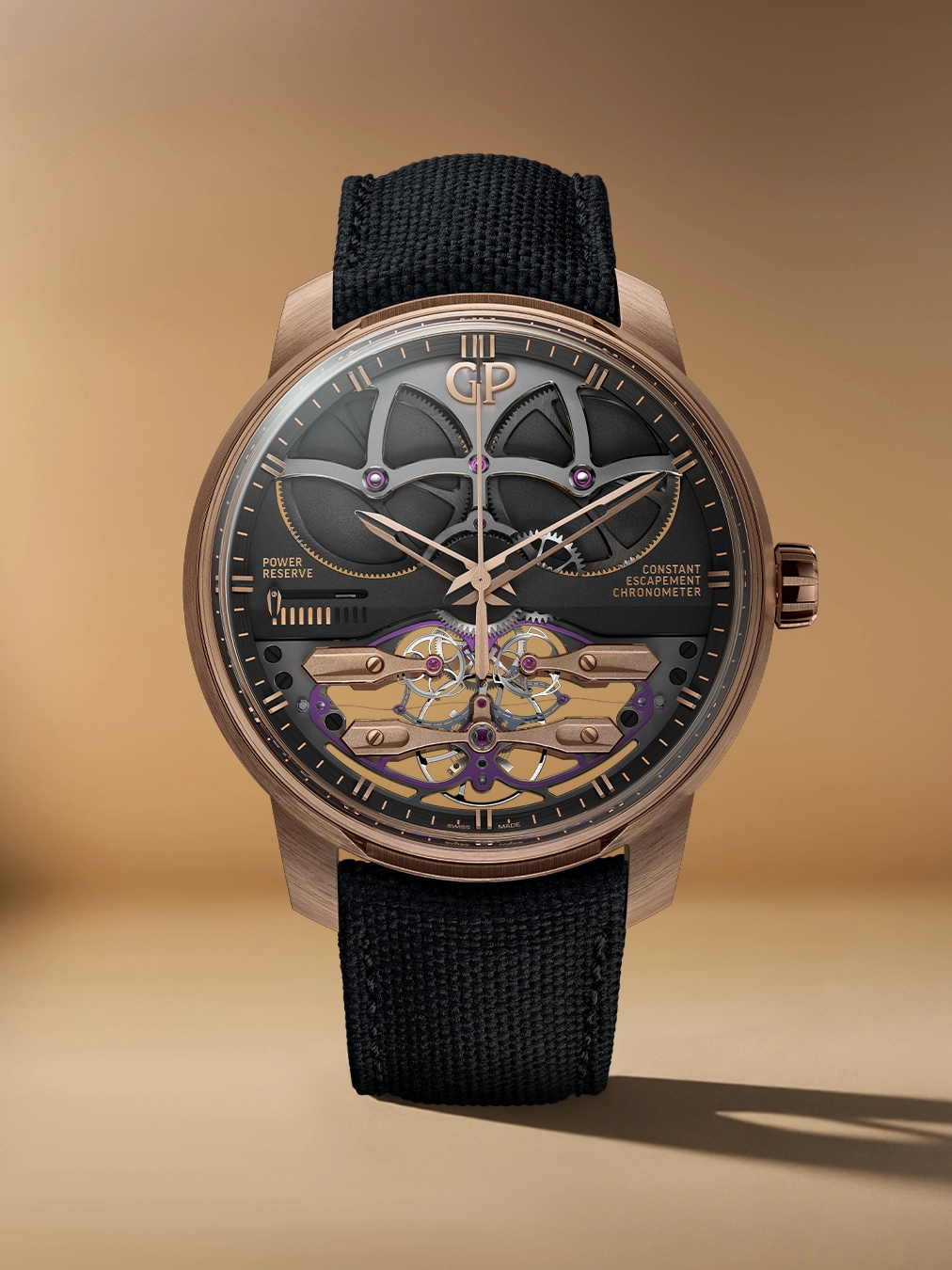
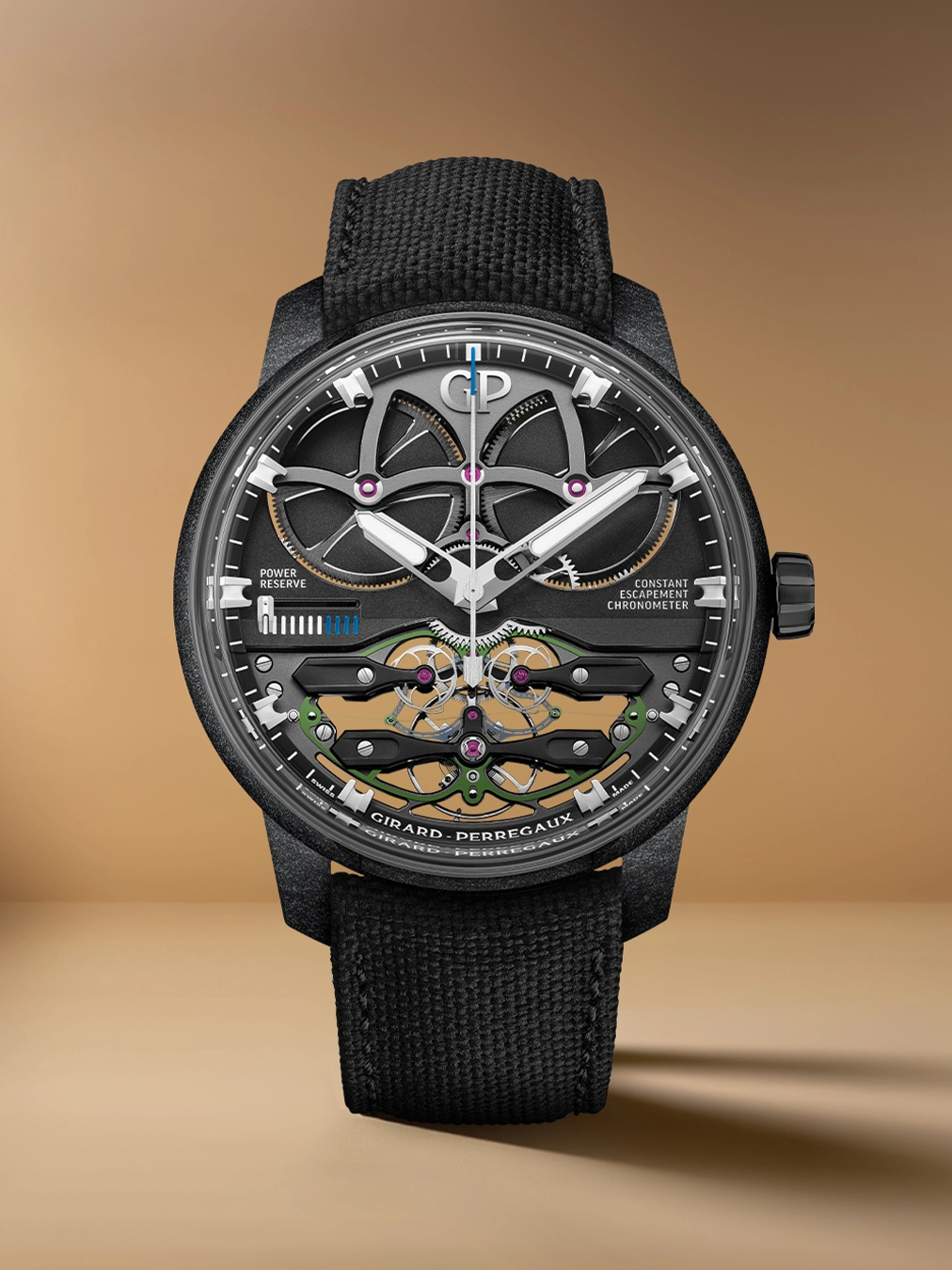
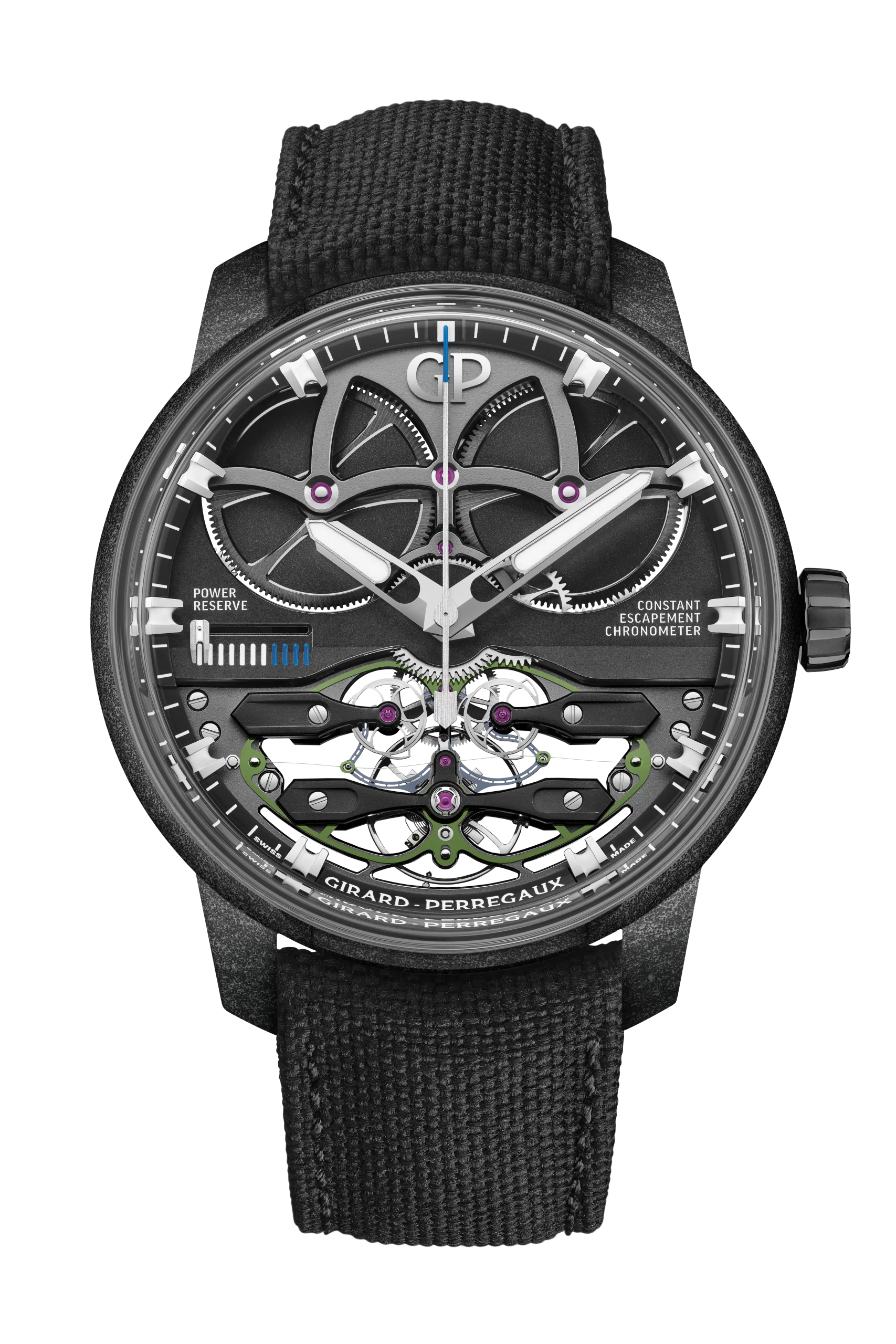
If the Cosmos speaks to wonder, the Neo Constant Escapement speaks to control — specifically, the pursuit of constant force, one of watchmaking’s most elusive goals. Building on the award-winning Constant Escapement concept that earned Girard-Perregaux the Aiguille d’Or in 2013, the Neo Constant Escapement represents decades of research distilled into a wearable chronometer.
Central to this innovation is a silicium blade, inspired by the physical phenomenon of buckling. Regardless of how much energy remains in the twin barrels, this blade delivers a perfectly uniform impulse to the balance wheel, ensuring stable amplitude and exceptional rate consistency until the very last moment of power.
The 2025 releases introduce two new executions:
-
A 45 mm pink gold version, combining advanced escapement technology with the warmth and gravitas of a precious metal case.
-
An ultra-limited carbon and silicium composite edition, restricted to just two numbered pieces, offering exceptional lightness, resistance, and a stealthy contemporary aesthetic.
Both are powered by the COSC-certified Calibre GP09200, an in-house hand-wound movement offering an impressive 7-day power reserve. The architecture of the dial places the escapement front and centre, beneath Neo Bridges, transforming mechanical regulation into a visual focal point.
The Neo Constant Escapement is not designed to impress through ornament alone — it is a demonstration of how deep scientific insight can redefine mechanical performance at the highest level.
Tourbillon with Three Flying Bridges: Architecture in Light
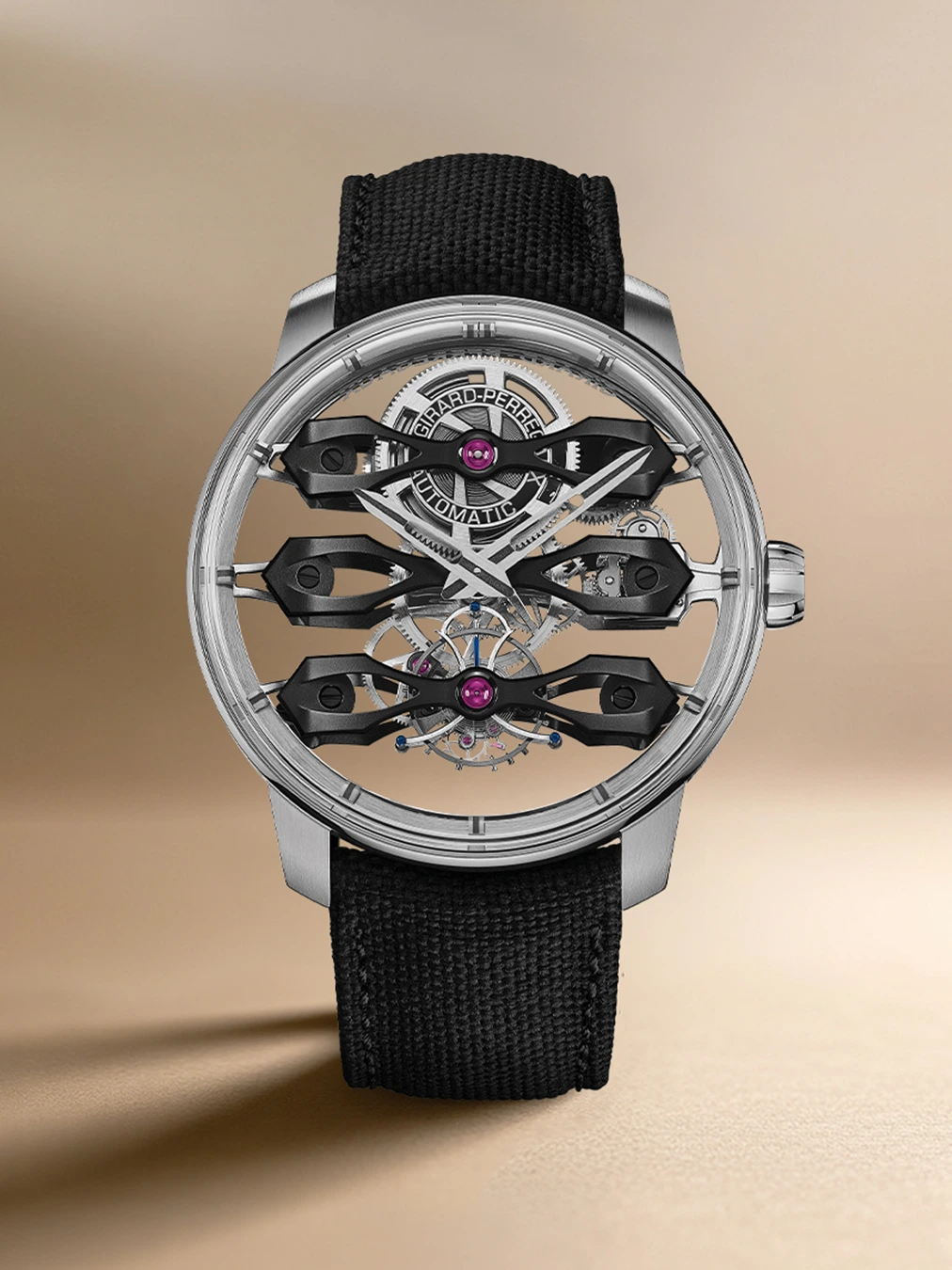
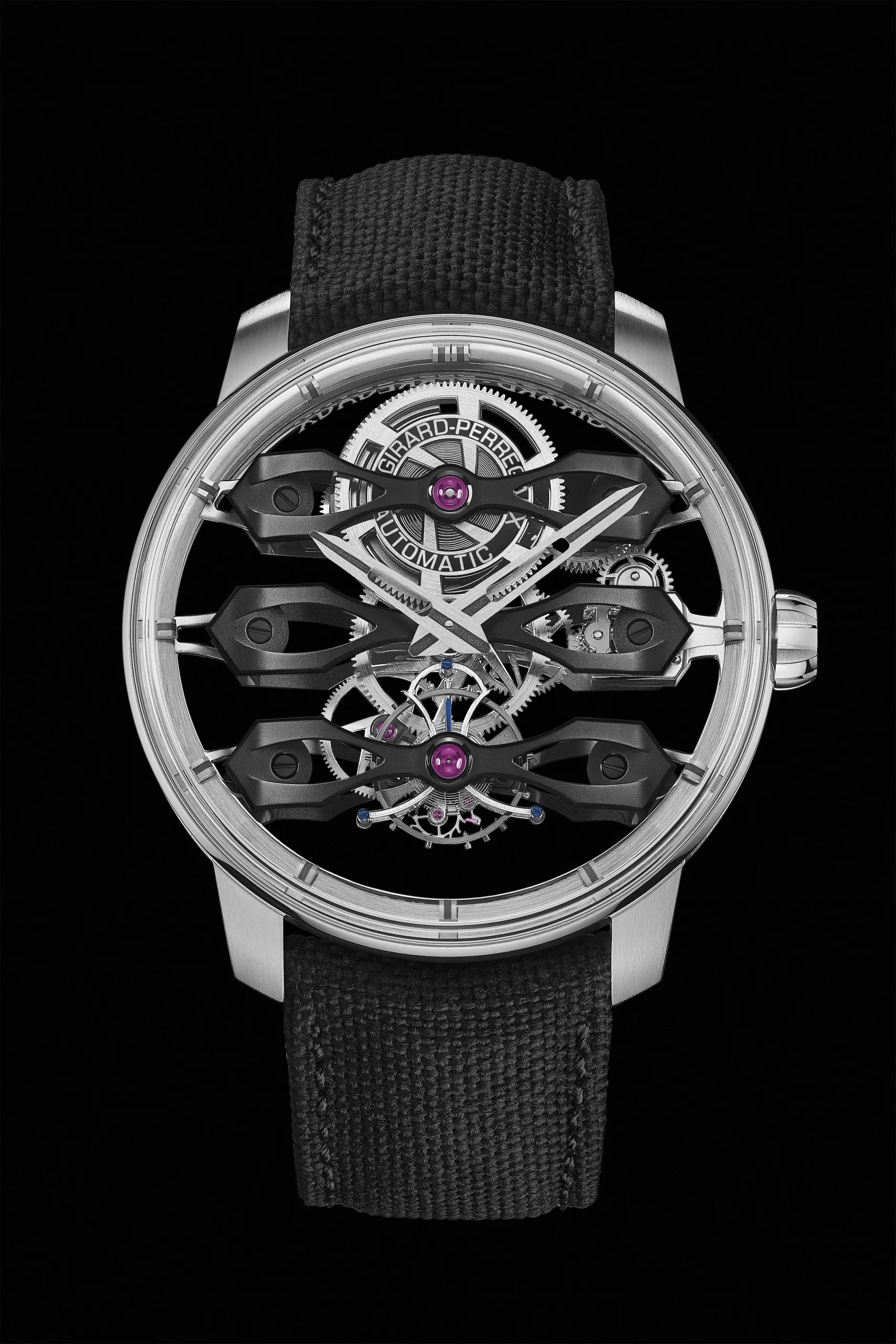
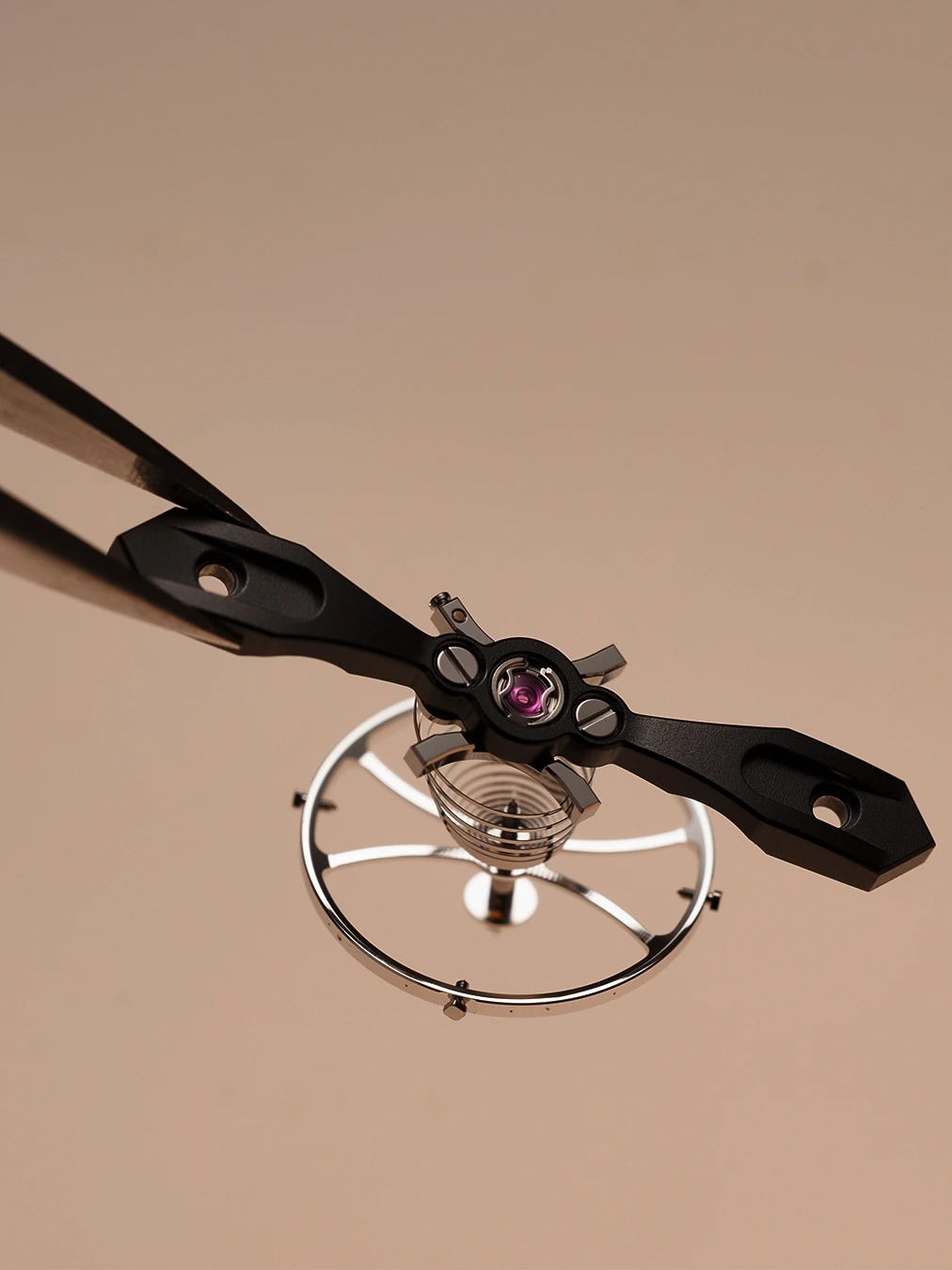
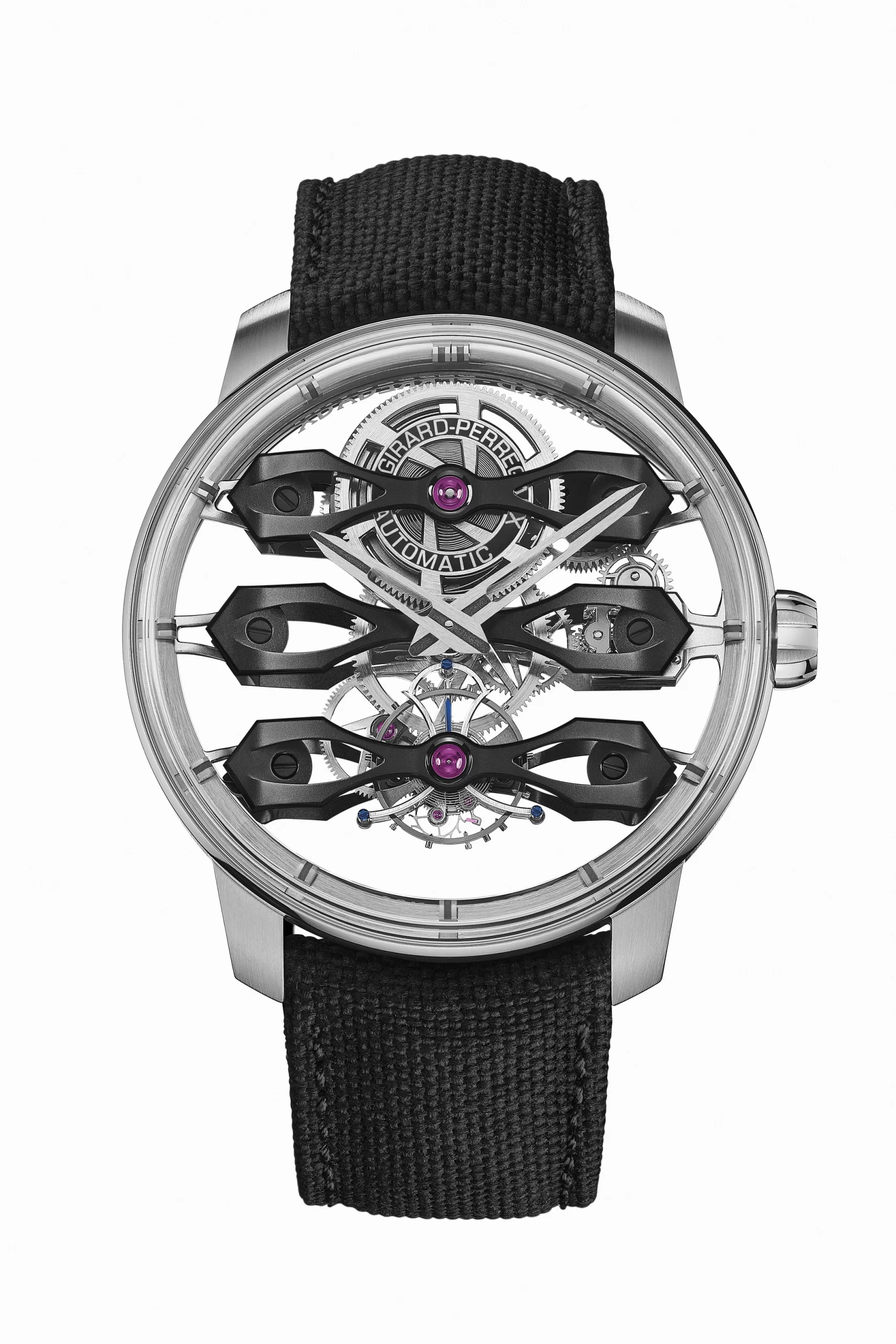
The Tourbillon with Three Flying Bridges is perhaps the most emblematic expression of Girard-Perregaux’s identity. Rooted in the legendary Three Bridges Tourbillon of 1867 and immortalised by La Esmeralda in 1889, the bridges have evolved into a signature where structure and beauty are inseparable.
The latest iteration is housed in a 44 mm white gold case and limited to just eight pieces worldwide. Three black-tinted titanium bridges, more sinuous and contemporary than their 19th-century predecessors, appear to float within a sapphire “box” case that floods the movement with light.
Unlike traditional designs, the watch dispenses with a conventional mainplate. Instead, the bridges themselves provide structural integrity, supporting the gear train, barrel and tourbillon. Luminescent hour markers are mounted directly onto the case, while skeletonised white-gold hands ensure clarity without disrupting the airy, three-dimensional composition.
Inside beats the Calibre GP09400, a self-winding movement with a patented micro-rotor crafted in white gold. Ingeniously positioned beneath the barrel, the micro-rotor allows the movement to remain slim while preserving an unobstructed view of its architecture. With a minimum 60-hour power reserve, it is as technically refined as it is visually captivating.
This is horology as architecture — light, space and mechanics fused into a singular aesthetic statement.
Three Visions, One Manufacture
Together, the Cosmos, Neo Constant Escapement, and Tourbillon with Three Flying Bridges illustrate the extraordinary breadth of Girard-Perregaux’s expertise. From cosmic complication to constant-force innovation and architectural transparency, each watch represents a distinct philosophy, yet all share the same foundations: in-house mastery, uncompromising finishing, and a relentless drive to push Haute Horlogerie forward.
These are not merely timepieces — they are mechanical narratives, written by a Manufacture that has been shaping the future of watchmaking for over two centuries.